
West Seattle, Washington
25 Tuesday
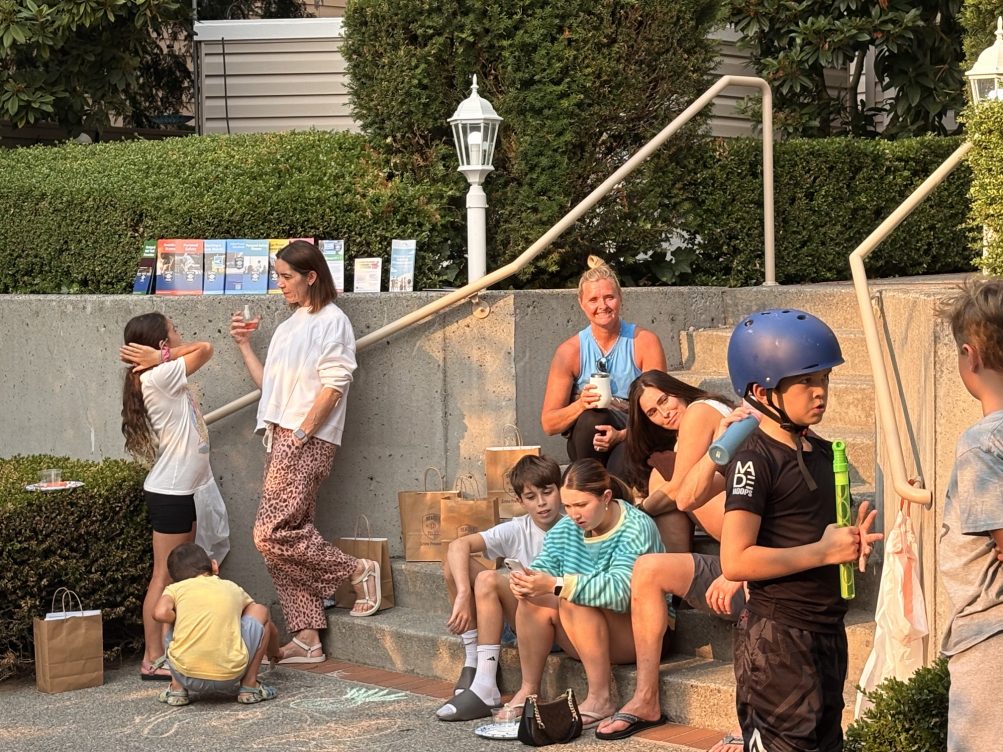
6:44 PM: Thanks to Dan Jacobs – who you might know from the Admiral Neighborhood Association – for being the first to send photos from one of tonight’s Night Out parties, on a stretch of 44th SW. This one even has music:
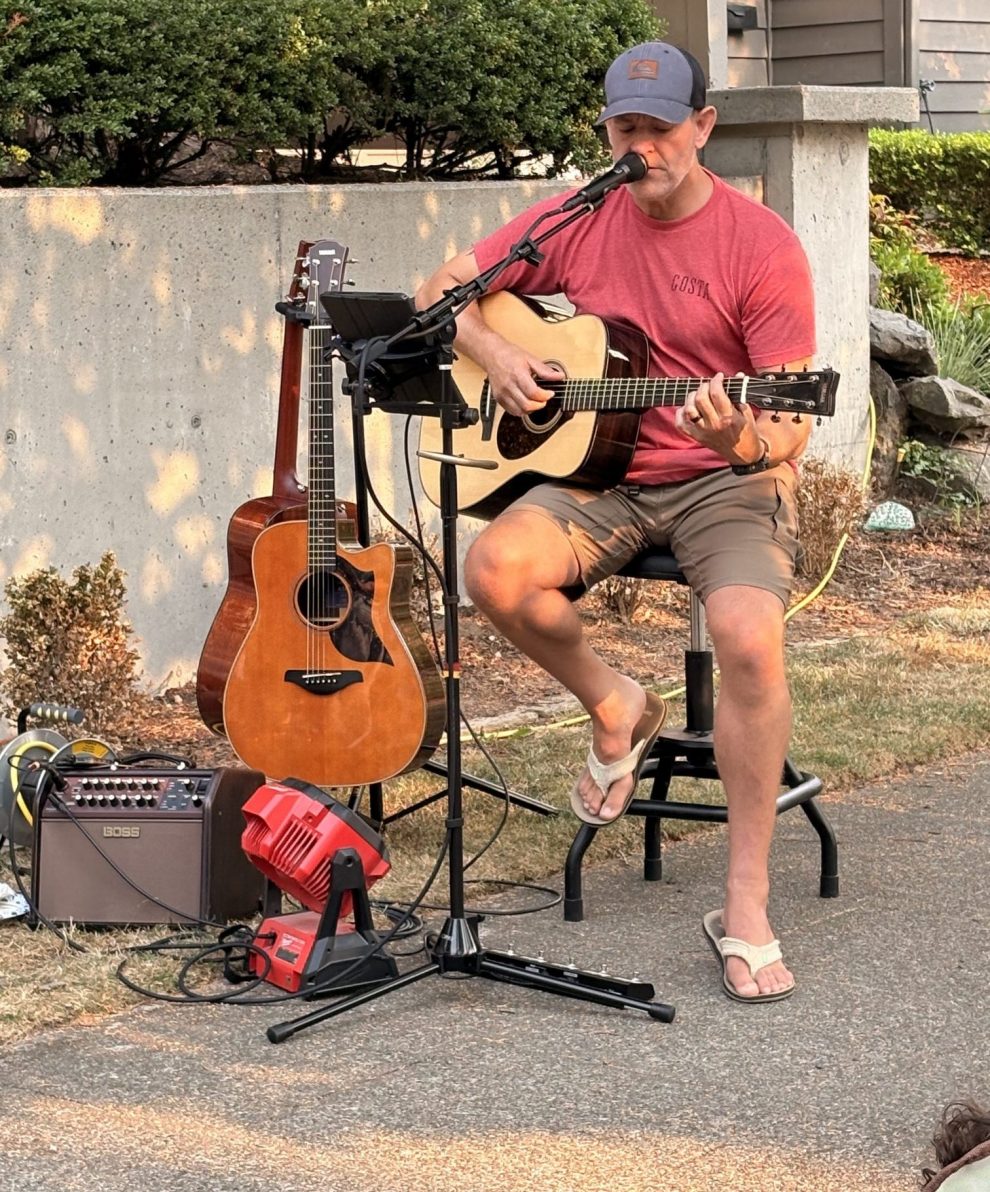
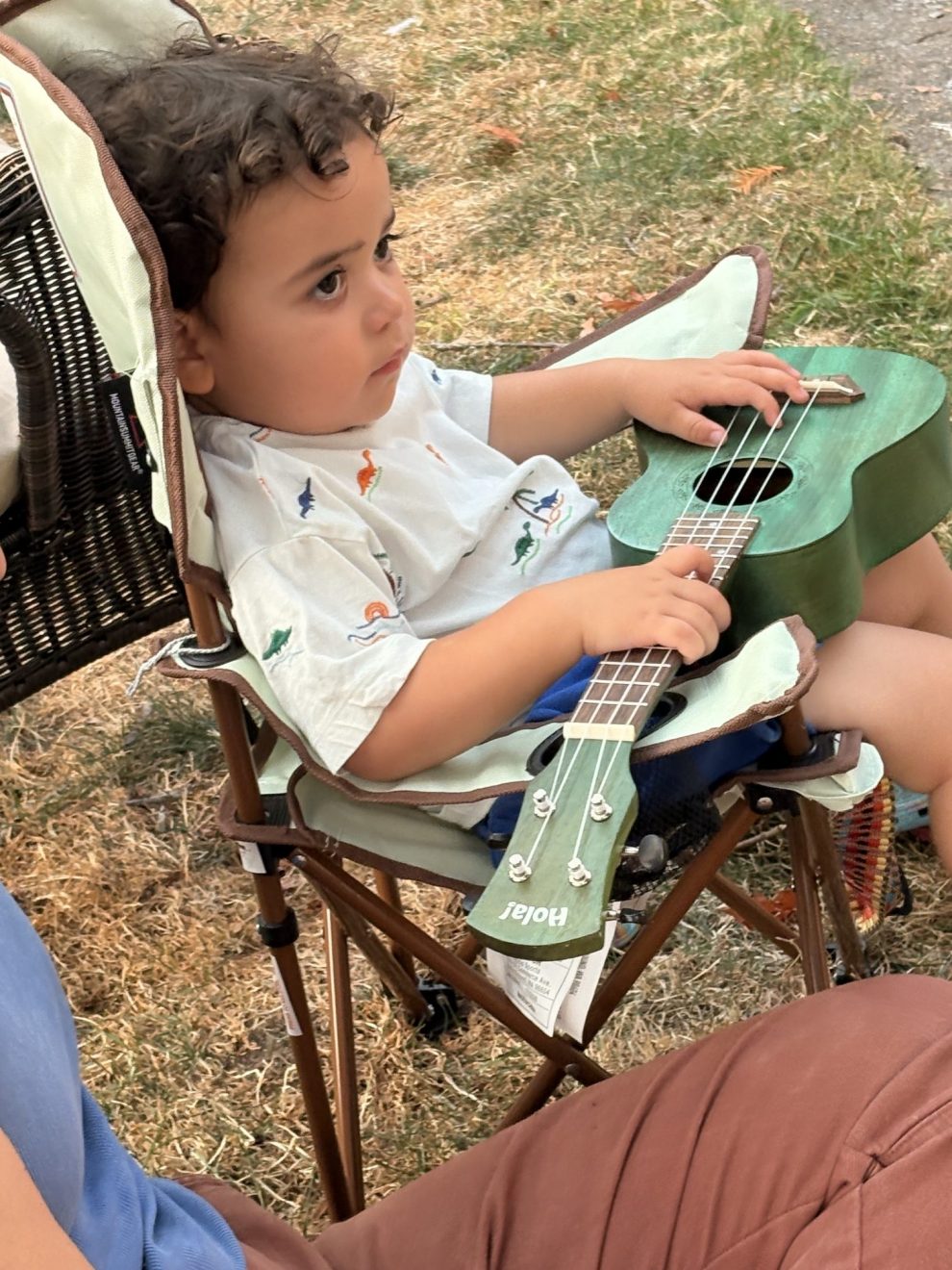
We expect to have some more Night Out scenes to share. If you have a photo to send – group shot? fun moment – text 206-293-6302 or email westseattleblog@gmail.com – thank you!
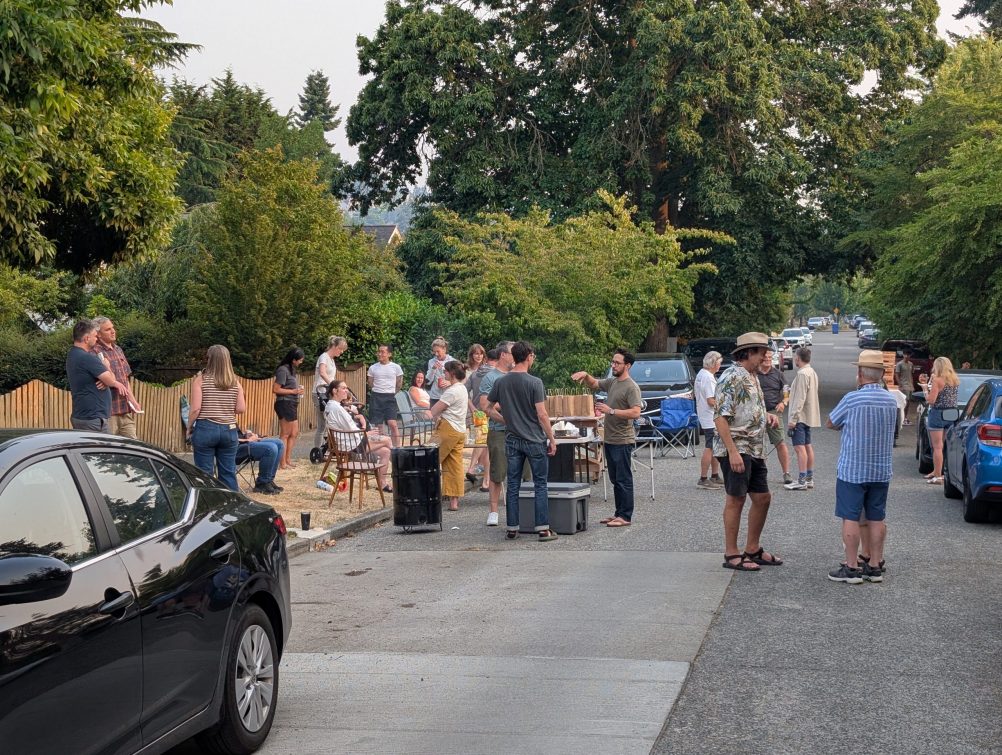
7:25 PM: Thanks to Joseph for the photo above, from 42nd/Juneau.
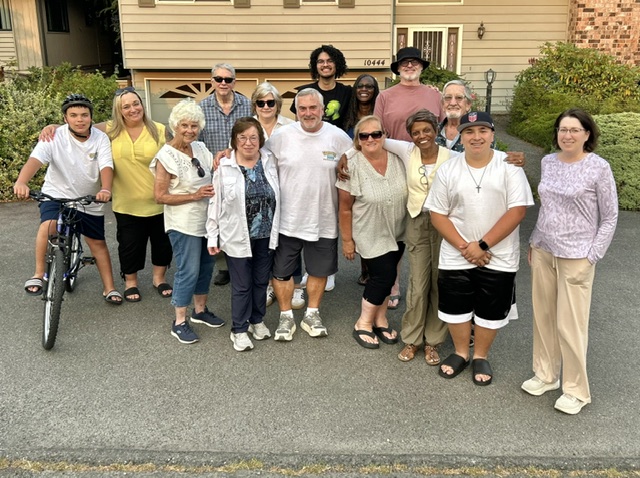
ADDED 8:46 PM: A WSB Night Out tradition – we visit JoDean‘s block party in Arbor Heights!
 (WSB photos by Jason Grotelueschen from here down)
That’s JoDean, fourth from left in front. She says the group was smaller this year because several households decided to stay in rather than go out in the smoke. … Also inviting us to stop by, Rosalie Miller in Admiral:
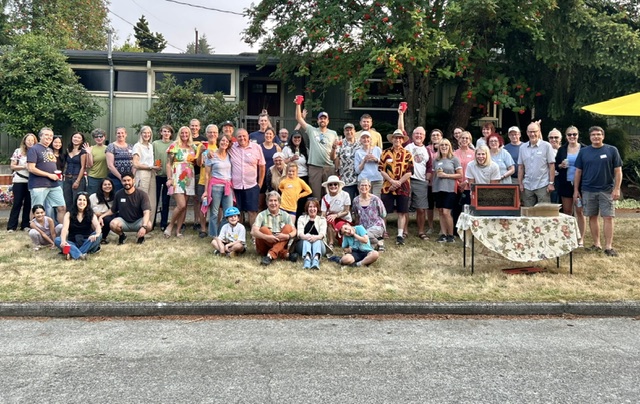
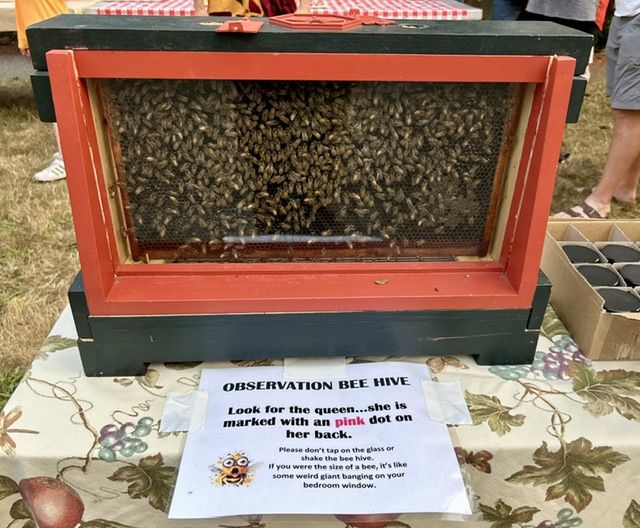
Rosalie’s a volunteer with Washington Bee Atlas, so we weren’t surprised to see a hive at the party:
9:54 PM: 34th and Kenyon:
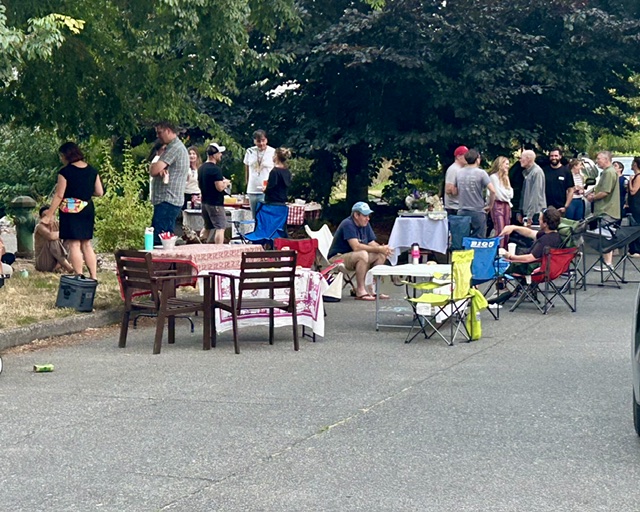
44th/Wildwood/Brace Point:
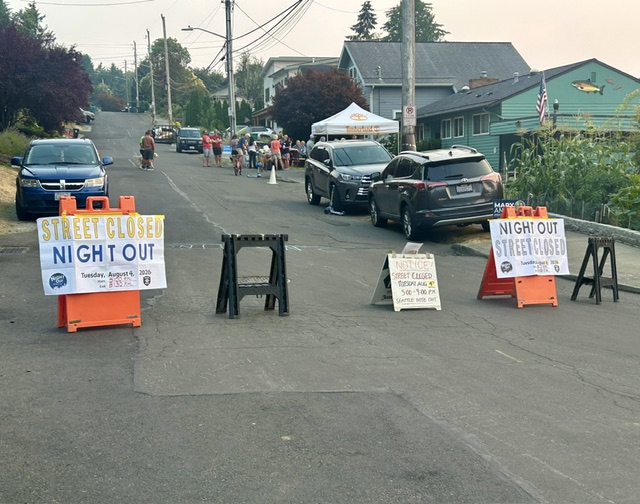
Charlestown/Belvidere:
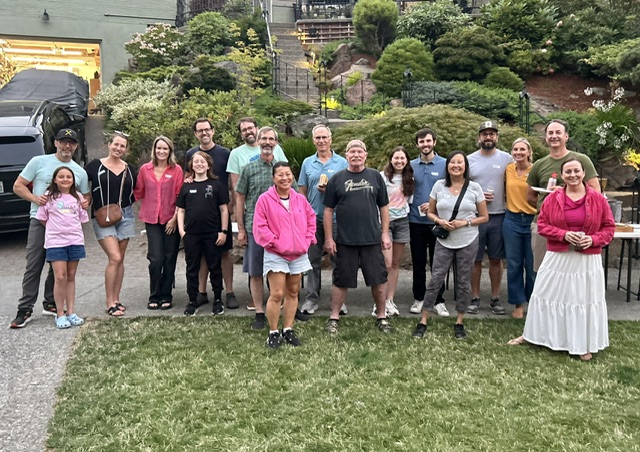
ADDED: Reader video/photos from here down – starting with one of the All-City Band’s Night Out stops, in North Delridge – thanks to the texter who sent video:
One of the musicians’ other stops was in Upper Alki – thanks to Lindsey Pearsall for the photo:
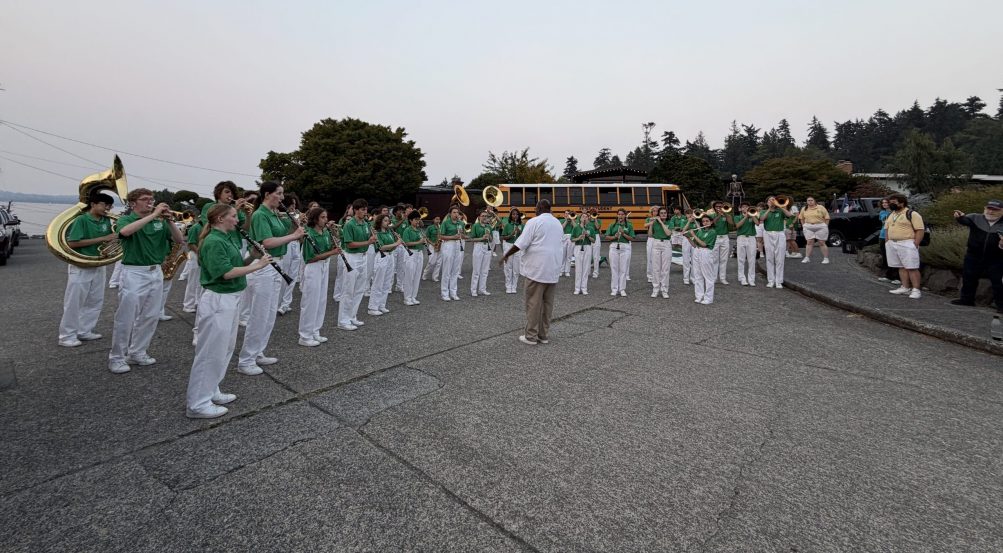
Plus one more block-party group photo – Allison‘s neighbors on 36th SW:
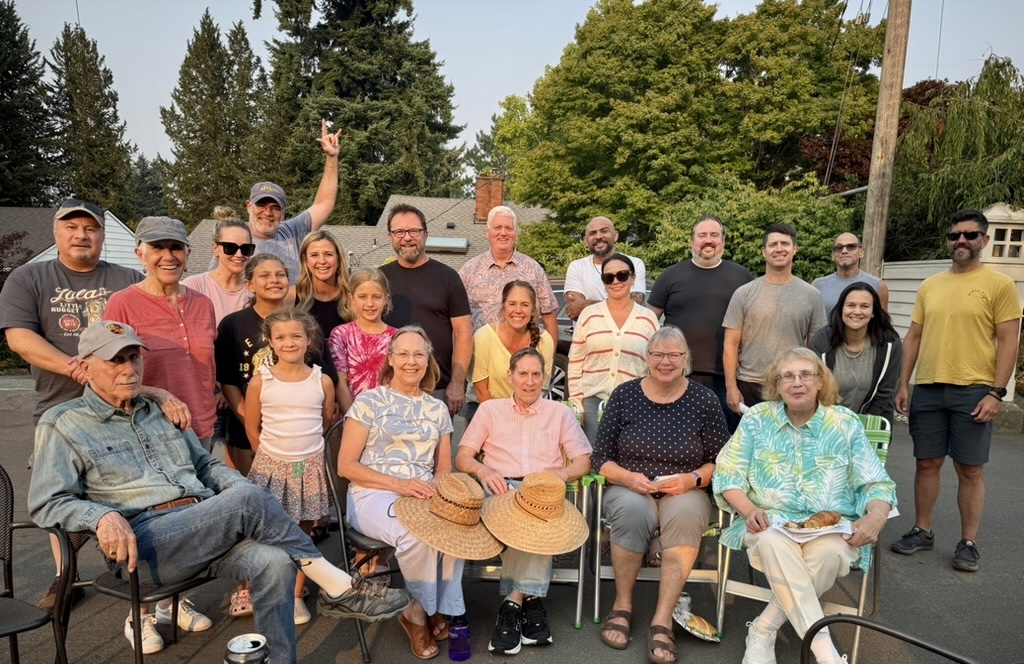
If you participated in Night Out, you’re part of a tradition going back more than 40 years!
ADDED: One more photo – sent by Robert Shampain, showing Pigeon Point’s big party:
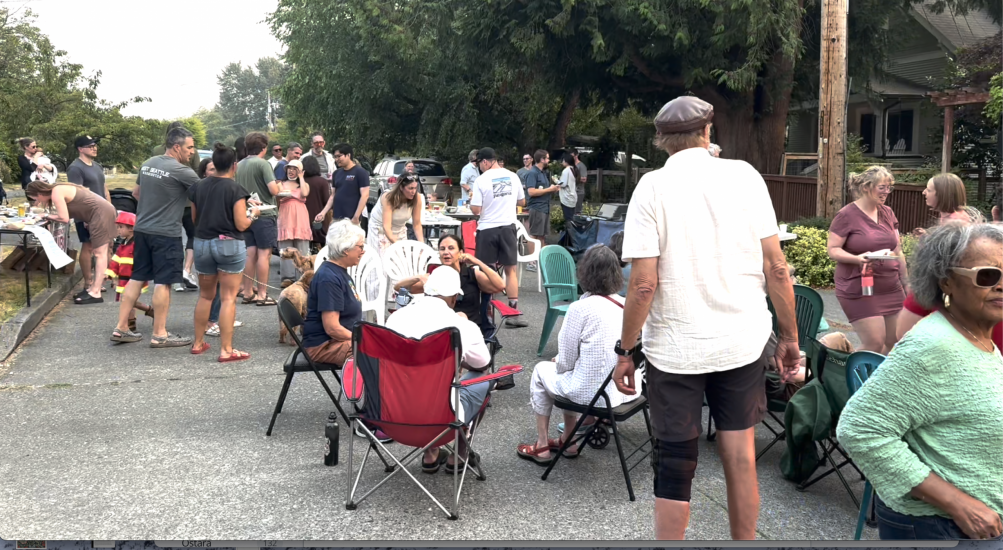
Robert reports, “More than 100 people, lots of dogs, fabulous food, live music by neighbors, a jump-rope competition, a fire engine — it was wonderful.”
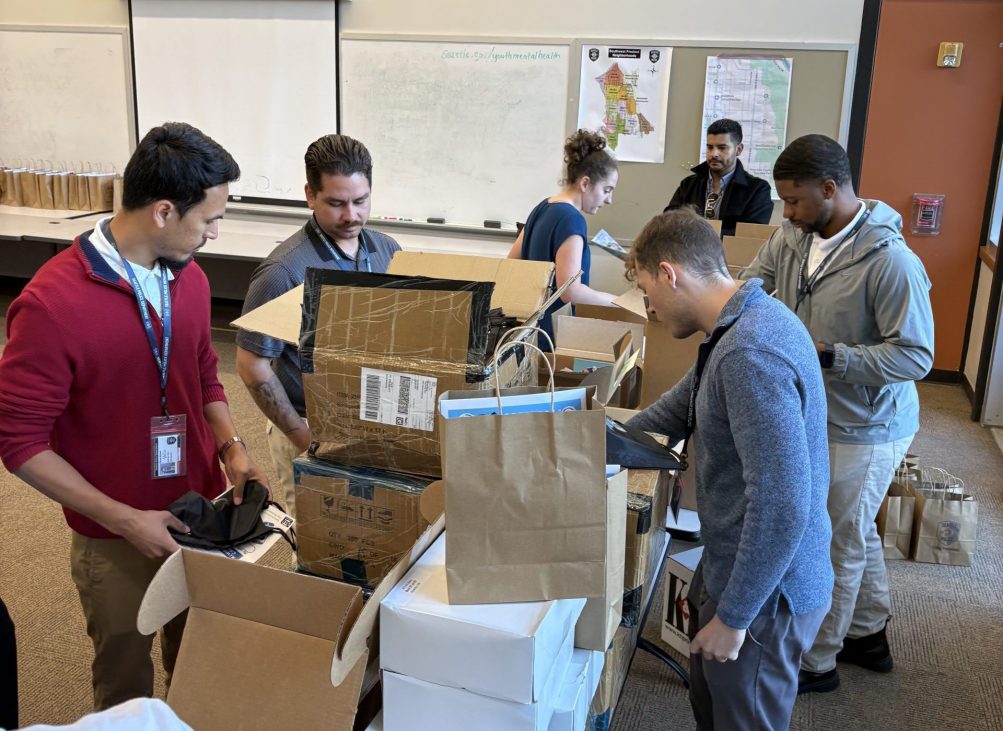
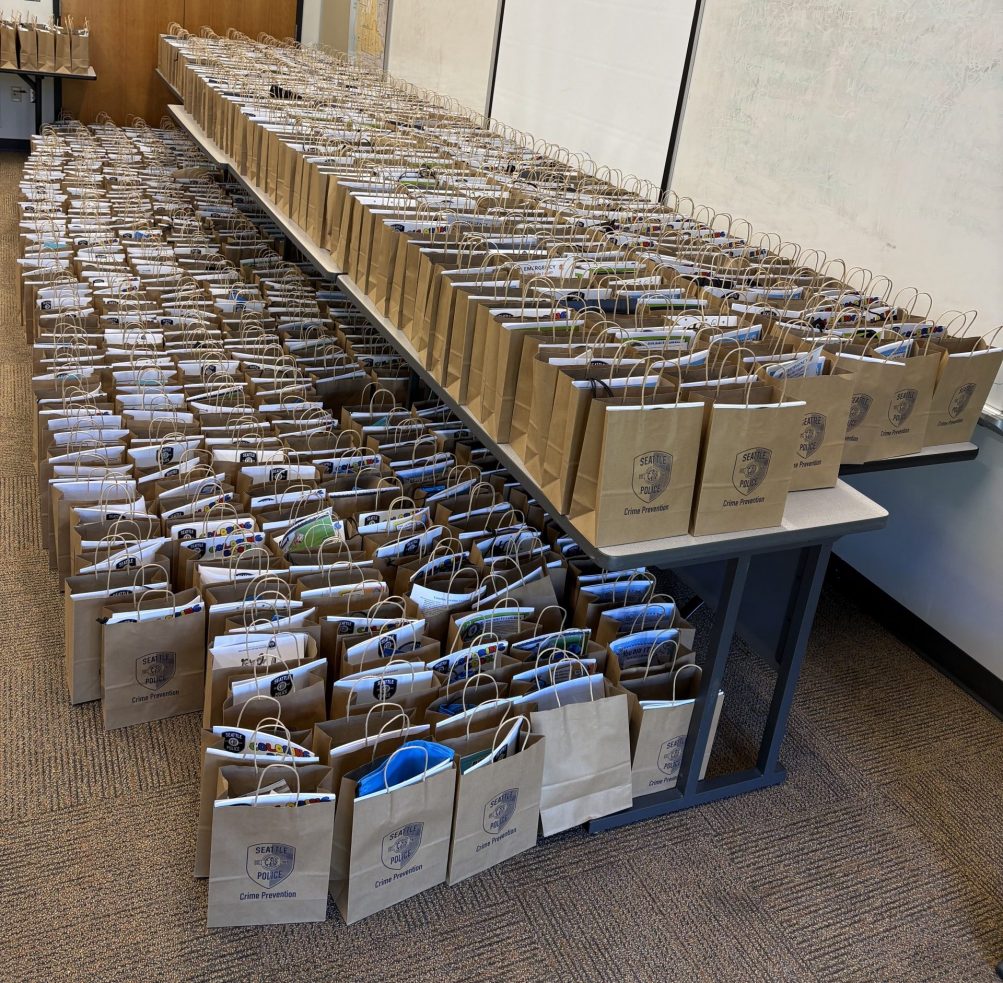
If you’re one of the almost-250 Night Out block/building-party hosts signed up with SPD, swag bags are ready for you to pick up at the precinct Monday, the day before Night Out. The update and photos are from the precinct’s Crime Prevention Coordinator Jennifer Satterwhite:
Today, with the help of the SW Precinct Captain, interns, and Before the Badge recruits – we have prepped 800 swag bags for our community. Pickup day is on Monday, and Night Out is Tuesday!
Jennifer says almost 1,000 Night Out parties are registered citywide – and a fourth of those, 247, will be in the Southwest Precinct area (West Seattle and South Park). Swag pickup time on Monday at the precinct (2300 SW Bebster) is noon-2 pm; party time on Tuesday (when you’ll find many side streets closed to through traffic) is 5-9 pm.
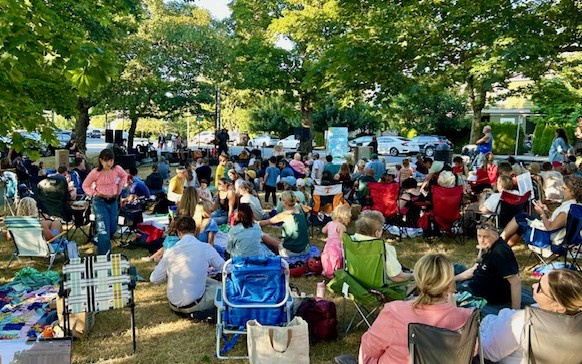 (2025 WSB photo)
Just a quick reminder that the second of three free Admiral Music in the Parks concerts is two nights away – Thursday (July 23) at California Place Park (California and Hill). The little park next to a bus stop is bigger than you think, and series-presenting Admiral Neighborhood Association leaders estimated 350 people showed up for last year’s AMP concert there! This one, like that one, will feature West Seattle musician Michael Pearsall “and Friends.” Like last week, extra features offered by ANA will include bike parking, a board-game library, craft activities, and a knitting circle. All you do is show up with your own chair, mat, blanket, etc. (and picnic dinner if you feel like it) – the music starts at 6:30 pm Thursday.
 Seattle Night Out 2026 is two weeks from tomorrow – Tuesday, August 4th – a time to gather with your neighbors and focus on neighborhood safety. The city grants permission to close non-arterial streets for block parties, but you need to register in advance, and the deadline for that is one week away – Monday, July 27. So far, SPD’s Southwest Precinct Crime-Prevention Coordinator Jennifer Satterwhite says, the SW area (West Seattle and South Park) has 180 block/building parties registered – #2 out of the city’s five precincts, though this is the smallest one. You can register yours by going here.
By Tracy Record
West Seattle Blog editor
 Besides big summer celebrations, this past week also brought two community-coalition meetings.
One, we’ve already reported on – the monthly Fauntleroy Community Association board meeting. Now, here’s what happened at the other, the Morgan Community Association‘s quarterly gathering, both in-person at Alki Arts (which is how we attended) and online:
UPDATE FROM POLICE: Some of what Southwest Precinct Operations Lt. Pat Daly reported – the West Seattle-wide crime stats – were the same as what he told the FCA the night before. He had Morgan-specific trends, saying major crimes were down “significantly,” including rapes and gunfire (each category had 1 incident year to date compared to 2 last year), aggravated assaults, burglaries (down 55 percent), and auto theft. SPD is touting a new monthly citywide newsletter; in the first edition, Lt. Daly said, the Southwest Precinct (WS and South Park) was noted for a steeper crime drop than the four other precincts.
In Q&A time, a family asked about crashes on the Fauntleroy Way curve just southwest of the Morgan Junction business district, including one recent crash. They were interested in seeing something to slow traffic through that stretch. One member of the family had done research and said that area has seen more than 50 crashes in 20 years. MoCA president Deb Barker, leading the meeting, noted that an SDOT rep was due at their October meeting.
A local businessperson talked about trouble with street disorder and fear for their safety. Lt. Daly said police can’t address some things, such as loitering, but they can address some kinds of law-breaking behavior, so do report it. 911 also can dispatch Community Service Officers to offer people resources; CSO Jamie Heslin also was at the meeting and said CSOs work in shifts stretching from 7:30 am to 10 pm.
Last community concern surfaced in the discussion with police was fireworks. On the Fourth of July, they won’t respond unless there’s an “imminent safety threat,” but the rest of the time, “DO call us,” said Lt. Daly – then adding that it’ll still be “low priority” unless there’s a “specific safety (concern).” Nonetheless, he said, “if you call us now (post-holiday), we’ll come, it just might take us a little while to get there.”
CITY PROJECT UPDATES: Barker said Park got approval from an in-house review team to proceed to 60 percent design with the Morgan Junction Park expansion project, which will include an “all-wheels area” (aka “skate dot”) thanks to relentless community advocacy. Parks’ project manager is also continuing to work with other departments (such as Seattle Public Utilities for stormwater-management issues and SDOT for the undeveloped street end between the current park and the expansion site to its north). Barker also recapped where the EV charging lot project was – but that was superseded by City Light’s announcement the next day (as reported here) that work had to stop because of a design problem, as yet unexplained.
KING COUNTY WASTEWATER TREATMENT DISTRICT PROJECT UPDATES: Three reps from KCWTD were in attendance to update work that’s under way at and near Lowman Beach. First they offered a primer on what they do (treat 183 million gallons of sewage a day). A valve replacement at the pump station beneath Lowman is complete; now they’re working on a “force main,” explained as 250 feet of pressurized pipe, including installation of two air valves to reduce corrosion. Some of the work has required Beach Drive lane closures. This coming week, they’ll be lining the repaired pipe, which is actually one of two “force mains” running through the area. Construction will be done by the end of summer, and restoration work will follow in fall. That includes part of the park and some area that will be fenced off while replacement grass grows.
EMERGENCY HUB ACTIVATION: A big event at Morgan Junction Park is just a few weeks away – the drill to “activate” the Neighborhood Emergency Communication Hub there is happening 10 am-1 pm Saturday, August 15. The scenario will be a major earthquake; volunteers will play different roles such as residents seeking information on how to get services. The hubs – West Seattle has 15 – are pre-determined places where volunteers would spring into action in case of catastrophe, to “help bridge the gap between a disaster and when help can get to you,” said Cindi Barker, long a leader inn neighborhood-preparedness efforts. Two upcoming sessions next Wednesday and Sunday will offer training for would-be hub volunteers. They’re open to all, to either get trained or refresh your training.
BE A CASA: Speaking of volunteering, the meeting closed with a detailed presentation on the project that recruits CASAs – court-appointed special advocates – for children who wind up in the foster-care system because of circumstances in their lives. 334 kids are waiting for CASAs, so the need for volunteers – who get comprehensive training – is great. A law, social work, or child-welfare background is helpful but by no means mandatory. There are onthly info sessions online, noon on second Mondays. A CASA joined the presentation to tell her story, saying this volunteer work “fills (her) heart.” You hace to be at least 25 but there’s no upward limit; right now, there’s a volunteer in her mid-80s. The kids range in age from babies to age 11. The most important part of the work is to just listen to them and think about what their best interest really is. Interested? Find out more here.
WHAT’S NEXT: MoCA will meet on the third Wedesday in October, which means 7 pm October 21, location TBA.
By Jason Grotelueschen
Reporting for West Seattle Blog
 “Something needs to be done now — not in 3 years — now.”
That was one of the many strong messages expressed Tuesday night by family and supporters of Maridee Bonadea, the Vashon bicycle rider hit and killed in Fauntleroy last month. The family and community members had been invited by the Fauntleroy Community Association board to attend their July meeting at the Fauntleroy Schoolhouse.
The well-attended meeting was chaired by FCA vice president Catherine Bailey (filling in for president Frank Immel). The first half of the meeting was devoted to a discussion of next steps to engage with city leaders to improve safety on local streets (the second half featured crime updates from SPD, as well as FCA board business, scroll down for summaries on those).
FCA is planning a larger public meeting in early August that will be fully dedicated to the bike/traffic safety topic, with plans to invite and involve multiple elected officials, organizational representatives, and community groups.
Bonadea’s tragic death prompted strong community support including a “ghost bike” memorial and Critical Mass bike ride, and has raised questions and concerns from the community and from cycling and safety advocates across Seattle.
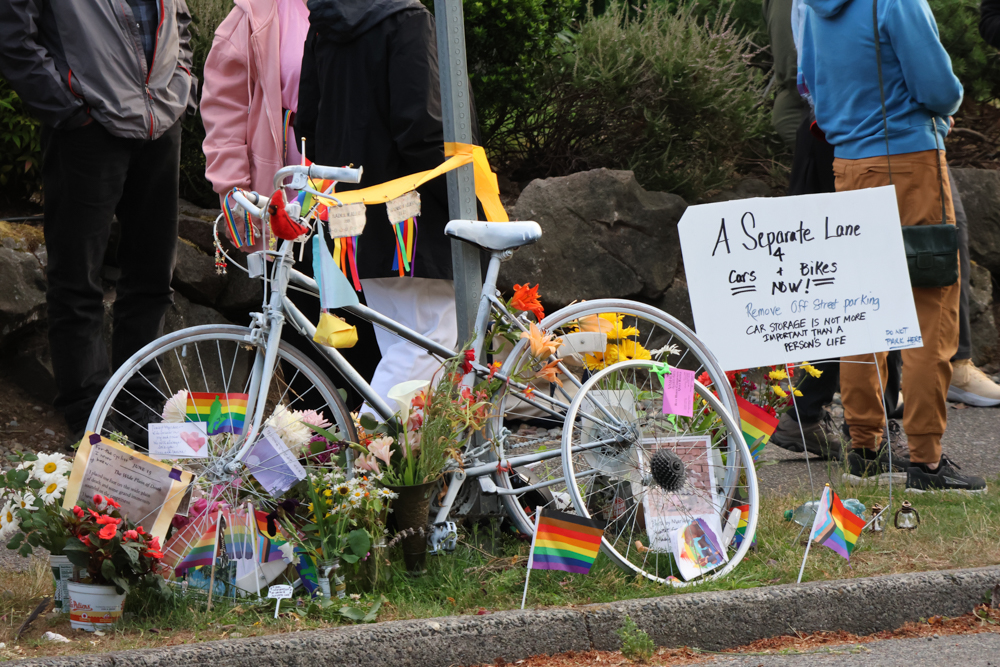 (WSB file photo by Torin Record-Sand)
Before opening up the topic on Tuesday night, Bailey called for a moment of silence for Bonadea, then invited family members in attendance to speak. Bonadea’s daughter Lani and spouse Laura described her as a “very safe lifelong rider” who emphasized group safety. Both expressed frustration with the allowed street parking and the lack of “share the road” signage in the area of Fauntleroy where Bonadea was killed, and they emphasized that now is the time for action. Lani said that although she appreciated the FCA meeting attendees’ respect and moment of silence, “my mom was not silent” when it came to issues that she believed in, and that it’s crucial that the community take action. Laura echoed that sentiment, describing herself as a longtime county employee with 35 years of experience in county government, and urged attendees and the broader community to come together to demand improvement. The family said they’re planning a memorial service for Bonadea in early August, and they thanked meeting attendees for their overall support. Family and attendees also emphasized that Bonadea’s death was not an isolated tragedy in the Fauntleroy area, with, for example, another “ghost bike” memorial just up the road on Marine View Drive.
The discussion was then opened up to other meeting attendees, and here’s a summary:
Before transitioning to the remainder of the meeting, attendees talked about plans for an early-August safety meeting hosted by FCA (the board typically doesn’t meet in August, but they plan to use that general timeframe next month to instead host this one-topic forum). The purpose would be to convene all relevant agencies and stakeholders to identify immediate and longer-term safety actions for cyclists and pedestrians near the ferry corridor and throughout Fauntleroy (and the broader community). FCA will work with stakeholders to identify the best date, and will communicate that promptly to its members and the community. There was agreement to invite representatives from SDOT (Vision Zero), Seattle Police, Metro, Washington State Ferries/WSDOT, elected officials including councilmembers and the mayor, and other West Seattle community associations. Bonadea’s family and other attendees agreed to draft and share letter templates with FCA that can in turn be shared with their members, so that concerned residents can effectively capture and report their concerns to elected officials and leaders.
Before this meeting, WSB had an inquiry out to SDOT regarding the status of their initial review of the site, and this is the response we received:
SDOT Vision Zero Team completed their initial site review. That review focused on documenting existing site conditions and identifying any immediate maintenance, or roadway issues at the subject location. Our site review did not identify anything that required immediate corrective action, like downed signs or faded pavement markings. While the initial review did not identify any immediate maintenance or repair needs, that does not mean the location is not undergoing further safety evaluation. The initial review is the first step in our fatal crash response process. As outlined in our new fatal crash response policy, SDOT is now moving into the next phase of the review process. This phase includes a more comprehensive safety analysis that evaluates the street’s design, operations, and other relevant factors to identify any potential opportunities for safety improvements. In this phase, we will collect traffic data, analyze police-reported crash history and review intersection and roadway geometry. We anticipate completing that review by the end of the summer or early fall.
Back to the FCA meeting; After this topic, some of the meeting attendees and guests departed (all were invited to stay, and some did), and the second portion of the FCA meeting began:
SPD UPDATE: Lieutenant Pat Daly, who joined the Southwest Precinct in early May but is a 19-year SPD veteran, provided an update with help from community service officer Jamie Heslin. Daly reported that the SW Precinct (West Seattle and South Park) posted the largest year-over-year crime drop amongst the city’s five precincts:
Daly also spoke about the cyclist crash investigation, saying it’s being handled by the Traffic Collision Investigation team, which has a city-wide caseload. Because it’s an active investigation, details could take time to be finalized. Heslin added that as a CSO she and her colleagues are able to visit with people and offer grief counseling resources and community support.
Another meeting attendee shared details with the SPD officers regarding a recent neighborhood incident at the 9200 block of Fauntleroy Ave SW, in which a homeowner was struck by a vehicle (with no license plates) that had been parked suspiciously on the property. The victim was reportedly in the ICU with a brain bleed, and a neighbor’s security camera captured the event. Daly said the incident didn’t sound immediately familiar to him, but he made note of it for follow-up.
FCA BOARD BUSINESS: The board spent time discussing a number of operational items, including approval of a new FCA board member (Jamison Johnson, who was in attendance and thanked the group for the support), plans for an open house event in September for prospective FCA board members, approval for the group to sponsor two glass floats for the upcoming scavenger hunt event, reinvesting group funds into a CD, and continuing fundraising efforts for the annual Fall Festival.
STATE REP CANDIDATE: Mary Anito, who is running for WA state representative 34th district position 2 (against Joe Fitzgibbon) was in attendance at the meeting, and introduced herself. She described herself as a 16-year resident and FCA member with 3 kids who is “especially passionate about education” and her community. She encouraged people to watch for their ballots (arriving in mailboxes today), with the election in 3 weeks.
The FCA Board meets ten times per year on the second Tuesday of each month, at 6 pm in the Fauntleroy Schoolhouse board room. Meetings are open to the public.
Tomorrow night, Belvedere Park is the place to be for the next major outdoor-music event of the summer – the first of three AMP concerts, presented at three parks over the next three Thursday nights by the Admiral Neighborhood Association, all free! The series opens with Steve Aliment and Annie O’Neill – here’s a sample of their music:
6:30 pm start time, bring a chair and/or blanket, and get ready for fun options during the show if you’re interested – a knitting circle, board-game library, and music-related crafts! The park is at 3600 SW Admiral Way, right across from the viewpoint, so best access is on all but the north side.
Though some groups go on summer hiatus, two West Seattle community coalitions have midsummer meetings next week, and sent their agendas today:
FAUNTLEROY COMMUNITY ASSOCIATION: 6 pm Tuesday (July 14), Fauntleroy Schoolhouse conference room (9131 California SW). Here’s the agenda, with much of the meeting to be devoted to a discussion of the recent crash that killed Vashon bicyclist Maridee Bonadea three weeks ago, and how to improve safety on area streets.
MORGAN COMMUNITY ASSOCIATION: 7 pm Wednesday (July 15), Alki Arts (6030 California SW). Here’s the agenda, which includes updates on ongoing/pending projects in Morgan Junction, among other items.The agenda also includes the link for attending remotely.
Community members are welcome at both.
 (WSB July 4, 2025, photo by Oliver Hamlin)
Now that it’s the 4th of June, we have the chance to remind you that we’re exactly one month away from the peninsula’s biggest 4th of July event – the Kids’ Parade, again presented by the Admiral Neighborhood Association, 10 am start along a neighborhood route that starts at 44th/Sunset [map], heads west a bit, then south, then east to Hamilton Viewpoint, where sack races, games, and food/treat trucks/carts await. No entry forms or RSVPs or entry fees for the parade – just show up (on foot or on human-powered wheels) and you’re part of it! The ANA also is still welcoming sponsors to help cover the costs of running the parade and post-and parade celebration – you can sign up here.
By Macey Wurm
Reporting for West Seattle Blog
Last night’s Alki Community Council meeting had an agenda packed with public safety initiatives, briefings, and plans, along with the presentation of awards to three dedicated community members.
CRIME AND PUBLIC SAFETY: Lieutenant Pat Daly from the Southwest Precinct was invited up to give the community an overview of crime trends and plans that the department has as Alki starts the summer season. According to Daly, crime in the precinct jurisdiction – West Seattle and South Park – is down by 12% and down in Alki by 10% compared to 4% citywide. He emphasized, however, that these statistics don’t take into account what the department calls “quality of life issues” including minor traffic issues, noise ordinances, and street racing.
As for plans to address these issues in Alki, Daly recounted three initiatives. First, they are proactively closing the Don Armeni Boat Ramp earlier at night to prevent cars from showing up. The department is also emphasizing that officers carry out “directed patrols” along Alki for quality of life issues also including illegal drinking and parking violations. Lastly, the department is still working to finalize an agreement with Seattle Parks and Recreation to deploy officers on the beach on weekend nights to help “close out” the beach.
The lieutenant reiterated the importance of calling 911 about noise complaints, or at least making an online report or a phone report. Not only does this help the department to immediately address the issue, but these reports create data so that the department knows if they are “effectively and efficiently” deploying their resources.
NEW PUBLIC SAFETY TECHNOLOGY FOR LIME: Stefan Winkler with SDOT provided a presentation on their partnership with Lime eBike and scooters, including plans to update technology and an outline of plans for Alki. Through SDOT’s permit program, vendors pay fees to operate within the city. The program comes with vendor performance expectations, and as of now Lime is the only partner in the program. As of April 1, permit conditions were updated for Lime’s technology to include sidewalk-riding detection, rider-behavior detection, increased parking fines, increased insurance requirements, more than 50% seated devices, and increased equity deployment. Winkler also mentioned efforts to implement technology to detect and prevent tandem riding. (Added: Here’s the SDOT slide deck.)
On Alki, riding is currently allowed on the shared-use path next to the beach and vehicles must be parked at corrals. This spring, a geofence was put along the business side of Alki and Harbor.
NEW PEDESTRIAN SAFETY INITIATIVE: Next up was revealing a new safety initiative by SDOT, resulting from collaboration with District 1 City Councilmember Rob Saka. The proposed concept will cost roughly $254,000. The councilmember’s office sent over a statement regarding SDOT’s plans:
We reviewed a request for speed humps/cushions and curb bulbs on Alki Ave SW from 59th Ave SW to 63rd Ave SW to reduce driver speeds and enhanced pedestrian safety near Alki Beach. We recommend installing two new speed cushions between 59th Ave SW and 61st Ave SW and adding a vehicle lane edge line. To discourage drivers form bypassing the speed cushions and enhance safety for people biking and rolling, we recommend adding a hardened bike lane buffer between 59th Ave SW and 63rd Ave SW. We also recommend adding a paint and post curb bulb at both 61st Ave SW and 62nd Ave SW to encourage slower driver speeds and improve visibility for all users.
Plans for traffic calmin on 63rd between Alki and Admiral, as reported here recently, require more data collection this summer.
ALKI EMERGENCY HUB: Amy, the new co-captain of the Alki Emergency Hub, gave a quick briefing about the organization and urged neighbors to get involved. The hub stands as a resource for community members in the event of an emergency – a potential disaster or other loss of communication – to connect with operators who are in touch with emergency management systems. They are looking for more people to get involved, and for neighbors to come together in helping one another. If you’re interested, you can learn more at seattleemergencyhubs.org.
PICKLEBALL UPDATE: Seattle Metro Pickleball Association‘s Don Gouley addressed the council with an update on the organization’s petitioning against Seattle Parks and Recreation’s plan to turn some outdoor public courts throughout the city into tennis-only – including in Alki – resulting in the loss of 36 public courts at 7 locations. SMPA has collected more than 3,200 online signatures, which were sent to city council members as well as Mayor Wilson. The city has since revised their strategy to more equally favor pickleball and tennis in the city, with an update Parks plans to release next week, according to Gouley. He noted that the sport has the power to bring generations and communities together, and that taking away these public facilities is “just not right.”
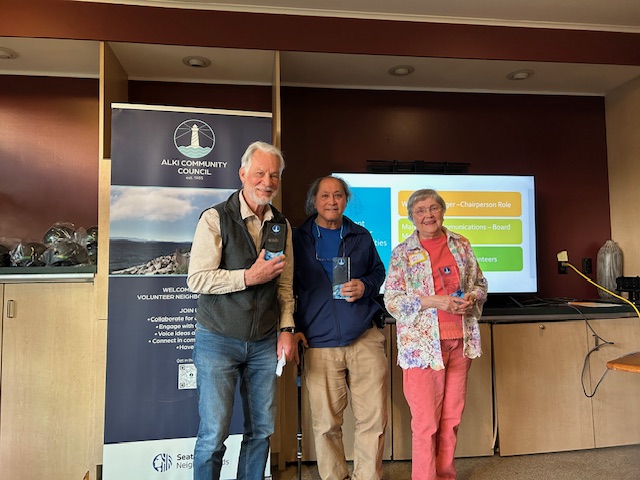
AWARDS: Possibly the most anticipated agenda item was the presentation of three volunteer awards to longtime Alki Community Council members. These awards were given to Kathy Olson, Tony Fragada, and William Winter.
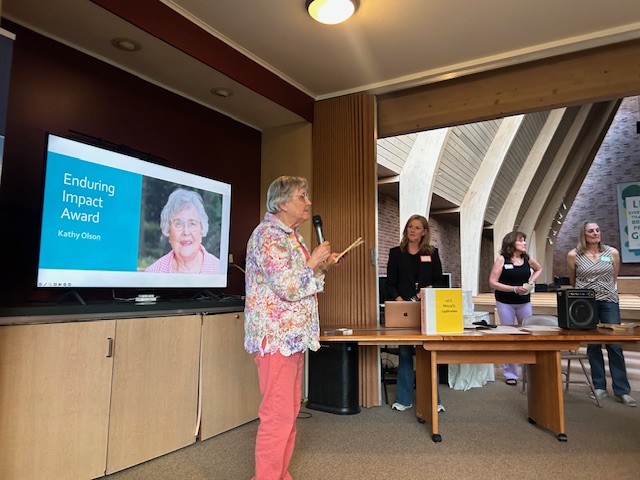
Olson was granted the Enduring Impact Award to commemorate the fact that the Alki Community Council “would not have made it through some of its toughest years without her.” She has spent more than a decade with the organization, and helped to establish and sustain its 501c3 nonprofit status. Aside from her assumption of multiple board leadership roles, she is known for being welcoming at the door, baking cookies for community members, and generally acting in kindness.
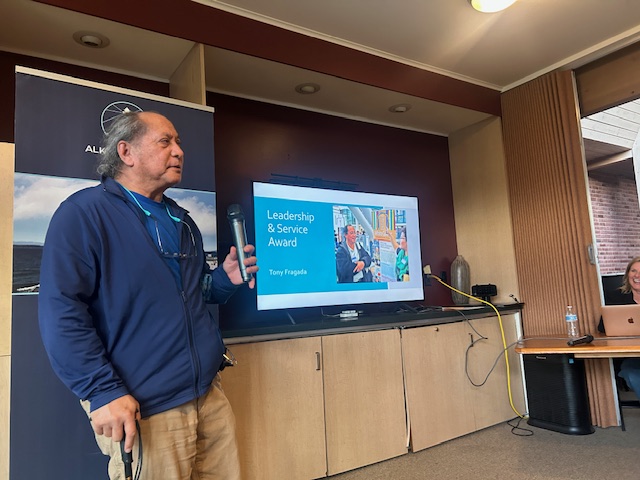
The next award recipient was Tony Fragada, who was granted the Leadership and Service Award. Fragada has been involved in the council since the 1990s, and was the president from 2011-2023 after a stint in the early 2000s. He contributed his “time, positive energy, manual labor, and ideas toward making Alki a better place to work and play.” Tony noted that his focus today is nature – encouraging future generation to live in respect of our ecosystems.
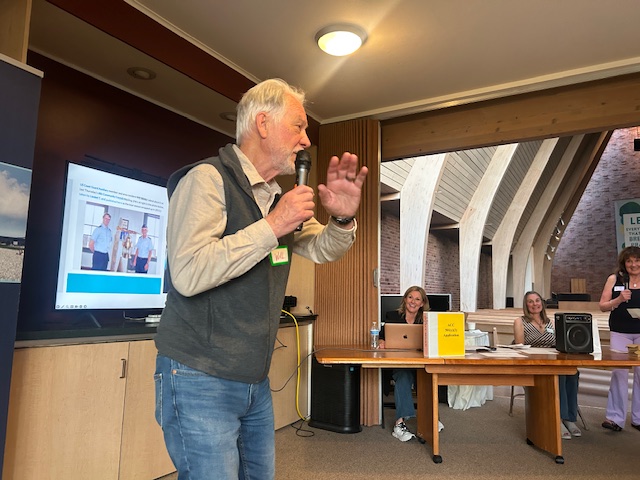
The final recipient was William Winter, who got the Alki Lifetime Service Award. Winter has been serving Alki for 38 years which began with his time at the Alki Community School. He started the fundraising effort for the community bathhouse called the Friends of the Alki Bathhouse, and helped start the Alki Art Fair.
The Alki Community Council typically meets on the third Thursday of every month. The council does not schedule meetings for June, August and December, so will presumably pick back up in July.
NOTE: Corrected post-publication – the titles of Tony Fragada’s and William Winter’s awards, and the spelling of the SDOT rep’s name.
One more set of honors to tell you about. From the Alki Community Council:
A very special Alki Community Council meeting is coming up Thursday.
Three exceptional leaders who are all currently involved with their community will be honored.
Will Winter, current board trustee and past ACC president, Tony Fragada, current board trustee and past ACC president, and Kathy Olson, past ACC secretary/treasurer, will be honored.
Collective contributions range from helping to design the Alki Trail, helping to launch the Alki Art Fair and keep it going, launching Alki Emergency Preparedness, and keeping the ACC operating to get us to where we are today.
This will become a yearly tradition. We hope you all can join us!
Lots of other big items on the agenda too – see it here. All are welcome at the meeting, which starts at 7 pm Thursday at Alki UCC (6115 SW Hinds).
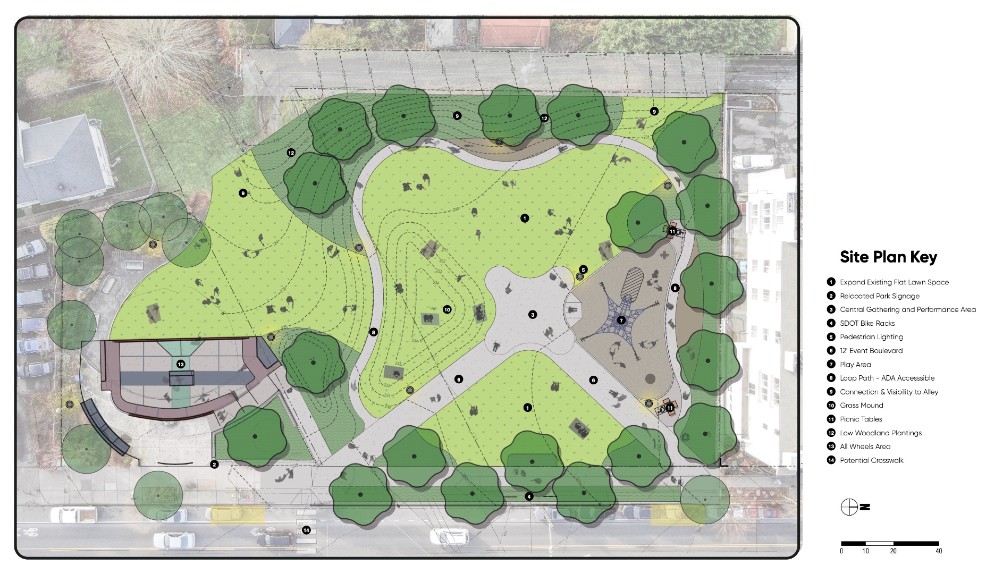 (Current design for expanded Morgan Junction Park, ‘skate dot’ in lower left)
By Tracy Record
West Seattle Blog editor
The latest meeting about the “skate dot”/all-wheels area in the Morgan Junction Park expansion plan served largely as a reminder of how much bureaucracy has bogged it down.
Project manager Trae Yang from Seattle Parks noted toward the end that she’s in negotiations involving a multitude of other city departments, including Public Utilities, City Light, and Construction and Inspections; some of that was explained in a meeting at the site last September, particularly the complication caused by stormwater-drainage requirements.
Development of the site – which held a mini-mart and dry cleaner when the city bought it more than a decade ago – has proceeded at the proverbial glacial pace. If not for advocacy by community members who at one point turned it into an unsanctioned skatepark and formed the Morgan Junction All-Wheels Association, it’s hard to say it would even reached the current point, where it’s just opened as a field of grass.
“It’s been a journey,” design consultant Zack Thomas of Board & Vellum sighed toward the meeting’s start, regarding the eight-year history of the Morgan Junction Park expansion project.
He joined Yang and planner Olivia Reed from Seattle Parks at the meeting in the basement community room at The Kenney. Though the project has drawn extensive interest, and skating-community involvement, over the past few years, attendance was relatively low.
Reed opened with history of the site purchase (closed for $1.9 million in 2014), the start of early design in 2018, the pandemic putting the project on hold (2020), and what’s happened since then:’
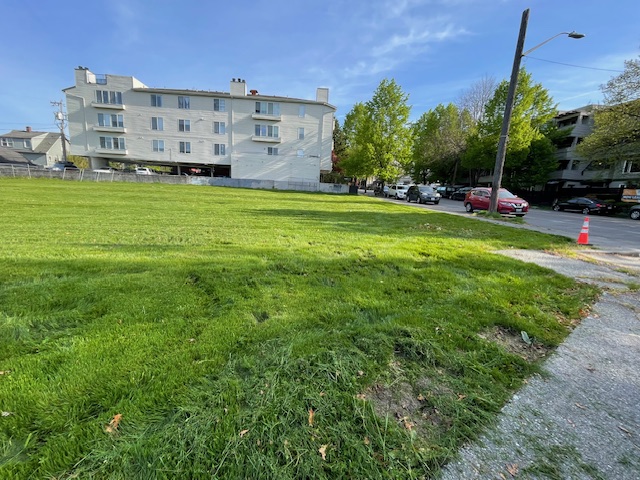 (WSB photo, April 30)
Current status: Fencing came down two weeks ago and grass covers the area. (Several attendees mentioned seeing it used for family play and dog-walking.)
Updated design context: Most original design concepts and park features stayed but a few were removed until they see, with the help of “professional cost estimates,” if some can be restored.
“This project is small but” has “unique” challenges, as the project team described it The site is still classified by the state as “contaminated” so that is affecting what can and must be done with the site. “We have to be careful when we think about how ww’re going to program this site.”
The stormwater matter was explained again. Then the project team answered questions. Could the expansion site be “activated” beyond lawn status before the project is built? Yang said the current plan is just to maintain the grass but “we’re open to collaboration.”
The relative lack of seating in the revised plan drew some attention. What about donated memorial-type benches? Reed said the program for those is just now relaunching, to be managed by the Seattle Parks Foundation, but it would require $10,000 to cover the cost of one. Why so much? “That includes 10 years of maintenance,” she replied.
Some attendees also voiced hope that the potential “sentinel tree” could be restored to the plan – a tree maybe 12 to 14 feet high, possibly atop a mound. And since the “skate dot” is currently planned for part of the original Morgan Junction Park site, advocates wanted assurance that cracked/upthrust concrete would be addressed.
 (Grindline’s schematic for proposed ‘skate dot’ at Morgan Junction Park site)
One person voiced a concern about a particular part of the existing infrastructure being potentially conducive to skater spills that could send skateboards flying into nearby California SW traffic.
One huge question, especially given Yang’s mention of “negotiations”: What can community members do to ensure this really does get built? Yang promised to reach out if she needs “extra lift”; otherwise, she said, “I feel I have momentum.”
MJAWA’s Zac Corum thanked the team for “keeping this project alive – it means a lot to us as community members. It has been a ride to get here; it’s time to get this project across the finish line – this will be a much-better place for families, kids, pets … MJAWA is ready to step up as we have been from the beginning.”
Next steps include the Parks team reviewing th latest cost estimates, which Yang said she received just before the meeting and didn’t want to disclose except to say she saw some “room for refinement” on initial review. Current total budget, from the money already spent on design and contaminated-soil removal plus additional Parks funding and the $700,000 that City Councilmember Rob Saka got into the budget to cover the skate dot, is ~$8 million. Construction is currently projected to start in the second half of next year.
By Jason Grotelueschen
Reporting for West Seattle Blog
The Fauntleroy Community Association board met on Tuesday night for their May meeting at the Fauntleroy Schoolhouse, chaired by FCA president Frank Immel.
Meeting summary below:
SPD UPDATE: Crime prevention specialist Matt Brown and community service officer Jamie Heslin from the Southwest Precinct were in attendance to give an update. Brown started with some year-to-date statistics for 2026, compared to 2025: City-wide crime is down 2 percent, and crime in SW Precinct (West Seattle and South Park) is down 9 percent. For Fauntleroy in particular, Brown said crime is up 34% but the relative numbers are not large (42 incidents YTD compared to 33 last year), with the majority of those incidents being property crimes (only 2 reports of violent crime). Similar to last month’s update, Brown advised neighbors to stay vigilant with securing homes, garages etc to minimize opportunistic theft. For “shots fired” incidents, calls are down 12 percent precinct-wide, with 30 total, 2 of which were in Fauntleroy.
FCA’s Dave Follis noted that on his block, a car was recently stolen (likely with a “Flipper Zero” electronic device) and still hasn’t been recovered, but video evidence has been submitted to SPD. FCA’s Alan Grainger said that he and his neighbors have noticed a significant increase in door-to-door soliciting, to which Brown suggested that although it’s tempting to ignore such visitors and not answer the door, it’s actually preferable to safely acknowledge (through the door or via electronic doorbell speaker) that you’re home, to deter rare instances of “casing.”
Heslin noted that although an SPD “resource fair” had been planned in the near future for the Westside Neighbors Shelter location, it’s being postponed to the fall because the shelter is still closed for renovations. She also said that their staff has been working on encampment outreach in areas such as 18th and Delridge.
Both officers said that SPD and other city agencies will be “all hands on-deck” preparing for and supporting the FIFA World Cup matches and associated events in Seattle in June and July. Finally, Brown noted that SPD’s Jennifer Satterwhite has returned from maternity leave, and Brown is helping with that transition.
FAUNTLEROY/ROSE CROSSING: As we reported last week, representatives from SDOT met with community members (including several from FCA) at Southwest Library to discuss plans for a new crossing near Lincoln Park and the ferry dock at Fauntleroy Way SW and SW Rose Street [map].
FCA members noted that there were mixed views discussed at the meeting, with some in favor of the design but with many attendees raising concerns about a proposed “raised median” as well as unique local considerations (notably U-turn behavior and neighborhood cut-throughs). There were also some concerns about the validity of SDOT’s traffic volume data because of the timing during which it was collected (three mid-day weekdays in October) which could result in the average number of cars being too low to accommodate for peak traffic (such as busy commute times, and Friday afternoons in the summer).
Immel noted that SDOT has indicated that this is a “fast track” project, with the plan being finalized this summer and construction likely beginning by the end of the year, which would likely coincide with another project in the area that involved new traffic signals at the ferry dock (details were discussed in FCA’s April meeting). He said that plans to ask SDOT’s Ching Chan (who was in attendance for last week’s meeting at the library) for an update regarding next-steps and details. He added that Chan had said that SDOT does want to move ahead, but that community input and feedback will factor into the final decisions and plans.
FERRY & TERMINAL: Immel said there wasn’t much new to report in this area, aside from what was already discussed regarding the ferry traffic. He said there had been some recent maintenance completed, with a road plate on a ramp that was wobbling, but was fixed last week. For the traffic signal, work could likely still begin after September 8 to add required underground power connections so the new light can be installed later this year. Dock expansion construction itself likely won’t begin earlier than 2028. One attendee noted that they had heard that a house adjacent to the ferry dock was surveyed by Washington State Ferries staff this week, but the intent of that action was unclear (acquisition? environmental or right-of-way analysis?)
FCA BUSINESS: A sizable portion of the meeting was spent discussing FCA board business and operations, including:
The meeting adjourned a few minutes early, with most members planning to trek around the corner to take part in the final hour of the Fauntleroy Fall Festival fundraiser (which we previewed here) at Endolyne Joe’s.
The FCA Board meets ten times per year on the second Tuesday of each month, at 6 pm in the Fauntleroy Schoolhouse board room. Meetings are open to the public.
By Tracy Record
West Seattle Blog editor
 Admiral Neighborhood Association president Joanie Jacobs announced tonight’s gathering as “the last meeting before summer craziness begins.” That’s a reference to the intense slate of summer events that ANA presents. Here are the meeting’s main points:
SEATTLE POLICE: Crime-prevention coordinator Matt Brown and Community Service Officer Jamie (both civilian employees of SPD) were at the meeting. Brown had the latest stats – first urging people to report incidents, since otherwise it won’t appear in the data at all – SW Precinct (West Seattle and South Park) area crimeis down 9 percent year to year, Admiral is down 21 percent. Confirmed gunfire calls are down 12 percent, 30 total, precinct-wide, and none of those were in Admiral; four of the incidents resulted in injury, no deaths. Brown was asked how SPD is preparing for the FIFA World Cup matches and related events; every precinct will be involved in deployment.
EX-CHURCH SITE REDEVELOPMENT: Two Admiral Church congregants gave an update on the church’s Homestead Community Land Trust partnership – the church is donating its site for an affordable-homeownership project that also will include a new home for the church. Current plan is for 21 units, 13 will be townhomes, 8 will be single=floor ADA-compliant flats in a building over the church’s new space. They just met with the architects today. For the last couple years, Homestead has been working to secure added public funding needed even though the church had donated the land. “They’re at a point in this process that our current expectation is that they’ll be able to start construction in September of this year.” Laura added, “The affordable-housing piece will allow folks to be able to buy and own the townhouses.” Mike elaborate, “For folks who make less than 80 percent of the area median income. … The people we depend on in this neighborhood can’t afford to live in this neighborhood,” and this project will address that. He also recapped that the units will have to “stay affordable.” Once construction starts, it’ll likely take about a year and a half. Laura noted that this also will allow Admiral Church to stay in the neighborhood – they voted to do this rather than selling the land for “a lot” to whomever wanted to do whatever. – and, they noted, the site is zoned for much-denser redevelopment than this will be.
HIAWATHA PLAY AREA: ANA’s main communicator Dan Jacobs said the Parks Department just hasn’t been able to send anyone to the ANA meetings but has given him some info on the play-area project. Construction is supposed to start “by late summer/early fall” this year; bids were opened two months ago. The long-pending play area project has kept ANA from bringing even one of the summer concerts back to Hiawatha, but maybe next year. He also noted that ANA would like to meet at newly remodeled hiawatha Community Center but it’s not staffed evenings so they’d have to pay – for staff, for the space, etc. They’re also looking for community suggestions on programming.
SUMMER EVENTS: Joanie Jacobs talked about what they have to do to cover the costs of the neighborhood cleanup (9 am June 6, starting location TBA, just show up) West Seattle 4th of July Kids’ Parade, the Admiral Music in the Parks three-concert series (July 16-23-30), and the Admiral Block Party (August 22). Monetary donations – no matter how small – help them pay for the events, and they are staffed with volunteer power. Next Tuesday (May 19) at 7 pm prospective volunteers are invited to a gathering at the West Seattle Realty event space (2715 California SW; WSBs sponsor).She exhorted the ~20 people in the room to come and bring a friend/neighborhood. On July 2, a screening of the Earl Robinson documentary by local filmmaker BJ Bullert will raise money for the summer concert series, ANA’s Meagan Loftin announced. She also said Admiral history walking tours will be back this summer.
HELP ANA COVER THE COSTS … of all those events, by donating here.
NEW BUSINESS MEMBER: The owner of a new record label The Big Dark Records spoke briefly – they’re new ANA business members. If your business would like to join, find info on the ANA website!
BE A HOUSEHOLD MEMBER: ANA would love to have more of those too! Go here to find out how.
EMERGENCY HUB: Admiral still needs a volunteer to lead theirs – a place people would go for information in case o catastrophe.
NEXT MEETING – isn’t until September, so in the meantime, find your community group out at all the aforementioned events (details on connecttoadmiral.org).
By Tracy Record
West Seattle Blog editor
 Two pending projects were in the spotlight during last night’s monthly meeting of HPAC, the community coalition for Highland Park, South Delridge, and Riverview, facilitated by co-chair Kay Kirkpatrick. Her’s how it went:
CRIME TRENDS: The meeting opened with SPD Officer German Barreto saying that most Highland Park crime categories are down, year to date. One exception: Burglaries, some of which involve vacant homes. Another: Confirmed gunfire. As he noted, shell casings that are collected go into a database and investigators can see if they match other incident. No word of any revelations from that process so far this year; Officer Barreto said the area has seen eight incidents so far in 2026, compared to six by this time last year: “Not really good.” The officer also mentioned walking through some encampment areas like one off SW Detroit, and he said he’s been notifying the Unified Care Team about what he finds. He said he’s hopeful the UCT will get to that area, but doesn’t know when. That led to several attendees voicing encampment-related concerns; one asked about 24th/Barton/Henderson, and Officer Bareto said he’s aware of that because that area is reoccupied repeatedly. Kirkpatrick said they’re in contact with City Councilmember Rob Saka‘s office on that too. Another attendee said fires are a concern with the encampments in greenbelts. Officer Barreto suggested people keep reporting via Find It Fix It, and include photos, albeit ones taken from a safe distance. One person with property in south Highland Park mentioned a problem one of her tenants had had – but the tenant hadn’t reported it to police. “Please report it, we’re data-driven,” said Barreto. He also mentioned the option to report online, provided the crime in question isn’t something that’s happening right now (if it is, call or text 911).
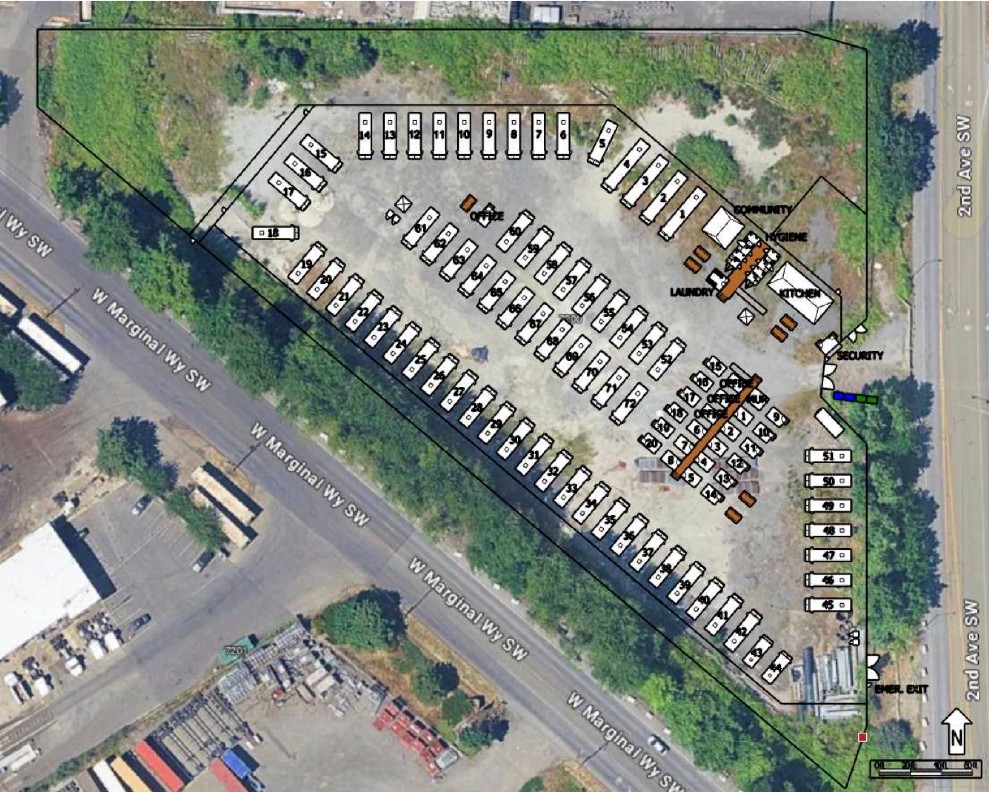 (‘Site plan’ from city permit filings for Glassyard Commons, with 72 RV spaces and 20 tiny houses)
GLASSYARD COMMONS: Marta Kidane from the Low-Income Housing Institute, which will operate the tiny-home/RV-lot site Glassyard Commons at 7201 2nd SW, was the next guest. (We’ve been reporting on the plan since breaking the story about it in January.) She first explained the concept of tiny homes – 8 x 12, “the dignity and privacy of having a closed door, heat (and A/C in the newer ones),” in villages, with shared spaces where people can cook and eat, plus hygiene trailers with showers, sinks, toilets, etc. And they have 24/7 staffing, with sign-in sheets, case managers there during weekday business hours, to help people negotiate the system. They also have behavioral-health providers at many sites.
Glassyard Commons would be LIHI’s second RV lot, twice as big as the now-dismantled first one, which Kidane said led to the demolition/removal of 67 RVs (entering a lot like this means you agree to eventually give up your RV). People are in their programs for an average of six months before moving on to housing.
One attendee wondered if the Glassyard Commons plan – on state-owned land – is a done deal. The answer was, pretty much yes. Another attendee who said they still had questions lingering from LIHI’s public meeting in Georgetown (WSB coverage here) such as, what’s the definition of “surrounding area” and what will be done about people already camping in the nearby greenbelt? She didn’t have information on that, but, “I think it’s all about developing relationships” which the UHeights Vehicle Outreach Team working with them will be trying to do.
One attendee mentioned someone often seen at Highland Park Way/Holden seemed like a perfect candidate for a tiny home. Could she refer him to LIHI’s partners? Kidane asked for information.
Kirkpatrick brought up the letter that HPAC had sent to the city and said one unaddressed point was the request for proactive cleanup for a mile each way from the facility. “They’ve only adopted 500 feet, which is only going to take us to the edge of the block,” she said. Kidane contended that “tiny house villages often make the area around them safer … there’s a level of activation” resulting from their presence. She offered to take people on a tour of a current tiny-house village. “I think when you see it you really get an idea” of how it works. (West Seattle already has one, Camp Second Chance on Myers Way. Expanding it remains a possibility, Kidane said in response to a later question.)
One attendee asked for more details on what happens to the RVs that are turned over when their owners get housing. Are they resold? No, they’re scrapped, Kidane said. (Before the RVs are brought on site, they’re decommissioned, including rendering their bathrooms unusable, meaning the RV residents have to use the hygiene trailers too.)
She mentioned an outreach team working in the area, so that led to questions such as, what happens to people who decline shelter/services? That’s more a question for the outreach team, Kidane said. But for RV dwellers, they appreciate having some control of their own space. Is the outreach for Glassyard Commons going to start in Highland Park? Yes, reiterated Kidane. But it won’t be limited to people found in West Seattle.
Can people smoke and drink in their tiny houses? Smoking is prohibited, and they have smoke detectors, but otherwise, there aren’t prohibitions about what they can do behind closed doors, though, she noted, they are made aware that recovery services are available. (Weapons and even guests from outside the site are prohibited too.)”
Kirkpatrick noted that HPAC has signed up to participate in the Community Advisory Council for Glassyard Commons, once it’s launched. Meantime, we asked Kidane after her appearance if there was any update on a timeline for costruction, as it had been said repeatedly that this site was on a fast track. Short answer, no,
SDOT’S HIGHLAND PARK WAY HILL PROJECT: Kirkpatrick said HPAC’s been talking to Councilmember Rob Saka‘s office about longrunning concerns regarding the lane-conversion plan, but it appears his office won’t be “intervening,” so feedback should be shared at the “agency” (SDOT) level. She asked attendees to list their concerns/observations about the project (and also invited supporters to speak up). Several concerns were voiced, including:
-A SW Othello resident said city reps have not yet made good on their promise of a walk-through with neighbors
-There are options not being addressed and a conversation needs to be had with engineers
-Restricting downhill to one lane means there’d be no way to get out of the path of a dangerous oncoming driver. “They need to re-engineer the whole road,” suggested an attendee. (Kirkpatrick noted that Saka had called for a Vision Zero audit, as we previously reported)
-Enforcement could make a big difference. Kirkpatrick said she was just back from a road trip in other West Coast states and they saw lots of it.
-One attendee said they expect there’ll eventually be a two-lane result. The discussion devolved briefly into a cacophony of other suggestions.
HPAC meets fourth Wednesdays most months; watch hpaction.org for updates.
HPAC – the community coalition for Highland Park, Riverview, and South Delridge – has just announced the plan for Wednesday’s monthly meeting:
Next HPAC Meeting Wed., April 22nd, 6:30 pm in person at the Delridge Branch Library
Plant a tree, and Celebrate Earth Day with your neighbors and friends at the HPAC April meeting!
As usual staffing permitting, we hope to have an SPD representative to discuss any concerns and safety updates from their Department.
Craig Rankin from West Duwamish Greenbelt Trails will tell us more about the upcoming season of guided hikes in the greenbelt and what you may expect to find along the way.
After a long and contentious meeting with SDOT in March, regarding the Highland Park Way Safety Project we intend to use this meeting to cover possible responses to the City and what HPAC can do to support concerns.
We will also bring more information about the proposed Glassyard Commons RV Safe Lot and Tiny House Village the Mayor proposes for 7200 W Marginal Way S and discuss our concerns, plus share what actions we have taken with the City on this so far. We have invited a spokesperson from LIHI to our meeting but have not yet heard back from them.
The library is at 5423 Delridge Way SW.
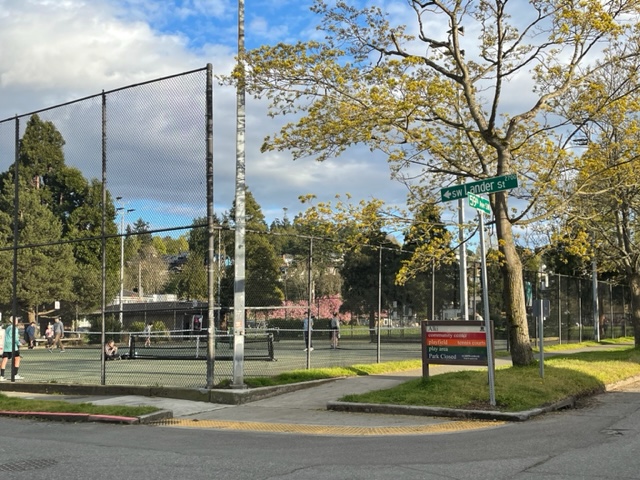 (WSB photo, Alki Playfield courts)
By Tracy Record
West Seattle Blog editor
“It’s not tennis vs. pickleball, it’s tennis AND pickleball.”
That’s what the president of the Seattle Metro Pickleball Association insisted, given a chance at last night’s Alki Community Council meeting to talk about his group’s campaign against Seattle Parks’ newly unveiled Draft Outdoor Racquet Sports Strategy, which at least in the short run would cut the number of public courts open to pickleball.
 (Photo courtesy Alki Community Council)
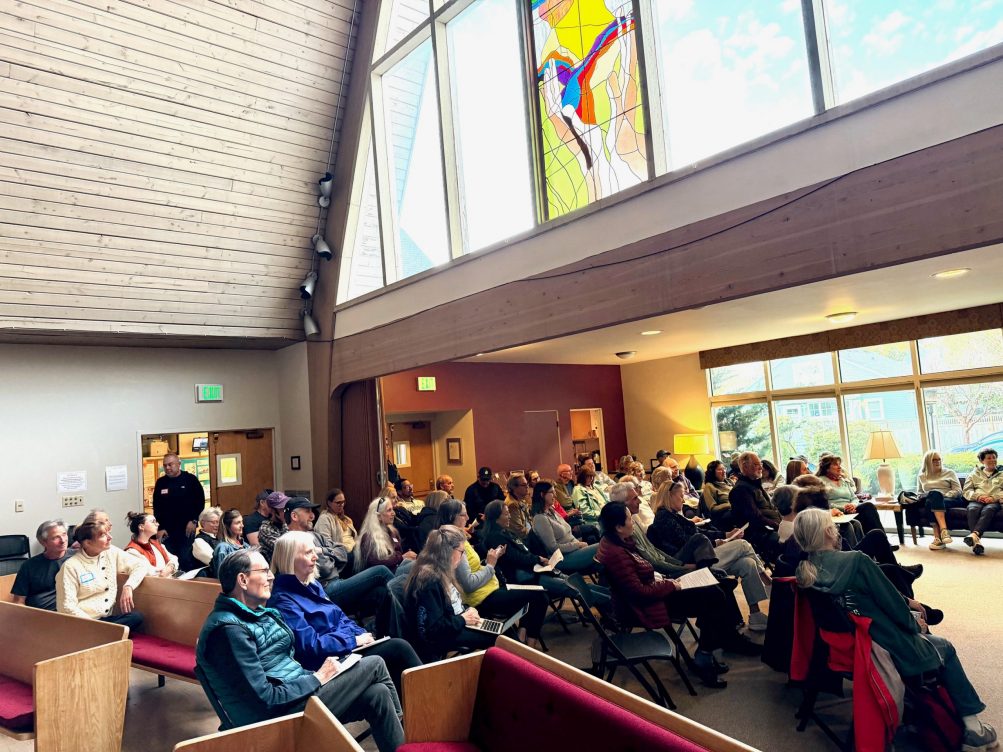
That was one of several matters discussed by the ACC in a well-attended meeting at Alki UCC, led by president Charlotte Starck. She made it clear that they weren’t presenting the pickleball group’s stance as a signal of where their sympathies lie – it was a simple matter of, they asked to speak, while no tennis advocates had.
The Seattle Metro Pickleball Association has an online petition drive going, as reported here, and president Tony Pisa said every signature – 1,000 as of Thursday morning, he said – sends email to a long list of city officials. A board member who joined him, Don Goulet, said the group was “blindsided” by the Racquet Sports Strategy proposal, as “we were in pretty good talks with (Parks and Recreation)” prior to its release. “We’ve been partnering for years,” added Pisa. “We worked on ways to coexist … then boom! we’ve got nothing.”
Their short-term goal is to get the city to pause its planned June 22 implementation of the “strategy,” which would among other thigs end the practice of “dual-striping” so that courts could be used by both pickleball and tennis. They intend to put the pressure on, not only via petition signatures and emails, but by showing up at “every meeting” and bearing visual reminders of their campaign, with the slogan LET US PLAY. “The reality is, they’re not really listening and they need to hear us.”
There seemed to be some suspicion of nefarious political influence by tennis supporters, and it was also noted that there’s a new mayor and (acting) Parks and Recreation Superintendent. They said an advisory council working on the racquet-sports vision didn’t even get a preview of the “draft strategy” before it went public. And they said marginalizing pickleball would throw away important community support for facilities – their organization had been discussion fundraising to help fix crumbling courts – and then the draft strategy emerged, suggesting they be simply booted off many courts.
Some attendees spoke up to reinforce that they don’t see it as “pickleball vs. tennis” – said one, “I’m not dissing tennis, I’m here as a pickleball player (to tell you) it’s socially engaging, it’s more than a sport.”
Regarding the issue of pickleball noise, they said they’ve asked for data, including number of complaints – “this can’t be anecdotal.”
Next up, the “strategy” will be formally presented at the Board of Parks and Recreation Commissioners‘ meeting – downtown and online – Thursday night (April 23), followed by a series of Parks-convened feedback meetings around the city (none in West Seattle). The city also has opened an online survey about the proposal
That wasn’t the only Seattle Parks-related discussion at last night’s ACC meeting:
ACC & PARKS WALKING TOUR: The racquet-sports proposal hadn’t been made public when ACC board members went on a walking tour of Alki earlier this month with Parks officials including acting Superintendent Michelle Finnegan. So they touched on a wide array of issues in their 40-minute tour, including crowds, trash control, bathrooms, the community center, off-leash dogs (citations are promised this year), unsanctioned vendors (citations are promised with this too), basketball courts, seawall and sandbags, illegal vendors, and racquet sports. The Parks officials are apparently doing these walkthroughs around the city. Here are the highlights of what they learned:
–Alki Community Center, a child-care only facility for years now but completely shuttered during school construction next door, will add back some public access, primarily teen and youth drop-in basketball, possibly some senior programming.
–Alki Bathhouse, which has reopened its pottery studio but otherwise is fairly fallow, might get some programming, administered by the team at newly reopened Hiawatha Community Center. (Let them know your thoughts – andrea.wooley@seattle.gov and hanan.gumalle@seattle.gov)
-Extra trash service, with 7-day-a-week pickup, was promised for Alki, along with more portable restrooms, in spots including 57th SW and by the volleyball courts. Starck noted that this would be a relief, so to speak, for beleaguered business owners beset by people looking for open restrooms.
This is all supposed to start May 1 with the summer-season launch. If you see a problem that needs to be addressed, use Find It Fix It – unless it’s a crime/safety problem happening right now, in which case, report it via 911.
Speaking of 911 …
CRIME TRENDS: As with the previous two community-council meetings we’ve covered this week, the ACC meeting got a quick update on crime trends. Crime Prevention Coordinator Matt Brown told the group that SPD data showed not only that Southwest Precinct’s jurisdiction (West Seattle and South Park) crime reports were down nine percent year-to-year, Alki is down 18 percent. He also noted that may not be as dramatic as it sounds due to the low numbers – 52 crimes reported by mid-April last year, 40 this year. Confirmed gunfire incidents: Two in the greater Alki area so far this year. And he repeatedly stressed that if you feel the numbers don’t mirror your experience, be sure everything that happens/that you hear about is getting reported.
He was asked about the pilot “private security” program that Golden Gardens is getting as part of this year’s “Summer of Safety” but Alki isn’t, and why that made sense given that Alki abuts residential areas while the Ballard-area beach has separation. Brown said different plans are under way for Alki such as – potentially – more bicycle officers (as was common in the pre-pandemic years). He also downplayed what the GG security guards will be doing – “they’re unarmed and they will be able to call 911 but that’s about it.”
Alki/Harbor community advocate Steve Pumphrey was not convinced, urging those in attendance to contact all their city reps, including District 1 Councilmember Rob Saka, and “let’s get what we need here.” Starck concurred that the more people from whom the city hears, the better.
Before his appearance ended, Brown also noted that the twice-yearly Drug Take-Back Day is coming up, 10 am-2 pm Saturday, April 25, at the precinct (2300 SW Webster). And as he’d done at the week’s previous community-council meetings, he thanked ACC attendees for their collaboration during his extended fill-in for longtime CPC Jennifer Satterwhite, who’s due back from maternity leave next month.
Other safety issues briefly surfaced included the continuing need for traffic calming on 63rd SW; Starck urged concerned residents to get “names and signatures” to Councilmember Saka to reinforce the request.
BUSINESS SPOTLIGHT: One more item from the agenda – the ACC heard from a representative of Seattle Dive Tours, headquartered on Admiral Way and often seen at Seacrest.
NEXT MEETING: The ACC meets third Thursdays most months; watch alkicommunitycouncil.org for updates.
By Tracy Record
West Seattle Blog editor
A Seattle Parks update on the “skate dot” – mini-skatepark – planned for the Morgan Junction Park addition was the centerpiece of last night’s spring-quarter Morgan Community Association meeting.
The meeting’s location itself was a highlight – first time in six years, since right before the pandemic, that MoCA met at The Kenney, previously its regular in-person meeting site. The meeting also was open to online attendees (which is how we covered it, due to last-minute transportation challenges).
Here’s how the meeting – wrapped up in less than an hour and a half – unfolded:
CRIME STATS: SPD crime-prevention coordinator (a civilian position) Matt Brown came with Southwest Precinct (West Seattle and South Park) stats as well as Morgan Junction-specific stats:
Year-to-date through April 15th, compared to same period last year, SW crime data shows a nine percent drop; in Morgan Junction, the drop is seven percent (total reported incidents 67, down from 76 in the same period last year). Most of those, he said, are larceny/theft. He also had stats on confirmed gunfire – 24 incidents so far this year in the SW Precinct jurisdiction, compared to 25 last year (none in Morgan Junction so far in 2026) . This year’s tally included three incidents in which someone was injured (the SW Precinct had no homicides last year and none so far this year).
Brown also told MoCA that this was the last meeting at which they’d see him, as longtime CPC Jennifer Satterwhite will be back from maternity leave in May.
EV CHARGING LOT: MoCA president Deb Barker had quick updates from Seattle City Light about this project. As we’ve reported, construction work has begun, including trenching across Fauntleroy Way to get power to the site. That work is mostly complete but pavement restoration will take a while. Next, she said, SCL plans to do some work on the SW Morgan side, which means that sidewalk along the project site will be closed. SCL still says the site should be ready to open in August.
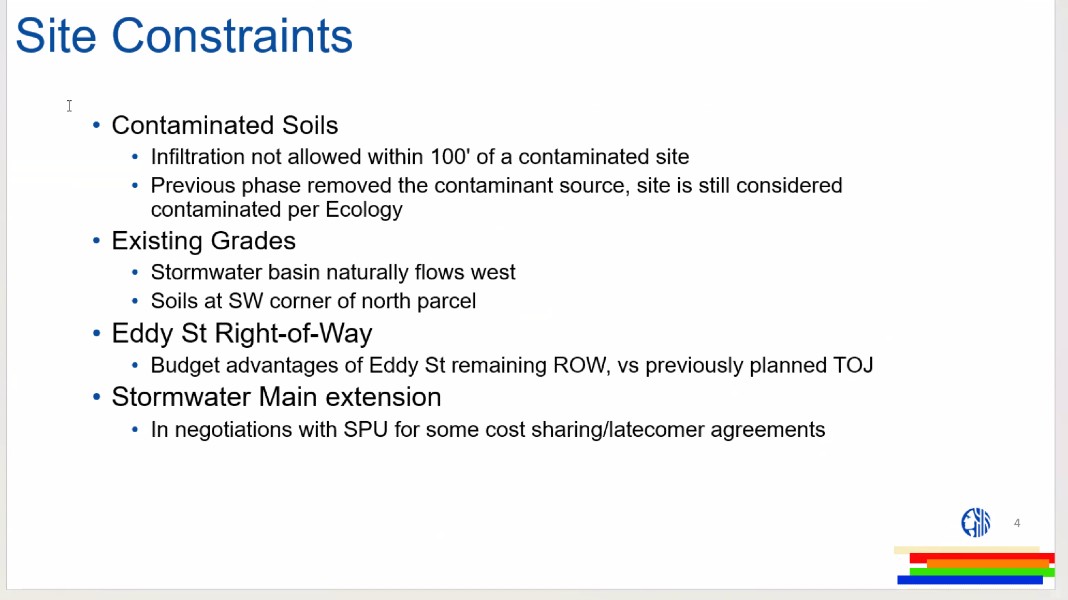
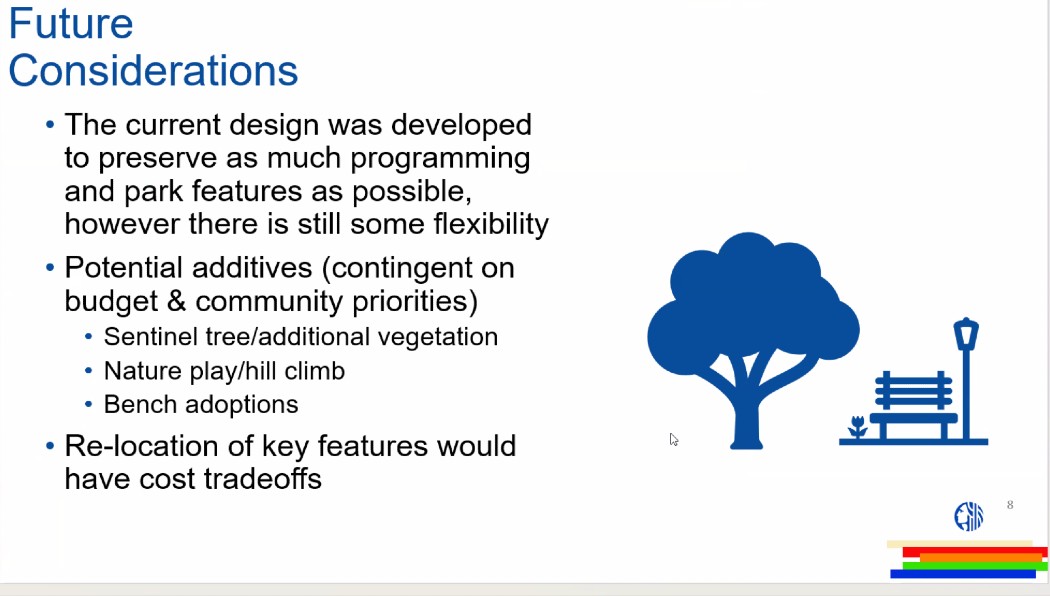
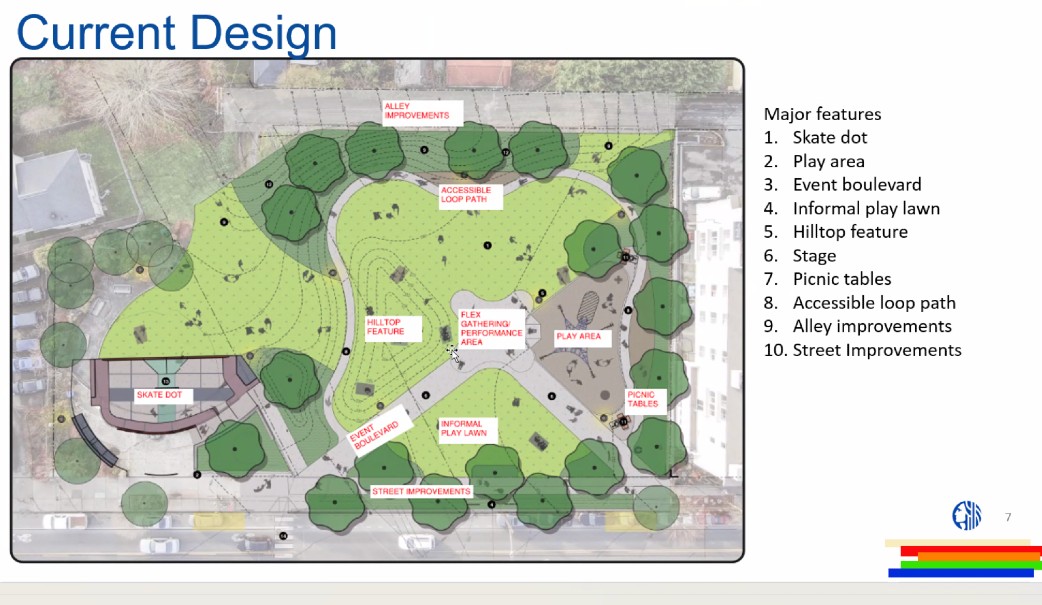
MORGAN JUNCTION PARK ADDITION SKATEDOT: Project team leaders from Seattle Parks presented this update on the project incorporating the currently fenced lot north of the existing park – here are their key slides:
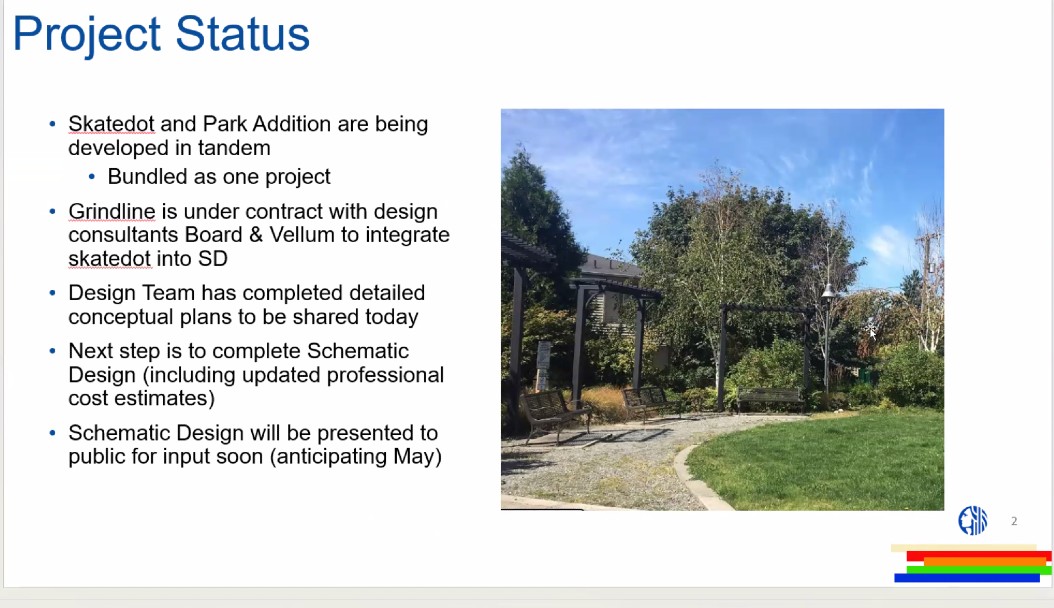
The latest conceptual design, Parks said, has no major changes from the previous version, Parks said.
Despite the soil removal that’s been done, the site is still considered contaminated, so the soil piled at the northwest edge of the site needs to stay – “moving it could be quite expensive.” There’s also still a lot of behind-the-scenes technicalities the Parks team is dealing with, such as having to extend the site’s stormwater main, and working out what the status of the SW Eddy right-of-way between the existing park and the addition site – it might not simply be transferred from SDOT to SPR after all. Access to utility poles along the site’s rear alley is being worked on too.
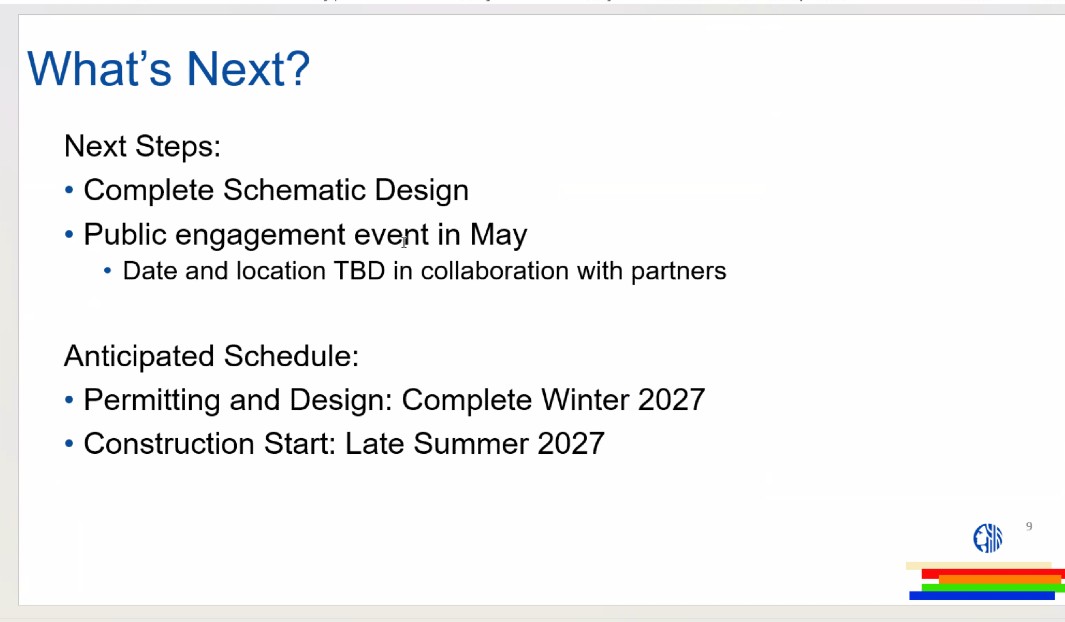
Next steps include a community-engagement event, likely sometime in May, and more design work that should lead to an accurate cost that would help determine whether there could be “additives” to the project such as a “sentinel tree,” a natural play area, or adoptable benches. The newest projected construction timeline is for work to start in “late summer” of 2027.
EMERGENCY READINESS: Cindi Barker from Seattle Emergency Communication Hubs said this year’s West Seattle exercise for hub-volunteer training drill will in fact be at Morgan Junction Park, maybe even utilizing the expansion site if the fences are down by the event date, currently August 15. Watch for other community involvement opportunities before then, all summer long, including opportunities to talk about the hubs at tables during events such as West Seattle Summer Fest in The Junction (July 10-12). And if you don’t know what a hub is or why you should know – this video explains:
West Seattle has 15 hubs, but some are sometimes deactivated because of lack of community involvement, so if you’d like to be part of it, here’s info on getting involved ASAP!
DESIGN-REVIEW REBOOT: The Design Review program, long one of the few ways that community members could get word of and voice an opinion about major development projects, remains on the ropes; Deb Barker is a former Southwest Design Review Board and presented MoCA attendees with the same info she’d given the Alki Community Council about a new push to save and reshape it (scroll to the bottom of this story).
MoCA LEADERSHIP AND SUSTAINABILITY: The group also had some of its own business on the agenda – first, the board election, in which the nominated slate got unanimous approval:
President – Deb Barker
Vice President – Conrad Cipoletti
Secretary – Christopher Miller
Treasurer – Michael Brunner
Business Liaison – Sierra Shea
MoCA is also working on organizational sustainability by working on potential paid memberships. Most other local neighborhoods have them, though they’re generally optional and meetings/events are open to everyone, paid member or not.
REMINDER, NO FESTIVAL THIS YEAR: Sustainability of a different type – the need for more volunteer/community help – was lacking last fall when MoCA’s board had to decide whether to have a community festival again this year, so there won’t be one (as reported here in October).
GATEWOOD ELEMENTARY’S HAVING ONE, THOUGH: In the greater south Morgan Junction/Gatewood area, Gatewood Elementary will be inviting the community to its Gator Fair on Saturday, May 30.
NEXT MEETING: MoCA meets every three months on the third Wednesday, so that means the next meeting is July 15.
By Jason Grotelueschen
Reporting for West Seattle Blog
The Fauntleroy Community Association board met on Tuesday night at the Fauntleroy Schoolhouse for their April meeting, chaired by FCA president Frank Immel and featuring several updates in addition to special guests from Washington State Ferries talking about plans for the new traffic signal scheduled for installation starting this fall at the Fauntleroy Ferry Terminal.
Meeting summary below:
SPD UPDATE: Crime prevention specialist Matt Brown and community service officer Jamie Heslin from the Southwest Precinct were in attendance to give an update, starting with some statistics:
Brown also noted that he followed up on the FCA’s board’s request from their March meeting to see if SPD can provide neighborhood support to help ease the potential “traffic nightmare” from the “dueling construction projects” planned for the area in a similar timeframe, including:
Brown said that requests for traffic support have been filed and that the SW Precinct captain (Krista Bair) is “definitely taking this seriously.” As Brown and Heslin departed the meeting for their next commitment, board members expressed gratitude for the support and action.
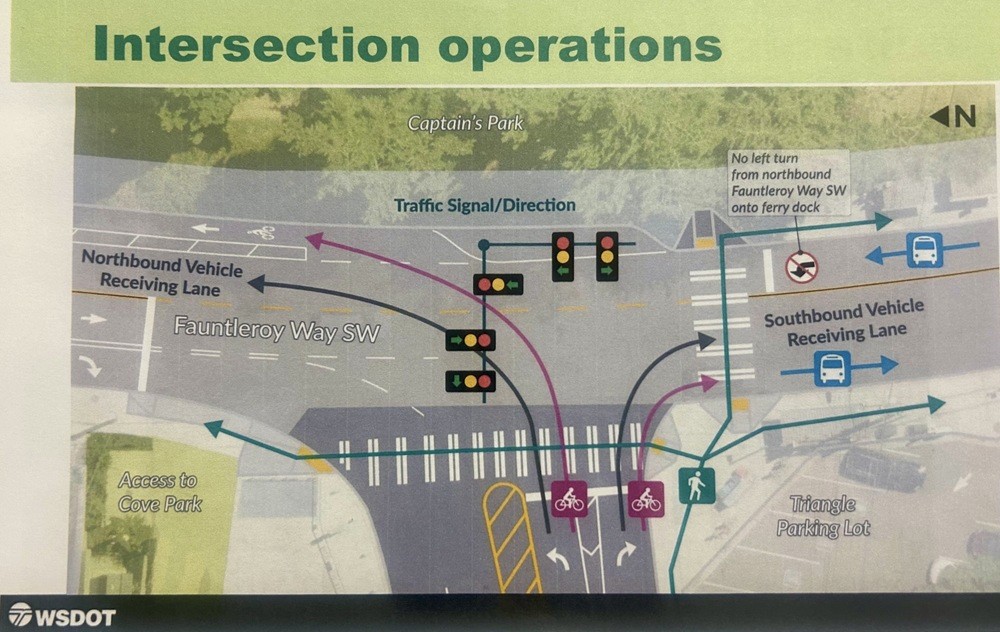
FERRY TERMINAL TRAFFIC SIGNAL: Next up was an update from WA State Ferries external relations director Hadley Rodero (who also lives in West Seattle) and Charlie Torres who serves as the project manager overseeing the design of the Fauntleroy Ferry Terminal. The team provided an update on the new ferry dock intersection signal installation planned for fall 2026, and they explained the design, safety features, and how it will be maintained by SDOT with the timing of the signals adjusted based on performance data.
The team brought some updated visuals and renderings to share, including an overhead view of the new signals:
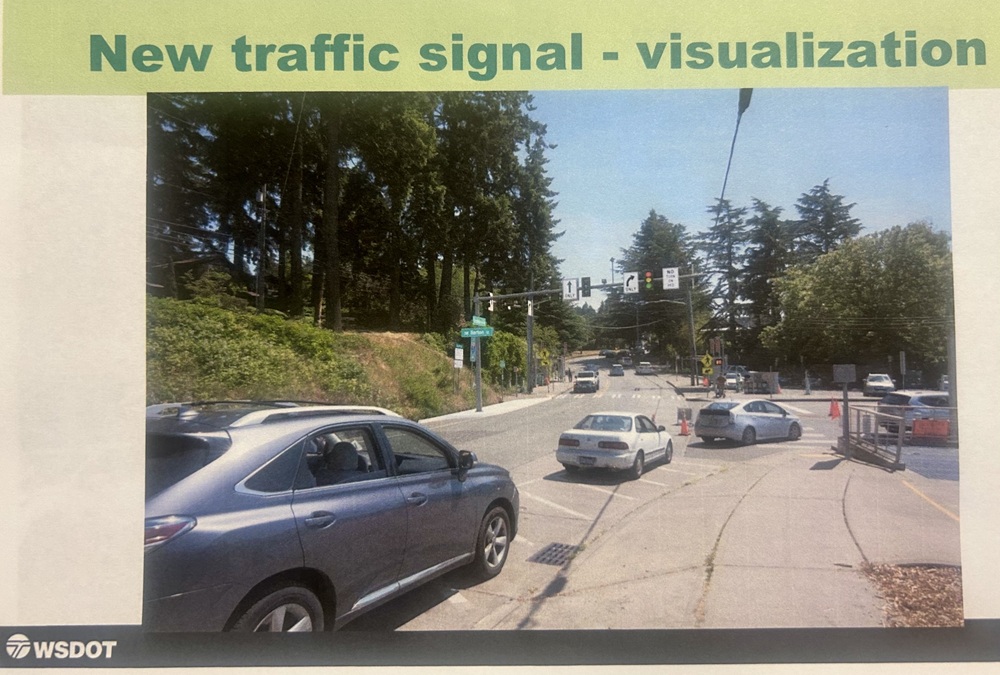
From Fauntleroy Way SW looking south:
From the ferry dock, looking east:
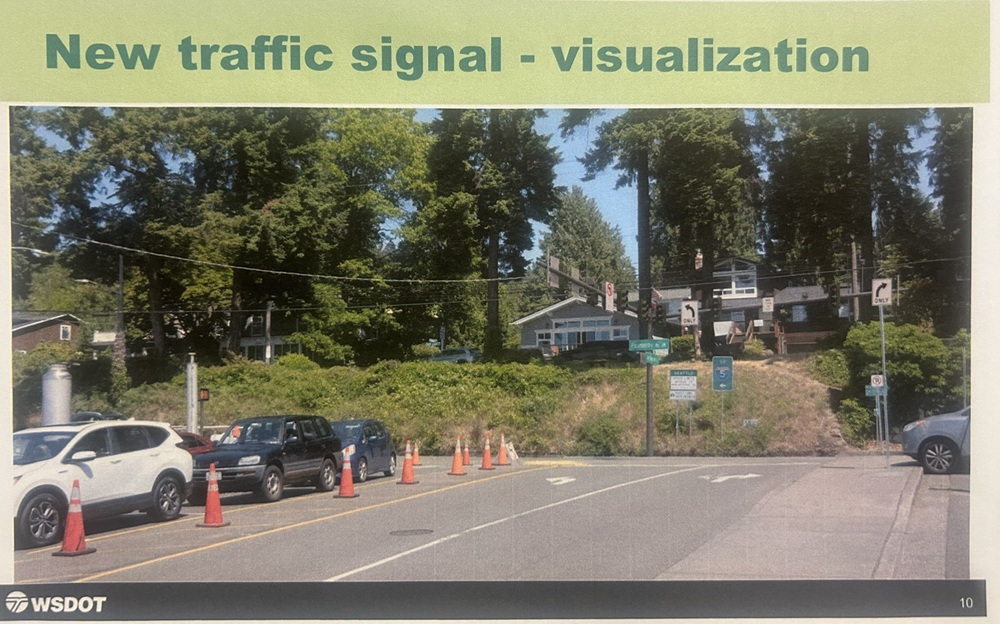
As well as the view from the bluff across the street, which has a lookout area known as Captain’s Park:
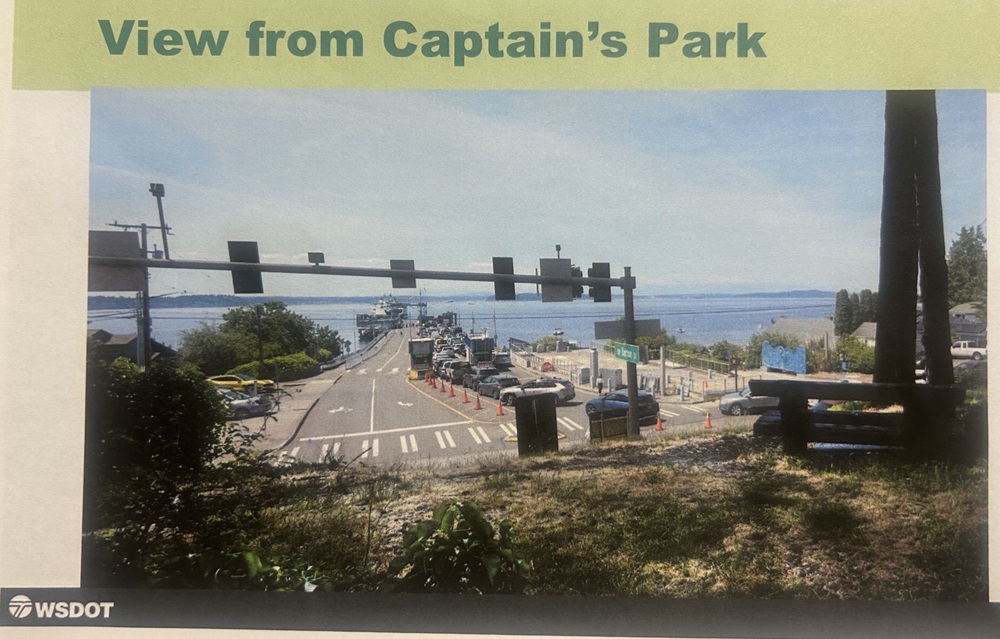
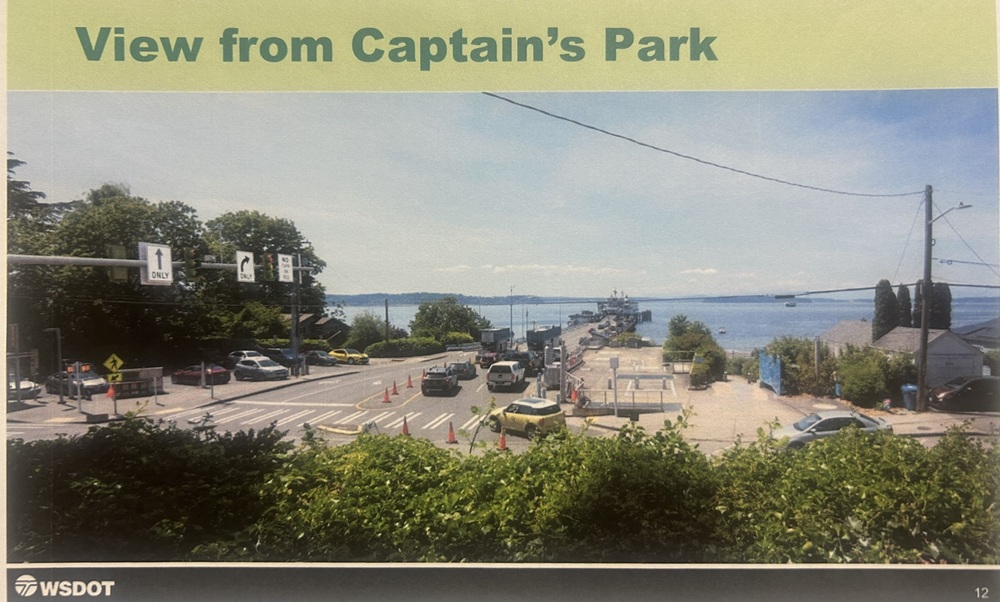
The team expects to award the construction contract in June, and construction work is scheduled to begin after September 8th to avoid the summertime “high season” rush as well as a construction moratorium related to the World Cup. The project will involve 3-4 months of construction work (which puts likely completion in late 2026 or early 2027). The signal will have sophisticated light controls designed to manage vehicle flow in different directions, with pedestrian safety being a key consideration. Rodero said there are plans to do extensive outreach to ferry customers and neighbors to provide information about the new system before it goes live. Torres said the signal is necessary due primarily to too many “close call accidents” in the area, as well as needing to improve overall traffic flow and efficiency with loading/unloading the boats.
FCA board members generally expressed support for the initiative but asked again about the aforementioned “dueling construction projects” in Fauntleroy, of which the new signal is one of them. The team acknowledged the challenges and agreed to have WSF representatives in attendance at FCA’s September board meeting (by that time, a contractor for the signal installation will have been selected and will likely be getting started), and again at the Fauntleroy Fall Festival in October to answer questions from the general public. The group also explored options for community engagement around the multiple related projects, including potential collaboration with the Rose Street crossing project, and potentially developing a community advisory group for the next environmental review phase.
Other points of Q&A:
FOOD FEST RECAP: FCA’s David Haggerty and Reed Haggerty, along with other FCA board members, talked about the group’s successful annual meeting and Food Fest event last month (WSB coverage here). There were over 175 people in attendance, and 21 vendors. There were 40 renewals of annual FCA dues, and 12 new households joining FCA. Feedback about the event was positive from vendors and attendees alike. Board members discussed strategies and ideas for future Food Fests and events.
FCA FINANCES: Treasurer Alan Grainger presented the group’s financial report, noting that dues and contributions from the annual meeting and Food Fest exceeded expectations, and highlighted the progress toward business member support goals. As of the beginning of April, the group is 46% of the way toward its annual goal for incoming contributions, thanks to the bump from last month’s Food Fest and egg hunt.
FALL FESTIVAL PREPARATION: Related to finances, the group also discussed fundraising for the group’s other big annual event, the Fauntleroy Fall Festival (scheduled for Sunday October 18). To raise funds between now and then, there are several events planned, including:
ROSE ST CROSSING: Immel noted that he had talked again with SDOT’s Ching Chan about the Rose St crossing project (involving pedestrian-operated flashing signals and a bus stop design with an island), and said that she wants to put together a joint community meeting with FCA and MoCA (Morgan Community Association) about the project, as a next-step. Details about that meeting are TBD.
OTHER FCA BUSINESS:
The FCA Board meets ten times per year on the second Tuesday of each month, at 6 pm in the Fauntleroy Schoolhouse board room. Meetings are open to the public.
As we first reported last Monday, Seattle Parks is circulating a “draft racquet-sports strategy” that would split up tennis and pickleball sites, with an initial reduction in the number of outdoor courts for pickleball. It’s launching a round of feedback starting with a survey opening Thursday, and including community meetings. None of those meetings are planned for West Seattle. But this Thursday, the racquet-sports strategy on the agenda for the Alki Community Council meeting, since the courts on the north side of Alki Playfield are involved, proposed as tennis-only. The ACC meets in-person-only at 7 pm at Alki UCC (6115 SW Hinds) on Thursday (April 16) and the agenda also includes other Parks issues as well as public-safety updates.
The Kenney (7125 Fauntleroy Way SW) is hosting community events again, and this Wednesday it will be the meeting site for a community coalition that used to meet there regularly, the Morgan Community Association. MoCA meets quarterly and has rotated through various sites, as well as gathering online, in recent years. At 7 pm Wednesday (April 15), it’ll be a hybrid meeting, with a variety of highlights and updates, including officer elections, public-safety info, and the latest on the Morgan Junction Park addition. See the agenda in our calendar listing, which includes the online link if you can’t attend in person.
 (WSB file photo from a past Station 37 open house
When the city announced that May 2 will be “Neighbor Day,” we asked the Seattle Fire Department if, as happened on many past occasions, they’d be opening local fire stations to community visitors. Though it’s not mentioned in the Neighbor Day announcement, SFD tells us yes, all stations will be open (updated) 1-3 pm on that day (three weeks from today) One caveat, though – the firefighters will remain on call, so if they’re dispatched to an emergency, that could bring an abrupt end to that station’s open house. West Seattle has five fire stations – Station 11 in Highland Park at 16th/Holden, Station 29 in North Admiral at 2139 Ferry Avenue SW, Station 32 in The Triangle at 38th/Alaska, Station 36 at the north end of Delridge beneath the West Seattle Bridge, Station 37 in Sunrise Heights at 35th/Holden.
Another neighborhood group with a notable event in the week ahead is the Fauntleroy Community Association. The FCA’s annual membership meeting Tuesday is known as the Food Fest because of bites contributed by local businesses. It’s also a chance to mingle with local nonprofits and what FCA describes as “civic-minded” organizations (we’ll be there to promote West Seattle Community Garage Sale Day, now just a month and a half away on Saturday, May 9). And the Food Fest will briefly convene everyone in attendance for the annual FCA board election. It’s a free event, but you’ll have the opportunity to renew or initiate FCA membership, supporting the organization’s community work. This will be in The Hall at Fauntleroy (9131 California SW), south end of historic Fauntleroy Schoolhouse, 6-8 pm Tuesday (March 24).
| 9 COMMENTS