
West Seattle, Washington
29 Tuesday
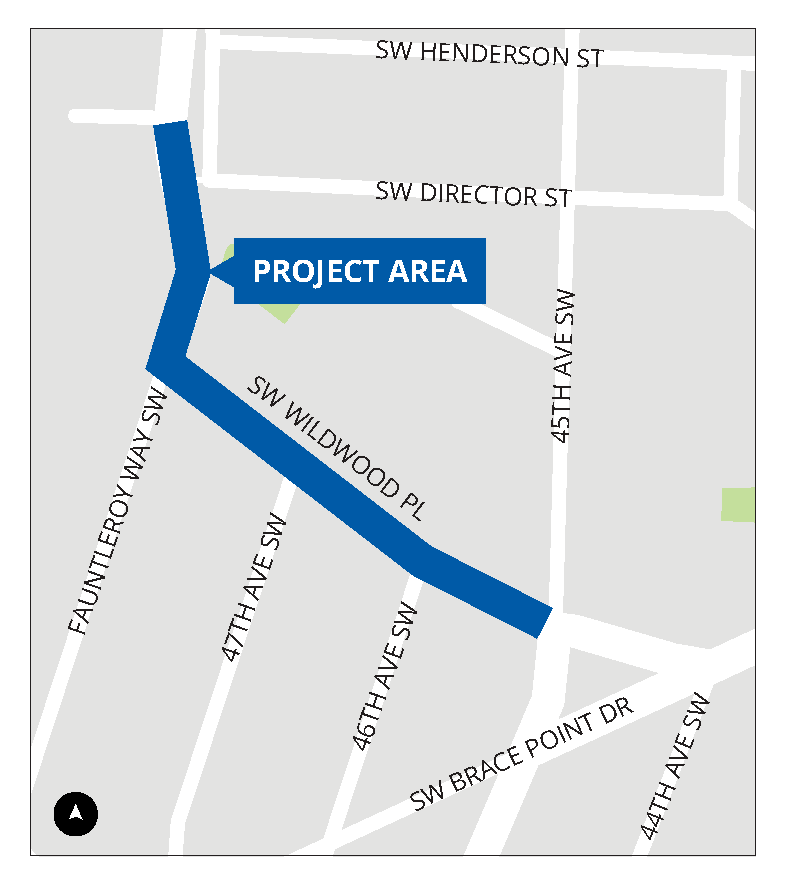
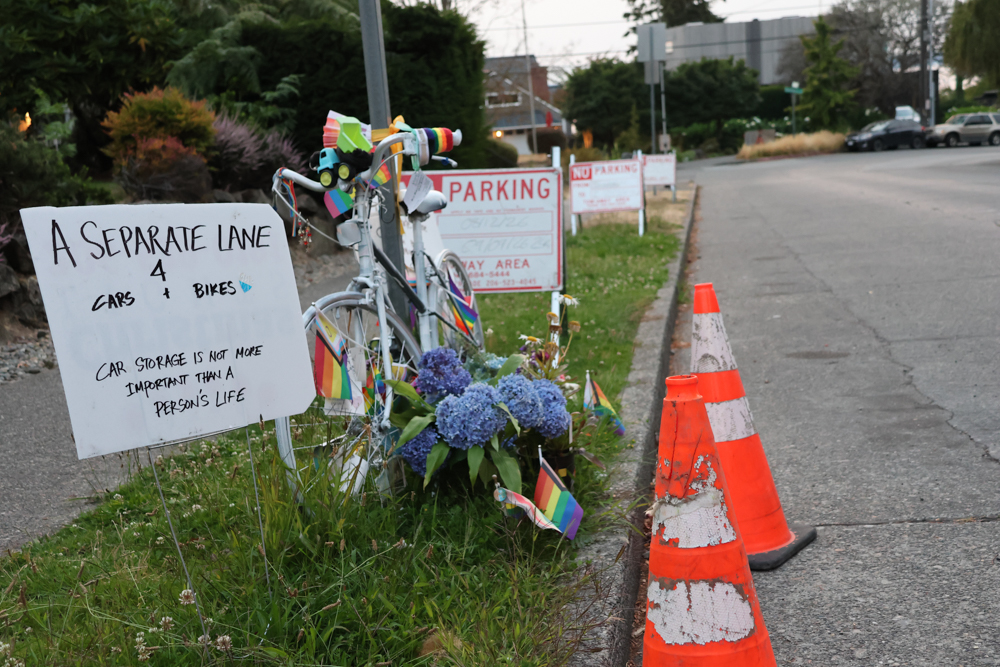
One month ago, we reported on an executive order by Mayor Katie Wilson that – among other things – mandated a protected bicycle lane by year’s end on SW Wildwood Place, the street near the Fauntleroy ferry dock where bicyclist Maridee Bonadea was killed in June. After seeing a Metro advisory for a stop closure because of “construction” this weekend, we checked in with SDOT, which tells us this is what’s scheduled to be done:
… Before we can install the bike lanes … we need to improve the condition of the riding surface:
-Repairing the pavement with asphalt patches on Fauntleroy Way SW and SW Wildwood Pl. To do this we will need to temporarily close parts of the street
Saturday, September 26 from 9 am until 6 pm
***We may reschedule this work if there is rain in the weather forecast.The street must be smooth before we can install bike lanes. Doing this work beforehand will make the street safer and our installation easier. We will come back later to seal cracks with a flexible sealant that will withstand rain and heat.
While the asphalt cools and hardens, the eastbound bus stop at SW Wildwood and 46th Ave SW will be temporarily closed.
The project’s webpage and fact sheet says they’re still deciding between an uphill bike lane only or bike lanes both uphill and downhill.
 (WSB photo)
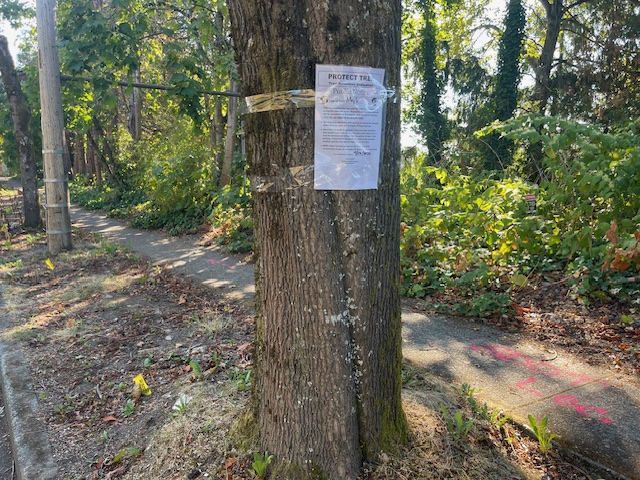
Notices like that one are posted on some of the trees along 16th Avenue SW by South Seattle College (WSB sponsor), particularly on the west side. This note we received from SDOT explains why:
The Sidewalk Safety Repair Program is planning to make repairs to the sidewalks damaged by tree roots on both sides of 16th Ave SW between SW Findlay St and South Seattle College Entry #2. Our tentative start date is October 5 and will likely take a few weeks once the work begins. The schedule depends on how much root pruning work there will be, especially on the west sidewalk. Our goal is to preserve all the trees, but there are a few trees at risk for removal because of the size and amount of roots that will need to be pruned to bring the sidewalk and driveways back down for ADA accessibility. The trees that are at higher risk for removal have been posted with SDOT Urban Forestry’s contact information. The sidewalk team and Urban Forestry will work closely together during construction to achieve both pedestrian safety and tree preservation to the extent feasible.
We’ve already previewed part of what’s on the HPAC agenda for Wednesday – the Homestead Community Land Trust plan for the ex-substation at 12th/Holden. An even-bigger agenda item: Crime and safety.
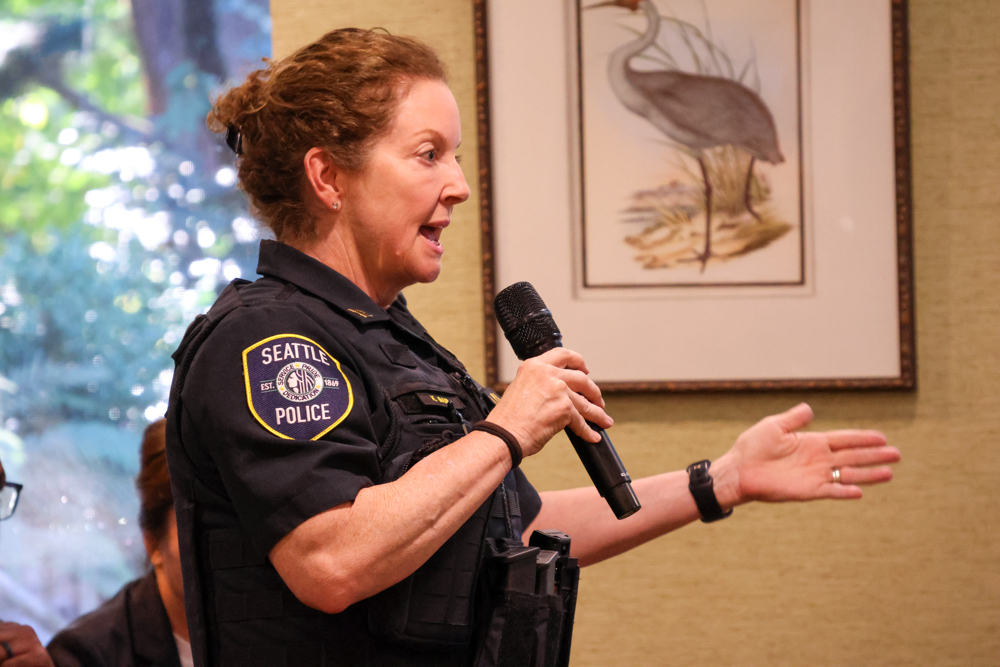 (WSB photo: Capt. Krista Bair at one of last week’s community meetings)
Southwest Precinct commander Capt. Krista Bair, who was at community meetings last Thursday about Roxhill Park (WSB coverage here) and Alki (WSB coverage here), will also be at HPAC’s first fall meeting. The community coalition’s neighborhoods – Highland Park, Riverview, South Delridge – have seen multiple shootings this summer, as summarized on the HPAC website – and are seeking updates on the investigations as well as plans to prevent more violence. HPAC’s meeting is set for 6:30 pm Wednesday (September 23) at Delridge Library (5423 Delridge Way SW).
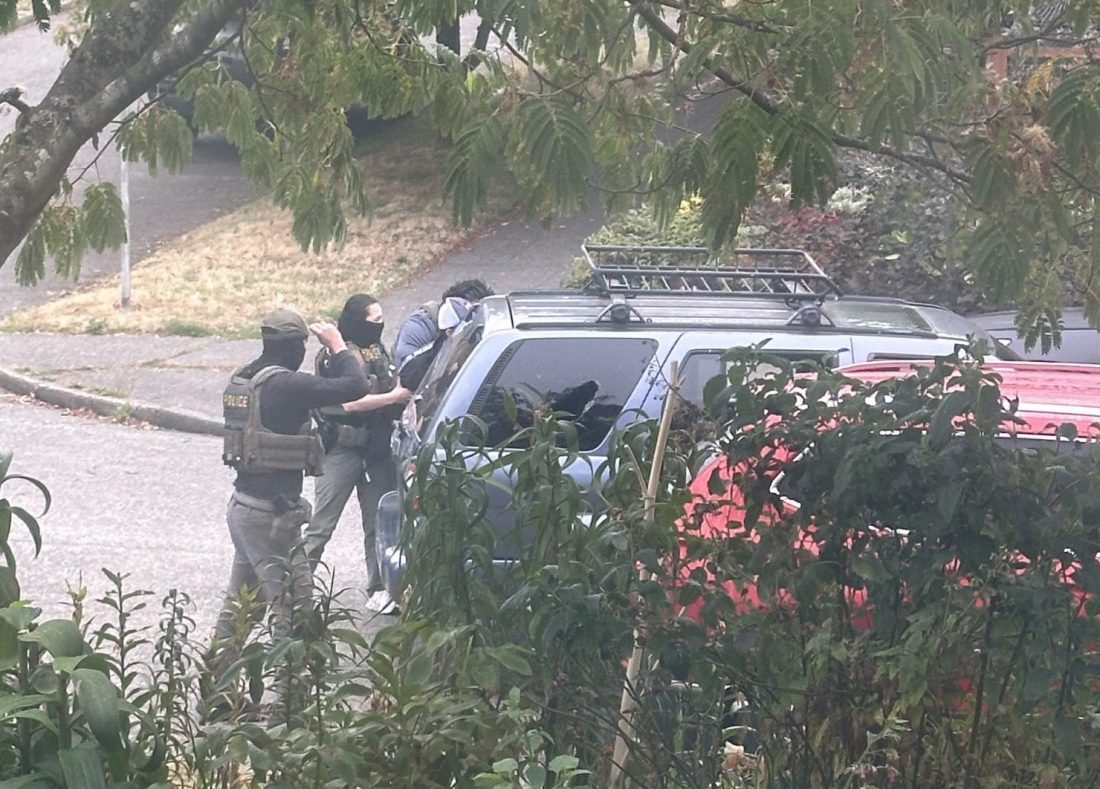
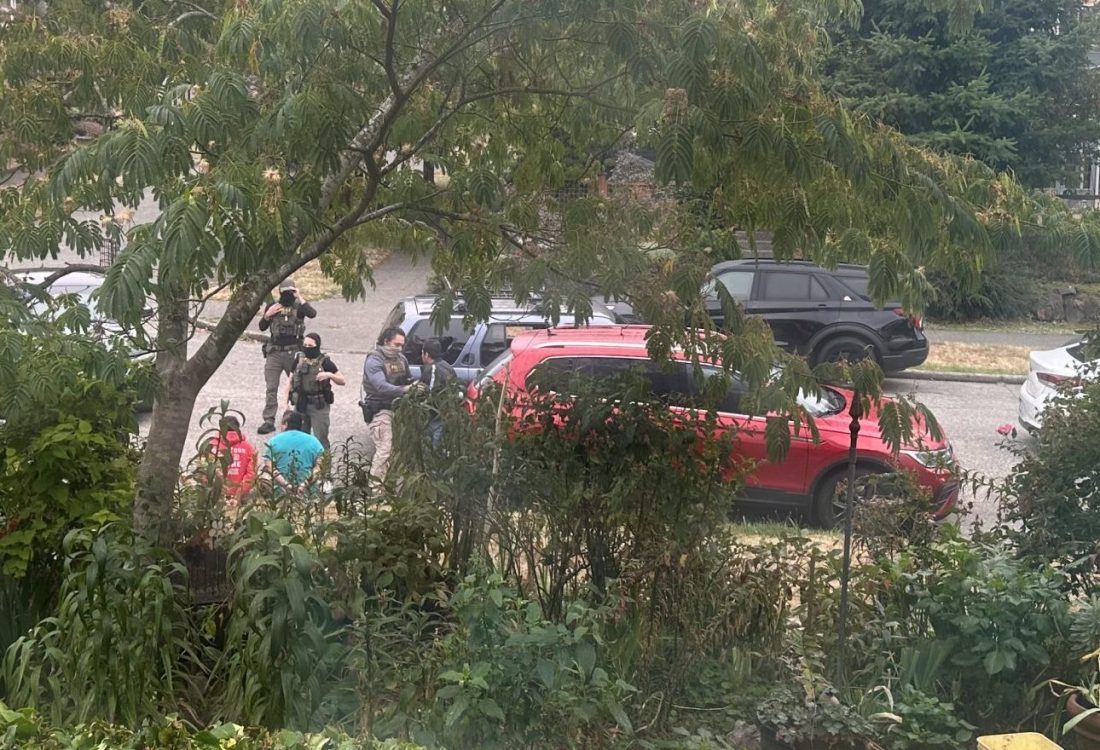
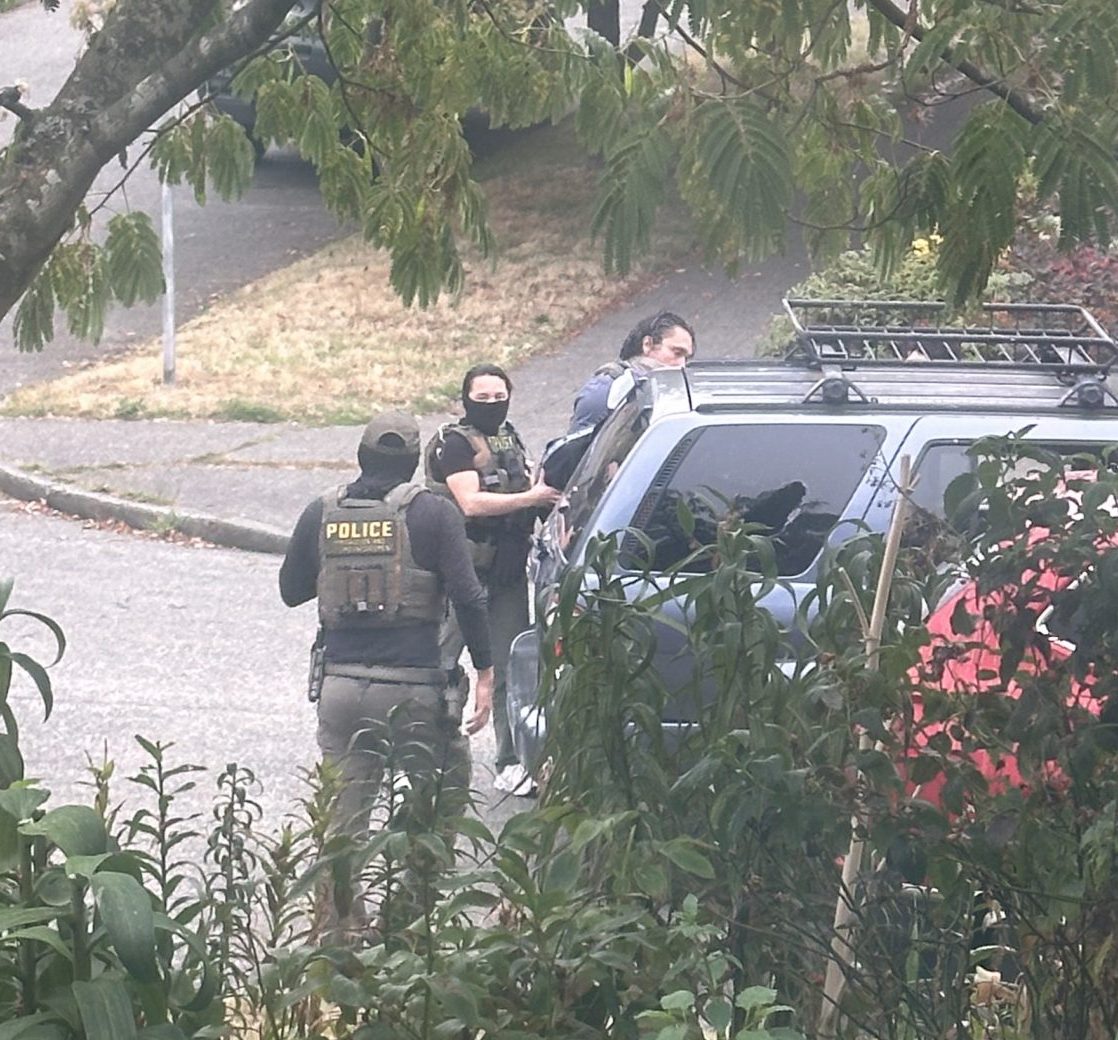
9:17 AM: We’ve received multiple reports of this, including the following just sent by a reader:
ICE just terrorized our neighborhood and took three poor souls away. They pinned in the car and busted out windows pulling them from their car. and damaged our car. Now we have to clean up the mess!!!
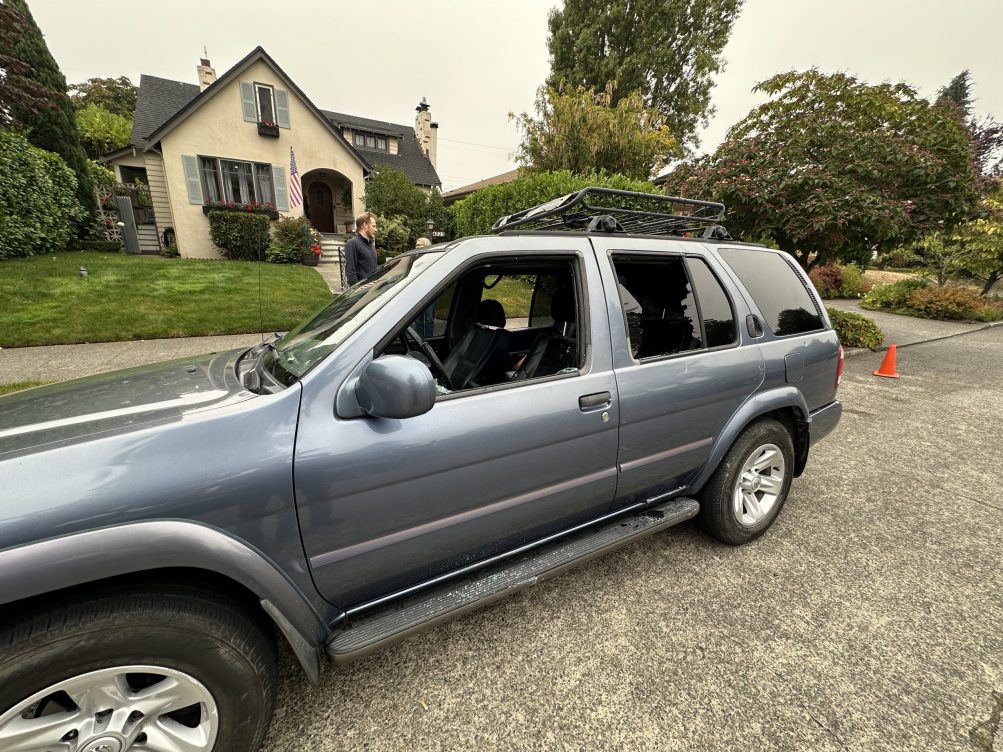
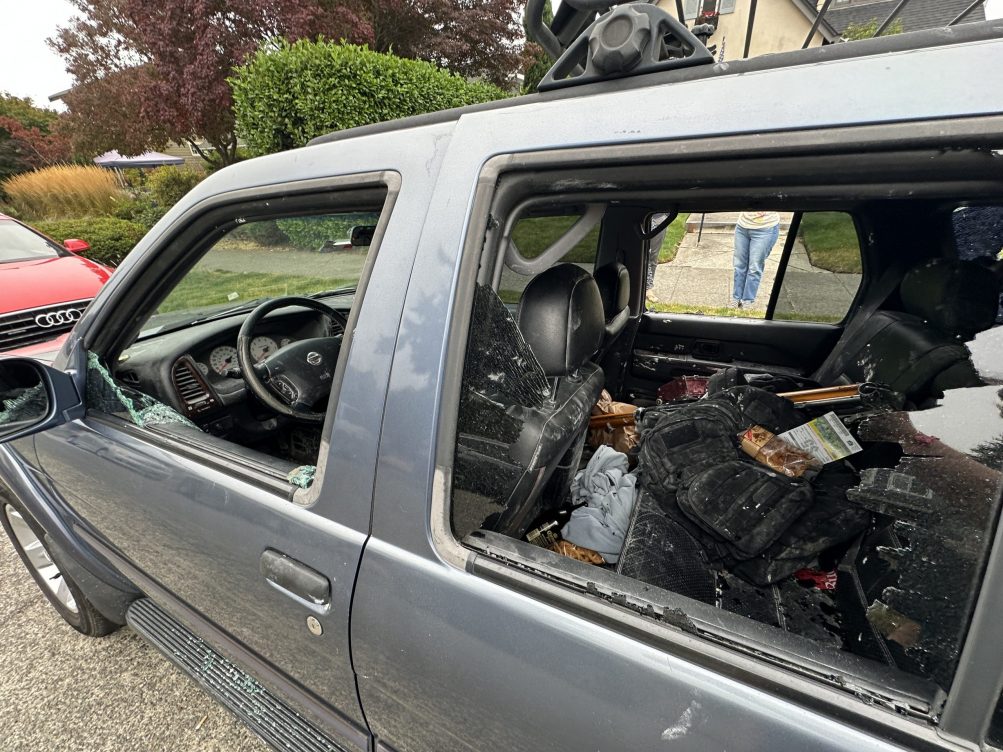
11:49 AM: Received from another reader:
Here are some pictures of the truck of the crew ICE arrested this morning. It had slashed tires and busted windows. Truck had construction equipment inside.
Story by Tracy Record
Photos by Torin Record-Sand
for West Seattle Blog
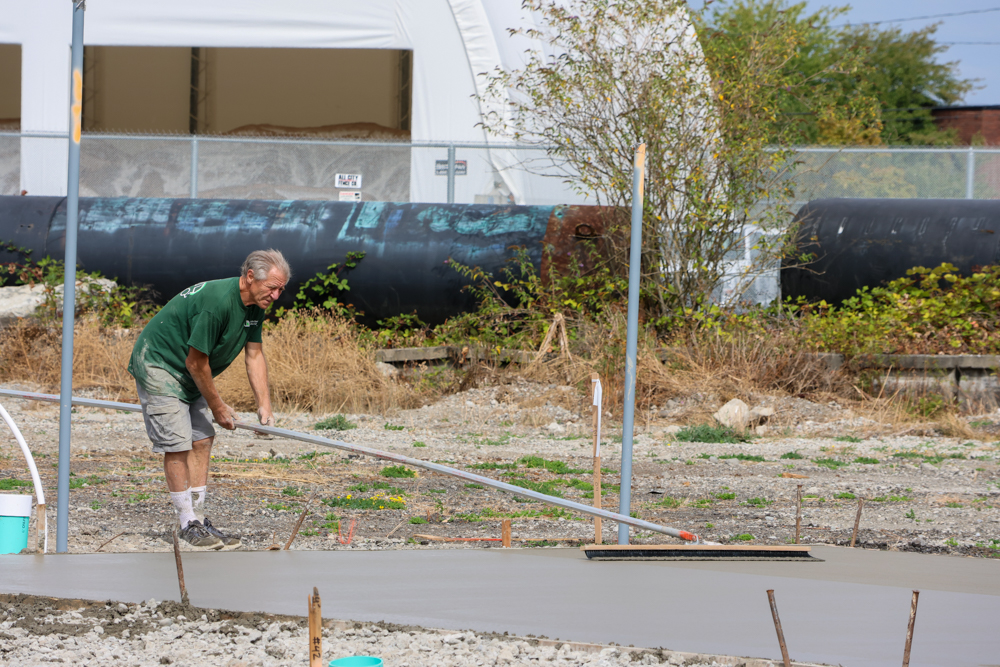
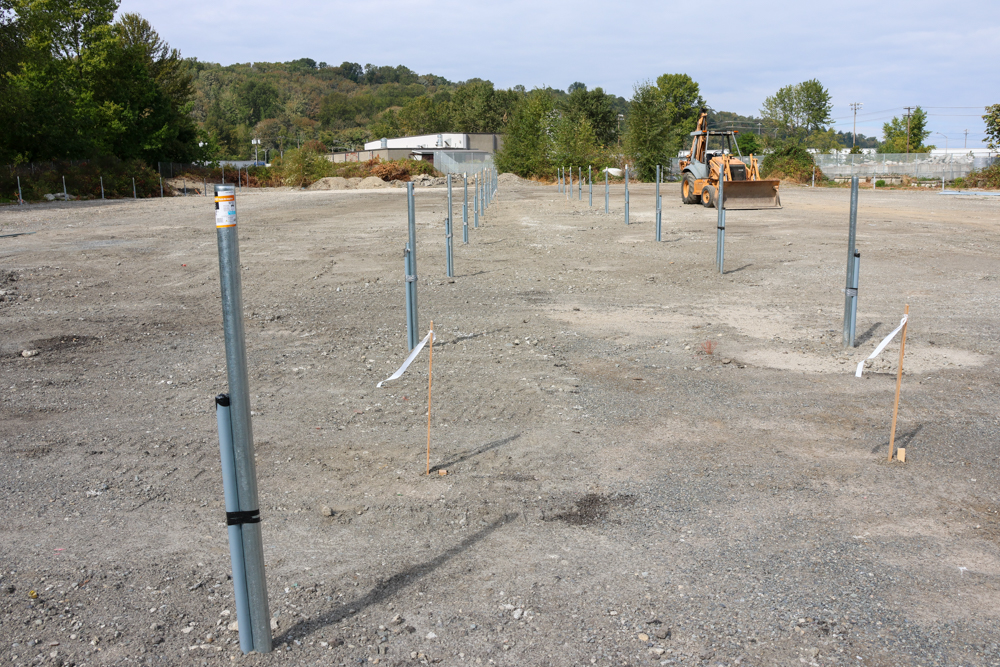
After months of taking photos from outside the gate, we got our first close-up look this afternoon at the state-owned West Seattle site (7200 2nd SW) being transformed into Glassyard Commons, with 72 RV parking spaces and 20 tiny houses. Each of those metal stakes, site operator LIHI explained, marks the utility connections for an RV.
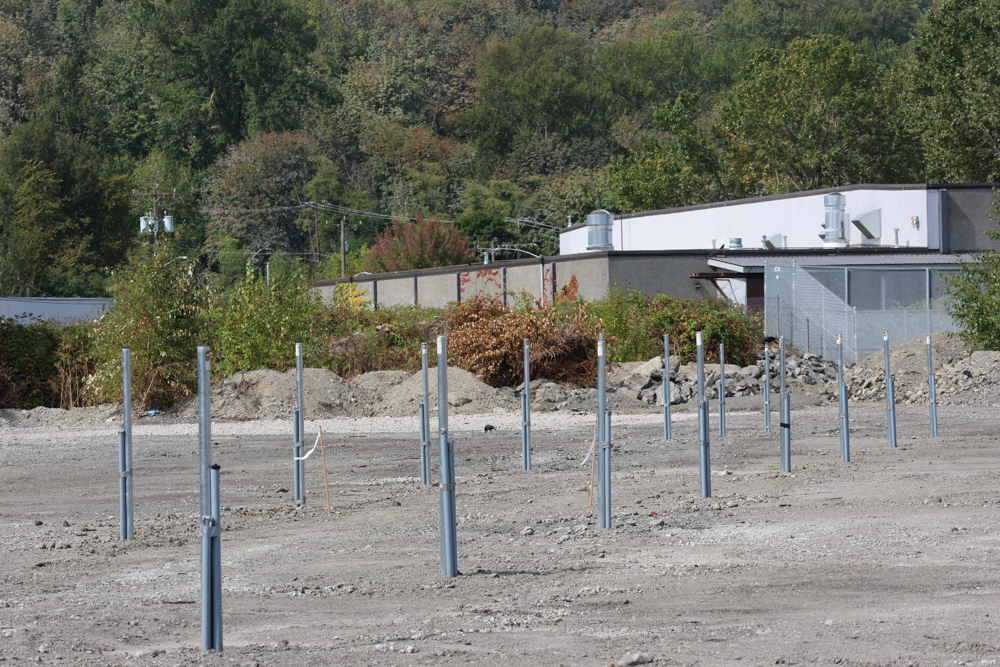
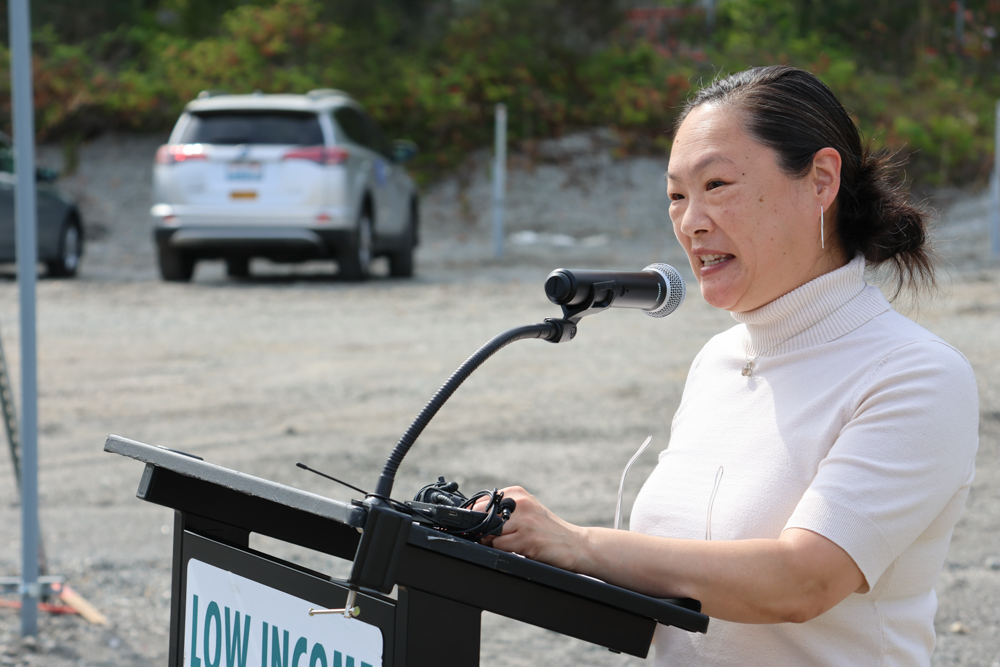
We were there for the ceremonial groundbreaking – a month and a half after work started at the site – organized by LIHI, whose executive director Sharon Lee led off a half-hour speaking program.
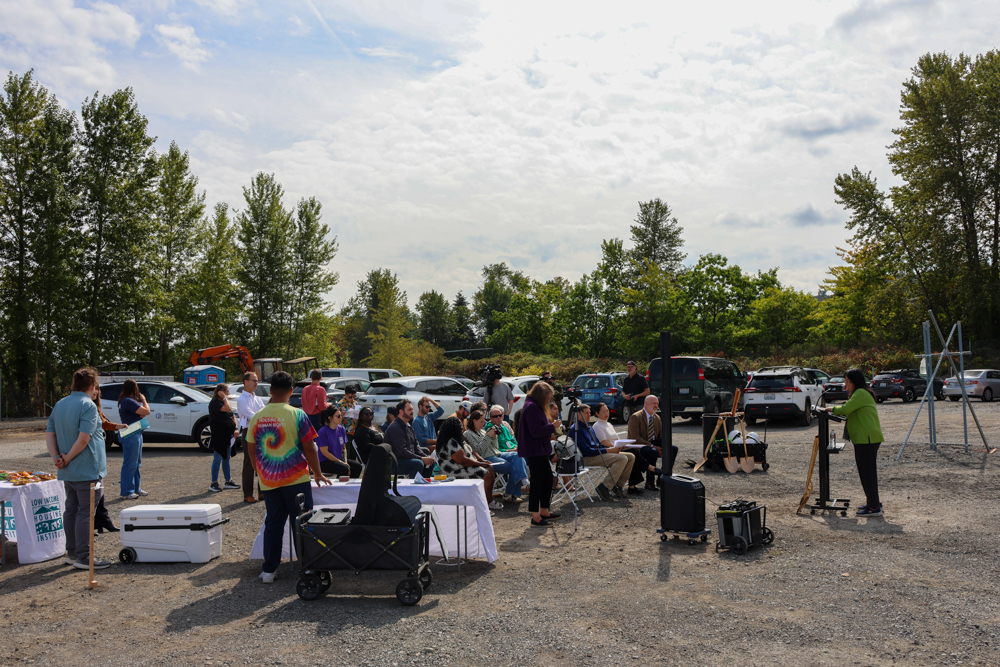
We recorded it all on video:
We broke the news of the RV/tiny-house plan for this site in January, after discovering documents in city files, but it had been eyed as a potential sanctioned-encampment site for years. LIHI has a $3.3 million/year contract to build and operate Glassyard Commons, leasing the land from the Washington State Department of Transportation after legislation was passed enabling state land to be used for “community benefit,” Lee said, adding they hope to lease the site “for many years to come.” The goal, she said, is to get RVs off the street, not just as a place to park, but to get the occupants into permanent housing, and to destroy the RVs – so the ones that come in won’t be going out.
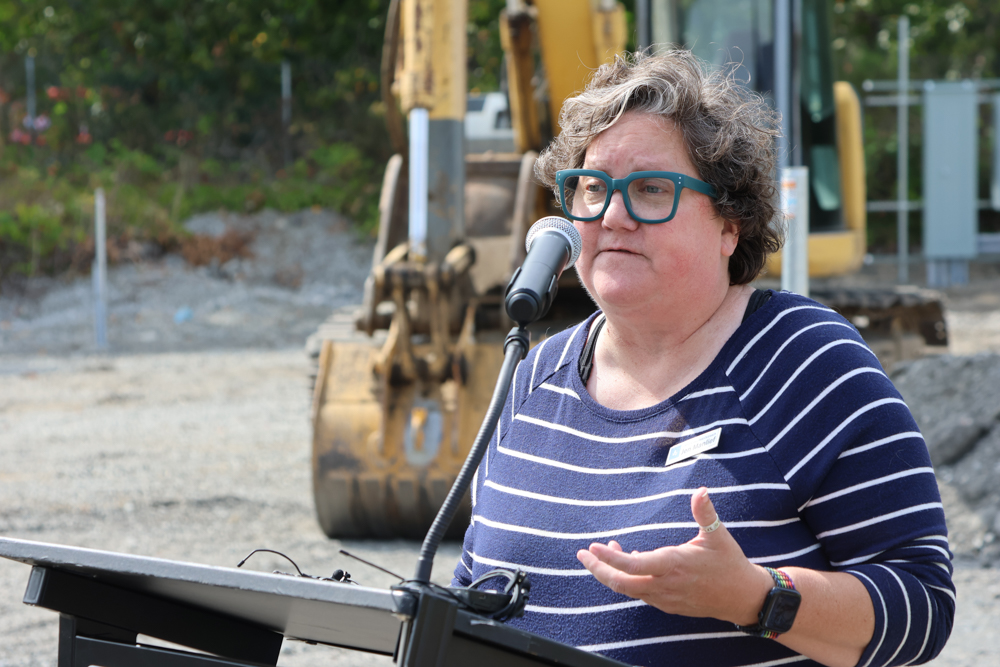
Who will be coming in? Lee reiterated that priority will be given to District 1 (West Seattle, South Park, part of south downtown) RV residents. Jen Manlief (above), who manages the Vehicle Outreach Program, said it won’t be an “easy yes” for RV residents, but they have been working with some potential future Glassyard Commons occupants for months, and the selling points include mental-health services and other assistance in getting back on their feet. We asked how early they would be signing people up to move in, and she said that they would probably have a list about a month in advance of what’s now an anticipated “mid-November” opening, according to LIHI. (Minimum age will be 18.)
Mayor Katie Wilson wasn’t there, but Human Services Department director Tanya Kim spokr, saying the city will be funding more new shelters – two tiny-house villages, a “master-leased” building, and two shelter “expansions” (locations were not mentioned). Kim described those as “more opportunities for people to say ‘yes’ to.”
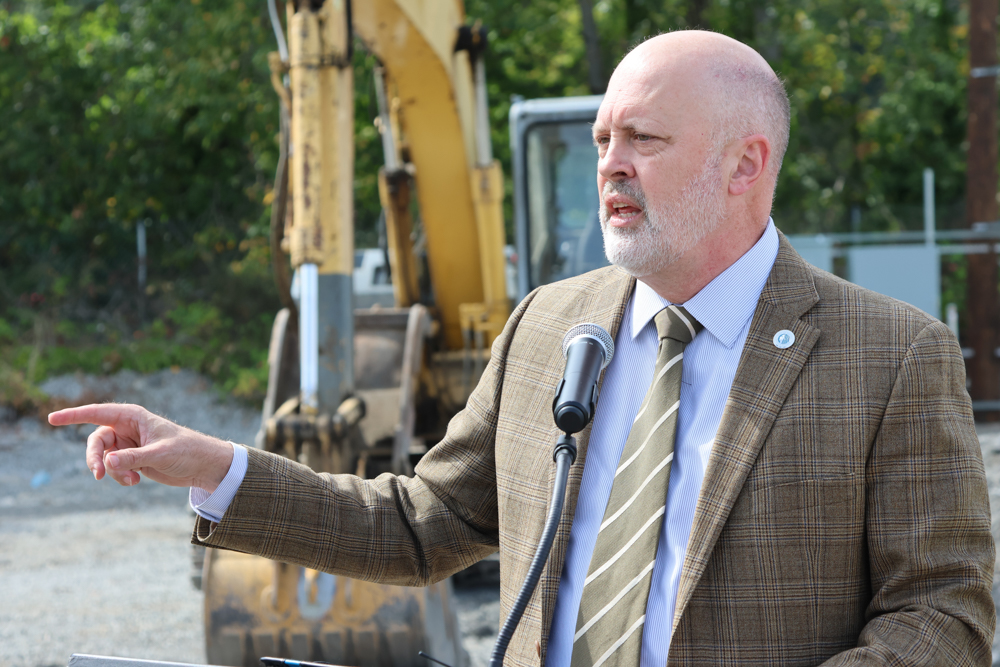
Bob Kettle was the only City Councilmember at the event; he explained that this aligns with his role as Public Safety Committee chair, and also that he had direct district experience with Salmon Bay Village, the RV lot that LIHI operated relatively briefly (closed because its owner decided to repurpose the site for pickleball). He said that during its time in operation, he noticed fewer RVs on nearby streets, and said the ones he did see were in better condition.
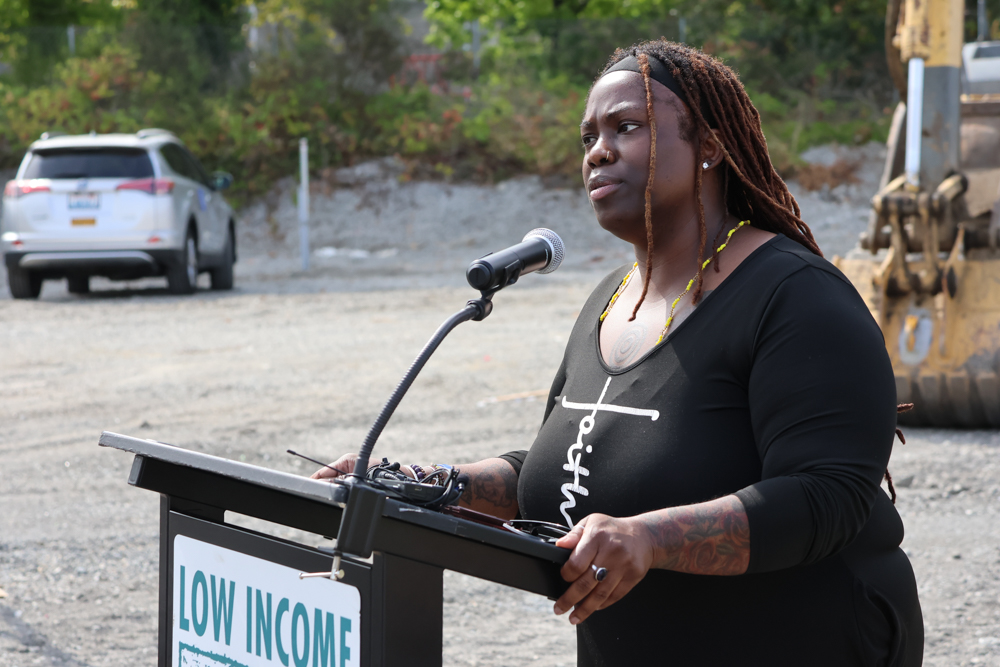
Rev. Erica Williams, representing the site’s “faith sponsor” New Hope Missionary Baptist Church, declared projects like this to be part of the “liberation and well-being of all people.”
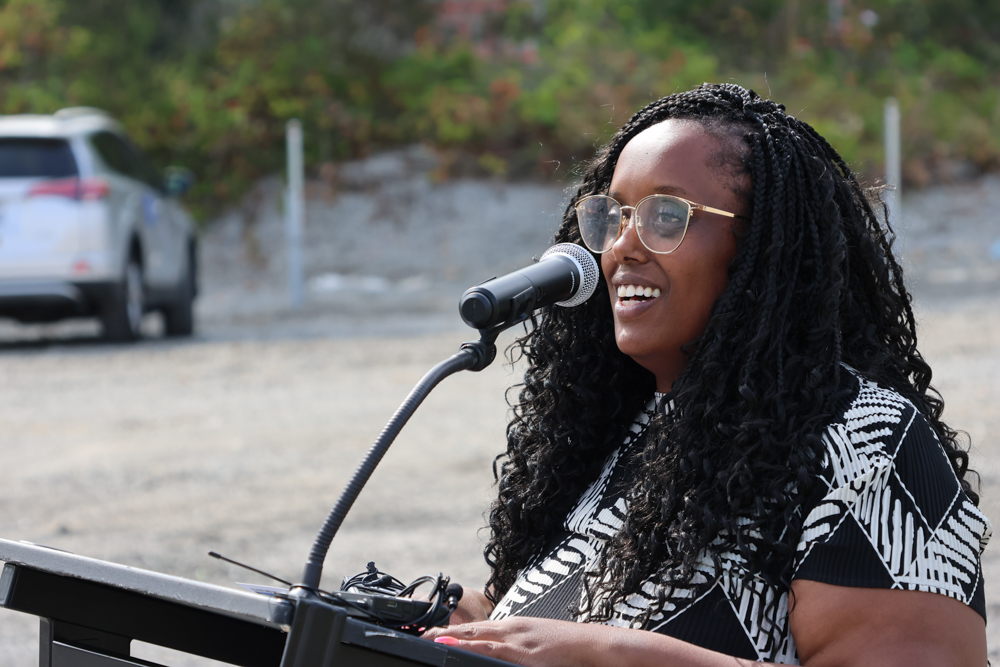
And LIHI’s Marta Kidane offered gratitude to the people of West Seattle and South Park, and also invited community members to sign up for the Glassyard Commons Community Advisory Committee, which will meet monthly online to discuss updates and concerns. (LIHI-operated West Seattle tiny-house site Camp Second Chance also has one that has plenty of room for more participation too. Contact marta.kidane@lihi.org if you’re interested.
Then, after the speeches, the photo op:
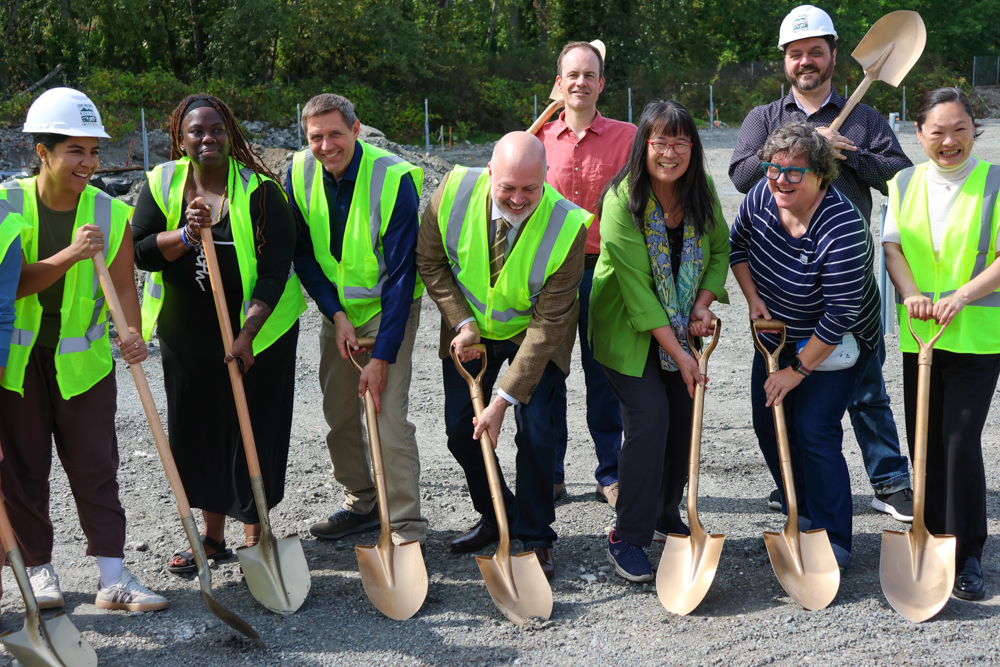
And the work continued, with promises of another gathering at the site when it opens in mid-November.
 We’ve already reported on the meeting that Village Green West Seattle (WSB sponsor) is organizing next week to talk about Roxhill Park safety with Seattle Police and other agencies/departments, at 3:30 pm Thursday (September 17). We’ve just learned that a few hours later, another trouble spot – Alki Beach – will be discussed with SPD Southwest Precinct leadership. It’s the regular monthly gathering of the Alki Community Council, 7 pm Thursday (here’s agenda info on the ACC website). After another turbulent summer, there’s lots to discuss, and it’ll be in the usual location, Alki UCC (6115 SW Hinds).
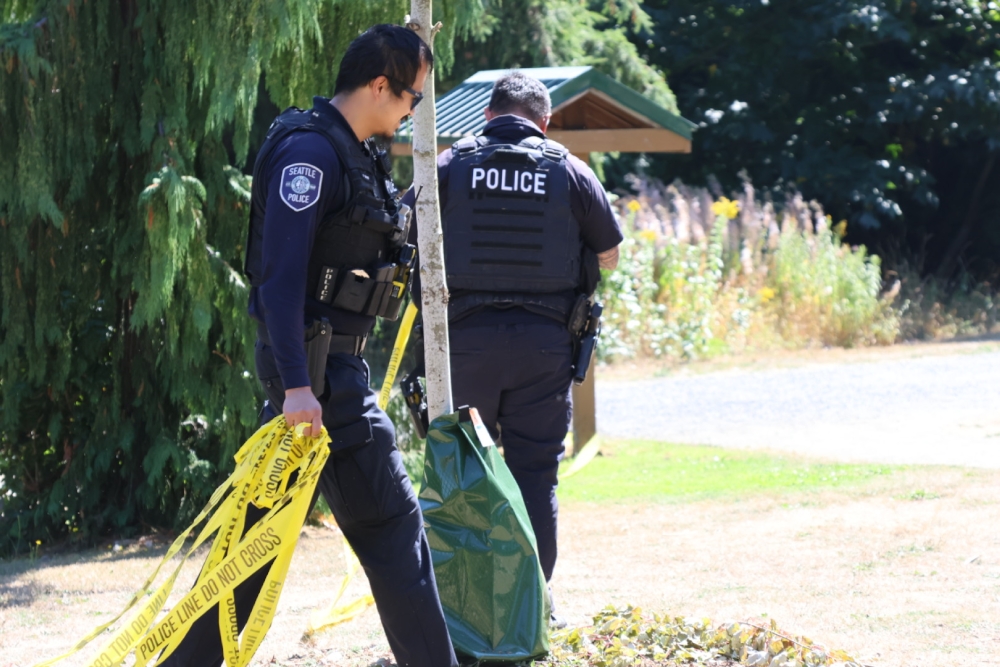 (WSB photo: Police at Roxhill Park after August shooting)
After a recent shooting and stabbing, plus the rapid return of a cleared encampment, Roxhill Park has generated more community concern than ever. Village Green West Seattle (WSB sponsor) is hosting a community meeting next week to address topics including safety, accessibility, and environmental stewardship of the park’s rare peat bog. Participants will include Seattle Police, Seattle Fire, Seattle Parks, King County Sheriff’s Office, and Unified Care Team representatives. The meeting will be at 3:30 pm Thursday, September 17, and will include Q&A; all are welcome. Here’s the flyer that Village Green (2615 SW Barton, east of the park) is circulating.
 (WSB photo from late July)
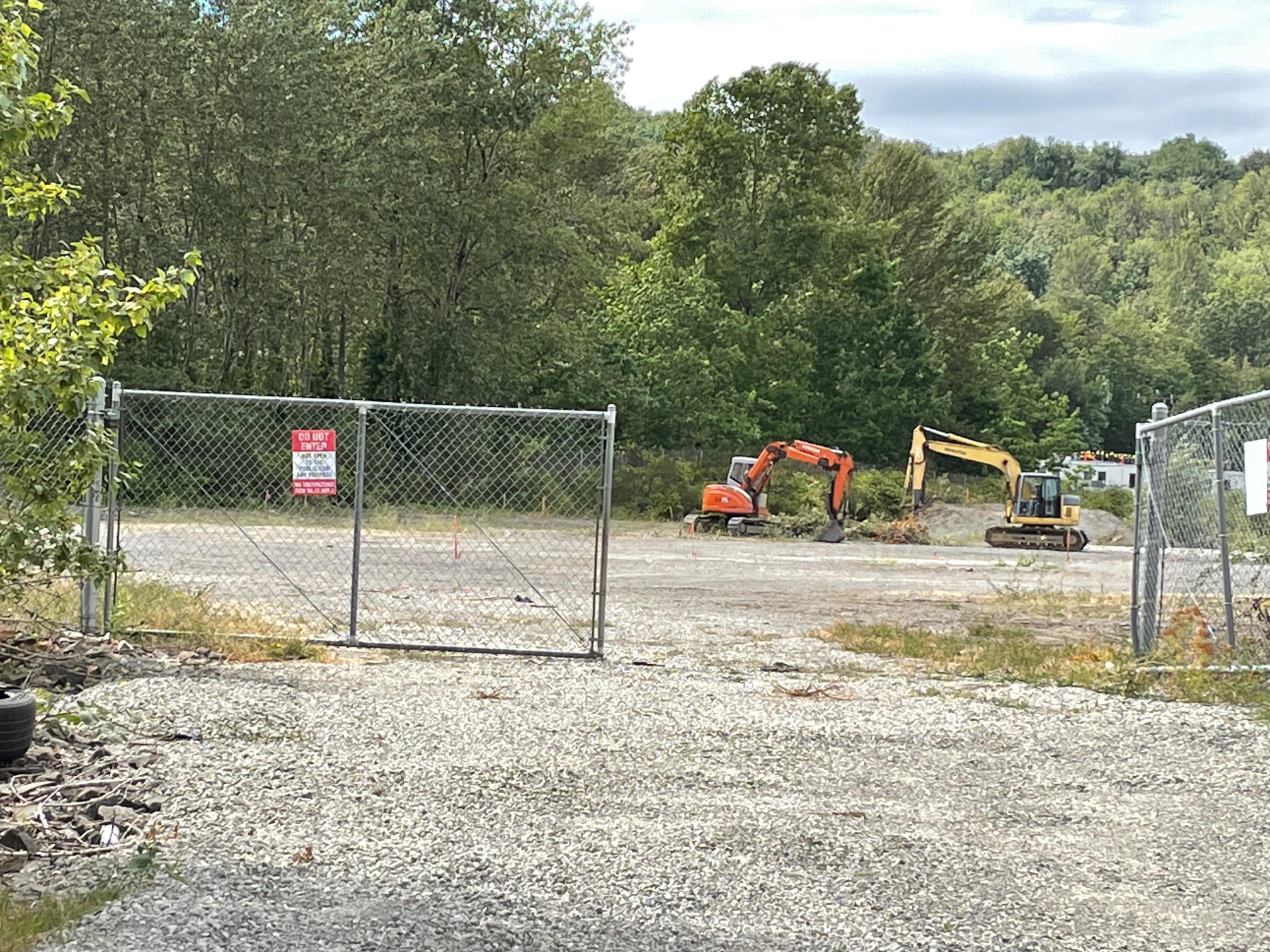
Almost eight months after we brought you first word of plans for an RV lot and tiny-house village on state-owned land in West Seattle, a groundbreaking ceremony is planned tomorrow. As we’ve shown you, work at the site began more than a month ago, but dignitaries will gather Thursday afternoon for this event, to which you’re also invited:
The Low Income Housing Institute (LIHI) is pleased to announce the groundbreaking event for Glassyard Commons, an RV Safe Lot & Tiny House Village located in West Seattle.
The press and public are invited to attend the groundbreaking ceremony on:
Thursday, September 10, 2026 at 12:30 pm
7200 2nd Ave. SWGlassyard Commons will operate as an enhanced shelter for approximately 140 people and will include safe parking for 72 recreational vehicles (RVs) and 20 tiny houses. LIHI is leasing a 3.9-acre site from Washington State Department of Transportation (WSDOT).
The goal of Glassyard Commons is to encourage vehicle residents to leave their rundown RVs, move temporarily into the safe lot or a tiny house, and work with case managers to obtain permanent housing. Once housing is secured, the RVs are demolished and disposed of by LIHI at no cost to the participants. This prevents the RVs from being recirculated back onto the streets of Seattle.
Speakers will include LIHI Executive Director Sharon Lee, Seattle City Councilmember Robert Kettle, WSDOT Northwest Region Administrator Brian Nielson, Seattle Human Services Department Director Tanya Kim, University Heights Center Vehicle Resident Outreach Programs Manager Jen Manleif, and Rev. Dr. Robert Jeffrey Sr. of the New Hope Missionary Baptist Church. The church is the faith sponsor of Glassyard Commons. …
“Glassyard Commons is a proven concept offering safe RV parking and is modeled after the success of Salmon Bay Village RV Safe Lot in Interbay. Over a short period of time 67 RVs were taken off city streets and destroyed and 89 people, including five homeless veterans, received services, shelter or housing to exit homelessness,” said Rev. Dr. Robert Jeffrey Sr. The New Hope Missionary Baptist Church was also the faith sponsor of Salmon Bay Village.
Glassyard Commons receives funding from the Seattle Human Services Department (HSD). Referrals will be made from outreach workers contracted through HSD. Preference will be given to Council District 1 and other locations with large numbers of RVs.
The design of Glassyard Commons includes a staffed entry pavilion, 24/7 staff, case management offices, tiny houses, a community kitchen, and hygiene and laundry facilities. On-site case managers will support participants with obtaining identification, employment, health and behavioral health services, education, and housing navigation.
LIHI sponsors 18 tiny house villages in Seattle and the region and owns over 3,700 units of affordable housing. Info on Salmon Bay Village RV Safe Lot can be found here. Last year LIHI sheltered 1,663 adults and children in tiny houses.
LIHI has a $3 million contract to operate Glassyard Commons. Today’s announcement doesn’t mention a projected opening date, but we were most recently told they were aiming for November,
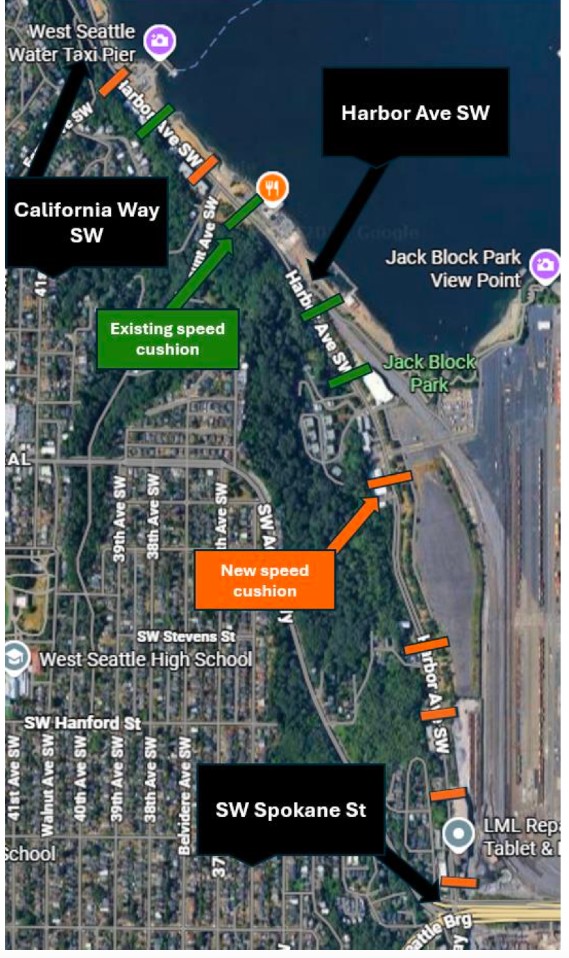
Thanks to Daniel for the tip! SDOT confirms that installation is approaching for seven more speed bumps – technically, speed cushions – planned for Harbor Avenue, between Seacrest and the bridge – five of them east/south of Jack Block Park – along with other traffic-calming changes. Here’s the map and notice mailed to area residents:
What are the changes we’re making?
On Harbor Ave SW between California Way SW and SW Spokane St, we will install safety upgrades to calm traffic and make the street safer for people walking, rolling, and biking. These will include:
• Speed cushions (speed humps with wheel cutouts for large vehicles such as buses and emergency response vehicles)
• Narrowing vehicle lane widths and widening the parking lane to visually narrow the roadway
• Adding painted medians
• Trimming vegetation to improve visibility of street lights and signsWhen will construction happen, and how long will it take?
We are planning to install these improvements by end of 2026. We anticipate this work to be completed over a couple of weekends. Please note this work is weather dependent and subject to change.How will construction impact you?
During construction, you can expect lane reductions while crews stripe the roadway and install speed cushions and painted median islands. Some driveways may be impacted temporarily and you may see some parking restrictions while the work is happening.Project funding
This project is funded by the Seattle Transportation Levy that was approved by Seattle voters in 2024.The Arterial Traffic Calming program is part of Vision Zero at the Seattle Department of Transportation (SDOT). We work on projects that help people travel at safer speeds. Street design interventions to help us reach safe speeds is one of the core elements of our Vision Zero Safe System Approach.
We reported back in February on the plan for more traffic calming in this area, as one of SDOT’s Transportation Levy projects for West Seattle
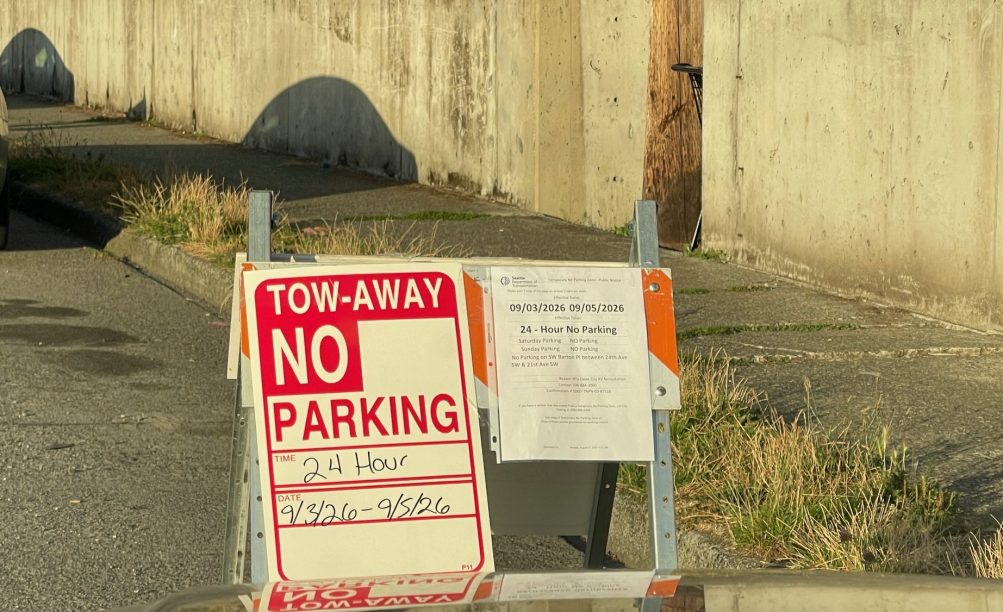
Noticed while out and about: Signs announcing an “RV remediation” for SW Barton Place uphill from (east of) Westwood Village. The no-parking signs are for Thursday through Saturday (September 3-5), on both sides of the street; as of Monday afternoon, a few RVs were parked on the westbound side (the sign we photographed was on the eastbound side).
You see them everywhere out on the ocean coast – signage warning you you’re in a tsunami-danger zone, and where to go to get away if one is expected. Now Seattle’s shores are getting signage too, and you’re invited to a city-hosted event with what you need to know to be safe:
Join the Seattle Office of Emergency Management for a tsunami preparedness discussion! You’ll learn about local tsunami hazards, the new evacuation signs being installed across Seattle, how to spot warning signals, when to evacuate, and how to prepare at home. Workshops will be offered at library locations throughout the month, and OEM staff can also attend community meetings by request. RSVP is not required but encouraged.
The one in West Seattle, as shown in the image, is at 6 pm Thursday, September 17, at Delridge Library (5423 Delridge Way SW), and you can RSVP here.
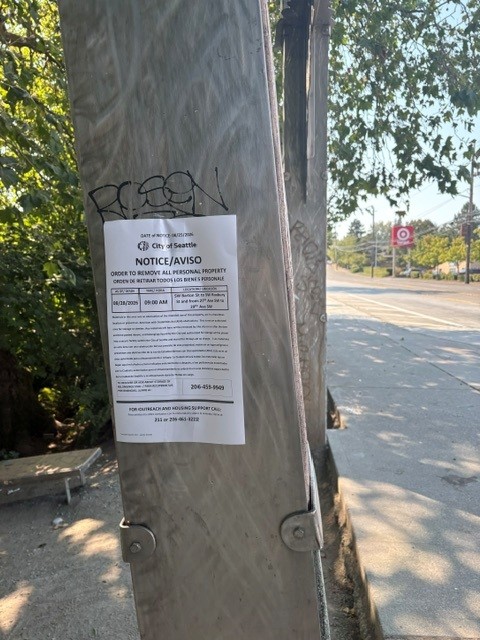
After last week’s shooting at Roxhill Park, we asked a city spokesperson whether the park’s encampment was slated for clearance. The answer, as reported here, was noncommittal. The park has continued to have incidents, particularly fires – four calls in one day alone, and a report by the cleanup group A Cleaner Alki that fire had intruded into the park’s peat bog. Now, there’s proof the city does plan to sweep the park’s encampment: That notice shown in the top photo, seen today and photographed by a reader, warns people camping in the park to have their belongings out by Friday morning (August 28).
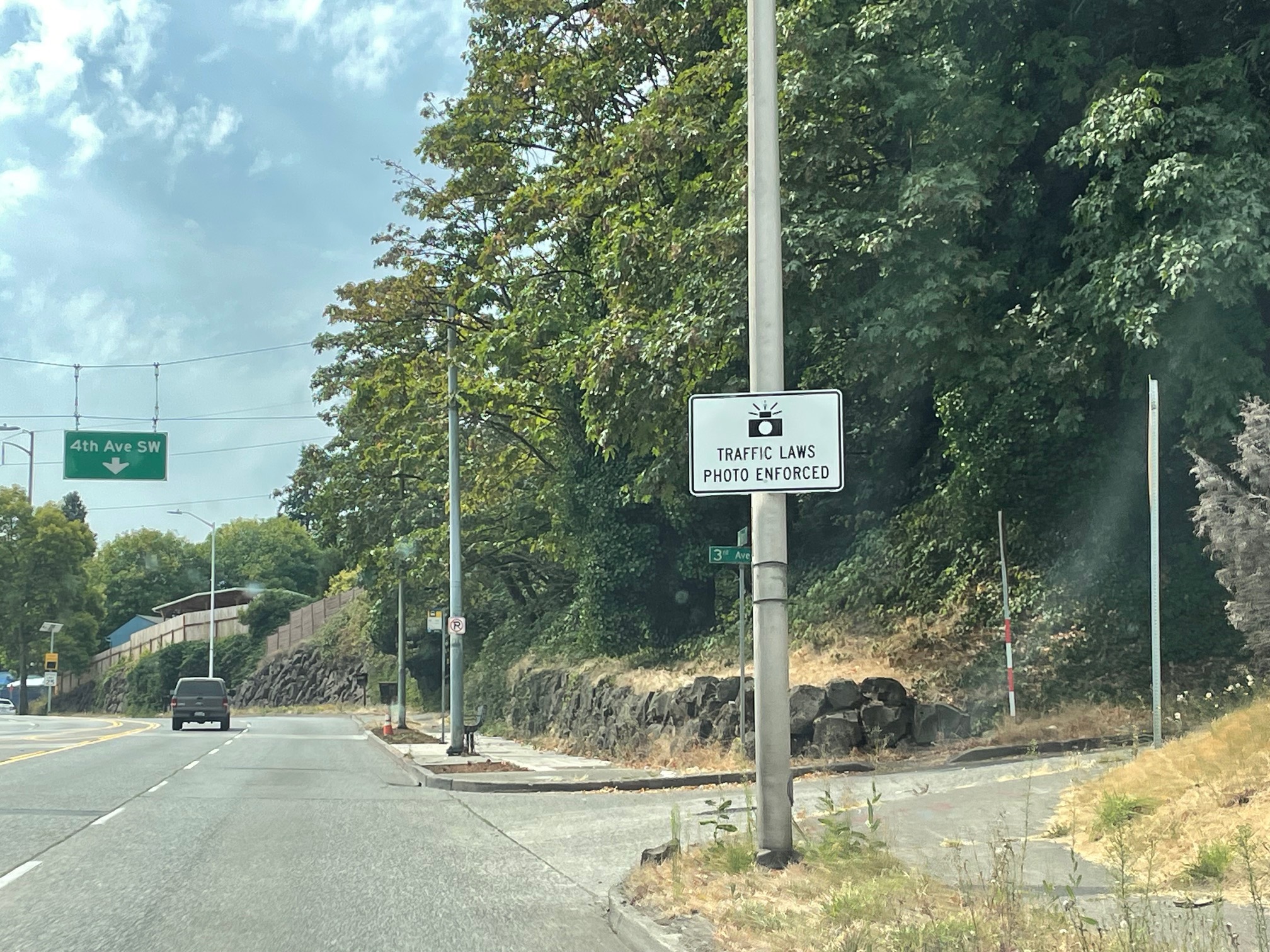
Seven years ago, we reported on signs that somebody put up in Arbor Heights, suggesting there were traffic-ticketing cameras where in fact there were none. SDOT told us those signs were “fake” and eventually took them down. Now, history seems to have repeated itself – this time on the Olson Place hill, where the sign above, on the westbound (uphill) side has a twin on the eastbound side, both pointed out to us by a reader. Since previously our area’s ony enforcement cameras were for school zones, red lights, and the bridge bus lane, we asked SDOT about these signs … and spokesperson Ethan Bergerson declared unequivocally that they did not install them. So, rogue signage again? P.S. Our area DOES have two new real speed-ticket cameras – for the West Seattle High School school zone on California and the Alki Elementary school zone on Admiral Way (all seven WS camera zones are on this citywide list).
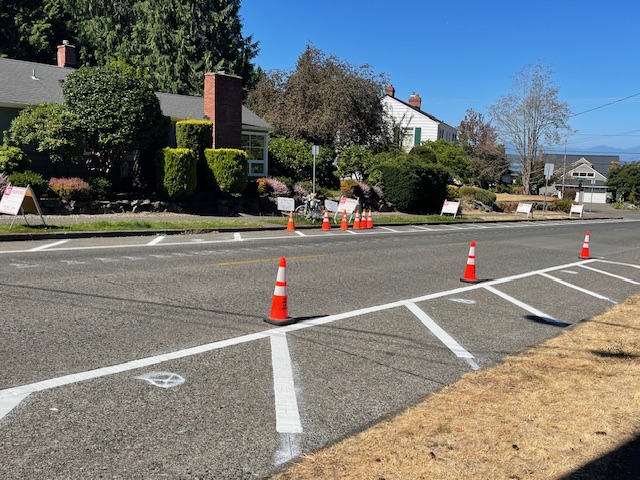 (WSB photo, Thursday)
Today, Mayor Katie Wilson signed an executive order she said was designed to speed up Vision Zero safety measures – one day after District 1 Councilmember Rob Saka held a committee briefing on his own package of transportation-safety proposals. We haven’t yet read both to see what’s different and what dovetails. But we did notice that the mayor’s order (read it here) refers very specifically to one West Seattle project: It decrees completion of a protected bicycle lane on SW Wildwood Place in Fauntleroy by the end of this year. That’s one of the safety upgrades urged by community advocates in the wake of the June death of bicycle rider Maridee Bonadea. Another one was installed just yesterday, permanent no-parking zones along the south side of Wildwood, where Ms. Bonadea died. The mayor’s executive order doesn’t mention any other specific West Seattle projects but does mention citywide plans to step up various types of street-safety measures, including lighting, signal, and signage upgrades.
By Macey Wurm
Reporting for West Seattle Blog
In West Seattle’s High Point neighborhood, 81 percent of youth say they have witnessed or heard gun violence near home or school in the last six months. Additionally, 70 percent of parents and caregivers keep their children inside and limit activities out of fear related to gun violence.
These findings came from a survey of 42 youth and 20 parent and caregiver respondents conducted by Fahima Mohamed, a High Point resident and student at the University of Washington. On Tuesday, Mohamed presented the results, alongside responses to other prompts, as a way to gauge community sentiment surrounding increased gun violence.
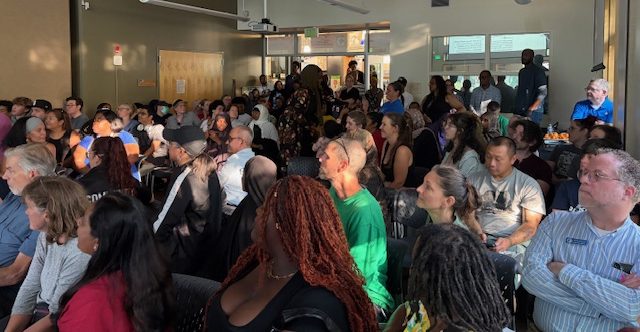
Neighbors, friends, and strangers filed into High Point community hub Neighborhood House on Tuesday, prepared to discuss current efforts and actionable plans to address the increase in recent months. The well-attended gathering, titled “It Takes a Village,” was organized by Mohamed.
“One of the big reasons I wanted to have this space and for everybody to come together is so that the leaders in the community can talk about the work they’re doing.” she explained.
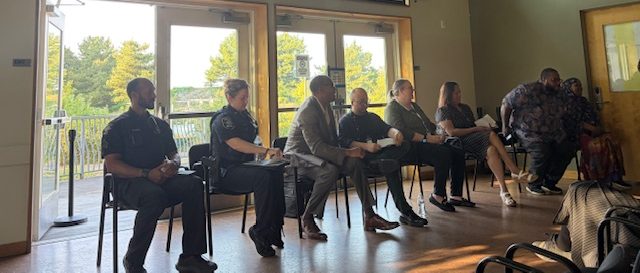
The meeting lived up to its name. Panelists from the Seattle Police Department, Seattle Public Schools, Seattle Housing Authority, Neighborhood House, and parent representatives established a sense of collaborative accountability. They acknowledged their individual responsibilities in preventing future gun violence and responding to those already affected.
Mohamed presented questions based on her survey findings to the array of panelists, who conveyed their responses to the audience.
Police Response and Violence Prevention
Southwest Precinct commander and panelist Capt. Krista Bair emphasized plans for “directed patrol” (as she had at last week’s Our City, Our Safety meeting). She shared that research suggests 20 minutes of police presence in hot spots generates 90 minutes of deterrence. High Point was already on the calendar for directed patrol prior to the August 10th murder; Bair promised that these plans would be enacted.
SPD’s response tactics were discussed iafter a question posed by Mohamed about consequences for repeat offenders in gun-related incidents. Panelist and Officer Matthew Roberson explained that the department shares information about offenders with community organizations that try to interrupt violence.
He mentioned a partnership with Southwest Youth and Family Services, which conducts followups with individuals, and SPD’s Community Service Officers, who connect offenders and those affected with additional resources.
Another SPD initiative highlighted by Capt. Bair: Twice-weekly “gun calls” on Mondays and Thursdays. The meetings are held in collaboration with city attorneys, other precinct captains, youth prosecutors, and the Department of Corrections to discuss gun violence occurring since the last meeting, and to share information about repeat offenders.
Ted Howard, Seattle Public Schools’ Chief Accountability Officer, introduced another preventive tactic, specific to SPS: A new protocol rolling out this school year called “SaferWatch.” The app is a federally funded platform that offers medical reporting, anonymous tips, and schoolwide communication. Tips are routed anonymously to trained professionals who then forward them to appropriate responders, according to Seattle Public Schools’ website.
Howard explained that the app will allow students to report potential instances of planned violence or threats, preventing dangers like fights or weapons on campus, before these events occur.
Infrastructure Fixes
Another preventive inquiry conducted by Mohamed involving the Seattle Housing Authority, which manages the High Point area, regarded lighting and camera installation on 30th Avenue as well as other hotspots for activity. SHA explained that 3 of their 100 lights in the area are currently out and said they are in the process of repairing. As for increased surveillance cameras, they would like to implement more, but need funding to ensure added cameras could fit in their budget.
Mental Health Resources for Students
Ted Howard explained that SPS works to identify students who may be in need of mental health resources through surveys, “tell a buddy” prompts, academic writings, and journals.
“One of the things we try to do at SPS is to be a conduit to bridge those supports in place. We don’t hire teachers or counselors to do mental-health counseling, but we try to make sure students that need help, that they get identified and get that resources to them.”
West Seattle Elementary’s new principal Stephanie Barragan built upon this sentiment. She highlighted the school’s renewed partnership with Atlantic Street Center behavioral-health services and two in-house therapists: “As much as our families are saying it starts with home life, the reality is once school starts, students are with us for seven hours a day. We have that responsibility too.”
Community Response
Throughout the meeting, emphasis was also laid on how the aforementioned organizations can work together to ensure the future safety and well-being of High Point’s children and families.
“All the organizations in the room, I think it’s our next step, our inspiration, to be more connected, for our youth so that things line up for our kids, so they’re not disjointed, and I think that we have the opportunity to do that in Seattle in ways that could be truly transformational,” said Jeff Clark, former principal of Denny International Middle School.
This notion of collaboration was extended not only toward organizations represented amongst the panelists, but to community members as well.
“Your community is not going to change anything if you come and have these community meetings and walk out and don’t take action. You got to get to know not only your students, but you got to get to know each other as you hold each other accountable, then you’ll start to see your community shift and change,” said Howard
As for what’s next, Fahima Mohamed laid the groundwork for a future of camaraderie and progress. She suggested a quarterly check-in hosted by Neighborhood House, monthly parent gatherings involving youth activities and a parent group advisory on safety, and a Friday tea time for community members to gather and discuss.
“I really have hope in the collective troubleshooting and the collective solution finding,” concluded Shak Sanders of Neighborhood House.
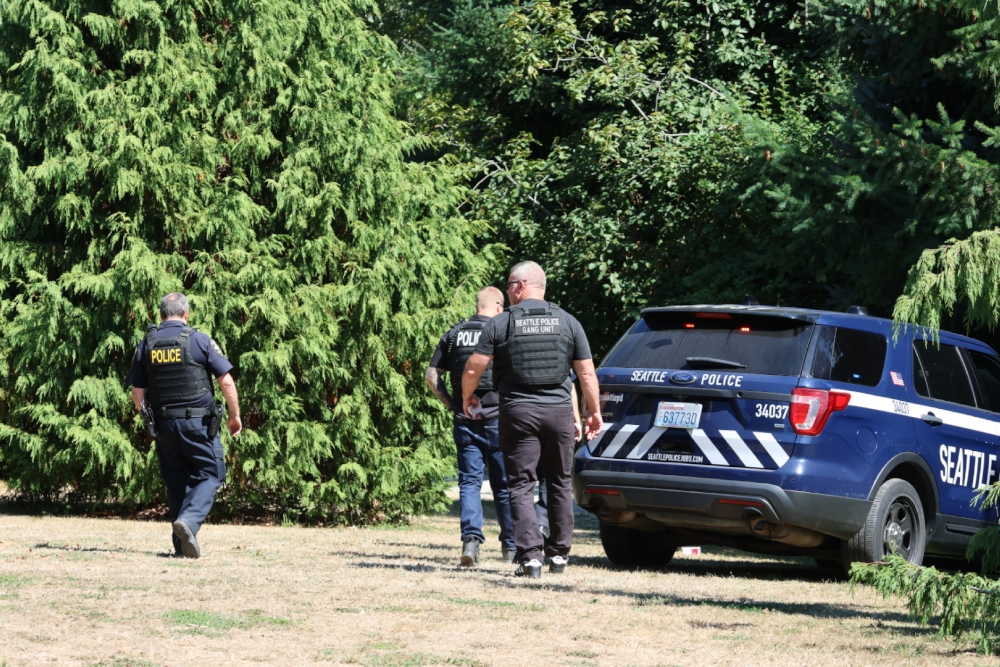 (WSB photo, Wednesday)
Though police have not specifically said whether Wednesday’s Roxhill Park shooting was related to the park’s encampments,
neighbors say their safety concerns were increasing even before the shooting that sent a 40-year-old man to the hospital. So we asked key city reps today if Roxhill Park has a clearance planned. Here’s what spokesperson Caitlin Moran from the Human Services Department and Unified Care Team said:
HSD typically does not share exact dates of encampment resolutions due to staff safety and possible changes in scheduling. However, resolutions may be expedited following incidents of violence.
UCT is awaiting information on the shooting from the Seattle Police Department to inform next steps.
We also asked District 1 City Councilmember Rob Saka‘s staff if this has been on his radar. Yes, said staffer Michael Taylor-Judd, while indicating that those concerned should be pressuring the mayor:
YES, our office has communicated with our contacts in several City departments and the councilmember has spoken directly with department leadership when he has the opportunity to convey the concerns of our neighbors in D1. He and I were also just out in the immediate neighborhood earlier this summer walking the paths in Roxhill Park and hearing the concerns of residents in nearby Village Green Retirement Home. He also heard directly from nearby neighbors while knocking a few doors in the afternoon and we have received emails in our office since then.
We take this very seriously, and we convey the same messages that our first responders share with residents in the Southwest Precinct — “If you see something, say something.” Neighbors have been encouraged to regularly contact 911 — especially to report when they see violent behavior, illlegal drug use, and unauthorized campfires that violate our current citywide burn ban.
We need partnership from the Executive Branch, however. Councilmember Saka cannot direct the public safety departments or Unified Care Team to respond. That authority resides with the Mayor’s Office, and we hope she is hearing from our neighbors just like we are, and that she is also aware of how urgent it is to address this situation before someone else is injured in the park.
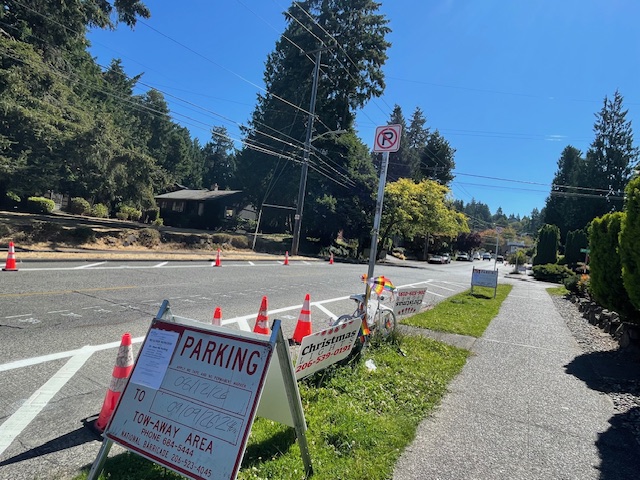 (WSB photos)
After SDOT told us Wednesday that crews would be out today making promised changes on SW Wildwood Place, and when we went over to check today, we found that indeed they are.
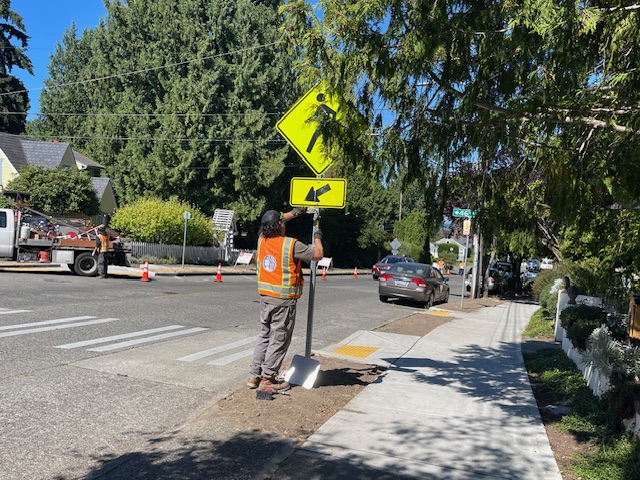
They’re installing permanent no-parking signage as well as reinforcing the no-parking zones on both sides of the street, which is just southeast of the Fauntleroy ferry dock, with pavement paint.
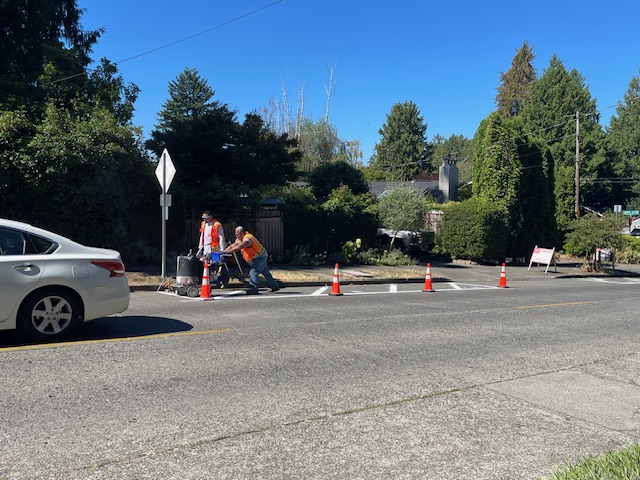
This comes a little over two months after the death of bicycle rider Maridee Bonadea, and a little over a week after a public forum about bicycling safety in the area; the removal of south-side parking was one of the changes SDOT promised, while they say they’re still studying others, including a possible all-way stop at Fauntleroy and Wildwood.
Two followups on safety measures discussed at last week’s Fauntleroy bicycling-safety forum (WSB coverage here), spurred by the death of Maridee Bonadea on SW Wildwood Place in June:
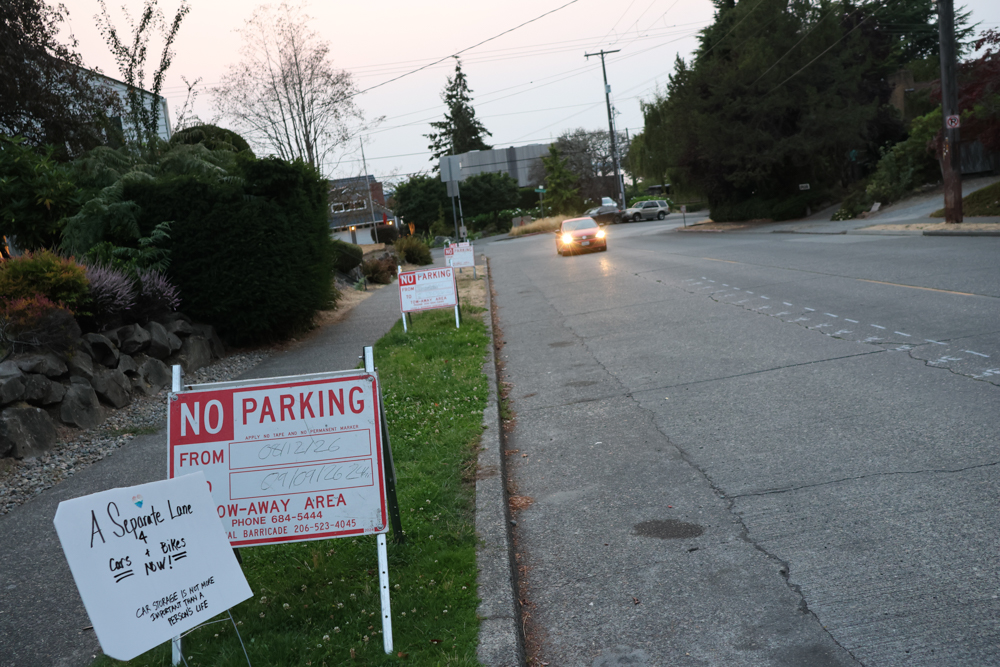
NO-PARKING ZONE: As we reported, the temporary no-parking signs went up on the south side of Wildwood – where Ms. Bonadea died – the day after the forum. We asked SDOT when the permanent signage would be installed, and today they tell us it’s happening tomorrow:
We can confirm that on Thursday, SDOT plans to make the temporary no-parking restrictions on the south side of SW Wildwood Place permanent. The work will include permanent no-parking signs and interim paint hatching with plastic delineators.
We are continuing to evaluate a potential all-way STOP at Fauntleroy Way SW and SW Wildwood Place, including additional data and operational considerations. We’re also continuing work on other safety improvements in the area and expect to have more information to share soon.
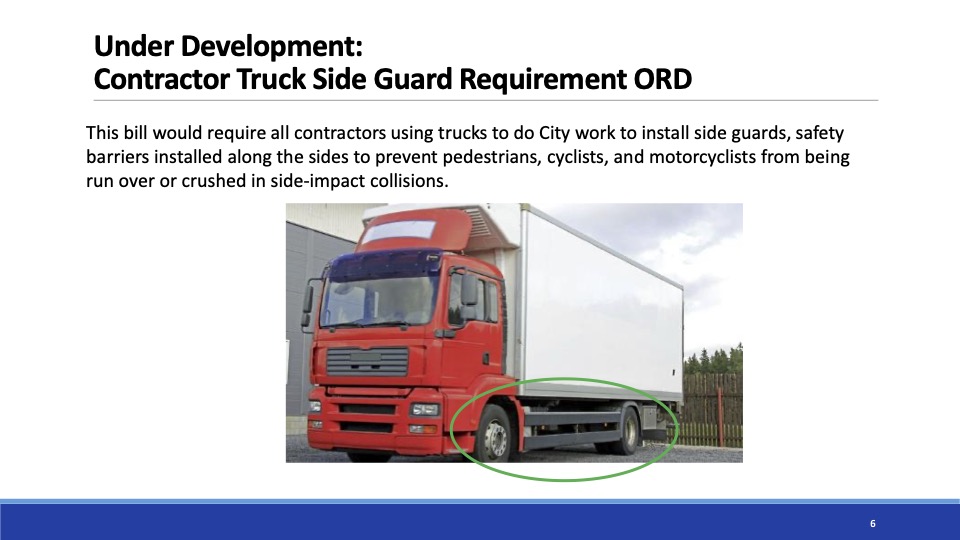
TRUCK SAFETY: Also discussed at the forum: Side guards for trucks. Legislation to require them on trucks used by city contractors is under development, according to a slide in this deck prepared for tomorrow morning’s meeting of the City Council Transportation, Waterfront, and Seattle Center Committee, which is chaired by District 1 Councilmember Rob Saka. The committee also is scheduled to discuss a package of other transportation-safety legislation Saka is proposing, according to this announcement.
By Tracy Record
West Seattle Blog editor
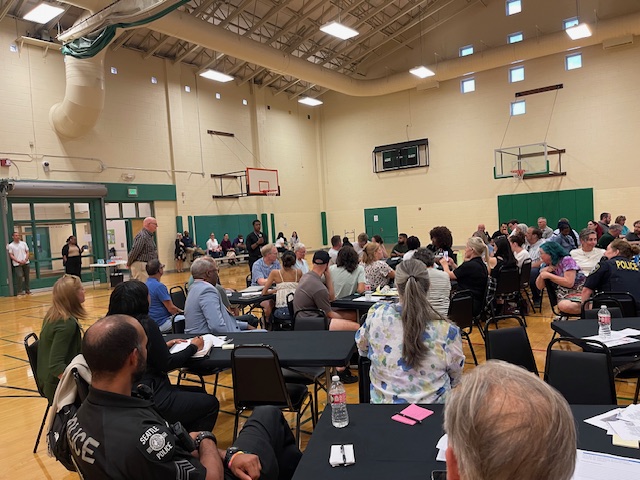
The date for SPD’s second “Our City, Our Safety“ meeting in West Seattle was set months ago.
But it turned out to be painfully timely – three nights after our area’s first murder in a year and a half.
During Wednesday night’s meeting at Delridge Community Center, police didn’t have a public update to share about the deadly shooting, but heard from High Point residents who came to share their stories of living amid increasing gun violence, of which the murder of 28-year-old Omar Tebad was just the most-recent escalation in their neighborhood.
Also coincidentally timely: The meeting came less than two weeks after SPD had an abrupt change at the top. But the ~50+ people gathered didn’t hear from SPD’s newly promoted Interim Chief Andre Sayles until late in the meeting, as he had been sidetracked to a gunfire incident elsewhere in the city, in which three of his officers reported getting shot at. Here’s what he said at the meeting in just under three minutes:
Sayles had also spoken at the first “Our City, Our Safety” meeting in West Seattle back in March (WSB coverage here) – we noted in our report that he answered concerns about driver lawbreaking and misbehavior with a suggestion that education might be better than enforcement. This time, he talked about investigations – saying that was now a prime mission for an SPD unit he’s now calling the “Proactive Team” – and about building relationships. As an example, he mentioned a meeting earlier in the day with first-year City Attorney Erika Evans, who also was there:
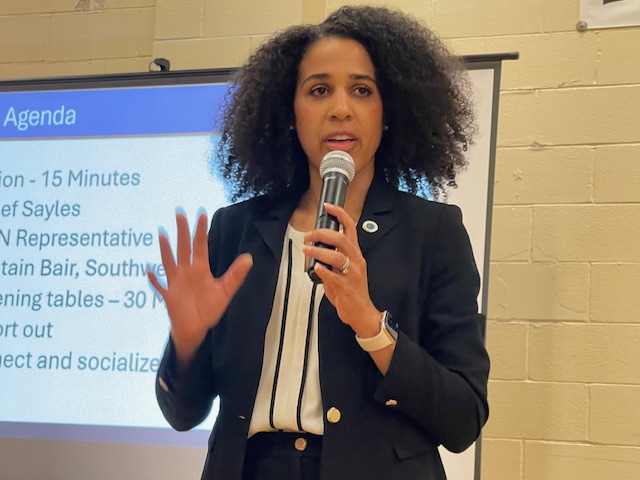
She explained her office’s role as “the city’s lawyer” during the earlier round of speeches and presentations, which we recorded on video too. First speaker was SPD’s Dr. Lee Hunt:
At nine and a half minutes in, a key speaker was Southwest Precinct commander Capt. Krista Bair, who rolled out data like this, as was also done during the March meeting:
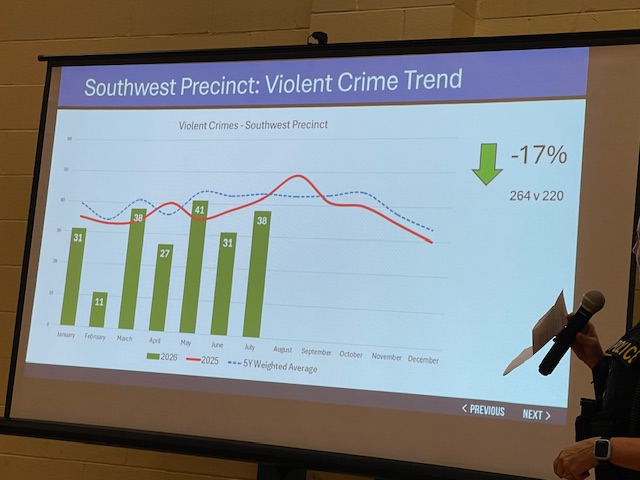
While she noted that crime hotspots included, as usual, Westwood Village, she also noted that stats had changed because businesses’ “protocols and policies” had changed – rather than theft, many shoplifting incidents were being reported as robberies (which is the classification if the thief uses force, threats, and/or a weapon). She also said they’ve had success in fighting crime there because of increased collaboration with businesses. Overall, Capt. Bair said, the Southwest Precinct (West Seattle and South Park) has seen a 17 percent drop in violent crimes so far this year compared to the same period of last year. Summer, overall, is usually a time when such crimes are on the rise, but not this year, she added.
She recapped the top five concerns voiced at the March meeting: Homelessness/RVs, open-air drug use, traffic safety/recklessness/racing, school/youth safety, police response times/presence. Regarding the top concern, she said the city was clearing some encampment areas in the next week or two (we reported on this one the next day after a reader tip). She also said they were addressing some concerns via “directed patrols” – having officers spend ~20 minutes in a certain area as a deterrent, an approach that she said has been proven to work nationwide.
The second half of the meeting was small-group breakout discussions, with a representative of each group presenting a short summary at the end. The table we monitored included City Attorney Evans, who noted that her office is on track to file more DUI cases than it had in previous years. Evans also said her office just got another attorney to handle Extreme Risk Protection Orders, which seek to at least temporarily confiscate weapons when there’s a concern about imminent violence. That’s a civil action, not a criminal action, though, it was noted.
Many of those who spoke from tables identified themselves as High Point residents. After multiple gunfire incidents, some said they’re afraid to go outside their homes; others said they feel SPD is “not doing enough.” One speaker pointed out, “Some of our houses have been hit … we don’t care about traffic, we don’t care about encampments …” but rather “what we all (are) experiencing.” Another speaker said youth are suffering the worst, in a multitude of ways, and mentioned the community forum set for next Tuesday (here’s the announcement we published).
But more than talk is needed, another man said, recounting one terrifying incident: “Suddenly in broad daylight there was that sound … to see my wife hit the ground, that will stay with me.” He said that in addition to police presence they want to see their area analyzed for Crime Prevention Through Environmental Design.
It’s not just gun violence, said a High Point resident speaking for another table, saying their neighborhood (Snake Hill) has been having trouble with people driving in “to drop their cars.”
In addition to city and SPD officials we mentioned above, others notably on hand included Jon Jainga from the Seattle Park Rangers, Tom van Bronkhorst from the Unified Care Team, and SPD Assistant Chief Rob Brown. Not there: District 1 City Councilmember Rob Saka, but his staffer Michael Taylor-Judd – a longtime West Seattle community advocate before going to work for the city – was.
WHAT’S NEXT: SPD has another Our City, Our Safety meeting planned in the East Precinct area on September 6.
 (WSB photos)
By Torin Record-Sand
Reporting for West Seattle Blog
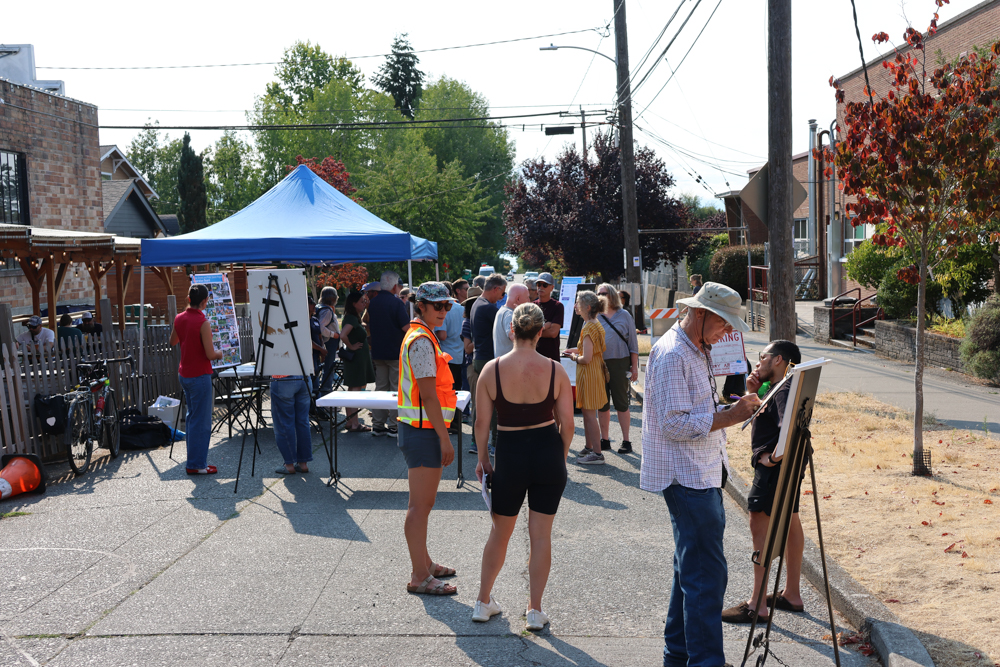
More than forty people came to small section of SW Lander Street west of California SW last night – between local businesses The Good Society and Seattle Yarn, and neighboring Lafayette Elementary – for an SDOT-convened “community design charrette.”
It offered a preview of what the street might look like in the near future, as the purpose of the gathering was for city officials to get feedback about their plans to close the street to vehicle traffic and turn it into a “People Street” within a year.
SDOT closed the small section of SW Lander for the evening, bringing together city reps and associated consultants and designers with community members to talk in-person about the best way to implement changes, and what they might like to see from the project.
The project is a part of the city’s People Streets and Public Spaces Capital Program, which seeks to transform various streets across the city into miniature public parks. Traffic is blocked off, and the designated area is transformed with various architectural improvements and amenities to encourage community gathering and engagement. This site, on SW Lander, is one of two in West Seattle that are currently part of the program; we’ve previously covered the other proposed project, on 18th Avenue SW, between Delridge Way and Southwest Barton (which also had a recent meeting). The city says its goal is to transform SW Lander into public space offering cleaner air as well as an overall sense of safety and security for students.
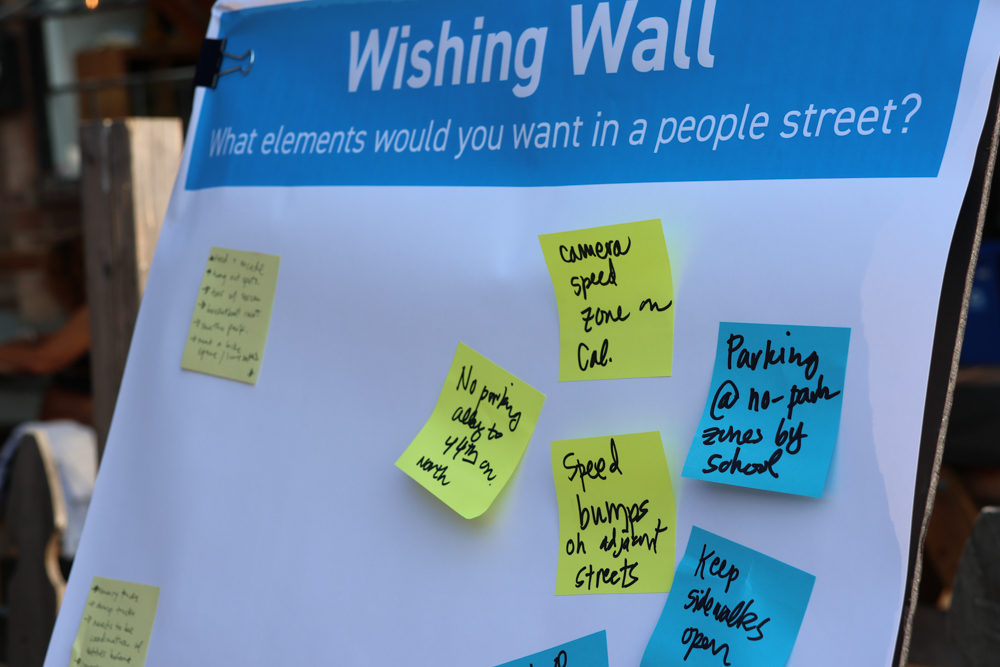
The meetings for both sites aimed at a very preliminary stage of the process, akin loosely to ‘brainstorming’ with the community in a more free-form atmosphere. No concrete designs were presented; instead, community members were asked to write sticky notes on poster boards asking for feedback on things such as desired features, and put stickers on stock photo ‘mood boards’ representing which features or visuals they would find the most appealing.
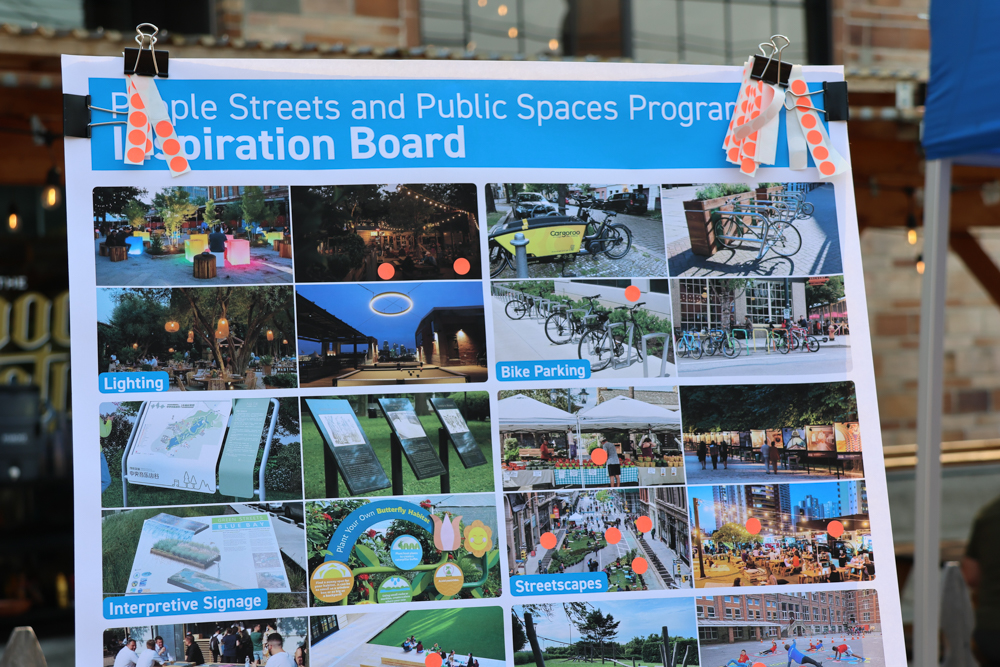
The feedback will be used by the city as an initial step before they begin a more formal design processs. Beyond the feedback process, other light activities were available for attendees as well, such as over-sized street board games and coloring books for kids; refreshments were also available, featuring fruit empanadas from the Salvadorean Bakery in White Center.
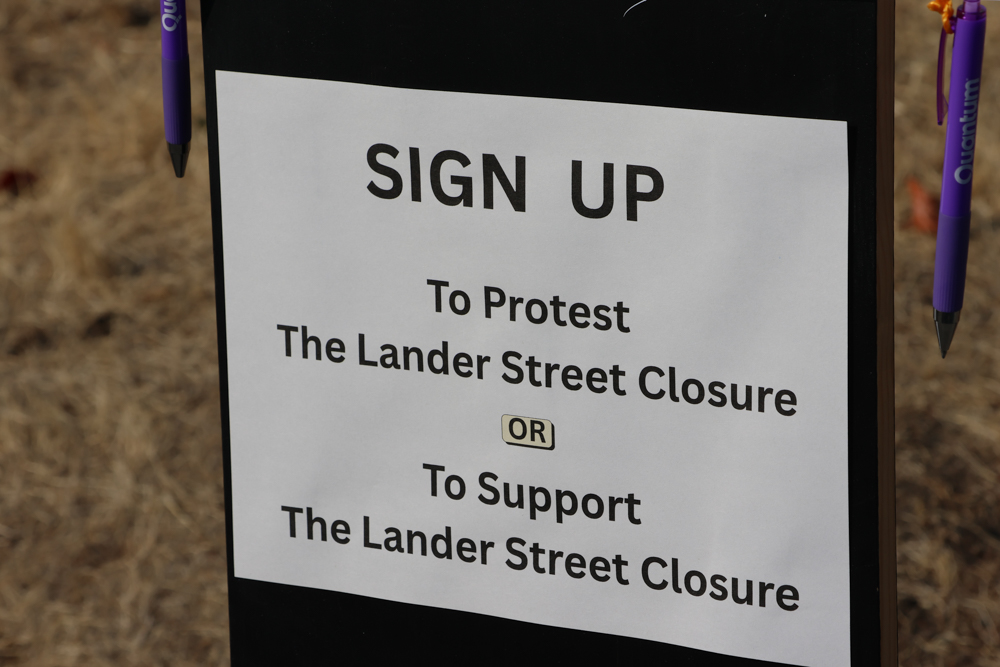
Despite the festival atmosphere, the project proposal did not come without controversy. In addition to what was provided by the city, some community members brought some of their own boards and posters to protest the proposed project. One board offered two sign-up lists, asking attendees to pick a side: “Yes, close Lander Street” or “No street closure”. The latter choice had garnered around 10 signatures already by 15 minutes into the gathering, while the former had no signatures at all in the early going.
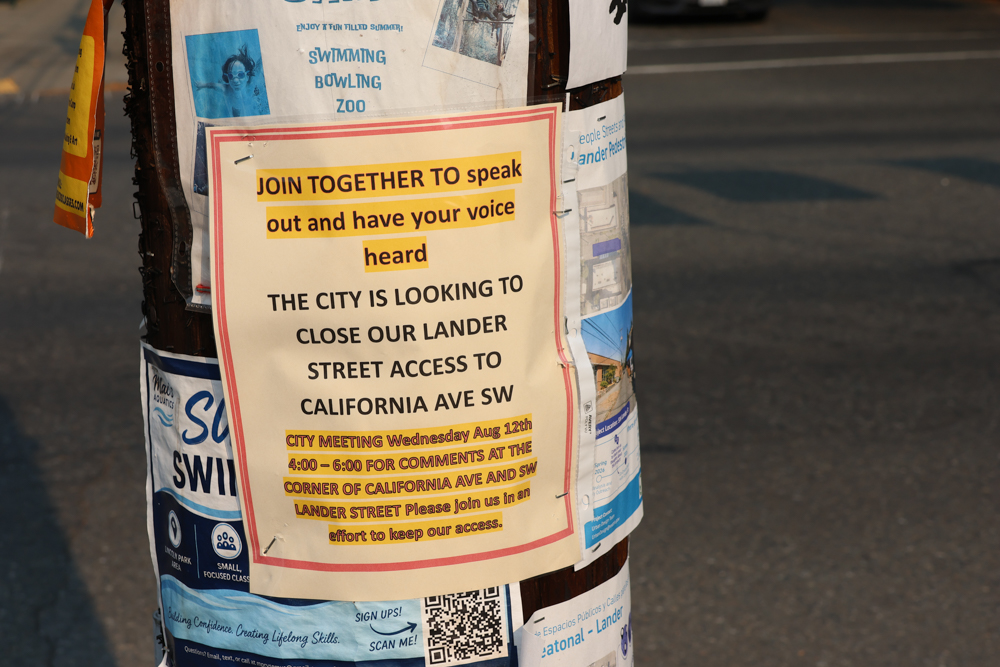
Another poster stapled to a local telephone pole called for neighbors to attend, framing the project as the city cutting off street access to California Avenue.
Words from attendees who spoke to us did not show much more positivity for the project either. “Well, this whole thing sucks!” said one of the attendees, an Admiral resident. “Congestion here is bad, and getting worse. Where are all the parents going to go to pick up their kids? […] The city is doing too much with too little, and too many people.”
People from local businesses and buildings in the block came to share their opinion too. Paul Cesmat, owner of the nearby Admiral Station apartments, came, also delivering a letter to city representatives from the owner of Financial Designs Insurance (in the same block) in absentia. Both of them expressed that the city’s plan would be negligent at best, actively harmful at worst – making it more difficult for emergency vehicles to access the school and commercial block, and increasing traffic congestion for the school: “In my 49 years here, there has never, ever, been an incident with a kid,” Cesmat said. He also expressed frustration with the city’s communication strategy. “There was no real mail notification to the neighbors; just some stuff stapled on the poles.” he said. “Neighbors had to communicate with each other to encourage turnout.”
According to SDOT, there will be more chances for the community to provide feedback through the design process, though dates are yet to be announced. The formal design process will begin this fall, with finalization of a plan expected next winter (early 2027).
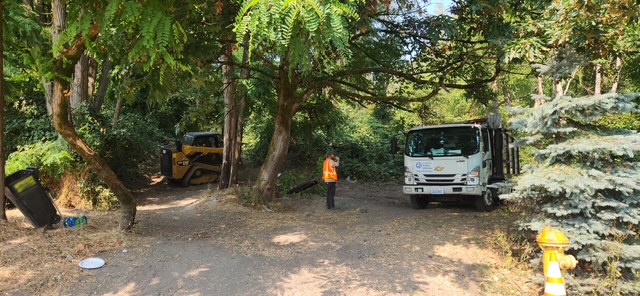 (WSB photos)
11:44 AM THURSDAY: At last night’s Seattle Police community-safety meeting in West Seattle (report to come), Southwest Precinct commander Capt. Krista Bair alluded briefly to multiple local encampment clearances this week. One of them is under way right now. Thanks to a tip from Jon, we got over to the Delridge Home Depot area in time for these photos of city crews at the notorious encampment west of the store.
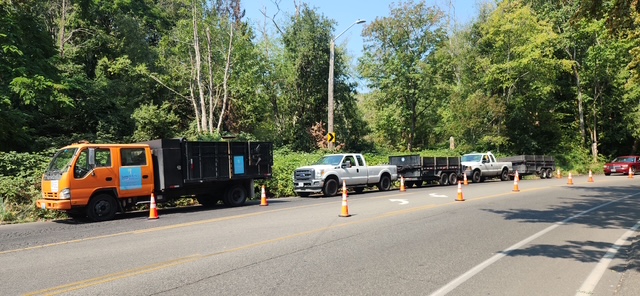
This encampment has been the site of problems including multiple fires. It’s on land that the King County Parcel Viewer shows is owned by the city.
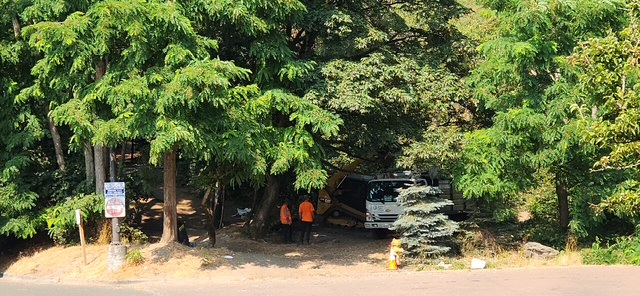
We have a message out to the city seeking information about today’s operation.
6:36 PM FRIDAY: Our inquiry got a short reply today: “5 people were identified at the site. No shelter referrals were accepted.”
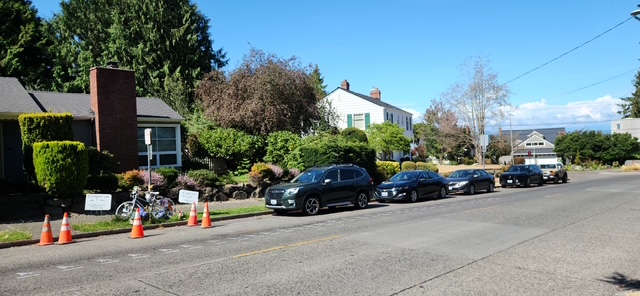 (This morning, SW Wildwood site where Maridee Bonadea died. WSB photos by Torin Record-Sand)
By Tracy Record
West Seattle Blog editor
Two months after bicyclist Maridee Bonadea died on SW Wildwood Place a short distance uphill from the Fauntleroy ferry dock, SDOT reps promised last night that they’d initiate some changes within “a few weeks.”
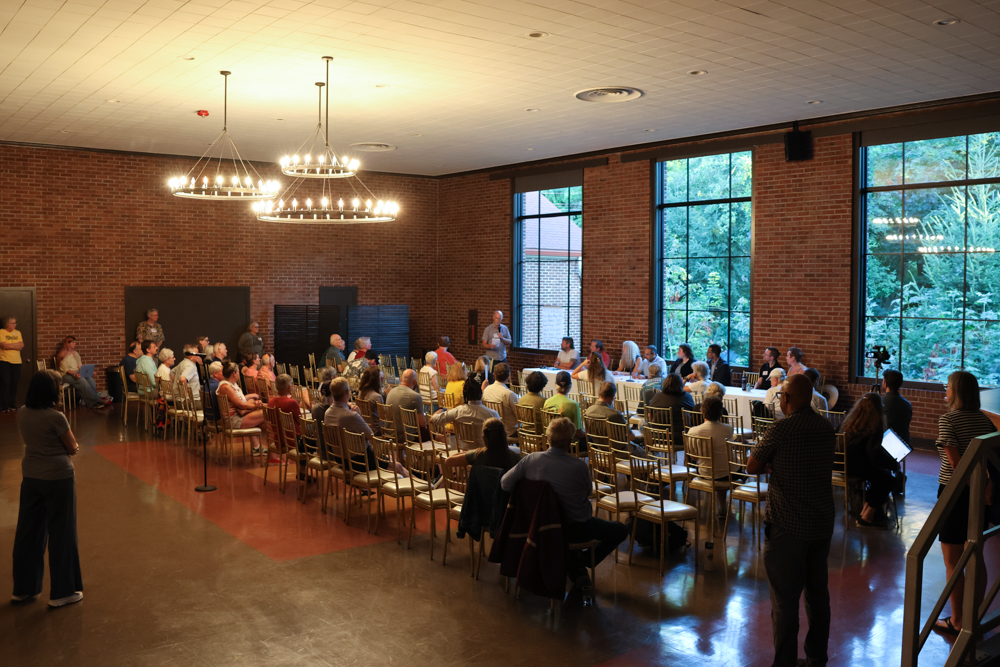
The promise came during a public forum coordinated by the Fauntleroy Community Association, and while community members in attendance were glad to hear it, many said it wasn’t enough. Given that changes were recommended on this stretch of road at least six years ago – recommendations that went unheeded then – they urged the panel of city, state, and county officials to take proactive action elsewhere.
We recorded the entire forum, held at The Hall at Fauntleroy – here’s the video, followed by our summary:
The forum was moderated by FCA president Frank Immel and vice president Catherine Bailey:
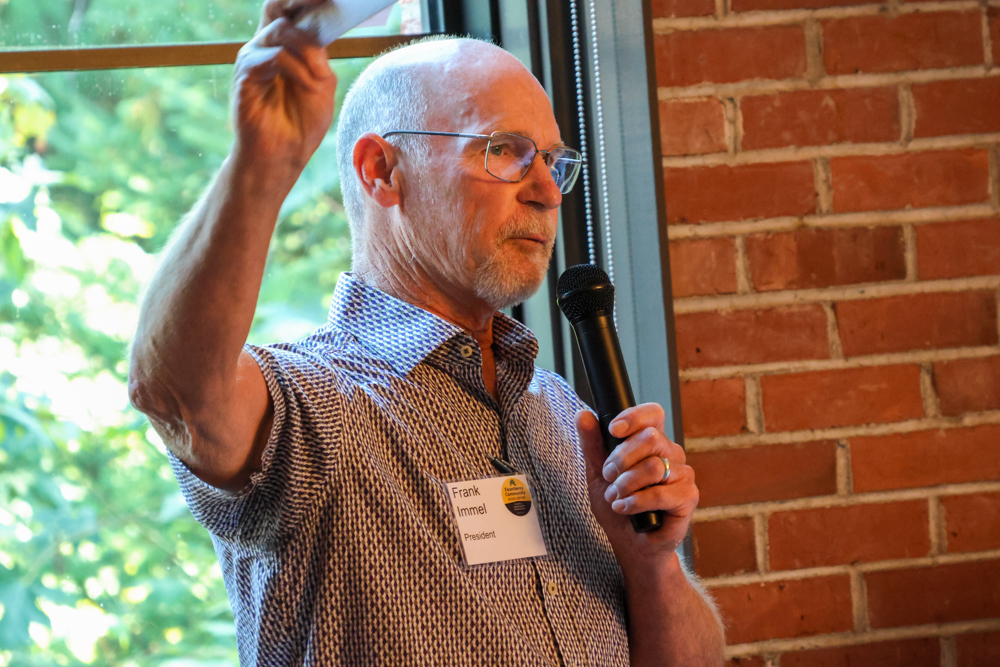
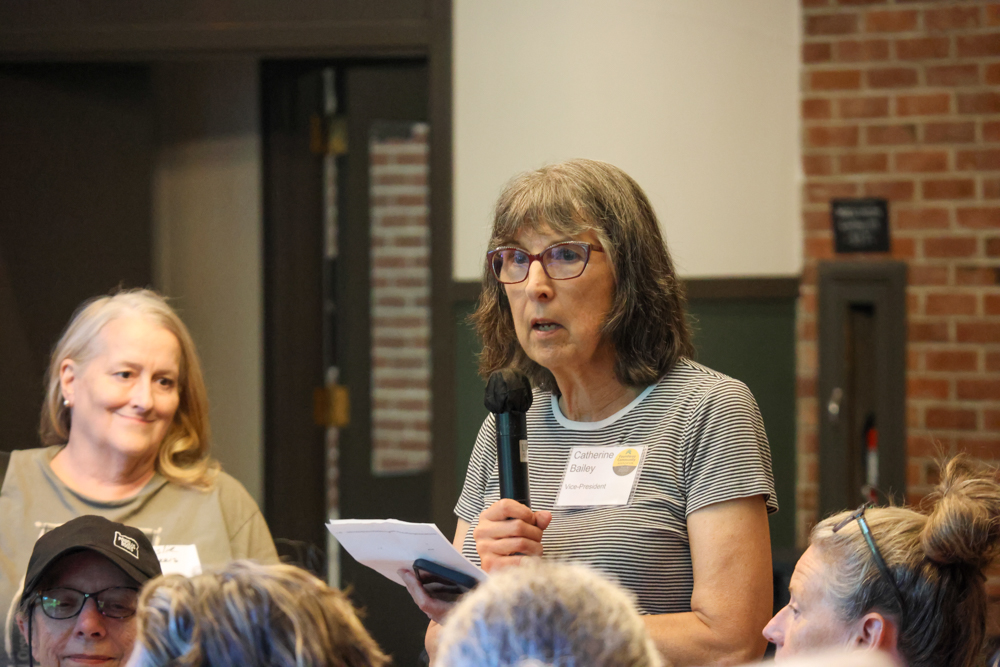
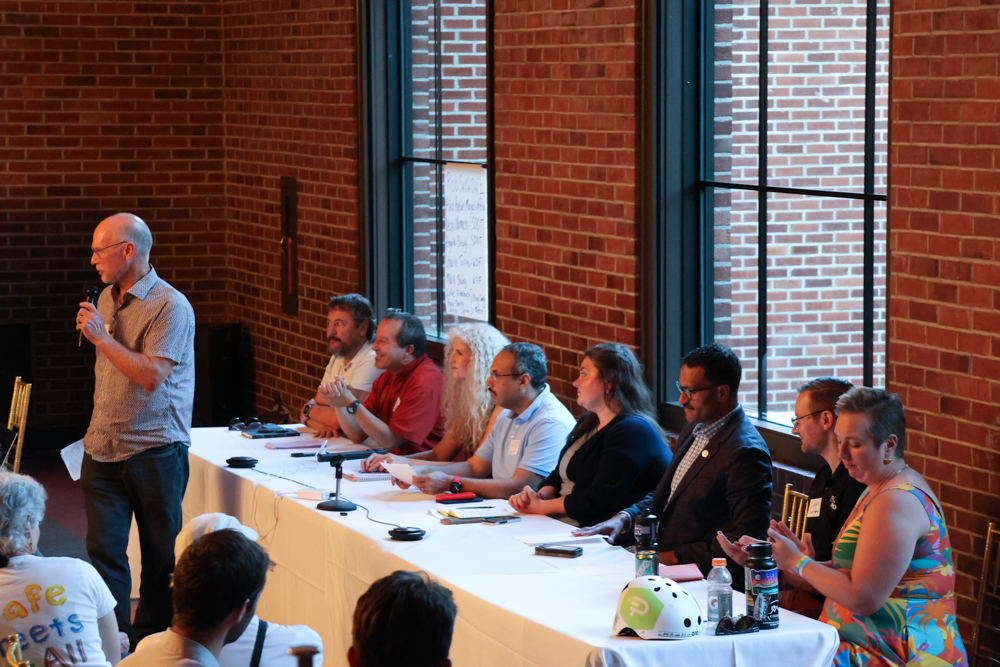
Here’s the panel, with reps from SDOT, Washington State Ferries, Metro, Mayor Wilson’s office, and City Councilmember Rob Saka (who said he arrived late because of a marathon council meeting):
First to speak was Ms. Bonadea’s daughter Lani, who said, “I want to believe that you all care about making the streets safer …” but it was “disheartening” that nothing had been done yet, even with a mayoral resolution about bicycle safety the month before the collision.
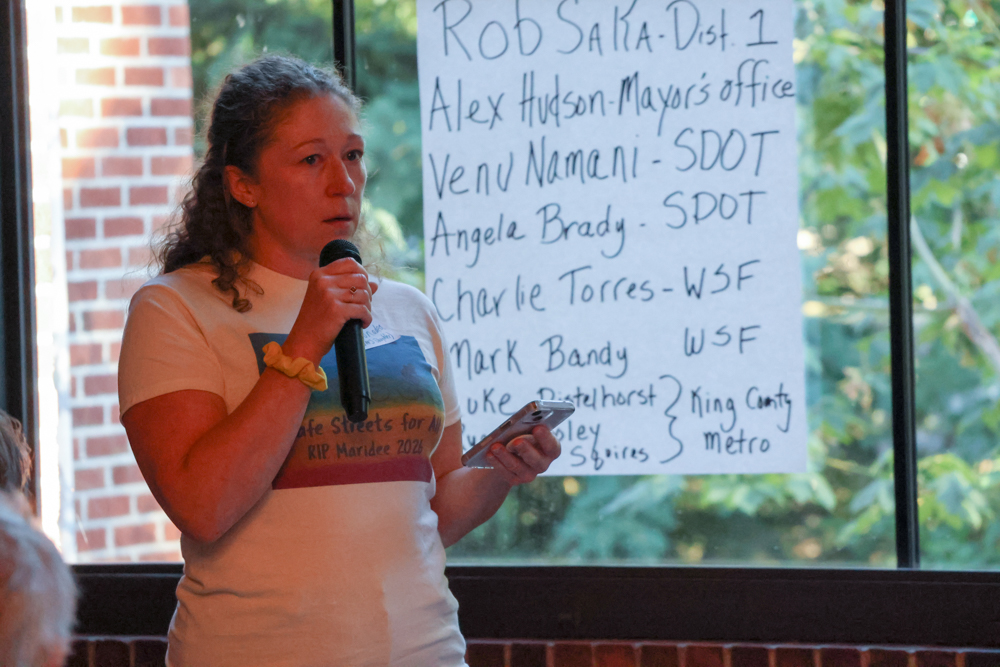
She also said that while her mother was an amazing person who “did a lot for a lot of people,” that shouldn’t be the reason safety is improved – it should be done on behalf of everyone. “I don’t uderstand why that street has been allowed to function.”
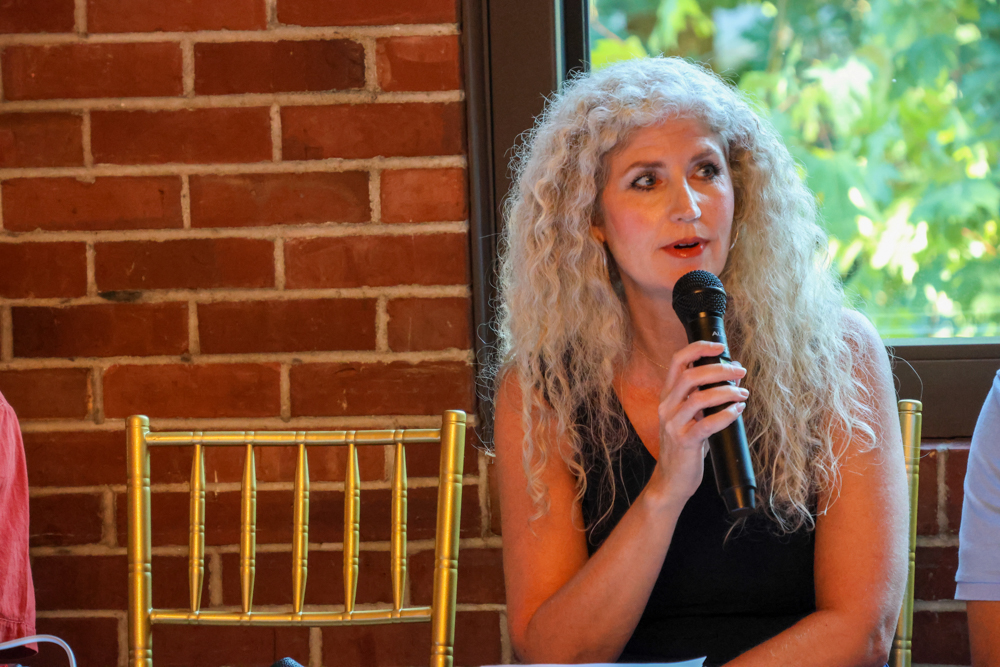
The first panelist to speak was SDOT director Angela Brady, who said her department had a “new policy” for reviewing sites of fatal crashes (although there had been previous policies, we note from our coverage of recent incidents).
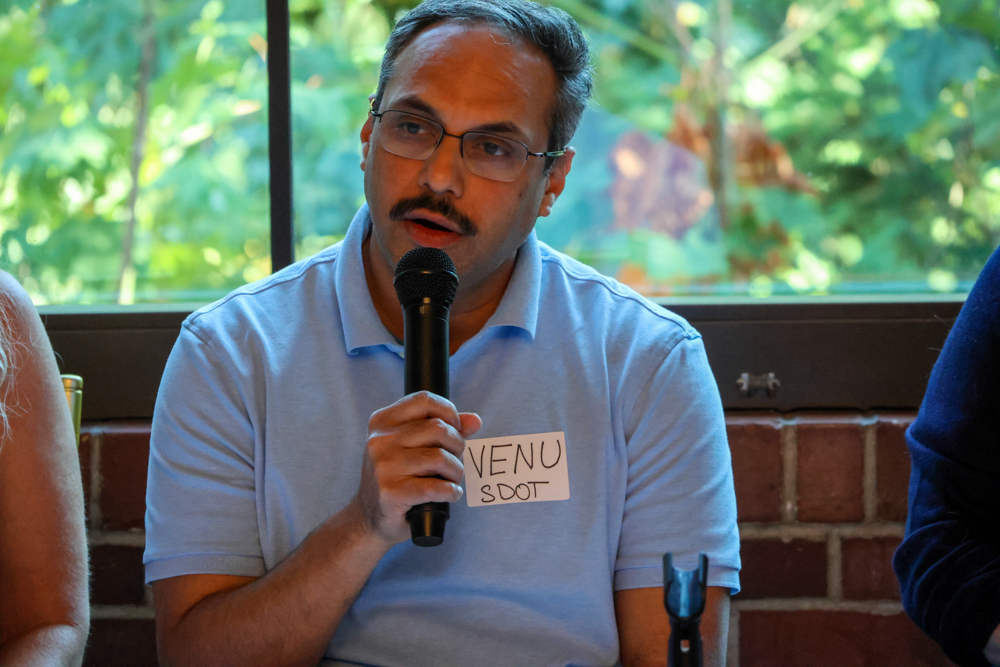
SDOT’s safety officer Venu Nemani also spoke about a “new process and policy,” including a semi-annual review of all walking and biking-related collisions in the city.
Then came some specifics for this site: Removing parking on the south side of that block of SW Wildwood (which would include the area where Ms. Bonadea was killed), a new all-way stop at Fauntleroy and Wildwood, and a bike lane. Nemani said SDOT is “working on the conceptual design” for this, and insisted, “We hear you” about wanting safety concerns to be addressed sooner rather than later. (The two-week promise for parking changes later drew a suggestion from a community member that the parking removal could be done overnight – “just put up A-boards.”)
Councilmember Saka spoke next, declaring “this is sobering stuff”:
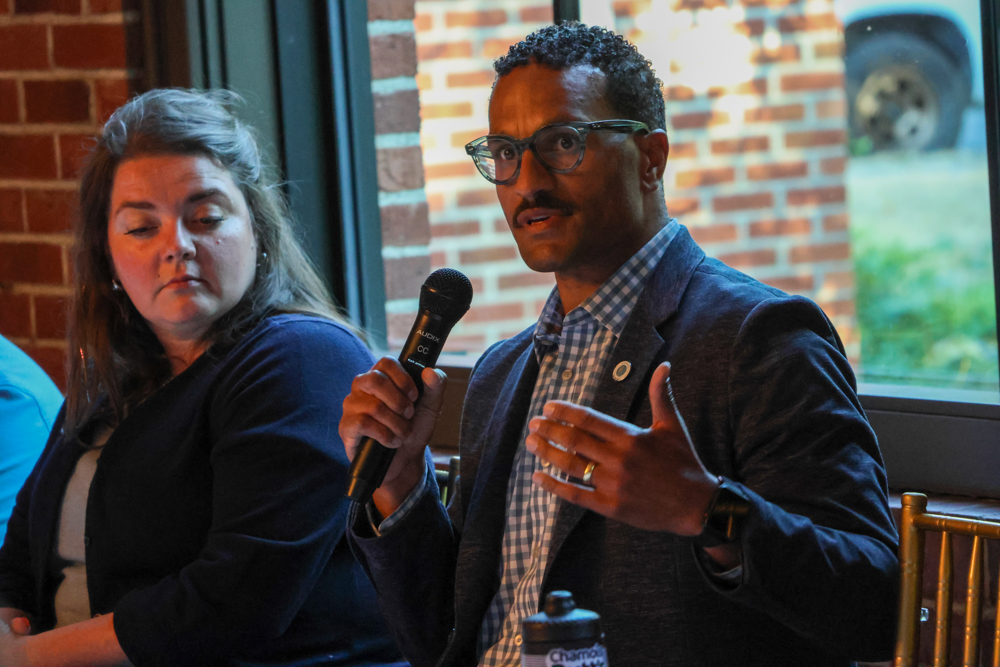
He said he’s working on “traffic-safety legislation” that would take a broader look at related safety challenges, citing advocates’ request for more daylighting of intersections, side guards on trucks, and mandatory Vision Zero reviews.
Ms. Bonadea’s widow Laura then spoke.
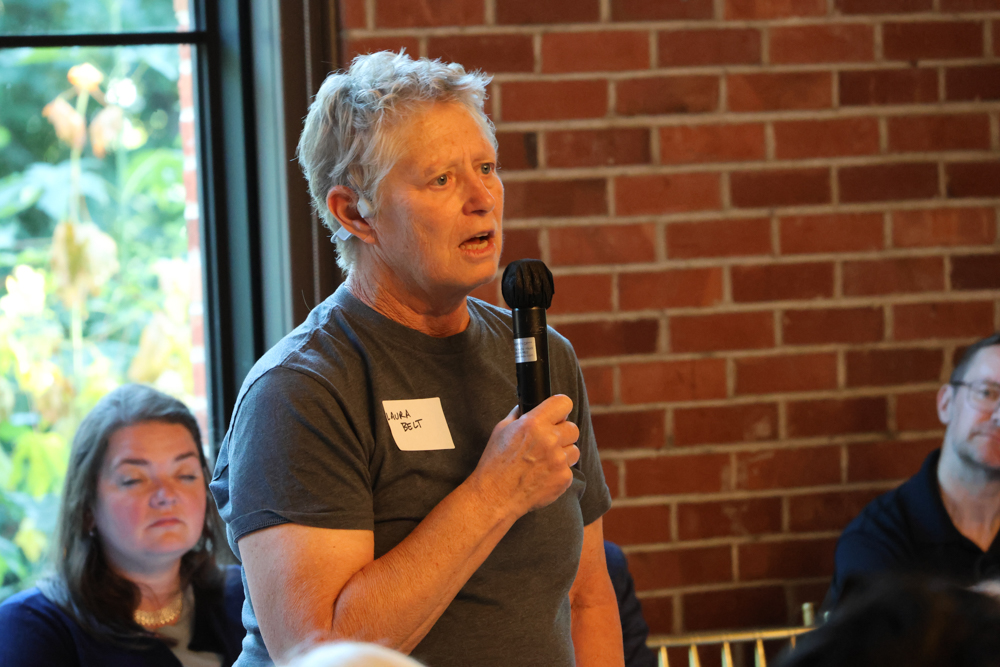
Like her wife’s daughter, she said it’s not just that exceptional people like Maridee “deserve to live” – everyone does. Why wait for a fatal crash? She urged action on problems all over the city, including “bike lanes that suddenly end. SDOT “needs to be proactive, before (more) people die. “I want to see some action” – quickly, urgently, she said.
That’s when Nemani promised the parking removal would be done “in the next few weeks.”
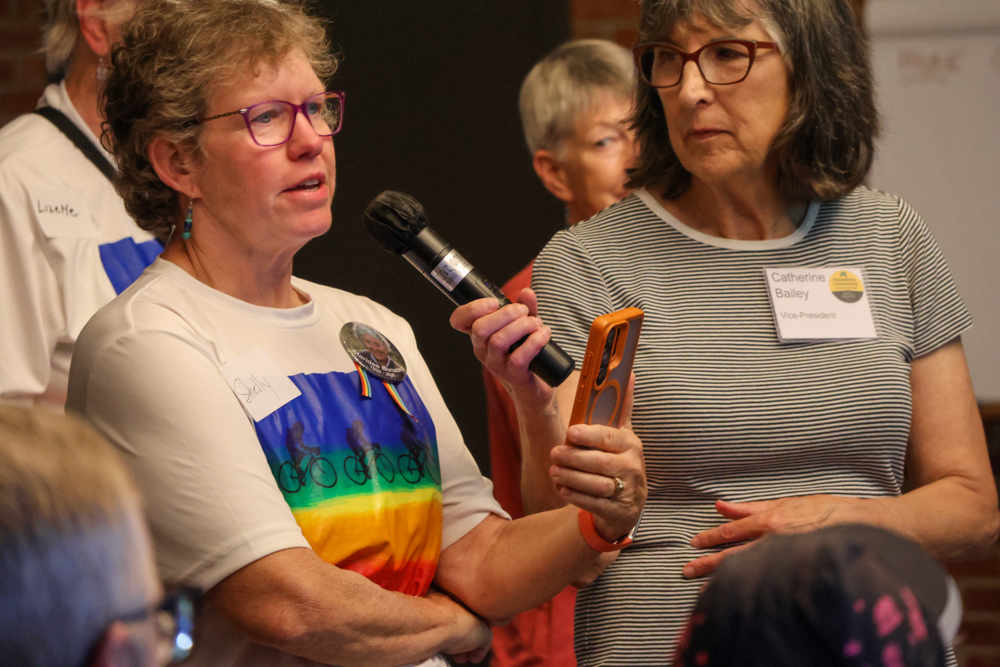
Friends of Ms. Bonadea from the Rainbow Riders group reiterated that urgent action is called for, in other areas with safety challenges too.
Alex Hudson from the mayor’s office assured attendees that her boss wants fast action too.
Some of the problems that community members surfaced were beyond fast action, maybe beyond any action at all, like the declaration that the root issue here was “a ferry dock in the middle of a commmunity,” and no dedicated space for vehicles to line up, just curbspace shared with parked vehicles.
Dock-related concerns were addressed by the WSF reps, primarily via a reminder that a traffic signal is going in later this year where the dock meets Fauntleroy Way.
Other comments included an observation about who was not at the meeting – West Seattle community advocate Leslie Harris, noting she had recently retired from the legal profession, said the City Attorney and a “risk manager” should have been present, as incidents like this can not only lead to devastating loss of life, they can lead to multi-million-dollar lawsuits. She observed, “Sometimes litigation is the only thing that moves bureaucracy – it won’t bring back people (but) will make things happen.”
The demand for action was echoed by numerous attendees. Related issues were surfaced as well, such as the need for enforcement of laws and rules that already exist. More known danger spots were described, including Beach Drive. Another repeated request: Keep the community in the loop as design concepts are developed and timelines are developed. SDOT promised they would. Director Brady also said the community’s help is needed to answer questions of, after parking removal and bike-lane installation, where would families pick up students that ride the ferries to and from Vashon schools?
There also were repeated calls for revisiting work that already had been done but was not acted on – like a 2020 report recommending removal of the Wildwood parking, and long-shelved projects like Fauntleroy Boulevard (in The Triangle). There were questions seeking to clarify processes – how do all the involved departments and agencies communicate? They already have “interagency meetings,” replied Brady.
Speakers made other requests – paint the curb red, once parking is removed; install boulders to reinforce borders with the curbspace; put in speed cushions before the curve onto Fauntleroy … the list went on. Beyond suggestions, the community’s role in what happens next was stressed, too. Community member Robert Pluma declared, “I see a community ready for action.’ And FCA president Immel closed out the meeting with a reminder that “as a volunteer organization, we need your help … we want to see change happen.”
WHAT’S NEXT: SDOT promised to communicate about how and when that change will happen; FCA promised to help circulate that information. And we’ll be following up too.
ADDED 4:09 PM: Since we went to SW Wildwood late this morning and saw no changes, there’s been one. FCA VP Bailey tells WSB via email that temp no-parking signs have since been put up, from Fauntleroy to 36th: “They heard us!” (Wednesday photo added)
As reported here early this morning, our area’s first homicide victim in more than a year ad a half was a 28-year-old man shot in High Point; our area’s previous homicide victim was a 15-year-old boy shot in High Point. Between those two deadly shootings, there have been not only shootings with physical injuries, but also incidents with damage and/or close calls that have terrified residents. Even before today’s murder, a community event was planned in High Point next week to address gun violence, “It Takes a Village,” hosted by DNDA in collaboration with other organizations – here’s the announcement they sent us today:
It Takes a Village will occur August 18th, 5:00-7:30 pm, at Neighborhood House in High Point.
It Takes a Village is a community seminar presented in collaboration with the Seattle Housing Authority, Seattle Police Department, and Seattle Public Schools. The event will feature a presentation by Fahima Mohamed, DNDA’s High Point Youth Coordinator, highlighting findings from surveys of local youth and parents/caregivers about the impact of gun violence in the neighborhood.
Following the presentation, representatives from participating organizations will take part in a panel discussion, providing an opportunity for community members to ask questions, share concerns, and learn about available resources and support services.
To conclude the evening on a positive note, attendees will be invited to enjoy ice cream and participate in a basketball dunk competition, helping bring the community together after a conversation on an important and challenging topic.
Neighborhood House is at 6400 Sylvan Way SW. To RSVP for this event, go here.
P.S. This is separate from the SPD-hosted “Our City, Our Safety” meeting this Wednesday (August 12), 6 pm at Delridge Community Center (4501 Delridge Way SW), but some of the same issues will likely be discussed there too.

| 18 COMMENTS