What are your biggest public-safety worries? See if they match this citywide survey’s results

The results are in from the latest annual Seattle Public Safety Survey, conducted by Seattle University, which provides results – without personally identifying info/data – to SPD. Here’s how SU summarizes this year’s survey results (which included almost 1,300 responses from our area):

Results of the 2025 Seattle Public Safety Survey are in, with traffic safety, public-order crime, fear of crime, property crime, and laws, policies, and accountability among the top themes participants cited.

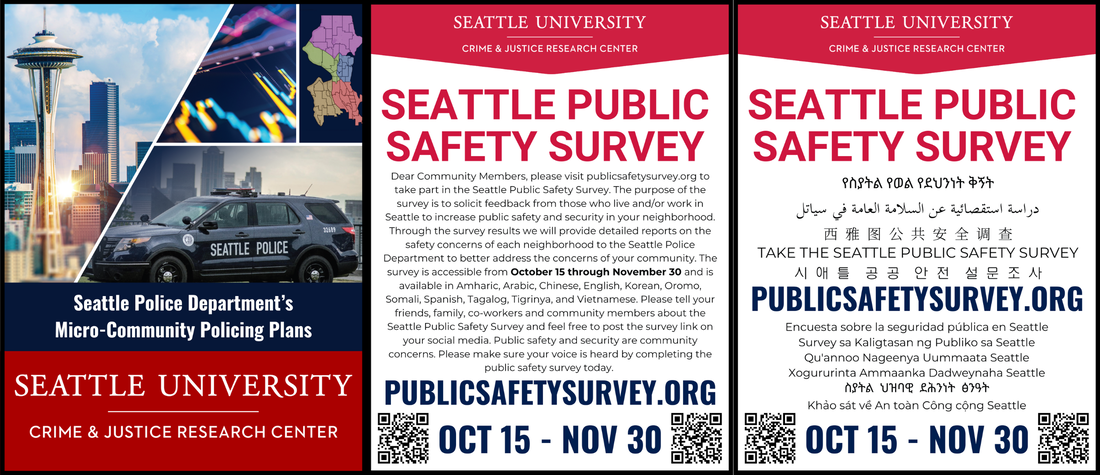
The Seattle Public Safety Survey is part of the Seattle Police Department’s Micro-Community Policing Plans, now in its 12th year, and has been administered annually by Seattle University’s Crime and Justice Research Center.

Traffic safety remains the top concern, continuing to rise in prominence in recent years. Participants frequently cited a sense of lawlessness on the roads and a lack of enforcement of safety violations across all types of vehicles, including electric bicycles and scooters.

One of the most significant findings this year is that community capacity rose to the second-highest concern, surpassing both police capacity and property crime for the first time in the survey’s history. This suggests that residents are not just concerned about police response to public safety issues, they are increasingly focused on whether the broader systems and services in place are able to respond effectively.
In addition to identifying top public safety concerns, the survey measures key public safety–related quality-of-life indicators including police legitimacy, social cohesion, informal social control, social disorganization, and fear of crime, at the citywide, precinct, and neighborhood levels. These measures allow community members, practitioners, and policymakers to assess the overall “public safety health” of the city and its 58 micro-communities and to use this data to inform and improve responses.

Police legitimacy ratings — measured on a 100-point scale — declined in 2025 following a brief increase in 2024, which had marked the first improvement after a steady decline from 2020 to 2023. Ratings, which were above 60 in the early years of the survey (peaking at 64.4 in 2016), fell into the 40s and 30s in recent years, reaching a low of 38.7 in 2023, rising to 41.9 in 2024, and declining again to 38.8 in 2025.

Results of the survey will be presented in SPD Community-Police Dialogues on select Mondays from May through August via Zoom. Community members will have opportunities to engage with SPD personnel about the results and discuss public safety concerns at the precinct and neighborhood levels. Registration is available online, and full results can be found on the Seattle Police Department’s Micro-Community Policing Plans website.

The Seattle Public Safety Survey is one of the longest-running efforts in the country to systematically track community perceptions of public safety over time, providing a rare longitudinal view of how trust, fear, and public safety concerns evolve at the neighborhood level.
Southwest Precinct (West Seattle and South Park)-specific results start on page 56 of the results report.

SIDE NOTE: The Micro-Community Policing Plans mentioned above cover neighborhoods chosen because, at the time of this project’s inception, those are the areas that had active neighborhood organizations with which SU and SPD could partner. But the survey every year is open to all, and we (among others) usually announce it a few times to help get the word out when it’s open.

12 Replies to "What are your biggest public-safety worries? See if they match this citywide survey's results"

  • Bad Survey April 20, 2026 (11:50 am)

    One of the highest concerns for West Seattle is “police legitimacy”. This is a deeply flawed definition (according to the document) and should raise questions about the entire document. Police legitimacy mixes several fundamentally different concepts: do people believe the police are effective, should people do what the police say, and are the police biased. These are very different concepts! I don’t believe in the police in Seattle because they haven’t proven that they have the resources to handle the crime. That means I want more police, not less. Intermingling these concepts will lead to “defund the police” narratives being shown as equivalent to “fund the police more” narratives in data. 

  • Slow the "F" Down April 20, 2026 (12:49 pm)

    I think it’s really worth noting in the results for SW Precinct that Traffic Safety takes the spot for top concern in both comments and box clicking for this survey. Meanwhile our esteemed city council rep is out there kafkaesque quest to see if spending money on traffic safety is really worth spending. 

    • Lauren April 20, 2026 (2:25 pm)

      That caught my eye, too…

  • aRF April 20, 2026 (1:29 pm)

    To my eye, the chart on page 10 detailing the citywide demographics looks all messed up. For example,  82.7% of the respondents are Hispanic, and 43.7% transgender. I think the data got shifted down a line at some point. 

    • Daniel April 20, 2026 (3:15 pm)

      I suspect it must be a display error?  In their description a page above, they write “Compared to Seattle demographics, survey respondents were disproportionately more likely to be non-minority and female.” But the following table has non-minority respondents as <1%, and female as <10%, which seems completely contradictory to the prior statement. Also none of the subsequent individual precinct results have the same error.

  • North Admiral Neighbor April 20, 2026 (5:10 pm)

    Traffic and pedestrian safety is definitely my #1 concern. I don’t have any close calls with gun violence or the violence from the homeless on a daily basis but almost getting hit by inattentive drivers is an almost daily occurrence. Most drivers here seem fundamentally unaware of the idea of unmarked cross-walks and think that they don’t have to yield to someone crossing a busy road such as Admiral Way at a marked intersection that doesn’t have a marked cross-walk.

    • Frog April 20, 2026 (7:58 pm)

      Why doesn’t SDOT paint more crosswalks?  It seems not expensive compared to their usual traffic-snarling projects, and hard to imagine any downside.  It’s almost as if safety is not really the priority, and they mostly want to promote conflict between cars and pedestrians to strengthen their case for war on cars.

      • North Admiral Neighbor April 20, 2026 (9:18 pm)

        SDOT would have to paint crosswalks at every single intersection along roads such as California Ave and Admiral Way which I don’t think they’re willing to do.@Dysfunction I do agree that there’s plenty of dumb pedestrians but they tend to pose less of a threat than a dumb car can (due to a pedestrian being ~200lbs vs. 4000lbs for a car). And totally agree about not crossing mid-block or against a red signal, I’m just talking about crossing at intersections where it is considered an “unmarked crosswalk”. I’d say that less than 10% of cars will stop for you if you start to walk into the unmarked crosswalk and seem quite surprised that a pedestrian would expect cars to follow the law and yield to the crossing pedestrian. I’d say that 90% of drivers not knowing the rules around unmarked crosswalks makes it accurate to say “most drivers”. The city’s number one priority is increasing safety for everyone which lane reductions and speed reductions are valuable tools to do so. A car traveling at 25mph has a much higher chance of stopping in time than a car traveling at 40-50mph. What we truly need is significantly more enforcement, both automated and old fashioned “speed traps” to change driver behavior toward safety.

      • Foop April 20, 2026 (9:28 pm)

        Drivers don’t respect those either.

  • Dysfunction April 20, 2026 (5:45 pm)

    Oh please, get a grip. “Most drivers” don’t have a understanding of basic crosswalk rules? I drive a lot and also jog here and every once in a while see a car do something dumb, but also see inattentive pedestrians that walk against a red pedestrian signal at crosswalks, especially at California and Edmunds. They just assume after waiting for a couple minutes that since a traffic light turned red they are next to cross. And to clarify, pedestrians do not have the right to cross the street in a marked crosswalk on a red signal. They do at unmarked crosswalks, like the middle of California Avenue. What I can say for sure is that a lot of drivers are sick of the city ignoring that driving is easily the number one mode of transportation, and will be into the future no matter what some people dream up, and limiting capacity with lane reductions, bus lanes, bike lanes, bus bulbs, and speed reductions on roads that don’t need makes zero sense. 

    • K April 21, 2026 (5:44 am)

      Or, perhaps, it is widely known that cars are the #1 form of transportation in the city, and that is seen as a failure.  I certainly see it as a failure, and i’m glad steps are bring taken to allow and encourage other ways of getting around.  

  • E April 20, 2026 (7:50 pm)

    If the city does not invest in all other modes of transportation, then people who currently do not drive frequently will be forced back into car dependence. How do you think that will affect the current traffic woes? Which causes more car congestion: lane reductions and traffic calming or more people operating motor vehicles? 

Leave a reply

Your email address will not be published.