Questions abound at Fauntleroy/Rose median meeting

By Tracy Record
West Seattle Blog editor

About 30 people gathered at Southwest Library Wednesday night to talk about SDOT‘s plan for a new crossing at Fauntleroy Way SW and SW Rose Street [map].

Most expressed the opinion that SDOT’s concept for the crossing – at the spot where the city removed a painted crosswalk 19 years ago – is overkill.

Most of the concerns centered on the raised median that is planned between the ferry holding lane alongside Lincoln Park and the southbound travel lane of Fauntleroy Way, though there was not a universal agreement on what might be better.
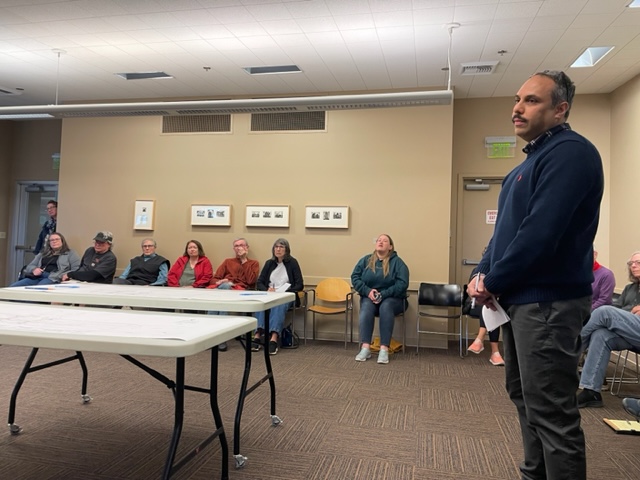
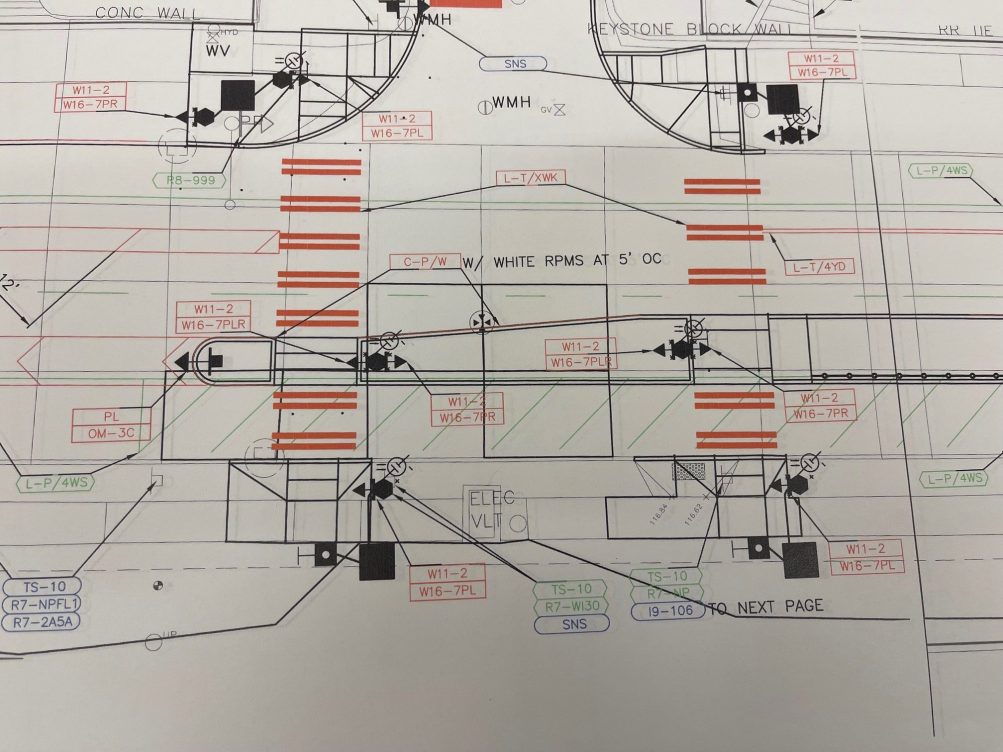
SDOT reps, including chief safety officer Venu Nemani, explained that this is a Transit Spot Improvement project, since the RapidRide C Line stops north of the intersection on the northbound side. They didn’t make a presentation, but rather talked to attendees, seated around the periphery of the room, until breaking into two groups to stand around tables with the sketched-out design, same one unveiled last fall:
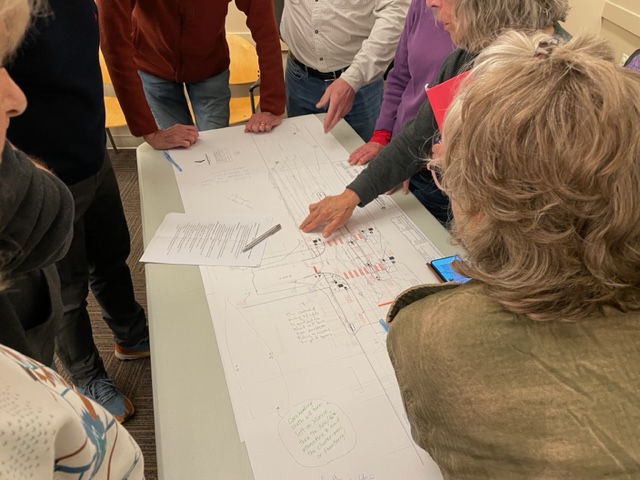
At the start, Frank Immel of the Fauntleroy Community Association – which joined the Morgan Community Association in organizing the meeting – implored attendees not to “beat up” the SDOT reps, pointing out that while government is often criticized for “not doing anything,” this is a situation in which they responded to community concerns by “doing something.”

SDOT’s Ching Chan noted that this is a rare RapidRide stop without crossing improvements, and described this as a fairly simple project, “quick and low-cost,” and saying there hadn’t been “heavy engagement” with the community because this is about safety “and for SDOT safety is non-negotiable.”

Nemani said traffic data to help with decisionmaking about the intersection was gathered in fall of 2024. That became a point of criticism for some, saying that wouldn’t have been an accurate sampling of how busy the area can get with summertime ferry usage, park usage, etc.

Regardless of traffic-volume accuracy, Nemani noted that many drivers were going well over the 25 mph speed limit. Some area residents seized on that as a concern, worrying that some will zip right through what’s meant to be the holding lane when it’s not full, endangering the pedestrians on the new median, waiting to cross. “Ferry people” rushing to get to the dock were cited numerous times as a source of concern.

And that, Immel observed, is what makes this location different from other places in the city with raised-median crossings – this is the only residential neighborhood in the city with ferry traffic.

Some advocated for the other options Nemani said had been considered – a traffic signal activated by pedestrians, like the one a few blocks south on Fauntleroy, or flashing beacons without a median. He said analysis of the situation in light of the Manual of Uniform Traffic Control suggested it didn’t rise to the need for one of those other options. Then why did other intersections on Fauntleroy have pedestrian-activated signals? he was asked. He said repeatedly that he couldn’t speak for why past SDOT employees made the decisions they did.

Another thing about the median, he noted – it’ll enable more poles to be mounted with the flashing beacons, so the intersection will have more of them. (And if you’re wondering about parking, he said it will lead to the loss of eight spots along Fauntleroy.) For those worried that some drivers would use side streets to avoid this area, Nemani said they could add traffic-calming features to side streets to dissuade or at least mitigate that.

The concerns kept coming: What about the ferry-bound drivers who approach from the south and make U-turns to get into the line? What if a broken-down vehicle blocks the lane between the curb and the median? One person insisted, “The median is not necessary at all.” The meeting ended without a summary, but those on hand had received an hour and a half – 50 percent longer than the meeting’s expected length – to air their fears.

WHAT’S NEXT? Chan told us the feedback will be considered in their final decisionmaking. As for who has the final say, she said Nemani’s input would certainly carry weight. The plan would likely be finalized by midsummer and they hope to start construction by year’s end. We also asked about the project budget; though the cost wouldn’t be clear until they know exactly what they’re building, SDOT’s Aidan Bernal told us that right now the budget is ~$250,000.

21 Replies to "Questions abound at Fauntleroy/Rose median meeting"

  • Aaron May 8, 2026 (12:17 am)

    I want to see serious speed humps up and down Fauntleroy from the Morgan Junction to the ferry. I’m really tired of watching (and hearing) people driving at double the posted speed limit past parks and playgrounds, elementary schools, and designated crosswalks.Rob Saka has been absolutely no help on this at all, which I know is shocking given his laser-focus on traffic safety throughout West Seattle.

  • Alex May 8, 2026 (9:28 am)

    I was at the meeting and left feeling more frustrated about the condition of Fauntleroy, the side streets and SDOT.  The FCA has been asking SDOT for years to improve the Rose crossing. It is only now that the city has Rapid Ride safety protocols and Rose is one of 3 stops across the the city identified as unsafe, that SDOT acts.  SDOT’s 2024 Fall Survey found an average 11,000 cars went through Rose daily and that does not include the summer park users and Kitsap day trippers.   Ferries estimates that by 2040, some 2M vehicles will use the dock.  As homes on the east side of Fauntleroy behind the dock to Morgan and Wildwood/Barton up to 35th are replaced with 5 story apartment buildings in the next 20 to 30 years,  the area will unnavigable.  The time to act is now.   Fauntleroy needs a dedicated queue lane , a safe place for U Turns (roundabout at the gas station?), speed deterrents and all of the side streets to the east of Fauntleroy and south of the dock need speed deterrents.  The dock stoplight and the Rose bus stop improvements are band aids.   I would challenge SDOT to stick around and post cameras as the summer gets going with a busy Friday afternoon with the speeders, motorists who don’t know how to queue for this dock, the line cutters, the U Turns and the walkers trying to cross Fauntleroy.

    • Mike B May 8, 2026 (9:33 pm)

      Seems like a reasonable, incremental step in the right direction rather than “band aid”. No true need to “act now” when the problem you’re describing will be in the 2040’s and 2050’s. While 2M annual vehicles seems scary, that only ~5,500/day. We have other priorities to work on in the next decade besides completely rebuilding a couple miles of road, and we can figure this out in 2036 because, as you said, this will be a problem in 20-30 years.

    • Fauntleroy Neighbor May 12, 2026 (10:44 am)

      I also attended the meeting and had several clarifying questions.I asked Nemani when the data was collected, how it was gathered, and the timeframe it represented. He shared that the data was collected in October 2024 over a Tuesday–Thursday period using a camera positioned at the Rose St intersection. The scope of the collection was limited to measuring vehicle traffic and pedestrian crossings specifically at that intersection. When I asked whether the data included surrounding blocks—specifically along SW Rose St between SW Thistle St and SW Monroe St—he confirmed that it did not. The analysis was confined strictly to the immediate intersection.Given this limited scope, the data does not fully represent the broader conditions of the area. For example, the RapidRide stop on the west side is not located directly at the intersection but several yards away, and the east-side stop on Fauntleroy Way SW is also offset from the intersection. As a result, pedestrian crossing activity occurs throughout the adjacent blocks, not exclusively at the intersection itself. Additionally, while it was stated that incident reports at the intersection was zero, this appears to reflect only incidents occurring within a very narrow boundary. Expanding the view to include the surrounding blocks would likely capture additional incidents, including those involving pedestrians. Off the top of my head I know of three that occurred because I called 911- I live right there. The timing of the data collection also presents limitations. Data gathered over two days in October does not account for seasonal variation and may not reflect typical traffic or pedestrian patterns throughout the year. A more comprehensive dataset, incorporating multiple time periods—including spring or summer—would provide a more accurate baseline and enable a more balanced assessment.Nemani also referenced adherence to the most current applicable manual in evaluating potential solutions. He noted that options such as a signalized crosswalk or pedestrian-activated crossing did not meet the thresholds for “high traffic” or “high pedestrian volume” based on the available data. However, he also stated that the recommendation to install a median and remove parking on the east side/bike lane was a “conscious decision,” rather than one strictly driven by the data and criteria in the manual.When asked if SDOT had spoken to WSF (Washington State Ferries that are part of WSDOT) the other representative on behalf of SDOT skirted around answering and when pressed on it he mumbled “yes” which otherwise proven different I would assume he lied when responding. Personally I don’t believe a median with make pedestrians safer, I sure wouldn’t feel safer crossing three lanes vs two lanes. Crossing west to east will create a blind spot having to see around the bus to cross the street. Also, pedestrians will need to be extra cautious of cars short stopping at the crosswalk/ being rear ended- we were told by city rep that cyclist will have to get in queue with the cars heading south to north with the 8 parking spots being removed. Cars trying to make the ferry will cut and speed through the bus lane/ and cut off those in the ferry lane. Personally a stroller and dog don’t all fit on the median waiting to cross the road making it more dangerous to cross. I’m pro simply putting in a pedestrian crosswalk where you have full visibility (no stop light) and a rapid ride shelter so everyone is aware of the bus stop on the west side of Fauntleroy. Gordon, Frank, K, and Mike B- community input provides important context that may not be captured in limited observational data. Residents experience the day-to-day conditions of the area and can offer insight into patterns, behaviors, and safety concerns that warrant consideration. Continued engagement between the city and the community is valuable in identifying solutions that are both effective and practical IF the city listens and implements feedback. We pay our taxes and have a voice, we pay the city representative salaries. So yes, keep the meetings for the communities to share their concerns and provide additional insights. Work in partnership for a solution to resolve the real issue- installing a simple cross walk with flashing lights for visibility. What is a waste of money is using inaccurate data to make a decision that affects the people that live there and those that pass through and it’ll have no impact to the city reps that are in their offices in Sodo and downtown. Waste of money is also over complicating the solution when other options are more cost efficient, built quicker, and the majority of voice from the community was considered in the decision making. With or without the median I want to be able to trust our city representative. It’s disheartening and discouraging when you challenge the city representatives to explain their methodology and when done so, you can clearly see where the data is flawed, inaccurate, or additional matters weren’t put into consideration. I would give these reps from the city more creditability if they were honest with the community and actually did their work and were held accountable as we all are within our jobs. 

  • Mark Schletty May 8, 2026 (9:48 am)

    “and for SDOT safety is non-negotiable* says it all about why SDOT does all the anti car things it does. All SDOT has to do is declare anything it wants to do to be about “safety” and they can ignore all public input, even if it is overwhelmingly opposed to their plan. Like the stupid Roxbury hill lane removal. This is just another form of totalitarian government like Trump is imposing on the country. We are the government so we can do anything we want. To get back to a SDOT that supports all forms of transportation, including the most needed and used form of cars, virtually the whole department needs to be replaced. 

    • Playtpus May 8, 2026 (12:07 pm)

      Mark, You are correct that SDOT puts human safety, regardless of mode of transportation, above opposition, and that is obviously how it should be. Safety is not democratic, that is literally the point of having trained people in a department to make the city move better. Cars are a popular way to get around, but they also take up the most space. The city should prioritize moving the most amount of people as fast and as safe as possible. This project is in alignment with that goal.

      • Mark Schletty May 8, 2026 (4:56 pm)

        Just to clarify for platipus and frank below. I made no comment on whether or not this particular proposal was for safety or not and i did not claim that any actions taken for safety are totalitarian. My comment went strictly to the SDOT comment that any thing they claimed was for safety was non-negotiable. That statement didnt limit SDOT to only real verifiable safety measures. It claimed that anything they claimed was for safety is non-negotiable. Not anything that actually is for safety but anything they claimed was for safety. That allows the state to dictate what citizens have a right to have influence on.  That, my friends, is totalitarian. 

  • Scott Cates May 8, 2026 (11:27 am)

    Good on you West Seattle Fauntleroy folks for gathering and speaking out. Keep challenging SDOT, asking questions, and demanding answers. I personally witnessed SDOT’s annihilation of NE 43rd St. at University Way NE in the U-District. In the space of 300 feet SDOT ruined traffic connectivity, endangered pedestrians, and blighted the block with around 20 enormous light-and-bus poles. This was massive overkill and grossly over-engineered here. Local businesses have suffered and the block is a transit ghetto after five years. There was ZERO integration with Metro, The City, Sound Transit, and the local Business Improvement Association (U-District Partnership). Numerous other solutions would have solved the majority of problems that SDOT’s decisions created here were either not explored or completely dismissed. And they had 20 years to planFight your fight, West Seattle! Demand answers! Insist on community participation and involvement in the decisions that will affect your neighborhood for decades to come. Best of luck!

    • Ursula May 8, 2026 (5:05 pm)

      > I personally witnessed SDOT’s annihilation of NE 43rd St. at University Way NE in the U-District. In the space of 300 feet SDOT ruined traffic connectivity, endangered pedestrians, and blighted the block with around 20 enormous light-and-bus poles.

      Have you even visited this block, or are you just trolling? I often sit at the tables they put in on those two blocks of NE 43rd—they’re a godsend since many of the cheap eats on the Ave are counter-service only. The only thing SDOT annihilated is some of the smelly, noisy, and unsafe car traffic on that 300 foot stretch; it would be a much worse place to sit or wait for a bus if they continued to allow cars. In any case, it’s a 300 foot span, and cars can drive on literally every other nearby block. Give me a break.

       There was ZERO integration with Metro, The City, Sound Transit, and the local Business Improvement Association (U-District Partnership).

      Those tables are the product of collaboration with the U-District partnership. The bus-only lane serves Metro busses. The lack of dangerous car traffic makes it safer for throngs of people exiting Sound Transit’s station. How is this not a successful collaboration?

    • Mike B May 8, 2026 (9:26 pm)

      LOL! I used 43rd for a couple years transferring between the subway station on 43rd and Route 44. Ya know, Link’s U District subway station with 7,500 daily riders. Idk what you’re on about when you say it was ruined and uncoordinated; it’s brilliantly integrated into the dense, urban fabric and provides some non-car focused space for people to use. The City, ST, Metro, and UDist spent years figuring that street out while hosting several public meeting and surveys to gather feedback.

      • Scott Cates May 10, 2026 (1:53 pm)

        The picnic tables were added to help the local restaurants offset the impacts of business loss. Please support these local businesses. All Metro had to do was route buses from 15th to Brooklyn, them North to the station. But because Brooklyn was designated as a section of the obsolete Green Streets program, the part of Brooklyn adjacent to the UW Tower was curbed six inches too narrow for Metro buses. Metro buses frequently force their way across University Way by aggressively honking through the crowded intersection on 43rd instead of slowing to 10 mph. It is only a matter of time before someone is seriously injured by this approach. The bicycle-only sections of 43rd between Brooklyn and 15th have been the cause of multiple pedestrian falls since this was implemented and both the post office and bookstore have had their delivery access impeded by the concrete berms. I’ve met with City Council Transportation Committee on this issue and they were very much surprised at of the engineering overkill and lack of pedestrian usability. But by then it was too late and SDOT had finished the 43rd St refresh. I also regularly interact and collaborate with the UDP whenever it’s needed. There continues to be a dysfunctional lack of communication and between Seattle’s transportation agencies and the communities they both impact and serve.  Also, the 20 light poles each cost around $100,000 so there’s at least two million dollars in just that aspect. About one-third of the poles could have been reduced by performing double-duty but neither SDOT nor Metro wanted to share responsibility for each other’s infrastructure. Many cities have central planning offices that combine and integrate their civil infrastructure with both public and private development. Seattle does not. This lack of coordination wasteful of time and tax dollars, which ultimately costs everyone in the community. Again, all Metro had to do was route buses from 15th to Brooklyn, them North to the station. A pedestrian-only redesign of 43rd between University Way and Brooklyn was never considered during the planning period from 1990-2010. Those who do not remember the past are condemned to repeat it West Seattle deserves better.

  • Scott Cates May 8, 2026 (11:32 am)

    And insist in your council member’s accountability. 

  • snowskier May 8, 2026 (11:47 am)

    If it’s really all about safety when crossing the street then put up a pedestrian triggered cross signal just like 2 blocks south.  Seems like that allows people access to Lincoln Park in a safe manner.  It’ll allow safe passage without creating any of the other dangerous scenarios such as people cruising through the ferry lane, around parked cars,  a bottleneck for fire and emergency vehicles to overcome, etc.  But… if your own studies don’t indicate there is a safety issue that would require simple solutions such as a signal or a beacon then it boggles the mind why you want to input a much more complicated piece of infrastructure and then suggest adding even more things to overcome the problems you created by inputting what you determined was an unneeded thing in the first place.

    • 1994 May 8, 2026 (8:51 pm)

      Agree 100% with Snowskier’s comment.  The SDoT proposal is way more complicated than what is actually needed for a safe street crossing.  

    • Mike B May 8, 2026 (9:09 pm)

      The simple answer is a pedestrian signal, which is just a traffic signal, costs one-to-two million dollars to install. Design, drilling foundations, adding conduit runs, installing poles and mast arms, adding a power drop from a utility pole, and a controller cabinet all add up. Flashing beacons, like those SDOT is proposing here, are intentionally simple and low-cost for these situations.

  • Marty2 May 8, 2026 (12:25 pm)

    It appears the north and south travel lanes will be shifted to the east side of the street and the raised median will be in the current southbound lane.  I think this is more about the Rapid Ride bus not having to merge back into the travel lane after stopping at the bus stops than it is about safety.  This design looks more unsafe than what’s there now.  I expect impatient drivers will go around the bus in the opposite travel lane.

  • Gordon May 8, 2026 (12:45 pm)

    Fauntleroy could use a holistic safety redesign from Alaska St to the ferry. This is one small step in the right direction. Thank you SDOT for helping keep everyone safe. 

  • Frank May 8, 2026 (3:10 pm)

    Don’t really understand why SDOT held a meeting about this at all. Installing crosswalks where they are necessary should not be up for debate, and installing them should be fast and routine.Lol to Mark Schletty for calling a crosswalk “totalitarian”. Grow up.

    • K May 8, 2026 (7:57 pm)

      Exactly. Outreach to the non-experts is a joke, SDOT needs to move forward with projects quicker and eliminate these silly meetings.

    • Mike B May 8, 2026 (9:18 pm)

      Amen. We wonder why city government can be so ineffective and unable to act in reasonable timeframe, this is why. A couple years of design and outreach and construction for a safe bus stop and crossing at a huge city park. These endless outreach meetings to please a few people is a waste of our taxpayer dollars and an embarrassment. The City can’t just move things forward because every person needs coddling.Where’s the public survey and outreach for those of us who want to support these kinds of projects and want them built? Why is there no way for our voice to be heard except by attending a meeting for a select audience announced two days ahead of time? Build the dang thing.

Sorry, comment time is over.