VIDEO: Council committee’s Vision Zero briefing, with one West Seattle project mention

(Seattle Channel video of committee meeting; Vision Zero item starts 35 minutes in)

By Macey Wurm
Reporting for West Seattle Blog

SDOT‘s chief safety officer says so far this year, things are safer on Seattle’s streets.

Not safe enough, says District 1 Councilmember Rob Saka. The committee he chairs – Transportation, Waterfront, and Seattle Center – had the Vision Zero safety progra on its agenda this past Thursday, including a review of 2025 data and an overview of planned projects for 2026. The meeting was the day after Saka called for an audit of the program, as we reported here.

Addressing the audit during the committee meeting, Saka said, “Vision Zero is about saving lives and while we are seeing some real progress the tragic reality remains that too many people are still dying and suffering serious injuries on our streets.” He also called for a moment of silence for the two people killed in a wrong-way crash on Highway 509 south of the city last weekend.

Funding for Vision Zero and other safety initiatives is part of the eight-year $1.55 billion Seattle Transportation Levy passed by voters in 2024. The presentation during Thursday’s meeting was given by Venu Nemani, SDOT’s Chief Safety Officer and City Traffic Engineer.
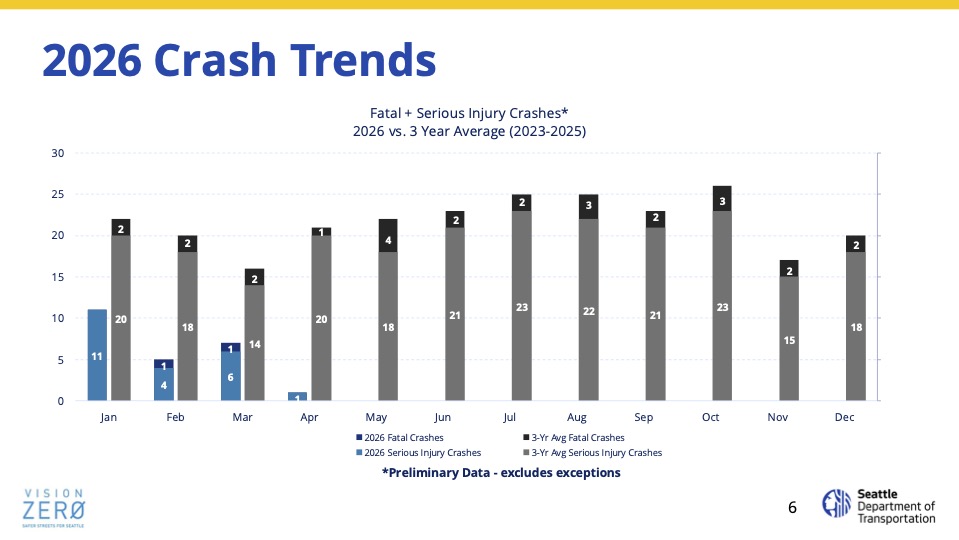
He noted that the first quarter of 2026 has brought fewer fatal collisions and fewer serious injuries compared to an average number from the past three years, and introduced some planned projects for the upcoming year.

These include four levy-specific deliverable goals– “safety upgrades on up to 12 corridors across the city, 40 high-collision locations, arterial traffic calming on 50 corridors, and pedestrian head-start signals at 280 intersections. Nemani added that a plethora of projects have been planned even in light of the construction timeline barrier provided by the FIFA World Cup coming to the city this summer.

Both Saka and citywide councilmember Alexis Mercedes Rinck voiced concern over SDOT improving their response timeline to traffic incidents involving fatalities or serious injuries. Saka wondered whether a 72-hour response model similar to that currently used for filling potholes could be implemented to make “immediate remediations” at collision sites.

Nemani explained that this would be difficult because it often takes much longer for SDOT to receive a police traffic-collision report – which is necessary for the department to fully understand the nature of the crash before beginning safety improvements.

“But I do understand the underlying need to have a more rapid response at locations that have had fatal collisions. I still don’t have all the specifics to share with you, but it is something that we are closely looking at,” Nemani said.

Councilmember Saka also addressed public comments that he heard at at the start the meeting, including what he called an “inference” that the city needed more bus lanes, bike lanes, and pedestrian-friendly improvements. He responded by declaring that he “fundamentally disagree(s)” that elected officials should “somehow be responsible for approving every safety project.” He noted the “Curby” controversy as an example, in which he was criticized for a $2 million proposal to remove a Delridge Way median preventing left turns to a preschool: “Every time that I’ve intervened in specific design decisions hasn’t gone too well. Even when I’ve fought for immigrant and refugee communities or kids, daycares, working families, some people have lost their natural minds. Even when we landed on a compromised solution to save Curby, still engendered passionate feelings.” Saka said.

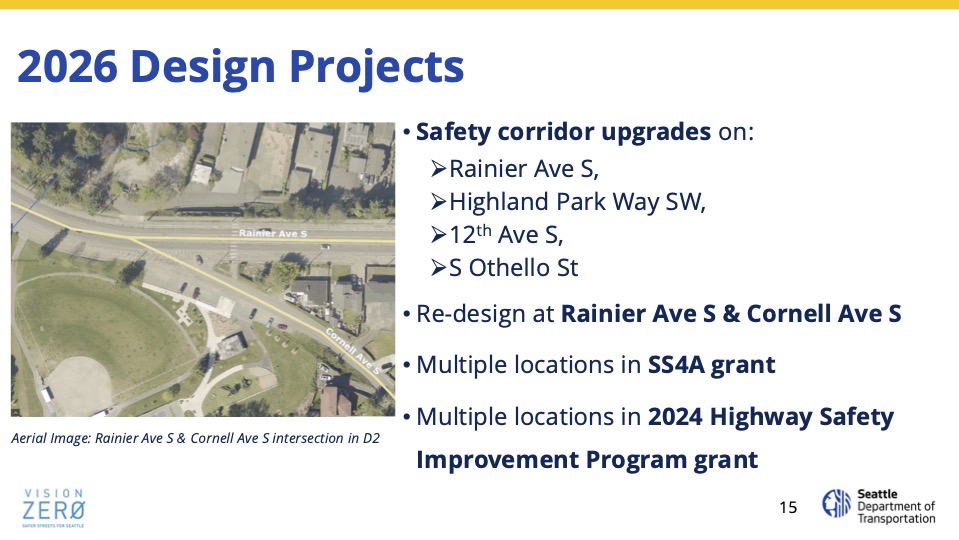
The only West Seattle project mentioned in Nemani’s presentation (here’s the full slide deck) – and briefly, at that – was the plan to convert the outside downhill lane on Highland Park Way to bicycle and pedestrian space:
36 Replies to "VIDEO: Council committee's Vision Zero briefing, with one West Seattle project mention"

  • K April 19, 2026 (6:41 pm)

    This frickin’ guy…

    • k April 19, 2026 (8:21 pm)

      Still can’t accept that the Curby thing was a debacle, it was deeply unpopular, and would have made the road less safe for those immigrant and refugee communities, kids, daycares, and working families.

      • Matt R. April 21, 2026 (9:57 am)

        I live in the neighborhood and appreciated Mr.Saka’s leadership in the curb situation.  He was the only one who stuck his neck out to advocate for the daycare that was not even consulted before the curb was installed!  Then he advocated for a compromise solution that has worked out really well.  I use the jughandle myself on a regular basis and I see others do the same.  

        • Slow Down April 21, 2026 (10:58 am)

          Is every business and every street required to acquiesce to changes on their street? The same camp that complains endlessly about how much things cost is often the same camp that demands endless consultation on every road change without considering the costs incurred in endless outreach.  And since literally every possible change to a street’s design will have an impact on adjacent residences and businesses one will always be able to find someone negatively effected by the change, so the unsafe status quo is preserved, and the ongoing negative effects on everybody are ignored because someone ignored the forest for the trees.

          And the fact that you use the “jug handle” is supposed to speak to it being a good idea?  I’m sure some people would love to drive 50 down Fauntleroy, so that must be a good idea too.  The “jug handle” isn’t a compromise, it’s a solution to a non-problem that puts pedestrians, cyclists, and even other drivers at greater risk.

  • Jimmy Jam April 19, 2026 (8:34 pm)

    He also called for a moment of silence for the two people killed in a
    wrong-way crash on Highway 509 south of the city last weekend.

    Do we know the identity of the murderer who was driving the wrong way?  Any other pertinent info?

    • WSB April 19, 2026 (10:19 pm)

      The WSP media memo identifies the driver, one of the two people who died, as 21-year-old Jaedon Parnell of Kent.

  • Al Aska April 19, 2026 (10:39 pm)

    “Not safe enough”… Well, what is the magic number of deaths below which Seattle streets are considered safe? Is it literally zero? We have been ranked in the top ten most traffic congested cities for decades now. In fatal crashes per capita (# of deaths), we are ranked way down at 204. That’s two hundred and fourth! How many more traffic obstacles contributing to nothing but traffic delays and jams must we install, spending millions on nonsense so that we waste even more time driving to work while elected officials pat themselves on the back like they’re genuinely doing something worthwhile? 

    • k April 20, 2026 (6:25 am)

      I don’t consider any traffic deaths acceptable, so yeah, zero is what I think they should aim for.  Are you literally trying to identify the acceptable number of people who can be killed to make your commute 10 minutes faster?

      • Al Aska April 20, 2026 (9:02 am)

        In every single human endeavor, people generally identify acceptable risks and outcomes including deaths and live with it. The entire insurance industry is built on this premise and if all of us insisted on absolute zero chance of any tragedy, the entire civilization would come to a screeching halt. How is this a shock to you or to other pearl clutching responders here? Any of the so-called “arguments” for Vision Zero are based on phony concerns, hysterical yelling, and dishonest false dilemmas like the “how many of your friends and loved ones” nonsense. You know what? You’re right, I’ll call all my friends and loved ones and tell them to never leave the house again and to wear helmets inside of their padded rooms. Meanwhile, any rational data showing Seattle is one of the safest cities in the country for traffic will be ignored by the pearl clutchers because they’re “an inaccurate metric”. Sure they are.

        • Jake April 20, 2026 (12:23 pm)

          Insurance is an money making industry, zero control over the capitalist aspects of insurance. Safety in our city streets, we do have control over. Satisfied with a death count is insane. 

    • Charles Burlingame April 20, 2026 (8:02 am)

      How many of your friends and loved ones are you okay with losing?

    • E April 20, 2026 (8:03 am)

      The only way to relieve congestion is to have fewer cars on the road. The only way to have fewer cars is to make driving a less convenient option.
      Looking at traffic safety strictly by deaths per capita is an inaccurate metric. Safety can be measured in many ways, including long-term affects. Cars as the primary mode of personal transportation in cities does not make sense.

      • Vision zero is the problem April 20, 2026 (9:01 am)

        E—I appreciate your honesty.  I entirely disagree with you, but you  acknowledge that your vision of safety is specifically anti-car, and you affirmatively state that policy should in fact target cars to make them less convenient.  I disagree.  I think the priority of SDOT, WSDOT, KC metro etc should facilitate smooth movement of people, in ways that meet their needs. we should have reasonable traffic laws, and we should enforce those laws and punish drivers who cannot be bothered to obey them.  But we should be clear that the problem isn’t “cars” as such,  it is “some drivers” who persist in anti social behavior.  The core problem is that it is 100% disconnected from lived experience to think that bicycles and buses will meet the needs of people’s lives as they are constructed.  It simply must be acknowledged that making such a shift would be a combination of difficult/impossible for some, and radically inconvenient for others.  I’ve never seen any plan for ameliorating that; instead the plan is just that it’s those people’s problem to deal with.  So explain again how buses work for childcare/school drop off and then trips to work?  Explain how bicycles work for the less physically able—even e-bikes do not solve for that problem.i suspect we both agree that there are real issues with some anti social drivers who refuse to follow traffic laws such as speed limits, traffic lights, stop signs, impaired driving laws etc.  Can we work together to support enforcement and punishment in these cases?  If you drive 100 in the city, we can’t “vision zero” our way out of that problem.  That person must be removed from free society.  They won’t magically become safe on a bus, and I don’t want to ride with them there either. Vision zero punishes everyone else for the literal, actual, should-be-punishable crimes of a relative few, it’s a tantrum policy that is reminiscent of grade school teachers punishing everyone until someone fesses up.  At least we can discuss and debate these differences, so thank you. 

      • wscommuter April 20, 2026 (9:03 am)

        Allowing that I think your premise is flawed, let’s set that aside.  How do you propose to “make driving less convenient”?  My suspicion is that your “solutions” will inevitably fall disproportionately on poor folks – the very ones for whom public transportation may not be an option and therefore they have to drive to get to work, move their kids, and so forth.  But maybe I’m wrong.  Let’s here how you will solve all our problems.  I’m all ears.  As a bicycle commuter, I fully recognize my own good fortune in having the luxury of access to a route I can practically use for work, that I don’t have to haul kids or run other necessary errands at the end of my day and have the blessing of health that allows me to ride.  I don’t/won’t take the bus because it doesn’t work for me, so on those really bad weather days, I’m in my car.  Not going to change that either.  Please do explain your “solutions” 

        • E April 20, 2026 (12:11 pm)

          I’m not in a position to singularly provide a solution to this systemic issue. I am a proponent of VZ. Cars have historically had an extremely negative impact on our communities, especially our impoverished and marginalized ones. In fact, the speed of cars has contributed to the necessity of and dependency on cars. VZ seems to be a good way to reverse this harm. I’m not anti-car, per se; I am pro strong communities. I see dense urban areas with fewer cars and more people, especially young and old, in our public spaces as a sign of a healthy community. There’s a weekly Wednesday night happy hour for West Seattle Urbanism if you want to learn or debate more.

          • Kyle April 20, 2026 (6:14 pm)

            The interstate highway system and the personal automobile are major quality of life achievements. These have actually helped lift many people out of poverty providing better access to jobs, services, and schools. 

      • Frog April 20, 2026 (10:56 am)

        Thanks for telling the truth about “vision zero.”  It really is just war on cars, dressed up as a concern for safety.

    • Jake April 20, 2026 (8:06 am)

      As many as needed. We shouldn’t be satisfied until car driving is fully safe as can be. I disagree strongly with car-brained Saka.

      • Snowman April 21, 2026 (2:26 pm)

        I have literally ridden the bus with Councilmember Saka.  I have also seen him riding a Lime.  I would not consider him “car-brained.”

    • cwit April 20, 2026 (8:33 am)

      What’s the magic number of deaths that is acceptable for you to be able to drive to work in whatever time you deem fast enough?

    • bill April 20, 2026 (8:43 am)

      Yes, zero. Is staying alive not worthwhile?

  • Delridge Dude April 19, 2026 (10:49 pm)

    I appreciate Councilmember Saka for calling for an audit of Vision Zero.  Strong leadership from the Mayor of West Seattle!

  • Frank April 20, 2026 (8:02 am)

    There is technology that reduces wrong way driving deaths significantly. Maybe it could have prevented the 509 deaths or the west seattle bridge deaths of teenagers of few years ago. With the amount of money sdot spends on projects, these are a drop in the bucket. If its not city property then surely the state or county would be happy to take our contribution

  • Vision zero is the problem April 20, 2026 (8:33 am)

    It’s time to *end* vision zero, because most of its efforts miss the entire point, and are not true to the spirit of the original goal as articulated by the Swedes.  It’s become an anti car ideology rather than a good design framework.  Design well—absolutely.  Pretend that most people are not in cars, and hobble the cars? No, that is literally punitive insanity based on privileged preferences.  

    • E April 20, 2026 (9:28 am)

      Car usage in cities absolutely has to change, or in your words, be “hobbled”, in order to reach VZ. With limited public space and a geometry problem, you cannot effectively maintain the status quo and reach VZ. We haven’t gone nearly far enough, especially with getting car manufactures to increase safety for those outside of the products they sell.

      Overview of Vision Zero
      Vision Zero is a road safety policy first introduced in Sweden in 1997. It operates on the ethical principle that no loss of life or serious injury on the road traffic system is acceptable and that the responsibility for safety is shared between road designers, policymakers, vehicle manufacturers, and road users. Unlike traditional approaches that focus solely on human behavior, Vision Zero emphasizes designing systems that anticipate human errors and minimize the consequences if mistakes occur.
      Key Principles
      System Design Responsibility: Road and vehicle designs must prevent death or serious injury, acknowledging that human error is inevitable.
      Speed Management: Safe speeds are determined based on the potential severity of a crash, with lower speeds in areas frequented by pedestrians and cyclists.
      Safe Roads and Vehicles: Roads are designed for forgiving behavior, incorporating features like median barriers, roundabouts, and safe pedestrian crossings. Vehicles are required to include safety technology such as airbags, seat belts, and collision mitigation systems.
      Shared Responsibility: Authorities, designers, and users share obligations—engineers design safer roads, policymakers enforce traffic rules, and drivers adopt safe behavior.
      Continuous Monitoring and Improvement: Crash data is analyzed regularly to refine infrastructure and regulations to prevent fatalities.

      • Vision zero is the problem April 20, 2026 (12:17 pm)

        I’ve read that vision zero summary many times, and it’s just amazing how bad the seattle/SDOT implemented version is. Just one example: the speed management section says “lower speeds in areas frequented by pedestrians and cyclists”Seattle’s version: single lower speed limit for every street everywhere. This is how a science and data based concept as developed in Sweden becomes an ideologically driven, data-impervious system in Seattle. Reasonable approach: low limits in school zones and near parks etc.  Unreasonable approach: low limits on every street everywhere without consideration for circumstance. Real life west seattle application: 35th Ave SW South of Avalon should be 35; California makes sense as 25.  This is what reasonable, measured people would suggest.   It is not anti pedestrian to suggest that a few corridors be dedicated to moving vehicle traffic—at speeds that take advantage of the characteristics that these vehicles (including buses) possess.  Set the side street limits at 20. Arrest the people who speed in school zones, fine by me.  But there is no “science” behind a blanket speed limit across an entire city, that is nothing more than an ideological preference masquerading as science, and it gives both a bad name. 

        • anonyme April 20, 2026 (3:48 pm)

          VZITP, your blanket assertions and hyperbolic cherry picking of extreme examples that are somehow supposed to justify your desire to drive a vehicle at high speeds in an urban environment are simply unconvincing and unjustified.  Any residential corridor, whether it be 35th or some little side street, has the same right to safety protections and quality-of-life considerations.  E, on the other hand, has provided some very rational explanations of why our habits must change, including simply doing the math.  We cannot just keep adding more cars to the roads.  I don’t love Vision Zero because it completely leaves out an essential element – enforcement.  There are too many enabled drivers in Seattle who drive like idiots for one reason – they can get away with it.  That needs to end, along with car culture in general.

  • Let it go Rob April 20, 2026 (8:48 am)

    Rob “Curby” Saka needs to get over himself and recognize the traffic engineers are the smarter people in the room. When you’re in a pothole, stop digging.

    • Snowman April 21, 2026 (11:21 am)

      Are you suggesting we just keep funding Vision Zero without expecting to see results?  Is that what you want from an elected official?  I sure don’t!  

      • Delridge Dude April 21, 2026 (12:13 pm)

        Exactly!!  City Council has to leverage some form of accountability over a program like this, lest we just keep pouring in good money after bad.

      • Foop April 21, 2026 (12:28 pm)

        We should keep funding vision zero but telling people like rob Saka to get out of the way. Him calling for an audit is basically that meme of the kid riding a bike, shoving a stick in his spokes and asking who would do such a thing.

        • Snowman April 21, 2026 (2:18 pm)

          I respectfully disagree.  If by “people like Rob Saka” you mean the duly elected members of Seattle City Council, then is their job to not just “get out of the way” when things seem not to be going well.  Lives are literally at stake here, not to mention many tens of millions of taxpayer dollars.  Oversight, accountability, and quality control are absolutely critical.  

  • 1994 April 20, 2026 (10:22 pm)

    Vision Zero is a good idea in theory but when the wheels hit the road the good idea remains just that, a good idea and not a guarantee of safety for any road user. Safety is a shared responsibility for all road users including those walking, biking, scootering.…”Vision Zero is a road safety policy first introduced in Sweden in 1997. It operates on the ethical principle that no loss of life or serious injury on the road traffic system is acceptable and that the responsibility for safety is shared between road designers, policymakers, vehicle manufacturers, and road users. ” Hear about the Lime bike that ended up under the pickup truck on Hwy 99? TV reporting indicates driver not at fault and the bike riders caused the accident…..road users includes everyone on the street.

    • Charles Burlingame April 21, 2026 (7:24 am)

      What if we built our roadways around the proposition that a mistake shouldn’t cost you your life? Look away from the individual, and look at the system.

  • DavisWS April 21, 2026 (3:17 pm)

    I’m disappointed to see the personal attacks on Councilmember Saka. It doesn’t take much research to find out that it is the same small number of anti-Saka hold outs that will never forgive him for winning his seat from those who thought they were entitled to it. Vision Zero is Councilmember Saka trying to save lives… and when he feels that the program isn’t living up to expectations he steps in. That’s what leaders do.  He’s taking the steps necessary to improve it (again, to save lives), and for it, they attack him. Come on people, we need to get behind Rob Saka as he works to make West Seattle safer for us all. Wanting to improve programs is what we should want in a leader. Wanting to save lives is what we want in a leader.  Rob Saka has continued to be engaged with the us. He’s available. He listens, he responds, and he cares.

    • Delridge Dude April 22, 2026 (9:12 am)

      Here, here!  I am pro-Saka and proud of it!

Sorry, comment time is over.