
West Seattle, Washington
05 Friday
By Tracy Record
West Seattle Blog editor
After Sound Transit discovered West Seattle light rail’s potential price tag had swollen to $7+ billion, the agency examined the rest of the ST3 plan … and now reveals another big number: The overall cost of building out the system could be up to $30 billion more than last year’s Long-Range Plan estimate.
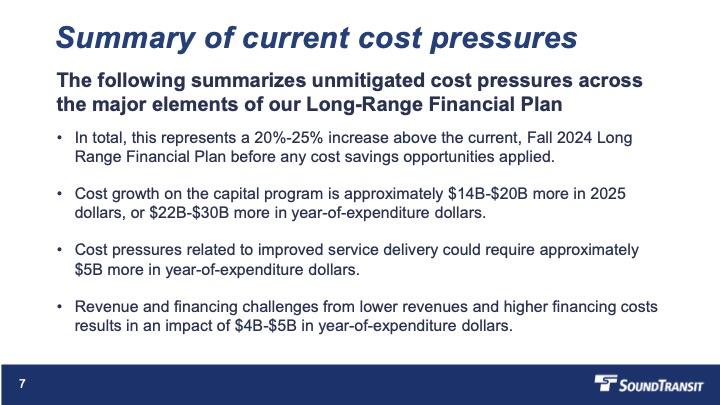
That was the biggest news from the Enterprise Initiative briefing at this afternoon’s Sound Transit Board meeting (which also noted cost-projection jumps in other aspects of the transit system, such as the cost of providing service, and a drop in expected revenue). No new project-specific estimates yet – for West Seattle or any other ST3 project – but staffers promised they’re coming and will be provided to board members as soon as next month.
One of the Seattle reps on the board, City Councilmember Dan Strauss, asked how the estimates could jump that much in a year.
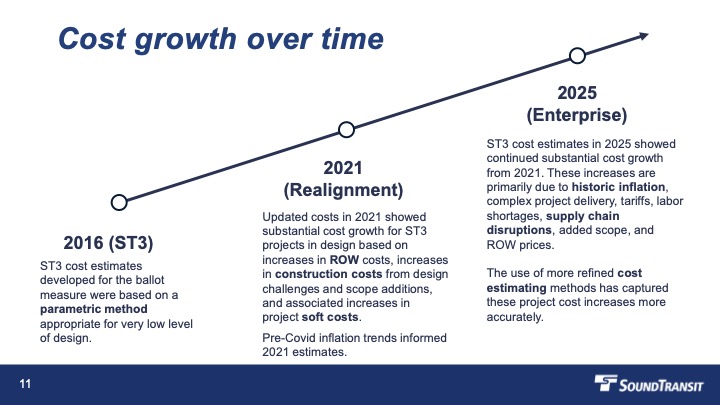
Deputy CEO Terri Mestas said the agency had been using a different methodology and hadn’t really taken a “bottom-up” look at the cost projections until after the West Seattle revision.
Before getting the new numbers, the board first voted on guiding principles for the Enterprise Initiative, after a spirited discussion over an amendment provided by the board’s other City of Seattle rep, Mayor Bruce Harrell. He wanted to be sure that decisions took into account the need to serve centers of growth and employment; some board members suggested that was a thinly disguised way to focus on Seattle, a perennial sore spot for non-King County board members, since ST is funded by and serves people in Snohomish and Pierce Counties too. After more reminders about the need to finish the system’s “spine,” the amendment passed 8-6, and the main motion with the principles passed too. (Harrell circulated this statement after the meeting.)
After that, CEO Dow Constantine began the update on the Enterprise Initiative, what it’s uncovering, and where it’s going. Most of what he said is in this memo. Here’s the excerpt related to capital projects including West Seattle light rail:
Capital Program: We are projecting $14–20 billion in added costs (2025 dollars), or $22–30 billion in year-of-expenditure dollars, for ST3 light rail projects. These increases are primarily driven by extraordinary COVID-era construction inflation, right-of-way cost escalation, and the added complexity of project design and delivery. The affected projects include:
o The West Seattle, Ballard, Tacoma Dome, Everett, Tacoma Community College, and South Kirkland–Issaquah Link extensions.
o Infill stations at Graham Street and Boeing Access Road
Constantine stressed that he believes they have plenty of time to “make a course correction,” but they’ll have to, because if they don’t, “we will eventually see our program become unaffordable.” He insisted that ST “is n strong financial shape right now.” And deputy CEO Victoria Baecher Wassmer added that “there is still significant financial capacity to deliver ST3.”
But in what form? That’s the multi-billion-dollar question, presumably to be determined next year. Deputy CEO Mestas elaborated that they obviously have more latitude over “pre-baselined projects” (of which West Seattle is one). Thoughg this wasn’t meant to be a meeting where cost-cutting ideas were proposed, one did emerge toward the start of the meeting: Board member Claudia Balducci, King County Councilmember from Bellevue, said ST should look at whether a second downtown tunnel is really necessary.
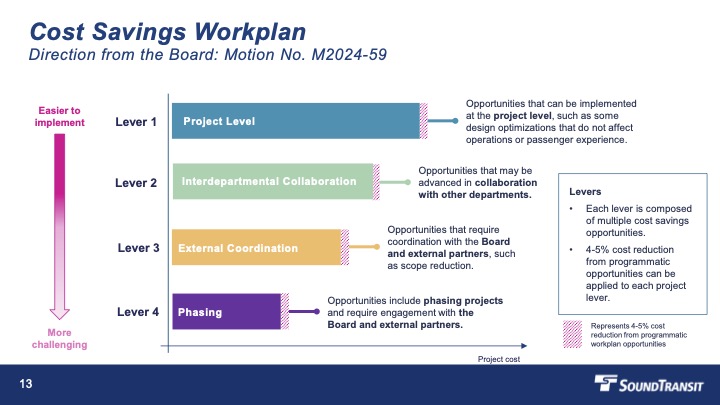
Meantime, deputy CEO Mestas went on to further elaborate about what ST says has pumped up the overall costs, including tariffs – though board chair Dave Somers, Snohomish County Executive, suggested it might be a bit too early to blame those – labor shortages, supply-chain disruptions, and the cost of acquiring right-of-way, and offered what amounted to a four-point plan on ways costs could be reduced:
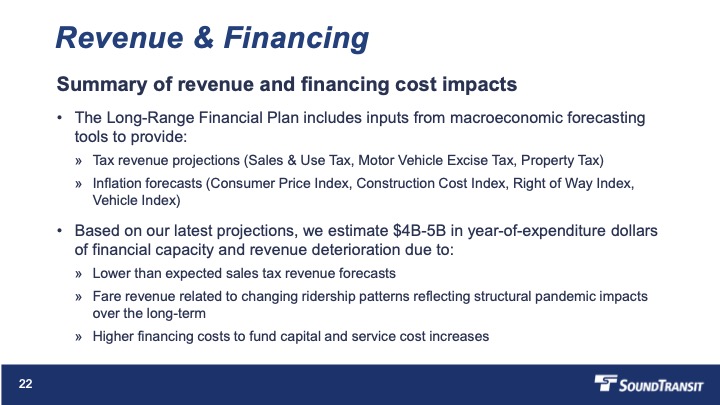
It should also be noted that in addition to higher costs, today’s presentation also featured projections of lower revenue and financing:
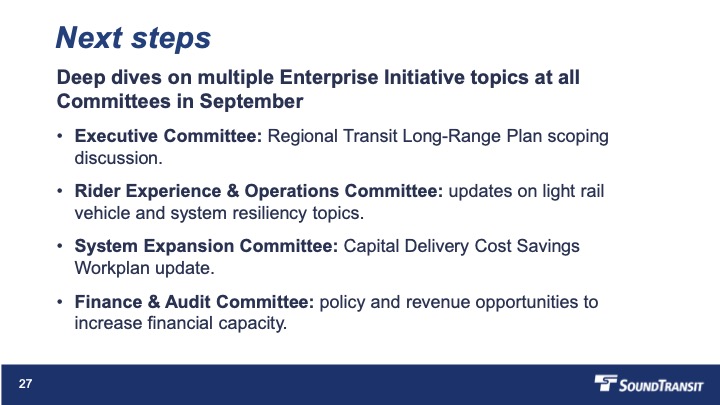
Next month, board committees will bite into aspects of all this:
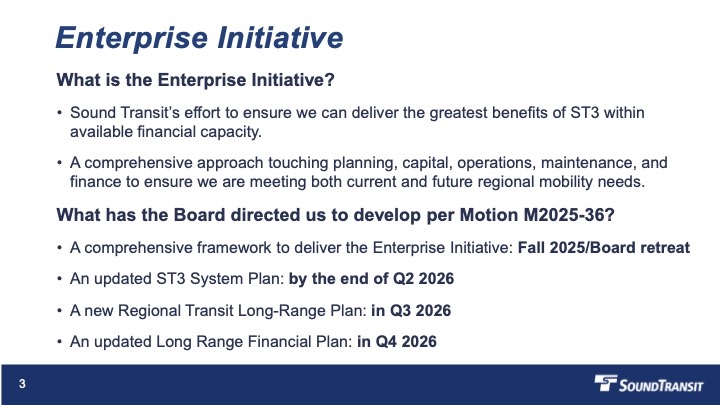
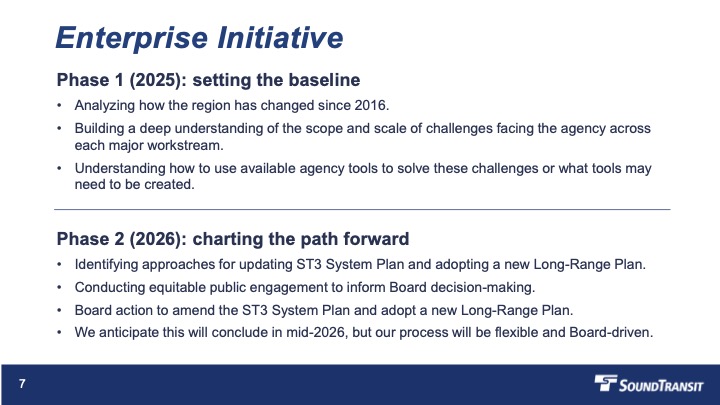
The big-picture decisionmaking is expected to be along the timeline on the lower half of this slide:
See the full slide deck here. Archived video of the meeting will eventually appear here.
 When Sound Transit board members gather for their monthly meeting Thursday afternoon, one item on the agenda is of particular interest to those tracking the West Seattle light-rail plan: Another update on the in-development Enterprise Initiative. As we reported a month ago, this is now the name for the package of policies that ST expects will help it reshape ST3 next year, into something more affordable. That could mean changes for the West Seattle project, currently projected to cost $7 billion, far more than ST has budgeted.
At Thursday’s meeting the board will consider proposed “guiding principles” for the Enterprise Initiative, laid out in this document. It warns, “If the agency does not take proactive measures via this Enterprise Initiative, the ST3 program will become unaffordable, and we risk our ability to operate a dependable, resilient, and safe system.” Among other subsequent points, the principles charge CEO Dow Constantine with ” the goal of achieving a balanced and affordable long-range finance plan and a clear path to deliver the benefits of Sound Transit projects and services as quickly as possible.” It subsequently says. “The framework and its implementation will comply with the ST3 voter-approved ballot measure … and should plan for the following outputs: an updated System Plan, with modified capital and operating plans; an updated Long-Range Plan that looks beyond ST3; and a balanced and affordable long-range finance plan.” Then there are promises of “inclusive collaboration” and “transparent governance,” and a final section where you could read the most between the lines regarding where West Seattle fits in, as there is a reiteration of prioritizing completion of the system “spine” (which West Seattle is not on) and a nod to “fiscal integrity,” yet another indirect reminder of this project’s price tag. As of this writing, there’s also one proposed amendment, by Seattle Mayor Bruce Harrell, primarily adding a goal of supporting future growth.
The meeting starts at 1:30 pm Thursday at ST headquarters, and you can attend in person or online, with public comment accepted both ways, as explained in the agenda document.
Related to West Seattle’s light-rail plan, here are two notes from the Sound Transit Board meeting that just concluded:
PROPERTY ACQUISITIONS: Board members gave unanimous approval to staff’s plan to pursue acquisition of three parcels, after hearing that these were all special cases and that the bulk of acquisitions will await further decisions on how (or whether) to proceed with the project. One – as noted in our preview – is a Port of Seattle parcel in the 1000 block of SW Klickitat that the board was told is needed for “load testing” that could assist in the staff review of potential cost savings; the other two are residential parcels in the 3200 block of SW Genesee whose owners need to sell and move due to personal circumstances but, with the project pending, can’t find any non-ST buyers. Board members, particularly Seattle City Councilmember Dan Strauss, expressed concerns about what would happen to the residences once vacated; he was told that ST will look into finding “quality tenants.” He was also told a meeting next Monday will take a closer look at ST policies regarding acquired properties.
‘ENTERPRISE INITIATIVE’: The board also got a briefing on the status of this review that’s been in the works a while now, figuring out ways to bring the ST3 plan into line with ST’s financial resources. This has its roots in alarm over the revised $7 billion cost projection for the West Seattle extension, but its determinations will be applied to other projects, ST staff says – saying today that in essence it will eventually bring a “realignment” of the future plan, but in a different way than ST’s done “realignments” before. Here’s the slide deck that was presented; it acknowledges that changes in scope, or even “reconsideration” of some projects, are options, as are “potential revenue enhancements.” Ultimately, they hope to have a new plan by the middle of next year.
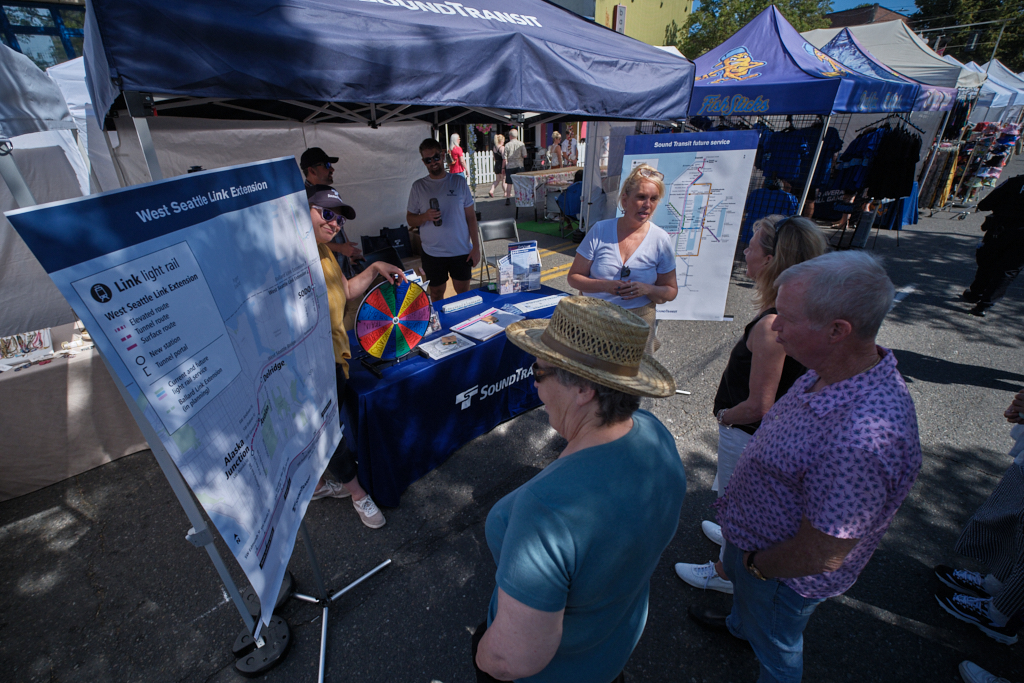 (July 11 photo by Dave Gershgorn for WSB)
Planning continues for West Seattle’s Sound Transit light-rail project, though the big issue of how to cover the potential $7 billion cost remains unsettled. The agency had a booth at West Seattle Summer Fest earlier this month to answer questions, and the ST Board has a West Seattle-related vote on the agenda for its monthly meeting tomorrow: Acquisition of three more properties, two residential parcels in the 3200 block of SW Genesee and a Port-owned parcel at 1011 SW Klickitat. The Port-owned parcel would be in relation to the new light-rail-only bridge in the project plan, with the board resolution noting “an early need for a bi-directional load test”; the immediate need for the two residential parcels wasn’t clear, so we asked ST to explain. Spokesperson Henry Bendon says, “These two properties would be used for the construction of the guideway and Avalon Station.” The timing of the acquisitions is due, he says, to personal circumstances of the owners “that necessitate acquisition and relocation as soon as possible.” Tomorrow’s board meeting is at 1:30 pm at Sound Transit HQ downtown, also streamed online; the agenda has details on attending as well as on how to participate in public comment.
ALSO OF NOTE: Related to the aforementioned “bi-directional load test,” a recent city land-use bulletin circulated word of a shoreline-development permit application for a project to install a “test shaft.” See the notice here; comments are open until August 15 (the notice explains how to submit them).
(Full Seattle Channel video of this morning’s meeting)
Though the price-tag problem remains unresolved, planning for West Seattle’s Sound Transit light-rail project proceeds, and the City Council’s Transportation Committee got a status report of sorts this morning.

The city has to give its official blessing to the project’s current designated route, including “transit way” rights for Sound Transit to use it, and this briefing was the first step toward future committee and full-council votes granting those rights. (Just rights, not possession, it was made clear.)

The first “transit way” rights were granted in 2000, it was explained, and this will be the fourth time the agreement has been changed.) Here’s the full slide deck from the briefing, which included – in case you’ve forgotten or are just catching up – succinct descriptions of each segment of the West Seattle Link Extension, still projected to start running in 2032.


Two numbers of interest – Sound Transit says they’re currently projecting the West Seattle extension (SODO to The Junction) will force 150 residential households and 130 businesses to move. But they insist they’re trying to find ways to lower those numbers in the final design, which they said they’re starting on “soon.”
And what about that price tag, last estimated around $7 billion? “We do have significant cost pressures on all our projects,” the ST team acknowledged. “That’s a risk.”
District 1 Councilmember Rob Saka, who chairs the committee, asked when the agency might decide on scoping changes required by those pressures. The ST team said they’ll be talking about it at next week’s board meeting (Thursday, June 26) but not expecting any changes in the “near term.”
No vote followed today’s briefing – that’s expected to happen at committee and full-council meetings in July. (Other related documents are linked from the agenda for this morning’s meeting, including the resolutions that would put the city’s “approval” of the plan on the record too.)
The Federal Transit Administration had most recently set today as the target date for its Record of Decision on Sound Transit‘s West Seattle Link Extension project, and at day’s end, ST announced the FTA has indeed just issued the ROD. As ST explains in its announcement, this ends the environmental-review phase and allows the project to move into final design. As noted at last week’s ST Board meeting, though, the agency has some milestones of its own ahead, including revising cost estimates and making funding decisions.
By Tracy Record
West Seattle Blog editor
Back when the Sound Transit Board first learned the price tag for West Seattle light rail could pass $7 billion – the original combined estimate for the West Seattle and Ballard extensions – some showed signs of nervousness.
A new round of nerves has erupted this month, continuing into today’s full-board meeting.
First hint came at the System Expansion Committee considered proposals earlier this month to spend tens of millions more on early-stage work for the West Seattle and Ballard extensions. The committee sent the proposals to the full board without a recommendation to pass (or not). One of the city of Seattle’s two current board reps, City Councilmember Dan Strauss, warned his council colleagues at their weekly “briefing” meeting that “tensions” were showing on the ST board, particularly regarding the West Seattle costs.

Despite those tensions, the proposals to spend $68 million more – 90 percent of that for the West Seattle project, which is projected for completion seven years before Ballard – were unanimously approved today by the 16 board members at the meeting. (The full slide deck with the proposals’ toplines are in this slide deck; the individual resolutions are linked from the meeting page.) But that was only after a discussion in which those “tensions” were definitely on display. “A lot of us are nervous,” said board member Kristina Walker, a Tacoma City Councilmember.
First, the proposals were presented by an ST team led by Brad Owen, who’s currently in charge of the West Seattle project. “This is needed work,” he contended, to get to the heart of the cost-saving measures that staff has contended they could deploy to shrink the cost and shorten the timeline of the projects approved by voters back in 2016. In essence, the contention was that they’d have to spend money to figure out how to save money. And the contention is that what they learn about cutting costs for the West Seattle project will make it “a vanguard” for savings that can be applied across the entire ST3 plan.
Some board members said that’s the main reason they’d vote to authorize the spending. Board member Christine Frizzell, Mayor of Lynnwood, wondered: Since there had already been previous conversations about “exit ramps” if they decided West Seattle (or any other) project was just too expensive, could this possibly be a case of throwing good money after bad – forcing them eventually to say, they’d spent so much, there was no choice but to plow forward? Other board members’ concerns included the possibility that so much would be sunk into this, it would affect the rest of the ST3 project list and timeline. (With today’s vote, as the slide above shows, they’ve now authorized spending a third of a billion on the West Seattle extension.) Another board member, Fife Mayor Kim Roscoe, was assured by staff that this work also would show them what “pieces” of projects would be possible, if they couldn’t afford to build what was originally proposed.

WHAT HAPPENS NEXT: New cost estimates are scheduled to be brought to the board this fall, and then they’d decide whether to spend more money – or not.
EARLIER IN THE MEETING: West Seattleite Marilyn Kennell, who’s involved with the light-rail-skeptic Rethink the Link group, repeated a request the group has made, for a new community meeting with ST reps to listen to the information they proposed at their own forum in January (WSB coverage here). Board member Frizzell later said she’d be interested in “meeting with the people from West Seattle.”
 Thanks to Andrew Trujillo from Ounces – one of the West Seattle businesses facing relocation because of Sound Transit light rail – for the update that both houses of the State Legislature have now passed HB 1733, raising the limit for relocation compensation from $50,000 to $200,000:
Sharing a big win for businesses impacted by light rail. Huge credit goes to ABA (Alki Beach Academy) and the other businesses in North Delridge (Mode, Ounces, Skylark, etc.) for voicing and advocating for more realistic support for displaced businesses. Also thanks goes to the city’s small business advocate and state legislators who sponsored it.
The bill’s original sponsors included one West Seattle legislator, 34th District Rep. Joe Fitzgibbon. The State Senate’s final vote Wednesday was unanimous. Next, it would go to Gov. Ferguson for his signature.
Sound Transit‘s West Seattle Link Extension project still has a variety of uncertainties – awaiting the federal Record of Decision, for example (still projected around month’s end) – but there’s something new: Advance word of the call for station artists. We were asked to share this announcement:
STart: SOUND TRANSIT ART PROGRAM
FOR ARTISTS: LISTENING AND INFORMATION SESSIONS—PLANNING FOR ARTWORK IN THE WEST SEATTLE LINK EXTENSION PROJECTSDates and Locations
Wednesday, May 7, 6-7 pm, Seattle Public Library, Delridge Branch
Thursday, May 8, 6-7 pm, Seattle Public Library, High Point BranchRSVP by May 2, 2025
Please RSVP by emailing start@soundtransit.org.Meeting Purpose
In the coming months, the Sound Transit Art Program (STart) will be hiring artists to create artwork for the future West Seattle light rail stations. STart wants to hear from West Seattleites about what is important to them in their neighborhoods while art projects are being developed. In addition, STart seeks to inform West Seattle artists about how they can apply for inclusion in an Artist Candidate Pool for art project consideration.
Listening and information sessions geared toward artists will be held in two West Seattle branches of the Seattle Public Library from 6-7 pm on Wednesday, May 7 (Delridge) and Thursday, May 8 (High Point). The conversation and content will be the same each evening, offering two opportunities for participation on different nights.
About the West Seattle Link Extension Artwork Opportunities
STart incorporates artwork in its stations and facilities to create welcoming spaces for passengers, and to contribute to the character of the communities connected with light rail. At these listening sessions, STart will describe what is known about the West Seattle Link Extension (WSLE) stations, and how artwork will play a key role in making its planned Alaska Junction, Avalon and Delridge Stations distinct and memorable. Hearing about the neighborhoods where the stations will be located is valuable to STart. The stations are currently in design and planned to be in service in 2032, connecting West Seattle with the existing Link 1 and 2 Lines. You can learn more here.
STart is working to identify locations for permanent integrated artwork and long-term rotating displays of temporary artwork. Due to the layout of the West Seattle stations, most of the opportunities will be for two-dimensional works that will be translated into a durable medium—such as cut metal, glass, porcelain enamel or mosaic—either fabricated by the artist or a third-party fabricator contracted by STart. This can be a chance for painters, photographers and printmakers to be part of the stations’ public art display. There may also be a few opportunities for works of sculpture to serve as station landmarks and draw passengers to entrances.
Artist Candidate Pool Application
STart will soon accept applications to create a pool of artist candidates for future commissioned permanent and temporary public art projects. Application materials will focus on artist’s past work, not on proposals.
This Artist Candidate Pool will be used to identify and review candidates for opportunities at the Alaska Junction, Avalon and Delridge Stations currently planned for the WSLE. Selected artists for the Artist Candidate Pool will not be under contract with Sound Transit and are not guaranteed a commissioned public art project but will be eligible as candidates until May 31, 2028. STart reserves the right to use the Artist Candidate Pool for additional art opportunities on other Sound Transit projects and to reopen the application process as needed to support additional development projects.
STart projects are developed to welcome passengers to our stations, help them find their way and relate the stations to their surrounding communities. Artists selected for STart opportunities should expect to adhere to those goals.
Questions? Please email any questions and/or interest in the Artist Candidate Pool to start@soundtransit.org.

3:42 PM: We’re in the Sound Transit board room at Union Station downtown, where ST board members have just voted unanimously to appoint Dow Constantine – the West Seattleite in his fourth and final term as King County Executive – as the transit agency’s CEO. The vote followed their search consultant’s recap of the process, including defense of the candidate confidentiality, and members’ reiteration of their confidence that Constantine was the most qualified and will “hit the ground running.” Board members’ remarks also acknowledged the big issues facing the agency, and one mentioned that Constantine “will not get a honeymoon” – those issues need to be addressed fast. As we reported yesterday, his starting salary will be $450,000.
He entered the board room right after the vote and is speaking next. (Added: Here are the 55 minutes of video including the discussion of his nomination, the vote, and his remarks afterward:)
4:14 PM: Constantine promised his new bosses that he will prioritize “regionality, transparency, stability, reliability, safety, and cleanliness.” He also vowed “we will navigate these choppy waters together,” alluding to the many intensifying challenges facing the agency, not the least of which is funding. We spoke to him briefly afterward; more on that after we’re back at HQ, but first, he confirmed that he’ll start work at ST on April 1 (next Tuesday) and that deputy county executive Shannon Braddock – also a West Seattleite – will take over on an interim basis until the County Council decides what to do until a new CE is chosen by voters this fall.
ADDED THURSDAY EVENING: Here are our two hallway questions, post-vote:
Here’s the Sound Transit news release with the announcement.
1:46 PM: Toplines of the contract Sound Transit is offering Dow Constantine to become its next CEO – pending a two-thirds-or-more board vote tomorrow afternoon – are now posted on the ST website, in this proposed board motion. The base salary is $450,000; the contract would start April 1 and run through December 31, 2026, “with two one-year renewal options at the Board’s discretion.” The motion also notes:
A market study will be completed at the end of 2025 to determine a base salary for 2026 that will be set, at a minimum, at the average of market comparable salaries, but not less than the current annual salary. The same process will be applied to determine base salary for 2027 if the Board, in their discretion, renews the agreement for the 2027 one-year term.
In addition to the annual market-rate base salary increase in 2026 and 2027, for each year, an annual 3% to 6%-Base Salary increase will be awarded based on Mr. Constantine’s annual performance rating.
Various amounts for incentives and expenses are laid out, too:
*”An Annual Contribution Performance Award of $30,000 may also be awarded on based upon the achievement of mutually agreed to goals”
*”Mr. Constantine will receive an annual taxable expense allowance of $24,000 to defray routine business expenses incurred performing his duties under the employment agreement”
*”Mr. Constantine will receive a one-time home office equipment stipend of $10,000 to facilitate the initial setup of the CEO’s technology and equipment needs and to further the performance of the CEO.”
The board motion also goes into details of health benefits, retirement-account contributions, and travel. It’s not the actual full contract, though; we’re requesting that. Meantime, Thursday’s meeting with the scheduled vote – which includes as usual a public-comment period – is set for 1:30-4 pm at the ST board room inside Union Station, or you can attend/comment online (the agenda document explains how).
5:23 PM: A Sound Transit spokesperson tells us we’ll have to file a public-records request to get the actual contract. … Meantime, looking around the ST archives, we found documents noting that former CEO Peter Rogoff was hired at $365,000 base salary in 2018; short-term former CEO Julie Timm‘s starting base salary in 2022 was $375,000.
 (WSB photo, March 13)
4:29 PM: It’s official – the Sound Transit Board Executive Committee‘s “preferred candidate” for CEO is outgoing King County Executive Dow Constantine (a West Seattle resident). That was finally revealed in this announcement sent this afternoon, almost two weeks after the committee’s vote to recommend what was at the time referred to only as “candidate C”:
The Sound Transit Board is scheduled to vote on the appointment of a new CEO at the full Board meeting on Thursday, March 27. The preferred candidate is Dow Constantine, and the appointment requires a supermajority vote at a public meeting. People can access meeting information and the link to watch it from the online calendar on the Sound Transit website.
The following is a statement from Snohomish County Executive and Sound Transit Board Chair Dave Somers, Pierce County Executive and Sound Transit Board Vice Chair Ryan N. Mello, and King County Councilmember and Sound Transit Board Vice Chair Claudia Balducci:
“We are pleased to put forward Dow Constantine for a vote of the Board. We are confident he has the knowledge, experience, and commitment to achieve Sound Transit’s goals and complete the ST3 package.
“Being CEO of Sound Transit is a tough job with many constituencies to serve, and Dow has proven over his career in public service that he can deliver large capital projects, successfully oversee a major transit agency, and foster partnerships across our region that are essential to make Sound Transit function at the highest possible level. We know this is a crucial time for the agency, and there are difficult and complex discussions on the near horizon, along with reforms that will require knowledge and commitment to continue forward. These include operational and maintenance challenges that need to be addressed immediately by an incoming CEO, increased accountability measures, as well as rising financial pressure from inflation and economic uncertainties. As Board leaders, our priority remains delivering on the voter-approved ST3 package, while operating a safe and dependable system.
“The search for a new CEO was competitive. The Board started with 60 applicants from around the world and narrowed the field from 15 to 5 to 3 and finally to 1. It was a thorough process with significant public input, vigorous discussions, and multiple panels that included transit riders, disability advocates, other regional transit agencies, and labor and economic development organizations.
“We are grateful to the many board members, agency staff, and community partners who provided valuable insights and have put their time and skills toward making sure we had an extensive and thoughtful CEO search process. We look forward to the Board’s decision on Thursday.”
Since the King County Executive has a guaranteed seat on the board (as do the executives of Snohomish and Pierce counties), Constantine has been an ST board member for 15 years. He announced last November that he would not run for a fifth 4-year term. That was 10 months after ST’s previous “permanent” CEO Julie Timm left. Interim CEO Goran Sparrman has held the job in the meantime but did not seek the permanent appointment. The proposed contract and other documents related to the proposed appointment are not yet available on the ST website.
ADDED 8:40 PM: An ST spokesperson tells us those documents should be available online by Wednesday. The meeting during which the hiring vote is scheduled is at 1:30 pm Thursday at Sound Transit HQ downtown; you can attend (and comment) in person or online, as explained on the agenda document.
 (Image from Final Environmental Impact Statement for West Seattle Link Extension)
Your next chance for an update on West Seattle light rail is 9:30 am Tuesday (March 18), when a briefing on Sound Transit‘s West Seattle and Ballard Link Extensions is the major item on the agenda for the City Council Transportation Committee, chaired by District 1 Councilmember Rob Saka. The ST presenters’ slide deck can be previewed here; also scheduled to present is the city’s team focused on the project, and their slide deck is here. The agenda document explains how to watch/attend the meeting, either in person at City Hall or online via Seattle Channel, and how to participate in the public-comment period.
Last month we told you about Mode Music Studios (WSB sponsor) proprietor Erin Rubin and others speaking in support of State House Bill 1733, which would increase the allowable amount of reimbursement if you’re going to be displaced by a project like Sound Transit light rail. State House Rep. Brianna Thomas‘s office sends word that HB 1733 passed out of the House on a unanimous vote Tuesday. Rep. Thomas and our area’s other state House Rep., Joe Fitzgibbon, are among the sponsors. Next, the bill goes to the State Senate. Here’s the latest version; it would raise the limit to $200,000, from the current $50,000, and allow future increases based on inflation. Rep. Thomas’s update summarizes it as follows:
This bill increases financial assistance for people, businesses, farms, and nonprofits forced to relocate due to government projects. Under this bill, displaced individuals and organizations can receive payments to cover moving expenses, lost property, and the costs of finding a new location. The bill also allows eligible individuals to opt for a fixed payment instead of itemized reimbursements, providing more flexibility in how they manage their relocation.
Following a 48-minute executive session (non-public discussion) during a special meeting, members of the Sound Transit Board‘s Executive Committee have just voted unanimously in favor of a CEO candidate, without identifying them by name. Search consultant Gregg Moser reported having about 60 people apply (including some that he recruited), 15 who met qualifications, narrowed that down to five semifinalists, then three finalists, whom the board identified publicly only as A, B, and C, voting unanimously today for C. Now board reps will negotiate an employment agreement with candidate C, bringing it to the full board on March 27.
The recommendation for permanent CEO comes 14 months after the last permanent ST CEO, Julie Timm, left; she had held the job 16 months. Goran Sparrman has been serving as interim CEO. The executive session in today’s meeting was preceded by a public-comment period which drew seven written comments summarized as opposing choosing King County Executive and ST Board member Dow Constantine – the only candidate whose name has been made public (Moser explained the need for confidentiality in a national search) – as CEO, plus three “live” commenters, one of whom voiced support for Constantine, another who stressed choosing someone who would “prioritize nailing the fundamentals” of service, and another who urged board members to have a more “transparent” process.
ADDED: Several board members made comments before the vote, but none gave overt hints at the winning candidate’s identity. They mostly discussed their hopes for the new CEO – Auburn mayor Nancy Backus, for example, said the new CEO must be committed to “get(ting) the spine built.”
With the Sound Transit board having already interviewed candidates for CEO – the only candidate name mentioned publicly so far has been board member King County Executive Dow Constantine – this might be your last chance to offer a comment: The board’s Executive Committee is having a special meeting 4-5 pm tomorrow (Tuesday, March 11). The agenda has a comment period followed by an executive session (non-public) and then possibly a recommendation of who the committee thinks the whole board should vote on. Here’s the agenda document, which explains how to participate either in person or remotely. (You can also email a comment now to meetingcomments@soundtransit.org.) Whoever is hired will take over at a pivotal time for the planning of West Seattle light rail, among other projects.
Three things to know from Thursday’s Sound Transit board meeting:
‘RECORD OF DECISION’ DELAY: We reported earlier this week on the Federal Transit Administration‘s new date for a “Record of Decision“ on the West Seattle Link Extension project, a milestone that allows the project to move into final design. This is what interim CEO Goran Sparrman told the board, in a ST-provided transcription:
We recently got word that the federal Record of Decision, which we anticipated at the end of this month, will likely be delayed 30-60 days to allow time for the Federal Transit Administration to work with the Office of the General Counsel at the White House to review and ensure consistency with recent Executive Orders. We understand that this added process step is not exclusive to the WSLE project and is being applied broadly at this time. We will continue to work diligently with FTA on next steps and look forward to providing you and the public updates as we have them.
BOARD APPROVES EARLY ACQUISITION: Board members approved the resolution authorizing “early acquisitions” in the 3800 block of Delridge Way SW (here’s our story from last weekend). That will pave the way for more North Delridge businesses including Mode Music Studios (WSB sponsor), nonprofit Mode Music and Performing Arts, The Skylark, and Ounces to work with ST regarding relocation assistance.
COST SAVINGS: The board got a technical-detail-heavy update from deputy CEO of megaprojects Terri Mestas and West Seattle project director Brad Owen regarding potential cost-savings measures – systemwide as well as on WSLE – mostly involving “design optimization.” Here’s the slide deck. They promised more cost specifics next quarter, but in the meantime, some of what they’ve identified includes:

-Precast (constructed offsite) components of guideways for elevated segments
-Seven “station prototypes” that could be used on projects throughout the system
-Measures to reduce station footprints
-Measures to reduce wetland impacts
Until those upcoming specifics are available, there’s no new overall cost estimate – though a possible WSLE savings of a third of a billion dollars is shown on one slide – but one board member, Lynnwood Mayor Christine Frizzell, said she’s still worried about “off-ramps” for the West Seattle project, given the “sticker shock” of the most recent estimates. Mestas told her that once they hire a design firm – expected this spring – that team, for example, could do “limited design work” that would help zero in on cost savings.
Watch for the video of Thursday’s board meeting to appear here. EVENING UPDATE: It’s viewable here.
Thanks for the tip. Curiosity has run high about how the change of administrations in Washington, D.C., could affect local services that rely on federal funding, and now we have one sign: The federal “Record of Decision” for Sound Transit‘s West Seattle Link Extension has been delayed, again. The original timeline was that it could have happened as soon as a month after the ST Board made its final decision back in October about West Seattle light-rail routing and station locations; then the Federal Transit Authority‘s online dashboard showed a new date for the Record of Decision, due in late February, aka right about now – but a reader just pointed us to the federal website link showing it’s just changed again, to late April.

We have questions out to Sound Transit, including how, or whether, that affects work being done now on the project; the project website notes that when it’s issued, for example, final design can begin.
As we reported four days ago, the ST Board’s monthly meeting tomorrow is scheduled to include a vote on expanding the list of properties for which it’s pursuing early acquisition; the additions to the list would include the North Delridge buildings that house Mode Music Studios (WSB sponsor), Mode Music and Performing Arts, The Skylark, and Ounces, all on the site designated for the Delridge light-rail station. We also reported last week on Seattle Mayor Bruce Harrell, an ST Board member, issuing an executive order setting up city actions that might speed up the construction timeline.
 (Sound Transit rendering of Delridge station site)
By Tracy Record
West Seattle Blog editor
Erin Rubin, who owns Mode Music Studios (WSB sponsor) and its nonprofit sibling Mode Music & Performing Arts, is used to making music.
This month, she’s also spent a fair amount of time giving testimony.
As we’ve reported previously, Rubin’s business and nonprofit are in a building that’s in the path of Sound Transit‘s Delridge station. But she’s had two challenges getting in the way of moving Mode somewhere out of that path, so that she and her staff can continue teaching hundreds of local kids:
For one, the building – where she’s been a tenant for a decade – was left out of Sound Transit’s early-acquisition plans, meaning relocation help couldn’t be offered to the tenants, unlike some buildings nearby. ST is looking at changing that; Rubin spoke to the ST Board’s System Expansion Committee last week as it considered an “early acquisition” resolution to buy the building that holds Mode and The Skylark, as well as the building down the block that holds Ounces. (Read the resolution here.)
But even if that happens, another hurdle is the amount of relocation help that can be offered. The Legislature is considering a bill raising the limit, HB 1733. Rubin testified to a Legislature committee last week and shared her statement with us afterward:
We currently serve over 400 students providing private music lessons. In addition, we work with Seattle Public Schools and partnering organizations to provide pay-what-you-can music arts education enrichment and music lesson scholarships to eliminate financial barriers in our local community.
We are waiting to be displaced by the light rail for the West Seattle Link Extension and have been told up until now that our cap for rebuild and rent increase will be $50,000. With the estimates we’ve received so far, we’re looking at somewhere between 350 and $400,000 to re-create the space that we currently are occupying on Delridge in West Seattle.
It’s extremely important for us that a cap increase to $200,000 be voted through not only for us but for other small businesses in other link extensions and neighborhoods in Washington State that will be facing displacement for public transit. It is our reality that this number won’t meet all of our financial needs but gets us closer to what we require to build a space that can house our services.
The heart of our neighborhood communities lies in small business. It’s where our kids congregate after school. It’s where we buy birthday presents and dine on the weekends. In support of local art and education, we have a responsibility to make sure our businesses are able to financially see this next step through for our buildouts and rent increases so we don’t have to close our doors and that businesses down the line are also compensated for their moves in favor of public transit.
On Monday (February 24) at 10:30 am, HB 1733 will have a public hearing in the State House Transportation Committee. Rubin plans to go to Olympia to testify again in support of the bill. Later in the week, the “early acquisition” proposal goes to the full ST Board for its 1:30 pm Thursday (February 27) meeting; here’s the agenda, which also explains how to comment, either in person or remotely. The proposed purchase requires a two-thirds “supermajority” approval vote to pass. Rubin will be there; she says it’s vital to “keep showing up” – not just for her own business and its neighbors, but also to help ensure a precedent for the others in West Seattle that will need to move.
Meantime, the show must go on; until the timetable and relocation compensation are settled, Rubin can’t seek a new space in earnest, so she and the many local artists she employs as teachers at her two Modes are carrying on in the current studios, not just with lessons, classes, and school programs, but also planning for summer camps.
(Image from Final Environmental Impact Statement for West Seattle Link Extension, page 176 of appendix N.2)
As reported here two days ago, Mayor Bruce Harrell‘s State of the City speech on Tuesday included a mention that he planned an executive order aimed at accelerating Sound Transit light rail expanded to West Seattle and Ballard. (Currently, the WS extension is expected to open 2032, while the Ballard date is 2039.) When we followed up with his office about the details, they said the actual order would be out later in the week – and now we have it. Read the executive order here. It still is short on actual details of what kind of zoning changes will be proposed, among other things, saying only “In 2025 and 2026, my administration will develop several bodies of legislation, including land use code amendments, formal adoption of the ST3 projects, and necessary real property transactions to allow the projects to proceed as quickly as possible.” The order also says that while there’s currently a team with 20 full-time city employees focused on ST3 (the ballot measure that included the West Seattle/Ballard extensions), that will be multiplied: “The detailed plan will identify up to 50 additional staff in various City departments who will collaborate with Sound Transit on project design and engineering, environmental review and project permitting, and construction management and project impact mitigation, as well as lead on station area planning and access projects to support the new light rail station communities.” Read the announcement about the executive order here.
We haven’t had a chance to watch Mayor Bruce Harrell‘s entire State of the City address yet (that’s the ~50 minutes of video above, courtesy of Seattle Channel), delivered today at noon – we saw the start and the finish, but had to go check out the South Delridge gunfire scene in the middle. However, a quick look at the summary provided by the mayor’s office yielded this point of interest:
Expediting light rail expansion: Mayor Harrell will issue an Executive Order this week to support faster delivery of light rail expansion to West Seattle and Ballard. The mayor will propose legislation that could speed up delivery by more than a year and the City will create the Office of Waterfront, Civic Projects & Sound Transit, which will orchestrate up to 50 staff in supporting project design and engineering, station area planning, and more.
We subsequently asked mayoral spokesperson Callie Craighead for details, and she said those would be forthcoming in a few days: “We will be announcing the Sound Transit Executive Order later this week, so more to come on that.” The “prepared remarks” version of his speech used this verbiage:
Growing our transit network with fast, reliable service is one of my highest priorities, and Sound Transit 3 is the largest transit expansion in the country. That’s why, this week, I will issue an Executive Order to make sure the City of Seattle is taking immediate action to safely and efficiently expedite delivery of light rail to West Seattle and Ballard.
Our efforts will include a newly expanded Office of Waterfront, Civic Projects & Sound Transit, led by Director Angela Brady, which will be at the center of orchestrating a surge in staff of up to 50 City employees supporting project design and engineering, station area planning, and more.
We will propose new pieces of legislation to ease the permitting process – maintaining essential safety protections while reducing burdens and barriers to shorten project schedules. This work could save more than a year of project time.
Our region is clamoring for light rail expansion – this Executive Order represents the City’s pledge to do our part to get it done as quickly as possible.
Currently, the West Seattle expansion is projected for completion late in 2032, but there are myriad milestones to achieve first, not the least of which is funding, including federal dollars.
As previously reported here, tomorrow (Saturday, January 25) is the day the light-rail skeptics of Rethink the Link are planning a public forum at the Center for Active Living. We asked organizers for updated details of the planned 10 am-noon event – here’s their summary:
The purpose of this town hall is to host a community discussion of Sound Transit’s West Seattle light rail plans. A gallery will display maps of the route segments, station maps, and charts of properties impacted from the Alaska Junction to SODO. This will give people an integrated look at what the West Seattle Link Extension light rail project entails.
Our group discussion will be framed by five topics will be posted on display boards; Cost escalation, Ridership changes, What voters approved, Environmental disaster, and Better, More Workable Transit Alternatives. Neighbors are invited to write their questions on those topics (on sticky notes). Each topic will be given a 15-minute time block to help maintain focus. All comments will be tallied and posted on rethinkthelink.org website.
We have invited Mayor Harrell, King County Executive Constantine and our other elected representatives to join us. As we did not ask them to RSVP we do not know if any (or all) will be attending.
The center is at 4217 SW Oregon. Meantime, exactly three months after the Sound Transit Board approved routing and station locations for the West Seattle Link Extension, the agency continues to await the formal federal Record of Decision, most recently estimated as likely to come out next month. The current estimated opening timeline remains late 2032.
Sound Transit has been preparing a site along SW Genesee for geotechnical work that they tell us will start on Monday. From the announcement:
… Sound Transit plans to conduct a geotechnical boring for soil analysis behind the guardrail along eastbound
lanes of the West Seattle Bridge. The area will be accessed from the alleyway at SW Genesee Street. This location may shift slightly depending on the placement of underground utilities. Sound Transit is in the planning phase of the West Seattle Link Extension project. This work, along with other investigations throughout the project corridor, is essential for planning and designing the project to be built.To study soil and groundwater conditions, a drill rig is used to bore vertically into the ground while collecting soil samples. Following the collection of soil samples, a monitoring device is installed which will be used by crews to monitor water levels on future visits. Water level readings will be taken every few months as the design phase progresses. In accordance with all local regulations, the 4- to 12- inch diameter borings will be installed carefully
to avoid soil erosion and dirt or mud from leaking into surface waters, wetlands, and drainage systems.
More• Vegetation clearing to access the work area (occurred) on Thursday and Friday, Jan. 2 and 3. Drilling is expected to begin on Monday, Jan. 13 and take approximately seven days. Activities are scheduled from 8 a.m. to 5 p.m. on weekdays.
• Access will be maintained in the alley and on all roadways. No-parking signs will be placed at least 72 hours prior to work. No-parking signs are enforceable during the dates and times listed on them.
• Crews will do minor brush clearing to access the work area using an excavator and small equipment. No trees will be impacted. Vegetation management will adhere to City of Seattle permit requirements.
• A portion of the metal fence adjacent to the West Seattle Bridge will be replaced following the work.
• Due to inclement weather or unforeseen issues, dates and times are subject to change.
• Drilling equipment will sound like a truck engine running, with occasional hammering.
ST has done this type of work at other sites in the past few years. As we reported earlier this week, the next milestone for West Seattle light-rail planning is the federal “Record of Decision,” now expected in February.

| 75 COMMENTS