
West Seattle, Washington
27 Monday
By Tracy Record
West Seattle Blog editor
 Two pending projects were in the spotlight during last night’s monthly meeting of HPAC, the community coalition for Highland Park, South Delridge, and Riverview, facilitated by co-chair Kay Kirkpatrick. Her’s how it went:
CRIME TRENDS: The meeting opened with SPD Officer German Barreto saying that most Highland Park crime categories are down, year to date. One exception: Burglaries, some of which involve vacant homes. Another: Confirmed gunfire. As he noted, shell casings that are collected go into a database and investigators can see if they match other incident. No word of any revelations from that process so far this year; Officer Barreto said the area has seen eight incidents so far in 2026, compared to six by this time last year: “Not really good.” The officer also mentioned walking through some encampment areas like one off SW Detroit, and he said he’s been notifying the Unified Care Team about what he finds. He said he’s hopeful the UCT will get to that area, but doesn’t know when. That led to several attendees voicing encampment-related concerns; one asked about 24th/Barton/Henderson, and Officer Bareto said he’s aware of that because that area is reoccupied repeatedly. Kirkpatrick said they’re in contact with City Councilmember Rob Saka‘s office on that too. Another attendee said fires are a concern with the encampments in greenbelts. Officer Barreto suggested people keep reporting via Find It Fix It, and include photos, albeit ones taken from a safe distance. One person with property in south Highland Park mentioned a problem one of her tenants had had – but the tenant hadn’t reported it to police. “Please report it, we’re data-driven,” said Barreto. He also mentioned the option to report online, provided the crime in question isn’t something that’s happening right now (if it is, call or text 911).
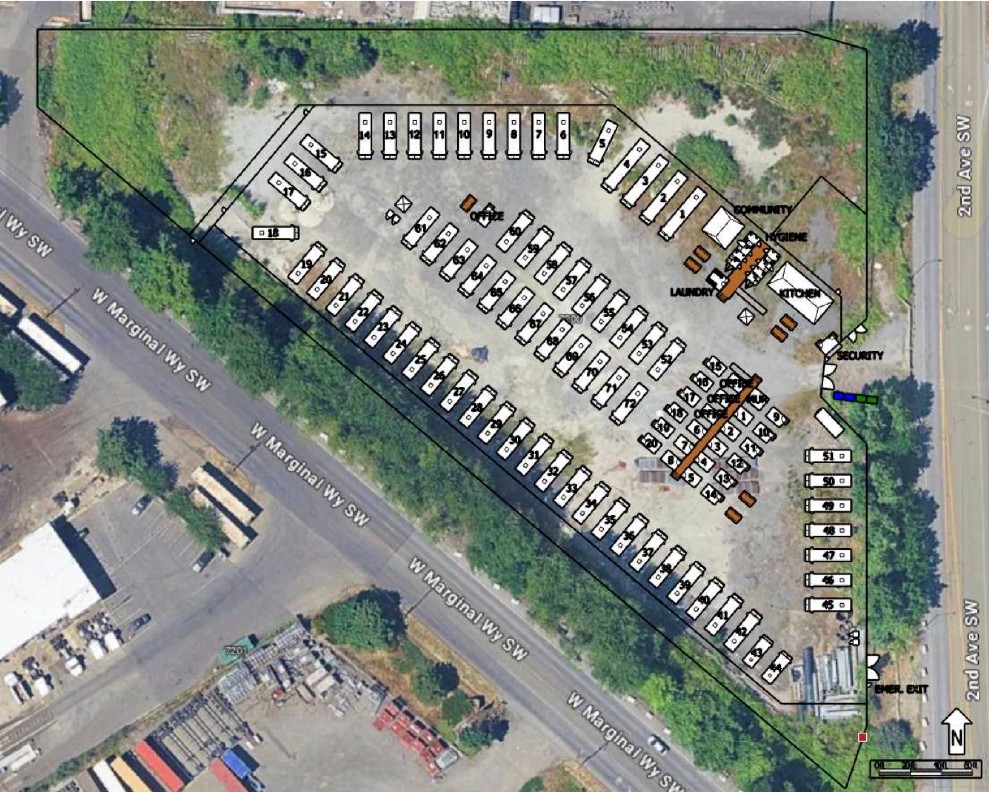 (‘Site plan’ from city permit filings for Glassyard Commons, with 72 RV spaces and 20 tiny houses)
GLASSYARD COMMONS: Marta Kidane from the Low-Income Housing Institute, which will operate the tiny-home/RV-lot site Glassyard Commons at 7201 2nd SW, was the next guest. (We’ve been reporting on the plan since breaking the story about it in January.) She first explained the concept of tiny homes – 8 x 12, “the dignity and privacy of having a closed door, heat (and A/C in the newer ones),” in villages, with shared spaces where people can cook and eat, plus hygiene trailers with showers, sinks, toilets, etc. And they have 24/7 staffing, with sign-in sheets, case managers there during weekday business hours, to help people negotiate the system. They also have behavioral-health providers at many sites.
Glassyard Commons would be LIHI’s second RV lot, twice as big as the now-dismantled first one, which Kidane said led to the demolition/removal of 67 RVs (entering a lot like this means you agree to eventually give up your RV). People are in their programs for an average of six months before moving on to housing.
One attendee wondered if the Glassyard Commons plan – on state-owned land – is a done deal. The answer was, pretty much yes. Another attendee who said they still had questions lingering from LIHI’s public meeting in Georgetown (WSB coverage here) such as, what’s the definition of “surrounding area” and what will be done about people already camping in the nearby greenbelt? She didn’t have information on that, but, “I think it’s all about developing relationships” which the UHeights Vehicle Outreach Team working with them will be trying to do.
One attendee mentioned someone often seen at Highland Park Way/Holden seemed like a perfect candidate for a tiny home. Could she refer him to LIHI’s partners? Kidane asked for information.
Kirkpatrick brought up the letter that HPAC had sent to the city and said one unaddressed point was the request for proactive cleanup for a mile each way from the facility. “They’ve only adopted 500 feet, which is only going to take us to the edge of the block,” she said. Kidane contended that “tiny house villages often make the area around them safer … there’s a level of activation” resulting from their presence. She offered to take people on a tour of a current tiny-house village. “I think when you see it you really get an idea” of how it works. (West Seattle already has one, Camp Second Chance on Myers Way. Expanding it remains a possibility, Kidane said in response to a later question.)
One attendee asked for more details on what happens to the RVs that are turned over when their owners get housing. Are they resold? No, they’re scrapped, Kidane said. (Before the RVs are brought on site, they’re decommissioned, including rendering their bathrooms unusable, meaning the RV residents have to use the hygiene trailers too.)
She mentioned an outreach team working in the area, so that led to questions such as, what happens to people who decline shelter/services? That’s more a question for the outreach team, Kidane said. But for RV dwellers, they appreciate having some control of their own space. Is the outreach for Glassyard Commons going to start in Highland Park? Yes, reiterated Kidane. But it won’t be limited to people found in West Seattle.
Can people smoke and drink in their tiny houses? Smoking is prohibited, and they have smoke detectors, but otherwise, there aren’t prohibitions about what they can do behind closed doors, though, she noted, they are made aware that recovery services are available. (Weapons and even guests from outside the site are prohibited too.)”
Kirkpatrick noted that HPAC has signed up to participate in the Community Advisory Council for Glassyard Commons, once it’s launched. Meantime, we asked Kidane after her appearance if there was any update on a timeline for costruction, as it had been said repeatedly that this site was on a fast track. Short answer, no,
SDOT’S HIGHLAND PARK WAY HILL PROJECT: Kirkpatrick said HPAC’s been talking to Councilmember Rob Saka‘s office about longrunning concerns regarding the lane-conversion plan, but it appears his office won’t be “intervening,” so feedback should be shared at the “agency” (SDOT) level. She asked attendees to list their concerns/observations about the project (and also invited supporters to speak up). Several concerns were voiced, including:
-A SW Othello resident said city reps have not yet made good on their promise of a walk-through with neighbors
-There are options not being addressed and a conversation needs to be had with engineers
-Restricting downhill to one lane means there’d be no way to get out of the path of a dangerous oncoming driver. “They need to re-engineer the whole road,” suggested an attendee. (Kirkpatrick noted that Saka had called for a Vision Zero audit, as we previously reported)
-Enforcement could make a big difference. Kirkpatrick said she was just back from a road trip in other West Coast states and they saw lots of it.
-One attendee said they expect there’ll eventually be a two-lane result. The discussion devolved briefly into a cacophony of other suggestions.
HPAC meets fourth Wednesdays most months; watch hpaction.org for updates.
HPAC – the community coalition for Highland Park, Riverview, and South Delridge – has just announced the plan for Wednesday’s monthly meeting:
Next HPAC Meeting Wed., April 22nd, 6:30 pm in person at the Delridge Branch Library
Plant a tree, and Celebrate Earth Day with your neighbors and friends at the HPAC April meeting!
As usual staffing permitting, we hope to have an SPD representative to discuss any concerns and safety updates from their Department.
Craig Rankin from West Duwamish Greenbelt Trails will tell us more about the upcoming season of guided hikes in the greenbelt and what you may expect to find along the way.
After a long and contentious meeting with SDOT in March, regarding the Highland Park Way Safety Project we intend to use this meeting to cover possible responses to the City and what HPAC can do to support concerns.
We will also bring more information about the proposed Glassyard Commons RV Safe Lot and Tiny House Village the Mayor proposes for 7200 W Marginal Way S and discuss our concerns, plus share what actions we have taken with the City on this so far. We have invited a spokesperson from LIHI to our meeting but have not yet heard back from them.
The library is at 5423 Delridge Way SW.
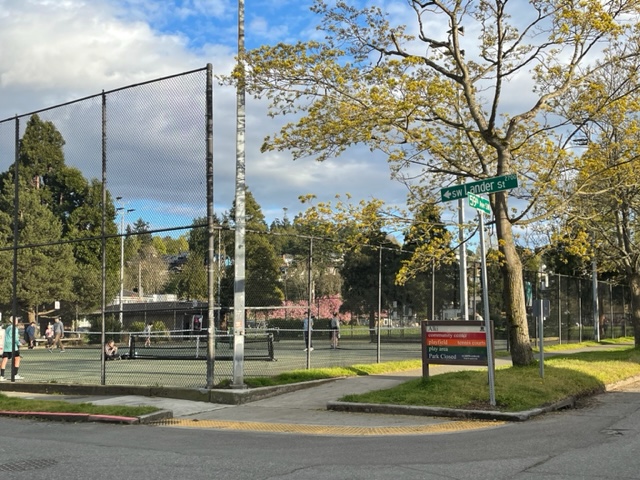 (WSB photo, Alki Playfield courts)
By Tracy Record
West Seattle Blog editor
“It’s not tennis vs. pickleball, it’s tennis AND pickleball.”
That’s what the president of the Seattle Metro Pickleball Association insisted, given a chance at last night’s Alki Community Council meeting to talk about his group’s campaign against Seattle Parks’ newly unveiled Draft Outdoor Racquet Sports Strategy, which at least in the short run would cut the number of public courts open to pickleball.
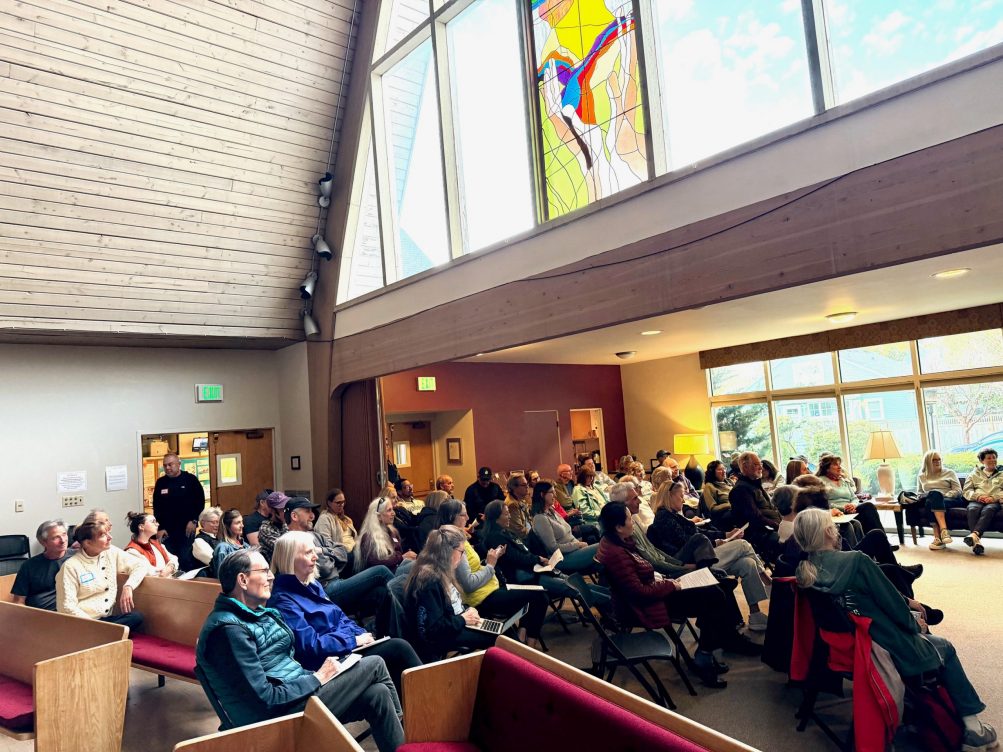 (Photo courtesy Alki Community Council)
That was one of several matters discussed by the ACC in a well-attended meeting at Alki UCC, led by president Charlotte Starck. She made it clear that they weren’t presenting the pickleball group’s stance as a signal of where their sympathies lie – it was a simple matter of, they asked to speak, while no tennis advocates had.
The Seattle Metro Pickleball Association has an online petition drive going, as reported here, and president Tony Pisa said every signature – 1,000 as of Thursday morning, he said – sends email to a long list of city officials. A board member who joined him, Don Goulet, said the group was “blindsided” by the Racquet Sports Strategy proposal, as “we were in pretty good talks with (Parks and Recreation)” prior to its release. “We’ve been partnering for years,” added Pisa. “We worked on ways to coexist … then boom! we’ve got nothing.”
Their short-term goal is to get the city to pause its planned June 22 implementation of the “strategy,” which would among other thigs end the practice of “dual-striping” so that courts could be used by both pickleball and tennis. They intend to put the pressure on, not only via petition signatures and emails, but by showing up at “every meeting” and bearing visual reminders of their campaign, with the slogan LET US PLAY. “The reality is, they’re not really listening and they need to hear us.”
There seemed to be some suspicion of nefarious political influence by tennis supporters, and it was also noted that there’s a new mayor and (acting) Parks and Recreation Superintendent. They said an advisory council working on the racquet-sports vision didn’t even get a preview of the “draft strategy” before it went public. And they said marginalizing pickleball would throw away important community support for facilities – their organization had been discussion fundraising to help fix crumbling courts – and then the draft strategy emerged, suggesting they be simply booted off many courts.
Some attendees spoke up to reinforce that they don’t see it as “pickleball vs. tennis” – said one, “I’m not dissing tennis, I’m here as a pickleball player (to tell you) it’s socially engaging, it’s more than a sport.”
Regarding the issue of pickleball noise, they said they’ve asked for data, including number of complaints – “this can’t be anecdotal.”
Next up, the “strategy” will be formally presented at the Board of Parks and Recreation Commissioners‘ meeting – downtown and online – Thursday night (April 23), followed by a series of Parks-convened feedback meetings around the city (none in West Seattle). The city also has opened an online survey about the proposal
That wasn’t the only Seattle Parks-related discussion at last night’s ACC meeting:
ACC & PARKS WALKING TOUR: The racquet-sports proposal hadn’t been made public when ACC board members went on a walking tour of Alki earlier this month with Parks officials including acting Superintendent Michelle Finnegan. So they touched on a wide array of issues in their 40-minute tour, including crowds, trash control, bathrooms, the community center, off-leash dogs (citations are promised this year), unsanctioned vendors (citations are promised with this too), basketball courts, seawall and sandbags, illegal vendors, and racquet sports. The Parks officials are apparently doing these walkthroughs around the city. Here are the highlights of what they learned:
–Alki Community Center, a child-care only facility for years now but completely shuttered during school construction next door, will add back some public access, primarily teen and youth drop-in basketball, possibly some senior programming.
–Alki Bathhouse, which has reopened its pottery studio but otherwise is fairly fallow, might get some programming, administered by the team at newly reopened Hiawatha Community Center. (Let them know your thoughts – andrea.wooley@seattle.gov and hanan.gumalle@seattle.gov)
-Extra trash service, with 7-day-a-week pickup, was promised for Alki, along with more portable restrooms, in spots including 57th SW and by the volleyball courts. Starck noted that this would be a relief, so to speak, for beleaguered business owners beset by people looking for open restrooms.
This is all supposed to start May 1 with the summer-season launch. If you see a problem that needs to be addressed, use Find It Fix It – unless it’s a crime/safety problem happening right now, in which case, report it via 911.
Speaking of 911 …
CRIME TRENDS: As with the previous two community-council meetings we’ve covered this week, the ACC meeting got a quick update on crime trends. Crime Prevention Coordinator Matt Brown told the group that SPD data showed not only that Southwest Precinct’s jurisdiction (West Seattle and South Park) crime reports were down nine percent year-to-year, Alki is down 18 percent. He also noted that may not be as dramatic as it sounds due to the low numbers – 52 crimes reported by mid-April last year, 40 this year. Confirmed gunfire incidents: Two in the greater Alki area so far this year. And he repeatedly stressed that if you feel the numbers don’t mirror your experience, be sure everything that happens/that you hear about is getting reported.
He was asked about the pilot “private security” program that Golden Gardens is getting as part of this year’s “Summer of Safety” but Alki isn’t, and why that made sense given that Alki abuts residential areas while the Ballard-area beach has separation. Brown said different plans are under way for Alki such as – potentially – more bicycle officers (as was common in the pre-pandemic years). He also downplayed what the GG security guards will be doing – “they’re unarmed and they will be able to call 911 but that’s about it.”
Alki/Harbor community advocate Steve Pumphrey was not convinced, urging those in attendance to contact all their city reps, including District 1 Councilmember Rob Saka, and “let’s get what we need here.” Starck concurred that the more people from whom the city hears, the better.
Before his appearance ended, Brown also noted that the twice-yearly Drug Take-Back Day is coming up, 10 am-2 pm Saturday, April 25, at the precinct (2300 SW Webster). And as he’d done at the week’s previous community-council meetings, he thanked ACC attendees for their collaboration during his extended fill-in for longtime CPC Jennifer Satterwhite, who’s due back from maternity leave next month.
Other safety issues briefly surfaced included the continuing need for traffic calming on 63rd SW; Starck urged concerned residents to get “names and signatures” to Councilmember Saka to reinforce the request.
BUSINESS SPOTLIGHT: One more item from the agenda – the ACC heard from a representative of Seattle Dive Tours, headquartered on Admiral Way and often seen at Seacrest.
NEXT MEETING: The ACC meets third Thursdays most months; watch alkicommunitycouncil.org for updates.
By Tracy Record
West Seattle Blog editor
 A Seattle Parks update on the “skate dot” – mini-skatepark – planned for the Morgan Junction Park addition was the centerpiece of last night’s spring-quarter Morgan Community Association meeting.
The meeting’s location itself was a highlight – first time in six years, since right before the pandemic, that MoCA met at The Kenney, previously its regular in-person meeting site. The meeting also was open to online attendees (which is how we covered it, due to last-minute transportation challenges).
Here’s how the meeting – wrapped up in less than an hour and a half – unfolded:
CRIME STATS: SPD crime-prevention coordinator (a civilian position) Matt Brown came with Southwest Precinct (West Seattle and South Park) stats as well as Morgan Junction-specific stats:
Year-to-date through April 15th, compared to same period last year, SW crime data shows a nine percent drop; in Morgan Junction, the drop is seven percent (total reported incidents 67, down from 76 in the same period last year). Most of those, he said, are larceny/theft. He also had stats on confirmed gunfire – 24 incidents so far this year in the SW Precinct jurisdiction, compared to 25 last year (none in Morgan Junction so far in 2026) . This year’s tally included three incidents in which someone was injured (the SW Precinct had no homicides last year and none so far this year).
Brown also told MoCA that this was the last meeting at which they’d see him, as longtime CPC Jennifer Satterwhite will be back from maternity leave in May.
EV CHARGING LOT: MoCA president Deb Barker had quick updates from Seattle City Light about this project. As we’ve reported, construction work has begun, including trenching across Fauntleroy Way to get power to the site. That work is mostly complete but pavement restoration will take a while. Next, she said, SCL plans to do some work on the SW Morgan side, which means that sidewalk along the project site will be closed. SCL still says the site should be ready to open in August.
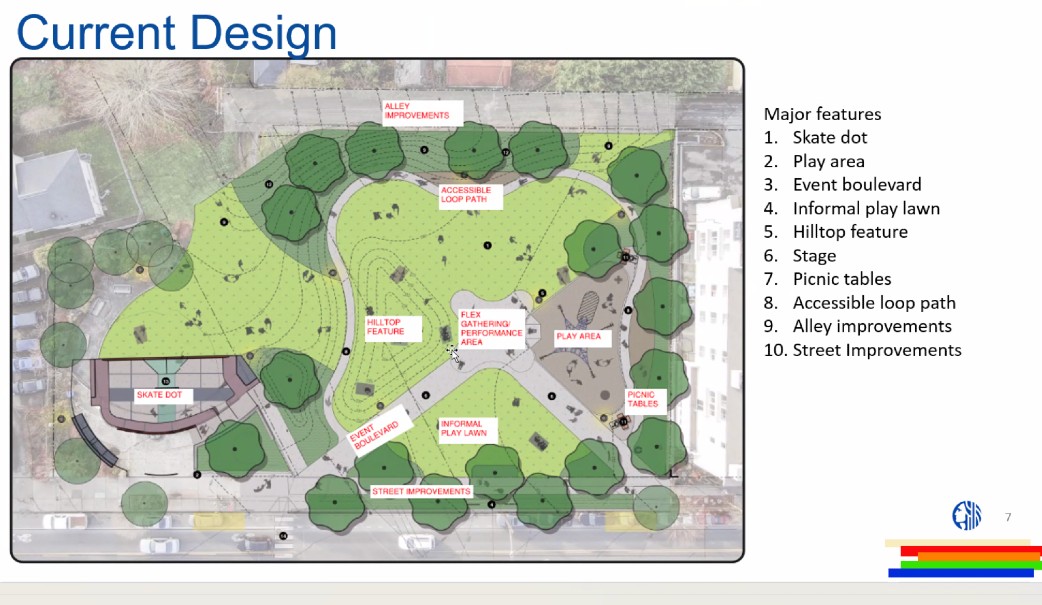
MORGAN JUNCTION PARK ADDITION SKATEDOT: Project team leaders from Seattle Parks presented this update on the project incorporating the currently fenced lot north of the existing park – here are their key slides:
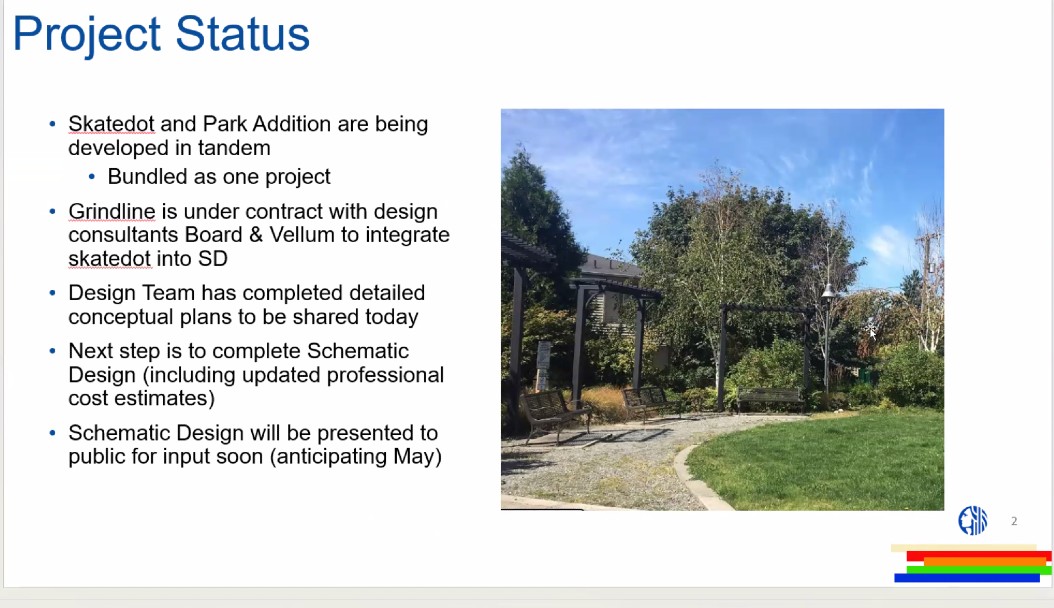
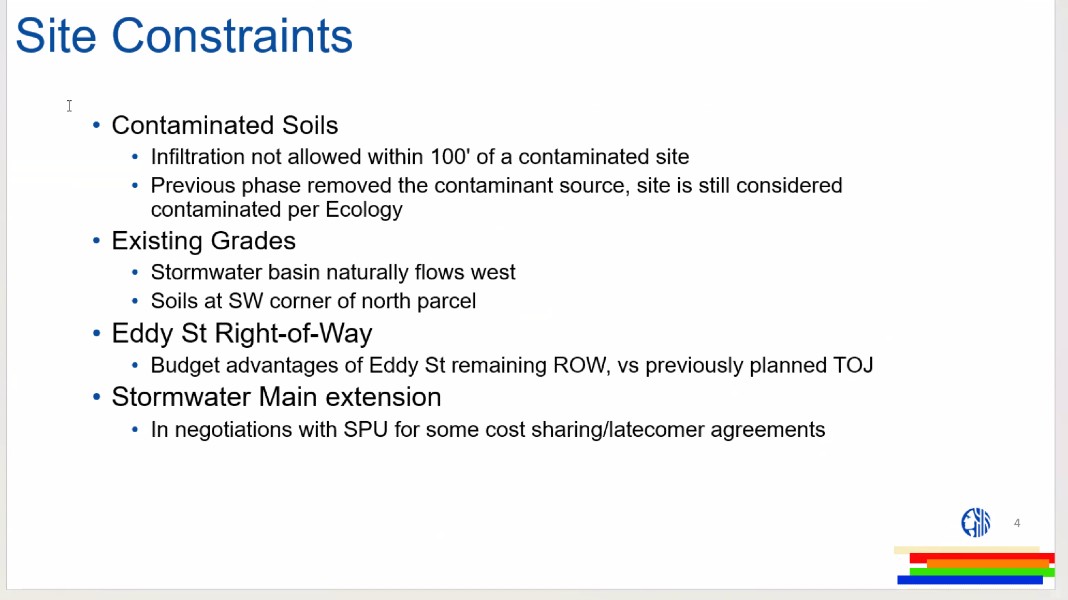
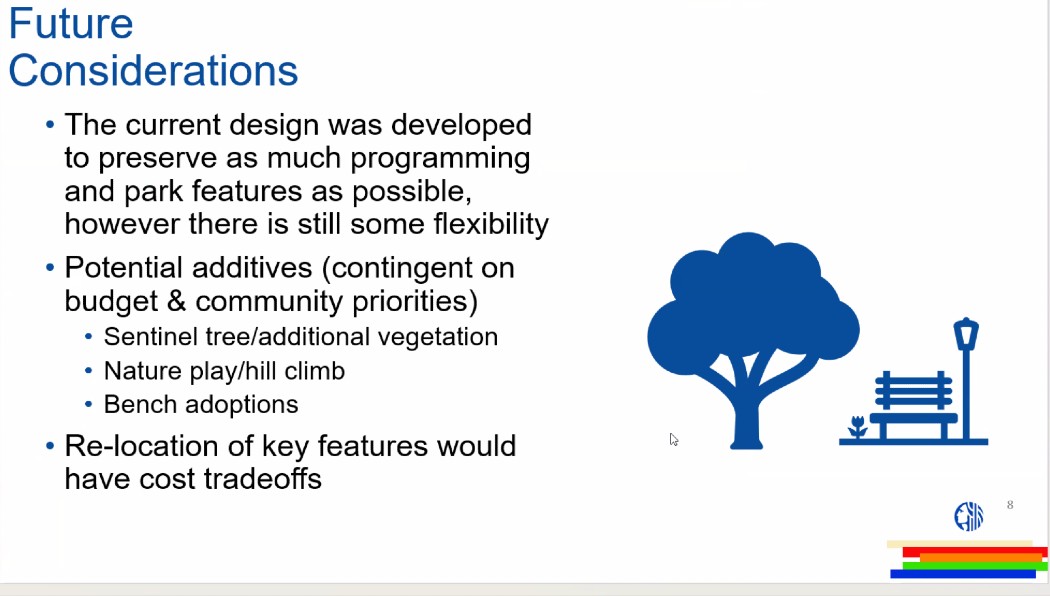
The latest conceptual design, Parks said, has no major changes from the previous version, Parks said.
Despite the soil removal that’s been done, the site is still considered contaminated, so the soil piled at the northwest edge of the site needs to stay – “moving it could be quite expensive.” There’s also still a lot of behind-the-scenes technicalities the Parks team is dealing with, such as having to extend the site’s stormwater main, and working out what the status of the SW Eddy right-of-way between the existing park and the addition site – it might not simply be transferred from SDOT to SPR after all. Access to utility poles along the site’s rear alley is being worked on too.
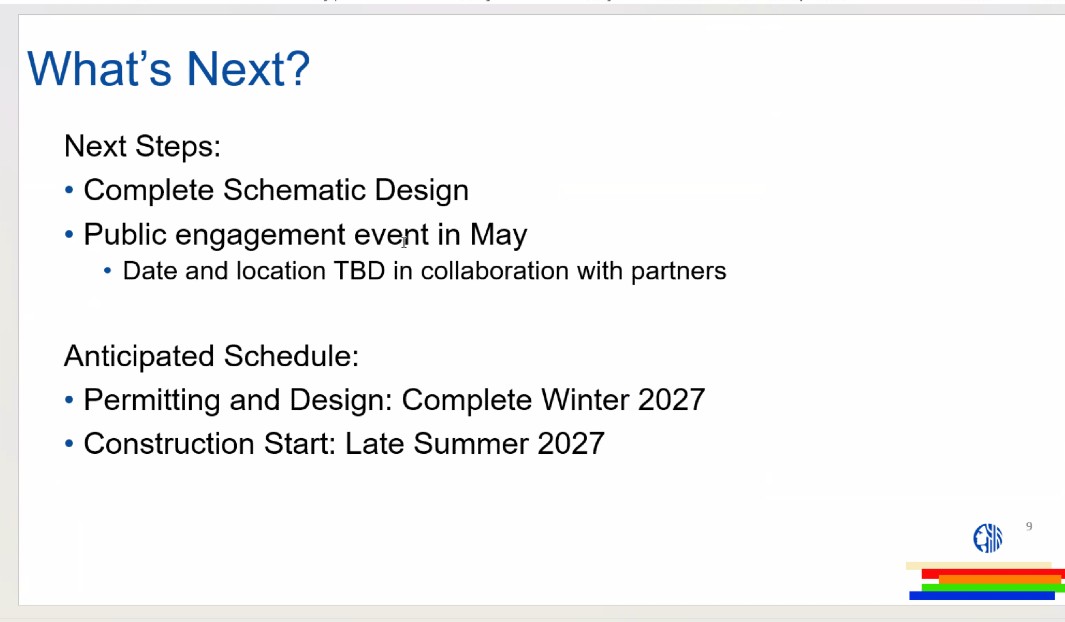
Next steps include a community-engagement event, likely sometime in May, and more design work that should lead to an accurate cost that would help determine whether there could be “additives” to the project such as a “sentinel tree,” a natural play area, or adoptable benches. The newest projected construction timeline is for work to start in “late summer” of 2027.
EMERGENCY READINESS: Cindi Barker from Seattle Emergency Communication Hubs said this year’s West Seattle exercise for hub-volunteer training drill will in fact be at Morgan Junction Park, maybe even utilizing the expansion site if the fences are down by the event date, currently August 15. Watch for other community involvement opportunities before then, all summer long, including opportunities to talk about the hubs at tables during events such as West Seattle Summer Fest in The Junction (July 10-12). And if you don’t know what a hub is or why you should know – this video explains:
West Seattle has 15 hubs, but some are sometimes deactivated because of lack of community involvement, so if you’d like to be part of it, here’s info on getting involved ASAP!
DESIGN-REVIEW REBOOT: The Design Review program, long one of the few ways that community members could get word of and voice an opinion about major development projects, remains on the ropes; Deb Barker is a former Southwest Design Review Board and presented MoCA attendees with the same info she’d given the Alki Community Council about a new push to save and reshape it (scroll to the bottom of this story).
MoCA LEADERSHIP AND SUSTAINABILITY: The group also had some of its own business on the agenda – first, the board election, in which the nominated slate got unanimous approval:
President – Deb Barker
Vice President – Conrad Cipoletti
Secretary – Christopher Miller
Treasurer – Michael Brunner
Business Liaison – Sierra Shea
MoCA is also working on organizational sustainability by working on potential paid memberships. Most other local neighborhoods have them, though they’re generally optional and meetings/events are open to everyone, paid member or not.
REMINDER, NO FESTIVAL THIS YEAR: Sustainability of a different type – the need for more volunteer/community help – was lacking last fall when MoCA’s board had to decide whether to have a community festival again this year, so there won’t be one (as reported here in October).
GATEWOOD ELEMENTARY’S HAVING ONE, THOUGH: In the greater south Morgan Junction/Gatewood area, Gatewood Elementary will be inviting the community to its Gator Fair on Saturday, May 30.
NEXT MEETING: MoCA meets every three months on the third Wednesday, so that means the next meeting is July 15.
By Jason Grotelueschen
Reporting for West Seattle Blog
 The Fauntleroy Community Association board met on Tuesday night at the Fauntleroy Schoolhouse for their April meeting, chaired by FCA president Frank Immel and featuring several updates in addition to special guests from Washington State Ferries talking about plans for the new traffic signal scheduled for installation starting this fall at the Fauntleroy Ferry Terminal.
Meeting summary below:
SPD UPDATE: Crime prevention specialist Matt Brown and community service officer Jamie Heslin from the Southwest Precinct were in attendance to give an update, starting with some statistics:
Brown also noted that he followed up on the FCA’s board’s request from their March meeting to see if SPD can provide neighborhood support to help ease the potential “traffic nightmare” from the “dueling construction projects” planned for the area in a similar timeframe, including:
Brown said that requests for traffic support have been filed and that the SW Precinct captain (Krista Bair) is “definitely taking this seriously.” As Brown and Heslin departed the meeting for their next commitment, board members expressed gratitude for the support and action.
FERRY TERMINAL TRAFFIC SIGNAL: Next up was an update from WA State Ferries external relations director Hadley Rodero (who also lives in West Seattle) and Charlie Torres who serves as the project manager overseeing the design of the Fauntleroy Ferry Terminal. The team provided an update on the new ferry dock intersection signal installation planned for fall 2026, and they explained the design, safety features, and how it will be maintained by SDOT with the timing of the signals adjusted based on performance data.
The team brought some updated visuals and renderings to share, including an overhead view of the new signals:
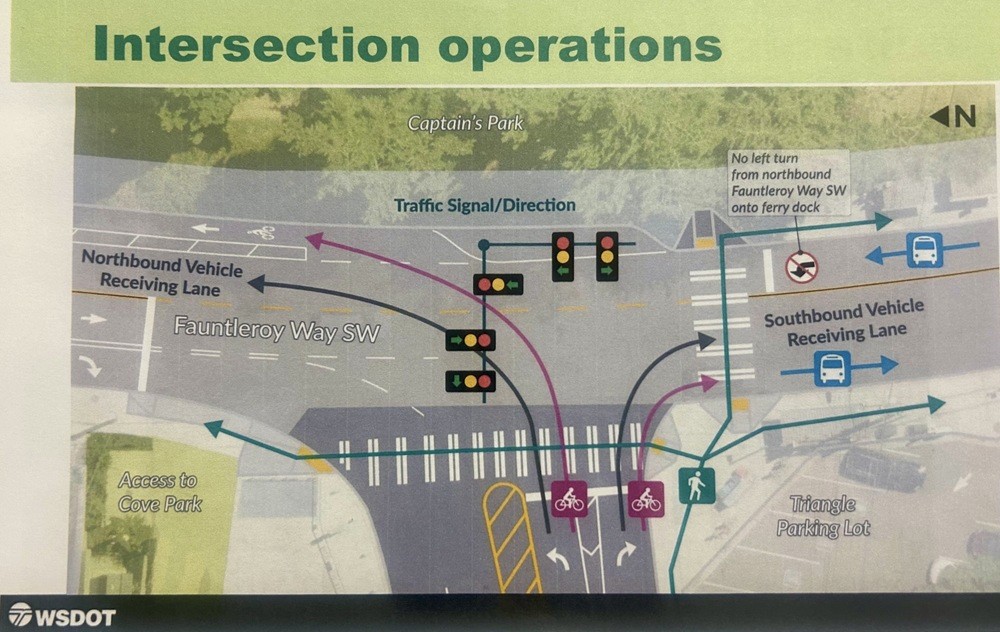
From Fauntleroy Way SW looking south:
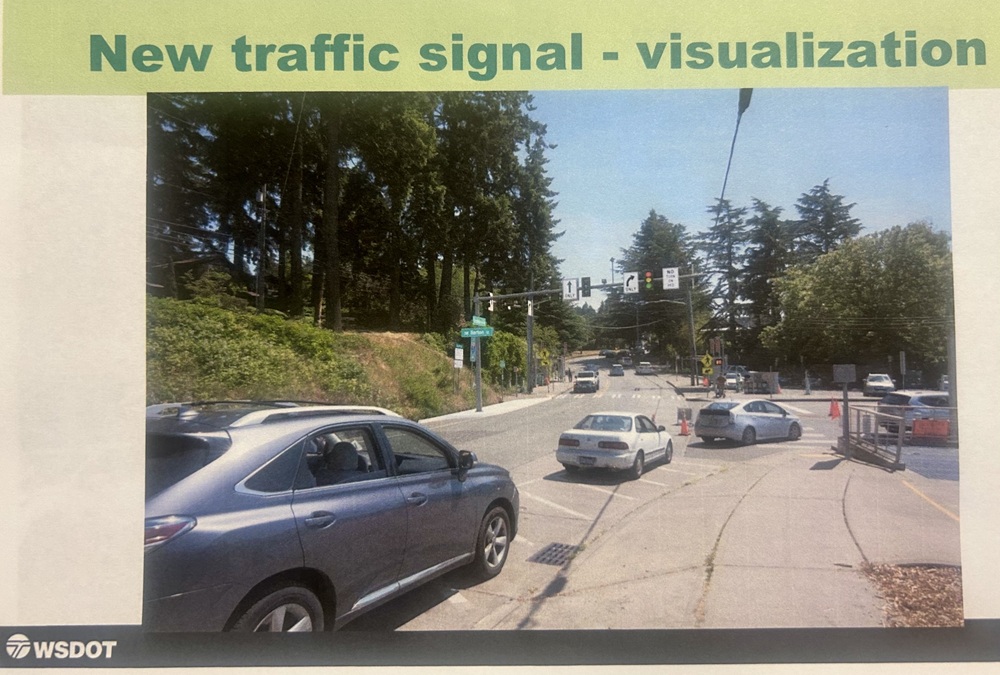
From the ferry dock, looking east:
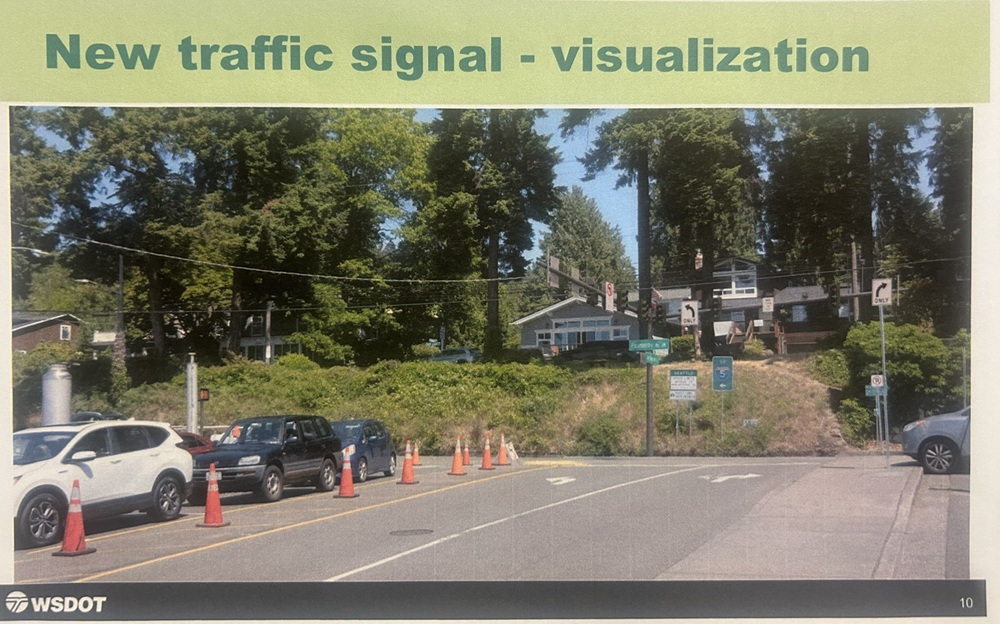
As well as the view from the bluff across the street, which has a lookout area known as Captain’s Park:
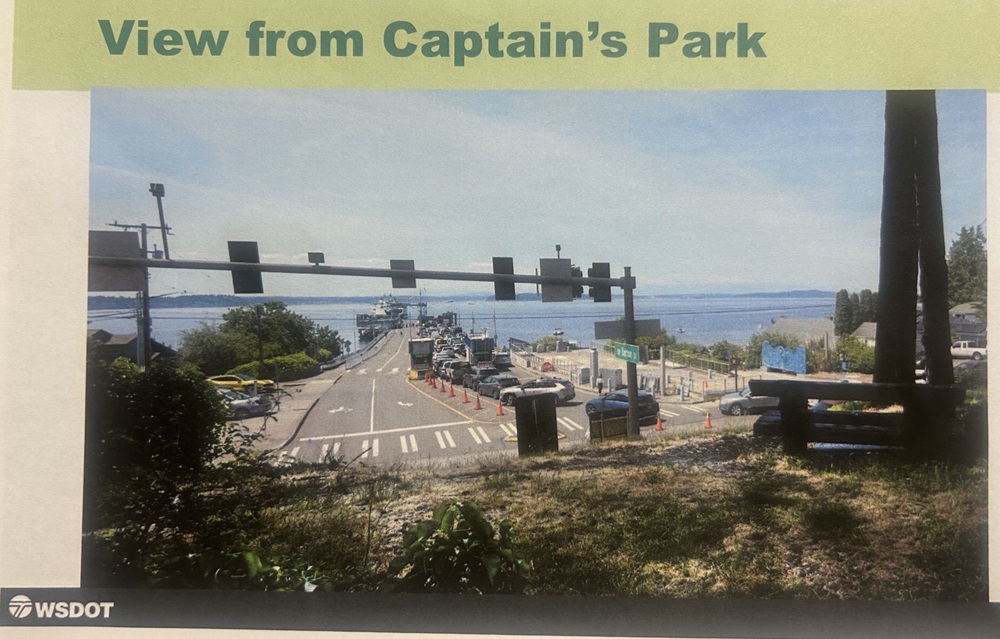
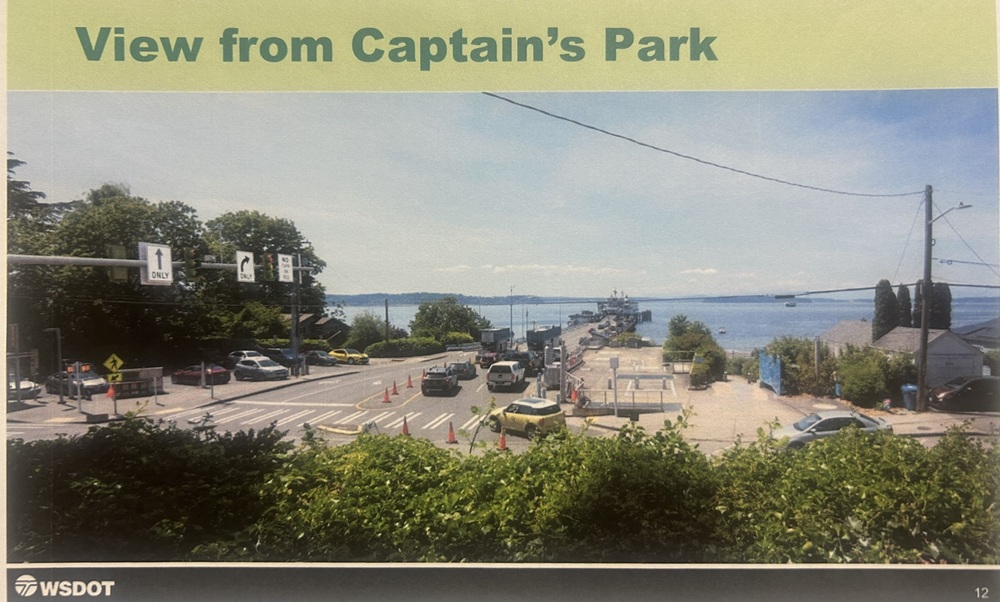
The team expects to award the construction contract in June, and construction work is scheduled to begin after September 8th to avoid the summertime “high season” rush as well as a construction moratorium related to the World Cup. The project will involve 3-4 months of construction work (which puts likely completion in late 2026 or early 2027). The signal will have sophisticated light controls designed to manage vehicle flow in different directions, with pedestrian safety being a key consideration. Rodero said there are plans to do extensive outreach to ferry customers and neighbors to provide information about the new system before it goes live. Torres said the signal is necessary due primarily to too many “close call accidents” in the area, as well as needing to improve overall traffic flow and efficiency with loading/unloading the boats.
FCA board members generally expressed support for the initiative but asked again about the aforementioned “dueling construction projects” in Fauntleroy, of which the new signal is one of them. The team acknowledged the challenges and agreed to have WSF representatives in attendance at FCA’s September board meeting (by that time, a contractor for the signal installation will have been selected and will likely be getting started), and again at the Fauntleroy Fall Festival in October to answer questions from the general public. The group also explored options for community engagement around the multiple related projects, including potential collaboration with the Rose Street crossing project, and potentially developing a community advisory group for the next environmental review phase.
Other points of Q&A:
FOOD FEST RECAP: FCA’s David Haggerty and Reed Haggerty, along with other FCA board members, talked about the group’s successful annual meeting and Food Fest event last month (WSB coverage here). There were over 175 people in attendance, and 21 vendors. There were 40 renewals of annual FCA dues, and 12 new households joining FCA. Feedback about the event was positive from vendors and attendees alike. Board members discussed strategies and ideas for future Food Fests and events.
FCA FINANCES: Treasurer Alan Grainger presented the group’s financial report, noting that dues and contributions from the annual meeting and Food Fest exceeded expectations, and highlighted the progress toward business member support goals. As of the beginning of April, the group is 46% of the way toward its annual goal for incoming contributions, thanks to the bump from last month’s Food Fest and egg hunt.
FALL FESTIVAL PREPARATION: Related to finances, the group also discussed fundraising for the group’s other big annual event, the Fauntleroy Fall Festival (scheduled for Sunday October 18). To raise funds between now and then, there are several events planned, including:
ROSE ST CROSSING: Immel noted that he had talked again with SDOT’s Ching Chan about the Rose St crossing project (involving pedestrian-operated flashing signals and a bus stop design with an island), and said that she wants to put together a joint community meeting with FCA and MoCA (Morgan Community Association) about the project, as a next-step. Details about that meeting are TBD.
OTHER FCA BUSINESS:
The FCA Board meets ten times per year on the second Tuesday of each month, at 6 pm in the Fauntleroy Schoolhouse board room. Meetings are open to the public.
 As we first reported last Monday, Seattle Parks is circulating a “draft racquet-sports strategy” that would split up tennis and pickleball sites, with an initial reduction in the number of outdoor courts for pickleball. It’s launching a round of feedback starting with a survey opening Thursday, and including community meetings. None of those meetings are planned for West Seattle. But this Thursday, the racquet-sports strategy on the agenda for the Alki Community Council meeting, since the courts on the north side of Alki Playfield are involved, proposed as tennis-only. The ACC meets in-person-only at 7 pm at Alki UCC (6115 SW Hinds) on Thursday (April 16) and the agenda also includes other Parks issues as well as public-safety updates.
The Kenney (7125 Fauntleroy Way SW) is hosting community events again, and this Wednesday it will be the meeting site for a community coalition that used to meet there regularly, the Morgan Community Association. MoCA meets quarterly and has rotated through various sites, as well as gathering online, in recent years. At 7 pm Wednesday (April 15), it’ll be a hybrid meeting, with a variety of highlights and updates, including officer elections, public-safety info, and the latest on the Morgan Junction Park addition. See the agenda in our calendar listing, which includes the online link if you can’t attend in person.
 (WSB file photo from a past Station 37 open house
When the city announced that May 2 will be “Neighbor Day,” we asked the Seattle Fire Department if, as happened on many past occasions, they’d be opening local fire stations to community visitors. Though it’s not mentioned in the Neighbor Day announcement, SFD tells us yes, all stations will be open noon-2 pm on that day (three weeks from today) One caveat, though – the firefighters will remain on call, so if they’re dispatched to an emergency, that could bring an abrupt end to that station’s open house. West Seattle has five fire stations – Station 11 in Highland Park at 16th/Holden, Station 29 in North Admiral at 2139 Ferry Avenue SW, Station 32 in The Triangle at 38th/Alaska, Station 36 at the north end of Delridge beneath the West Seattle Bridge, Station 37 in Sunrise Heights at 35th/Holden.
Another neighborhood group with a notable event in the week ahead is the Fauntleroy Community Association. The FCA’s annual membership meeting Tuesday is known as the Food Fest because of bites contributed by local businesses. It’s also a chance to mingle with local nonprofits and what FCA describes as “civic-minded” organizations (we’ll be there to promote West Seattle Community Garage Sale Day, now just a month and a half away on Saturday, May 9). And the Food Fest will briefly convene everyone in attendance for the annual FCA board election. It’s a free event, but you’ll have the opportunity to renew or initiate FCA membership, supporting the organization’s community work. This will be in The Hall at Fauntleroy (9131 California SW), south end of historic Fauntleroy Schoolhouse, 6-8 pm Tuesday (March 24).
By Tracy Record
West Seattle Blog editor
Barely 24 hours before tonight’s Alki gunfire, preventing crime at the beach was a major focus at this month’s Alki Community Council meeting.
PREVENTING ALKI CRIME: President Charlotte Starck recapped a recent walking tour with city reps including District 1 Councilmember Rob Saka, Southwest Precinct police, and managers from Seattle City Light.
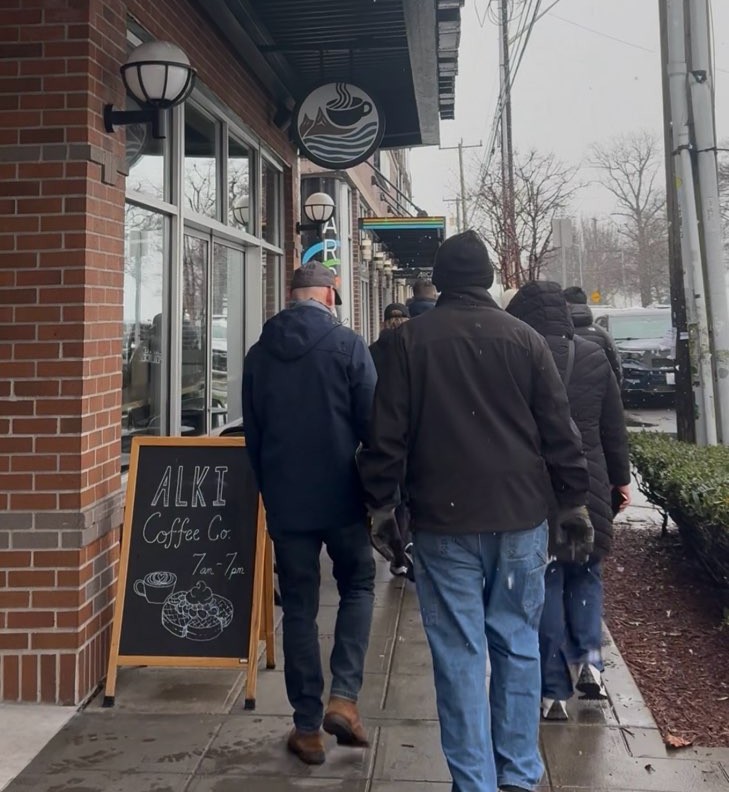 (Photos from Councilmember Saka’s office via Alki Community Council)
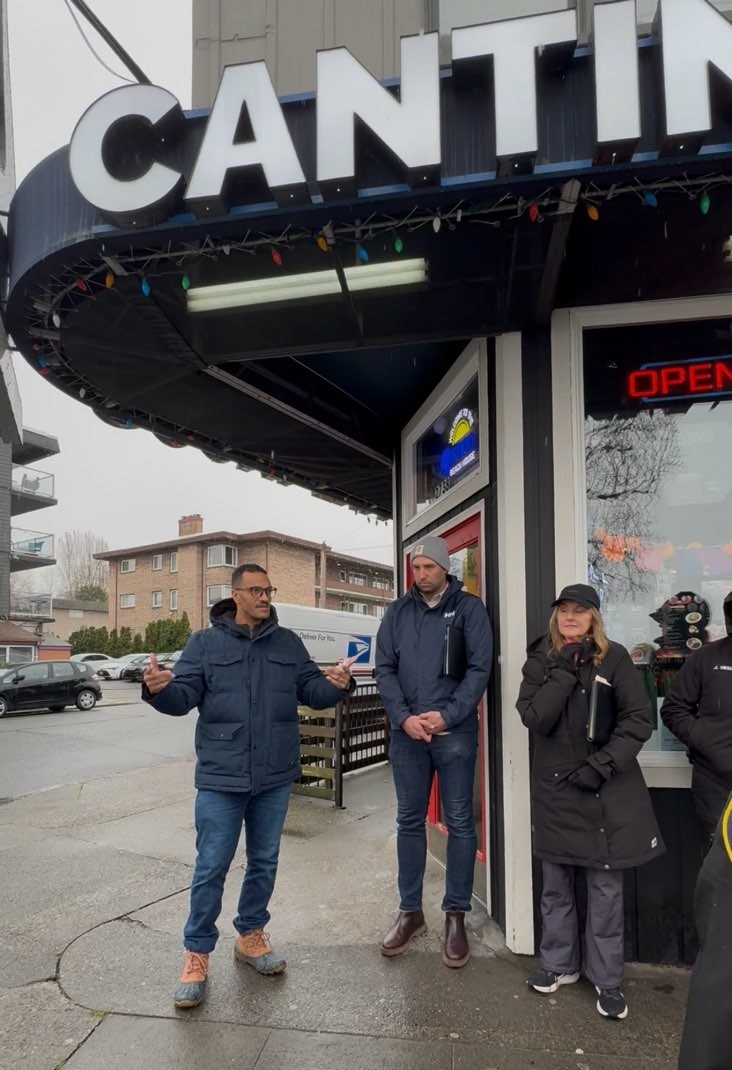
Starck said City Light has committed to, by Memorial Day, install brighter lights on the inland side of Alki Avenue – “pedestrian-level” lighting on wood utility poles. Businesses participating on the walk included some already hit by burglaries or attempted break-ins. (That included Fire Tacos, near the scene of tonight’s gunfire as shown in the photo below.)
So now, ACC vice president Zak Nyberg said, they are looking into rebooting the Block Watch program in more areas of Alki. The SW precinct’s interim Crime Prevention Coordinator Matt Brown said he has 10 volunteer Block Watch Captains on Alki right now – maybe covering 25 percent of that area, which he considers “underserved.” One of those 10 BW captains was at the ACC meeting and said she has been a captain near Alki Point for five years and has an email list of 62 neighbors to circulate information to. She said she’s worked with neighbors on feedback for city projects as well as disaster preparedness, and that they’ve had mini-block parties in the summer, as well as holiday gatherings. She said it’s not a major time commitment – maybe an hour per month most of the year.
One attendee who had experience in a non-West Seattle business district said that security-related signage can be helpful in businesses. Also discussed, the Connect Seattle program where people with security cameras can let the city know so that they can be asked about video if anything happens in their area. Even if you’re registered and get a request, “You can say no,” Brown reminded everyone. (He also said that West Seattle is the area of the city with the largest number of registered cameras.)
Other topics at the ACC meeting:
SCHMITZ PARK CREEK RESTORE: This organization‘s co-founder Brian Barilleaux said this effort has been under way for about three years now (publicly surfaced two years ago) – they’re conducting tours and ivy-removal events, and working on forest trails in Schmitz Preserve Park.Their project’s ultimate goal remains to daylight the creek and bring back salmon. Tim DiMarco, co-chair, talked about how “this beautiful creek” gets “dumped into a culvert.” Can the creek really be restored? They now have funding for a hydrologic study to help answer that question.
They’re also working to honor the Schmitz Family’s intention in donating the forested parkland to keep it natural. Their tours have increasingly focused on the history of the area, including the Indigenous people who lived there first. And Barilleaux said they have a lot of help in their efforts – with 350 volunteers now on their list. And you can support them by donating. He said it’s vital to get even more of the community involved “in the park and what we’re trying to do with it.” They’re also urging people to rip invasives out of their own yards and replant native species to “bring back the isects” and the birds. “We’re trying to get people to quit plating English ivy … it ends up in the park,” DiMarco noted. Brian added that the tire-dust poison seen in automotive runoff doesn’t affect Schmitz Preserve Park, because runoff flows elsewhere and the park water is pristine. That’s why it’s so unfortunate that “right now the creek is in a pipe and the salmon don’t want to go there,” said DiMarco. An attendee had memories of the creek being routed down to 56th/Alki back in the ’60s. Daylighting the creek is going to take years, they summarized, but you can help take small steps now, moving ever closer to the goal. Find out about volunteering and tours on the Schmitz Park Creek Restore website.
UPDATE FROM A CLEANER ALKI: Erik Bell, who’s also on the ACC board, is in his fifth year leading cleanups around (mostly) West Seattle – restoration and “sprucing” of public spaces too. He demurred, “You don’t have to have any special skills to do what we do.” Besides pre-scheduled events, A Cleaner Alki also offers Block Drops – buckets of tools at various public spaces where you can borrow them. He introduced volunteer Joe, who makes good use of Block Drops and told his story – including the joy of gratitude expressed by passers-by. Also discussed: The need for more regular litter pickups by Parks crews.
EMERGENCY HUBS: Also in the vein of community involvement, visiting speaker Cindi Barker from Seattle Emergency Hubs reminded the group that there’s a hub – a pre-designated community gathering place in case of catastrophe – for Alki, and it’s ready for more involvement. The next West Seattle hub practice (drill) will be in August at Morgan Junction Park. To get involved and to see the map that’ll show you the nearest hub – whether or not you’re an Alki resident – go here.
NEIGHBORHOOD ASSOCIATIONS: Starck reported on a citywide meeting of reps from neighborhood groups like ACC, with the big question: “How do we keep the neighborhood groups going?” (West Seattle, for example, has barely half the number it used to.) They discussed their mutual challenges, strengths, and needs. “It was really great to meet them,” and to also note who’s active and who’s not – the city Department of Neighborhoods website has a list that’s largely outdated, she said. The coalition plans to meet again in August.
DESIGN REVIEW REBOOT: Deb Barker, president of the Morgan Community Association and retired municipal land-use planner, is also a former Southwest Design Review Board member, and as such has thorough knowledge of a city program that is on the ropes. She came to let the ACC know about a new citywide effort, the Design Review Reboot Coalition. They’re trying to make sure there is a community voice at the table before Design Review – which used to offer opportunities for public participation in development planning – is killed off forever. The group disagrees with the oft-heard contention that Design Review raises project costs and lengthens timelines. Even more than the city, she said, state government is behind much of the momentum for scrapping or shrinking Design Review. “We’re trying to get back to the Design Review table,” she said; it was also noted that Design Review requirements had led to community notification of projects that otherwise go largely unannounced. If you’re interested in getting involved, email design.review.reboot@gmail.com.
NEXT MEETING: The ACC meets third Thursdays most months, so watch for the April meeting announcement by mid-month.
On the last night of winter, talk about spring and summer with the Alki Community Council! You’re invited to the ACC’s in-person meeting Thursday (March 19), 7 pm at Alki UCC (6115 SW Hinds). Planned topics include crime prevention as the beach’s busy season approaches, rebooting the Block Watch Captain program, Schmitz Park Creek restoration, A Cleaner Alki volunteer work, and more. Door-prize giveaways as always. Check in on more of what’s up at alkicommunitycouncil.org.
By Tracy Record
West Seattle Blog editor
 Here on the verge of spring, summer was on many minds at the Admiral Neighborhood Association‘s general gathering Tuesday night, facilitated at the Admiral HUB (ex-church) by ANA president Joanie Jacobs. Introducing other board members who were there, she said, “We are the board – but the ANA is YOU” – the community.
One early board member with a bit of info to present – new treasurer Becky Crompton, who said the group has about $9,000 on hand – that might sound impressive, but it’s only a quarter of what the ANA’s summer events cost to put on, so the group has some fundraising to do.
POLICE UPDATE: Seattle Police Community Liaison Officer German Barreto presented the crime data, as has become a regular feature toward the start of most neighborhood-group meetings. He’s the community liaison officer for the Southwest Precinct. Year to date stats – no categories are up, he said. For Admiral, aggravated assaults are the only category that’s up (weapons make the difference); no confirmed gunfire incidents in the Admiral area so far this year. Inviting questions, he was asked about a sign at Jack Block Park that said “no immigration activity” allowed; Officer Barreto reiterated the city position, but wasn’t sure about the park sign (Jack Block is a port-owned park). If you see an incident and aren’t sure what’s going on, call 911 so they can find out for sure – ICE, undercover SPD, or something else. “Don’t intervene, call 911,” and let the calltaker know you’d like to get an update on whatever it turned out to be.
Another attendee asked about summer patrol plans for Alki and vicinity. SPD plans “emphasis patrols,” he said, but again this year that depends on staffing “and I heard our budget might get cut” (the mayor has asked city departments to prepare possible cuts). What about ramping up for the World Cup Seattle matches? Jacobs asked. Barreto said he’d have to look into the Southwest Precinct specifics. Another question: Do you have emphasis patrols around schools? SPD and the district are still working on it.
After Barreto concluded, when nobody else had anything to ask: Jacobs suggested to attendees, “Know your neighbors.”
CARE DEPARTMENT: One of the city’s other standalone public-safety departments is CARE – Community Assisted Response and Engagement – explained by guest speaker Devonte Belle, its public-affairs and policy director. He was previously a supervisor in 911 (a service that CARE provides in addition to deploying its Crisis Responders). CARE is 2 1/2 years old now – but the responders are still primarily dual-dispatched (with police); they are all social workers, “with a lot of knowledge of the system and the ihdividuals they are helping in the field.” He mentioned the “tension with the Police Department” about who handles what (highlighted lately in regional-media reports), and though they can now be solo dispatched without police in some circumstances, there are still a lot of restrictions “that we don’t necessarily agree with, but they’re there.” It’s up to 911 dispatchers to decide who to send to an incident when you call in; you might be able to request them but be ready to tell them what’s going on so the dispatchers can make the best decision.
The CARE responders number 27 right now, and that’ll grow to 48 people this year, but they’re also expanding hours, so those 48 responders will be stretched across more hours/days. Typically they’d have one or two teams in this area (Southwest) between noon and 10 pm. We asked what a typical CARE response might be like; Belle said that responders typically spend 40 to 45 minutes at a scene, possibly offering emotional support, maybe helping with reasons they can’t get into shelter – offering clothes, transportation, caring for pets that might not be able to go into a shelter with them. Bus tickets too, if somebody has family somewhere that can help (Belle was careful to say that they don’t just put people on buses to get them out of town). They can provide food and hygiene items. They also can refer someone to the Crisis Solution Center.
One other bit of information: CARE responders’ starting pay is around $43/hour.
First question was about who does what in the alternate response world, which also includes the “nurse line.”
The 911 center only has about 75 percent of the staffing that it should, 150 currently.
If something is happening now – call 911 not the non-emergency. Let THEM decide who to – whether to – dispatch.
Belle was asked about the upcoming RV/tiny home site, Glassyard Commons. Tiny-house sites rarely generate 911 calls, he said; often residents of tiny-home villages realize that if they screw up, they’re probably going to get kicked out, so they self-police.
SUMMER IS NOT FAR AWAY! That’s how Jacobs opened the next part of the meeting, about the ANA’s event slate for this summer. They’re recruiting volunteers to help with everything.
It all starts with the West Seattle Kids’ 4th of July Parade, 10 am July 4. Becky Brownlee is co-chairing it – “it’s such a fun day.” The parade as usual will be followed by park games, food trucks, sack races, and they need lots of help with both advance coordination and day-of. They’re having a volunteer meeting on May 19 for all ANA summer events. Jacobs noted that the parade “is not just a kids’ event” – and she added that they’re looking for a connection with a marching band, “even a small one,” to lead the parade. One suggestion was for a HONK! style marching band.
Admiral Music in the Parks (AMP), chaired by Dan Jacobs and Meagan Loftin, will be “on the road” again this year and beyond, even though its original home, Hiawatha, is open. July 16 at Belvidere, July 23 at California Place Park, July 30 at Hamilton Viewpoint, and 30 bands already have expressed interest in playing. Loftin said it’s “the chillest thing possible” to volunteer at – “sit at a table and talk to people when they come up to you.” They have “lots of opportunities for business sponsors.”
The Admiral Block Party, headed by Joanie Jacobs, will again start with a Friday night pre-func, August 21, and then all-day August 22, on California north of Admiral Way. That not only spreads the fun over two days, but also spreads the setup over two days. They try hard to focus on truly local vendors, “to let our local businesses really shine,” said Joanie. Everyone is a volunteer so “we run on volunteer power,” she exclaimed. “The volunteer meeting is where to hear specifics about those events,” she said – so save 7 pm May 19, location TBA. The point was also made, you don’t have to decide which one event to get involved with – you can be part of more than one.
MEMBERSHIP: Loftin talked about how they’re continuing to revise tiered levels – “ways for you to give us more money” if you want to, and working on swhich levels of involvement are available for businsses. She talked about some of the business supporters (you can see them on the ANA website). They’ve also produced brochures, too. And volunteer help to deliver copies to businsses would be welcome too!
PATRICK SAND AWARD: Dan Jacobs talked about the opening of nominations for the second year of this award in the spirit and memory of WSB co-founder Patrick Sand, who died almost a year an a half ago. Alki Bike and Board owner and community advocate Stu Hennessey was the first recipient. “We’re looking for somebody who is an incredible influence in the neighborhood.” You can make a nomination through the ANA website. A committee will review the nominations and then your editor here (Patrick’s widow) will help choose from among the finalists. Dan Jacobs is looking for people to help him review nominations – you can contact him through the ANA website.
ADMIRAL CLEANUP: ANA will do one or two cleanups this year, said Ryan Crompton – last year they picked up 20 bags of trash and Ryan was surprised by the volume of cigarette butts. First one will probably be “in May-June timeframe,” then one in fall, dates expected by next ANA meeting, so you can make plans to volunteer.
EMERGENCY HUBS: Longtime leader in the Seattle Emergency Hubs organization, Cindi Barker, stood in front of the group to say that Admiral needs another volunteer hub captain to lead this place that will spring into action to help coordinate information in case of catastrophe that cuts regular communication levels. If you’re considering getting involved, a HUB class this Saturday (here’s our calendar listing) will kick off training for West Seattle volunteers. It’s not a lot of work, Barker and Joanie Jacobs agreed – “it’s really not hard-hard,” emphasized Barker. Admiral’s had turnover though some hubs have the same captain with whom they started more than a decade.
ART WALK THIS THURSDAY: Admiral is one of the main neighborhoods this time again – 5-8 pm Thursday (March 12); you can preview venues here.
ADMIRAL CHURCH: The church’s new Pastor Jermell Witherspoon was introduced (and noted his showcase here on WSB last month).
ANA MEETING LOCATION: May 12 will be back at the HUB again and then after that, when meetings start up in fall, they want to find a semi-permanent space for the meeting, since the ex-church site won’t be available, with demolition and then redevelopment likely to be under way this fall. Watch connecttoadmiral.org for updates.
By Jason Grotelueschen
Reporting for West Seattle Blog
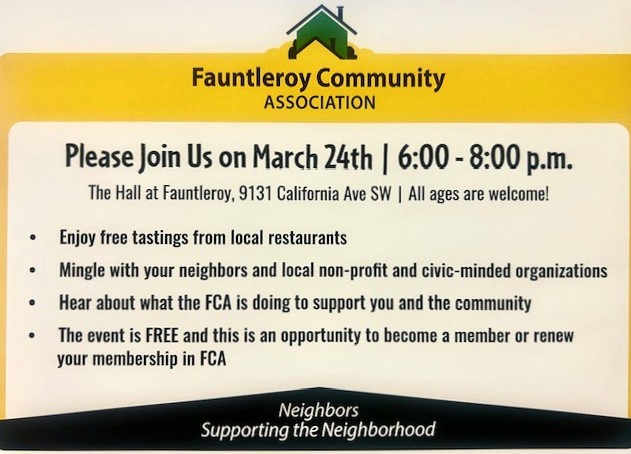
The March board meeting of the Fauntleroy Community Association, chaired on Tuesday night by FCA president Frank Immel, focused largely on putting the finishing touches on planning for the group’s annual membership meeting, aka Food Fest. The big event is coming up in just a couple of weeks on Tuesday March 24th from 6-8 pm at The Hall at Fauntleroy (9131 California SW). All neighbors are welcome!
Board member David Haggerty, joining the meeting remotely, went through his list of items and tasks in preparation for the fest, including the list of local food and beverage vendors who plan to attend and provide attendees with a variety of tasty bites and sips. The board conducts a brief annual meeting at the event, which includes the election of officers for the upcoming year.
As usual, there will also be large number of community-table participants (civic, community, nonprofit, and advocacy groups) at the event, and WSB will be there as well to cover the proceedings and also to share info about the annual West Seattle Community Garage Sale Day which opens for registrations on April 1. Here’s the flyer that was sent to neighbors last week, with additional copies being handed out as well:
Another popular Fauntleroy event coming up: The Annual Spring Egg Hunt at Fauntleroy Schoolhouse on Saturday, March 28 at 1 pm. Board members said that planning is well underway for the event, and the group looks forward to welcoming egg-hunters for the event.
Other items of interest that were discussed at Tuesday night’s meeting:
SPD UPDATE: Crime prevention specialist Matt Brown provided some crime statistics, with the help of another officer. For the SW Precinct as a whole (West Seattle and South Park), total crime is down 14% year-to-date compared to last year, larceny/theft down 10%, and violent crime down by a whopping 29%. For Fauntleroy in particular, total crime is actually up 62% year-to-date (but Brown pointed out that the numbers are small, with 22 incidents so far this year compared to 15 last year during the same time period, and that the 5-year weighted average is “right on par.”) Fauntleroy has had zero violent crimes this year-to-date, and all incidents logged are property crimes (with larceny/theft being the highest), including burglary and one motor vehicle theft. Shots fired: zero for Fauntleroy this year, while the SW Precinct as a whole has had 11 incidents; 3 with injuries; zero deaths; most recent incident at Alki on Saturday.
A board member asked Brown if he had any insights regarding the notable drop in crime, and he called out the citywide policing strategy emphasizing repeat offenders, for example, focusing on individuals tied to the most gun-related incidents, as being a possible factor.
Another meeting attendee asked about staffing: Brown said things are going well, with many recruits currently in the FTO (Field Training Officer) phase, ready for assignment soon. He did add, though, that the SW Precinct—having the lowest crime compared to other Seattle precincts—will likely receive fewer new officers than other precincts.
Immel asked about the availability of community safety resources for neighbors, and Brown said he frequently provides personal safety and de-escalation trainings, and there are home/business security assessments available, along with brochures and handouts. Brown said SPD will bring handouts and materials to the March 24 FCA meeting, as well as probably have a squad car available out front (the popular “mobile precinct” vehicle is unavailable that night, though).
DUELING PROJECTS IMPACTING TRAFFIC: Before Brown and his colleague departed for their next commitments, Immel raised the issue of the “traffic nightmare” looming as a result of the large number of concurrent civil/traffic projects that Fauntleroy will soon be facing. Imel asked if SPD was involved to help with enforcement and/or initial emphasis around upcoming the upcoming traffic changes (especially at the ferry dock). Brown took notes and said he would inquire internally at SPD and report back.
Imel called out several concurrent projects that will all be occurring with a mile of each other, likely causing a serious congestion and safety risk:
Board members and meeting attendees including neighbors Victoria Nelson and John McNulty continued the discussion on these projects, with several noting that the agencies involved appear to be “siloed” and not coordinating with each other. Attendees agreed that ideally there should be much tighter coordination between various groups like Metro, SPD, SPU, and Washington State Ferries, with some suggesting that projects should be staggered over time to ease gridlock. Immel said that if many of these projects indeed happen at the same time, then drivers trying to leave the area will have “no way out” due to competing detours and closures.
Immel did provide an encouraging update that he met recently with Councilmember Rob Saka and asked if he could help. Immel noted that Saka’s office has already sent a coordination request letter to several relevant department heads, and that Saka seemed ready and willing to assist with encouraging coordination. FCA board members agreed that they would also draft a consolidated letter to numerous parties, outlining the traffic and safety issues likely to be caused by so many concurrent projects happening in the area.
For the Rose Street project in particular, Nelson and other attendees reiterated their opinion that the project is too heavy-handed and that desired results could be achieved without including components such as the planned pedestrian refuge island. Attendees agreed that better coordination with Metro to ideally install a visible bus shelter would be beneficial, and the group also talked about signal design, possible speed cushions/raised crossings, protecting bicycle access and allowing for emergency vehicle movement.
Attendees agreed that there isn’t enough community awareness for most of these projects, and still a lot of unanswered questions, and it would be ideal to have project representatives attend future FCA board meetings to provide updates. These would include people like Washington State Ferries’ Hadley Rodero (who also lives in West Seattle) and SDOT’s Ching Chan.
BOARD BUSINESS: Some board members were absent Tuesday night and the group didn’t have quorum until partway through the meeting, so the agenda shifted a bit. No significant financial updates because FCA’s treasurer was not in attendance. For membership, the group expects a bump in activity at the upcoming Food Fest, as neighbors renew their memberships or sign up for the first time. Board members also discussed the existing committees that FCA has, and that some of them should be evaluated and potentially restarted.
CROSSING FLAGS: As the meeting closed, board member Bill Wellington also said that he had recently noticed a disturbingly high number of the group’s orange crossing flags being strewn on the ground and in the streets. Attendees agreed that this was something worth watching, to ensure that there are enough flags being properly stored and restocked for neighbors to use when crossing busy streets.
The FCA Board meets ten times per year on the second Tuesday of each month, at 6 pm in the Fauntleroy Schoolhouse board room. Meetings are open to the public.
 (WSB file photo)
Thanks to HPAC co-chair Kay Kirkpatrick for the tip. SDOT has scheduled an online public meeting March 4 for the most controversial West Seattle project on their drawing board, the plan to convert the outside downhill lane on the Highland Park Way hill to a multi-use path. The possibility of rechannelizing the hill – which was a busy detour route during the West Seattle Bridge closure – first came up in the 2010s, then went on hold in 2020, then turned up again in a city application for federal funding in 2022, and then moved onto the path toward finalization a year ago despite loud opposition. SDOT recently told WSB that construction is at least a year away; the department says it’ll have design updates at the March 4 meeting, which is scheduled to start at 5 pm, and will be at this Zoom link.
By Tracy Record
West Seattle Blog editor
Planning for next month’s Fauntleroy Community Association annual membership meeting, known as the Food Fest, was a major item of business for the February FCA board meeting, facilitated by FCA president Frank Immel.
FAUNTLEROY FOOD FEST: Local food and beverage purveyors usually participate in the annual meeting by contributing bites and sips, and that’s how it got its name. Board member David Haggerty reminded everyone that Tuesday, March 24, is this year’s date (6-9 pm) and invitations are going out; they discussed all the food/beverage purveyors in Fauntleroy that anyone could think off, as well as past community-table participants (a wide variety of civic, community, nonprofit, and advocacy groups – this year we’ll be there too, not just to cover it but also with info about West Seattle Community Garage Sale Day, since registration will start just eight days later, on April 1).
The annual meeting is the occasion for voting on the next year’s board; there could be room for someone new, it was discussed, They currently have 12 members and the bylaws cap board membership at 15. To change that or any other bylaws would require a quorum of at least 50 percent of the membership – currently numbering more than 350 people.
One board role is being vacated – a new secretary is needed because Kris Ilgenfritz is stepping down from that role, while intending to stay on the board. A discussion ensued about whether an AI voice transcription of meetings would be “good enough” to fill the role. Human oversight/responsibility would still be needed, it was noted. What about recording and publishing the meetings? One objection to that: Some people would rather not have their voice online for fear of spoofing, some said. Nothing was finalized regarding handling the secretary’s role going forward, though at least one current board member expressed interest.
Other major items of discussion:
SEATTLE POLICE: A Community Service Officer attended with crime stats – first, the same general Southwest Precinct stats reported at preceding neighborhood-group meetings since the start of the year, that crime is down overall. For Fauntleroy, violent crime is “down 100 percent,” she said (without numbers) and property crime up by 1 (eight incidents compared to seven for the first month of the year) also, one shots-fired incident in Fauntleroy so far this year. She said a grant has been approved for a Resource Fair expected to happen at Westside Neighbors Shelter. Some talk turned briefly to security officers in Target, since WWV is still a shoplifting hotspot. Anything happening in schools, in light of the South Seattle killings? She said even CSOs “have to be invited into the schools,” not only sworn officers. But that is happening in some places. CSO still number 24 – four supervisors, 20 officers. They were deployed at South Seattle after the shootings, she added, just there in case people needed support, and have been out at the ongoing memorial too.
EMERGENCY HUBS: Fauntleroy’s hub – a pre-designated place where information would be collected and disseminated in case of catastrophe – is being rebooted, Cindi Barker from the Seattle Emergency Hubs said, with a series of West Seattle events soon, starting with a hub explainer in mid-archand culminating in a big meeting and annual hub exercise on June 7. “You may find someone who finds their entry into community via disaster preparedness,” Barker said. She and/or the Fauntleroy hub’s volunteer coordinator will be at the Food Fest too.
WASHINGTON STATE FERRIES: So will WSF, Immel said, focusing on the dock-intersection signal update. No new developments otherwise – “the dock [replacement] work is still (at least) a couple years away.”
COUNCILMEMBER MEETING: On another transportation-project matter, vice president Catherine Bailey said she and board member Dave Follis had met with District 1 City Councilmember Rob Saka and his district director Erik Schmidt a few days earier. She said they talked about the Rose Street crossing and the interest in more conversation with the project manager. She reported that Saka also tried to clarify for them the difference between what he can do and what the executive branch (mayor) can do. Bailey reminded the board that they’ve been campaigning for the crossing for at least 10 years. (Going on 20 – a marked crosswalk was removed there in 2007.) They’re hoping SDOT might send a rep to the Food Fest to talk about it.
SPRING EGG HUNT: FCA’s event is March 28.
PEDESTRIAN FLAGS: Discussion focused on keeping them maintained and stocked.
FUNDRAISING: The egg hunt, autumn’s pumpkin hunt, planter boxes in the Endolyne triangle, and pedestrian-safety flags are just some of what FCA spends money on. So board members engaged in a round of brainstorming on fundraising ideas. No conclusions were reached; board member Bill Wellington suggested that increasing (paid) membership might be a more-suitable overarching goal. VP Bailey suggested making a pitch for donations and membership during the Food Fest (which, despite being the annual membership meeting, draws non-members too).
MARCH: No FCA board meeting next month since the Food Fest will be March 24. Watch for updates at fauntleroy.net.
Though this week will bring the third Thursday of the month, it won’t bring an Alki Community Council meeting. ACC board members say they’re busy working on events for the year ahead, so they’ll reconvene community members at 7 pm Thursday, March 19, at Alki UCC (6115 SW Hinds)
By Tracy Record
West Seattle Blog editor
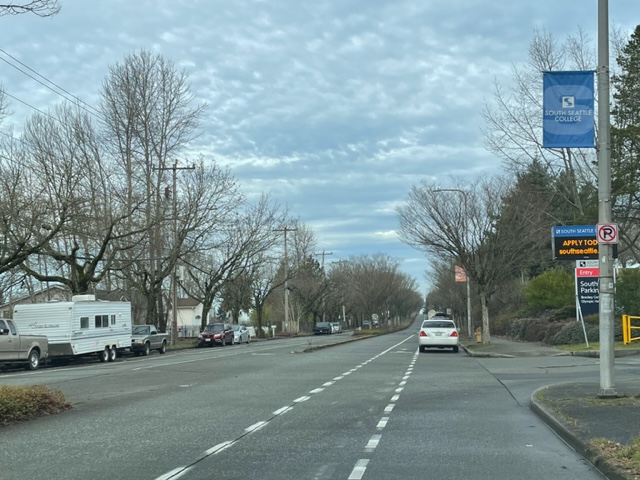
More than 50 people filled a room at South Seattle College‘s Cascade Hall last night for a “community conversation” about parking along 16th Avenue SW in front of the campus.
The west side of the median-divided street is lined with single-family homes, and the street parking is relatively devoid of signage, so in addition to the vehicles of students and staff – who have to buy permits to park in campus lots – street parking is also used by RV/trailer/truck residents. The number fluctuates but we counted 10 on a visit earlier this week.
While that wasn’t mentioned in the meeting announcement, that was clearly what everyone was there to discuss – though not all agreed on what was at the heart of it. A panel of city reps included Tom Van Bronkhorst from the Unified Care Team; Mike Estey from SDOT; and Laura Fox from SPD Parking Enforcement (a listed panelist from the city’s “unsheltered services” program did not show up). SSC communications director Ty Swenson facilitated. Also there but not seated with the panel in front of the room were SSC president Dr. Monica Brown and District 1 City Councilmember Rob Saka‘s new policy adviser, Brendan Kolding.
The college wants to be “more than a neighbor in name … also a neighbor in deed,” said Dr. Brown in brief welcoming remarks. Swenson said SSC was trying to “approach this conversation” with a better understanding of “the needs of our unhoused population.” He said the conversation’s goals included the “opportunity to share your experiences” and to learn about the city’s approach to “supporting the unhoused population” and “parking enforcement” – tincluding the options that might be available for the latter.
Fox was the first city panelist to speak and said she empathized with the situation. Estey said, “We keep getting introduced as experts (but) it’s hard to be an expert on this issue.”
Swenson then provided “background from the college perspective,” saying Van Bronkhorst had contacted SSC last fall about possibly installing parking-restriction signage. “One of the things (he shared) was that these days the city most commonly puts up 2- and 4-hour signs” but that might not work for students, so SSC was looking for a wider range of possibilities. Swenson said they also were concerned that restrictions would just move RVs “further down the road.”
Van Bronkhorst spoke next, explaining the Unified Care Team – representatives from 10 city departments, “one part of the city’s overall response to homelessness … working on restoring access to public spaces” among other things. The UCT is “not a first-responding group” and “our mission is not to solve homelessness,” he clarified.
Fox said Parking Enforcement works with UCT, coming out during remediations and giving three-day warnings (those familiar orange notices). But they usually don’t move, and don’t get towed because people are living in them, she explained.
An attendee then spoke out about observing a recent situation where no-parking signs went up, people in RVs left, “and they came back.” Another attendee then voiced concern for trauma to the people who have been swept. Another attendee stood up and said she wants everyone to have someplace to live, and she’s paid taxes for that. But “we’ve dealt with so many things in the city in the past five years.” So has she, saying for example, she had to replace her fence, had to call police for someone peeping into her home. “Are there conseaquences when people are offered shelter (and don’t take it)?” She mentioned streets in other neighborhoods with barriers such as rocks. She said the city’s had five years to collect data but all she sees is the UCT “replacing propane canisters … The frustration is, I want everybody to be housed, you have the data, where is the plan? Do something …” She also said she was frustrated that Councilmember Saka himself was not in attendance. “He should be here,” she said, her voice continuing to intensify. Many in the room applauded when she was finished.
The next person to speak said, “There should be campers outside Rob Saka’s house … there should be campers outside all our houses” until things were equalized. Others in the room demanded to know whether the speaker owns property. The speaker replied, repeatedly, “I live here.”
Next person: Why aren’t tickets being given out, considering that the RVs block the bike lanes? Parking Enforcement supervisor Fox said there’s a rule for that but a ticket isn’t going to remove the RV. “There has to be someone calling in, we’re not just driving around looking,” She added that parking enforcement officers have safety concerns. She said that precinct officers often assist PEOs, and promised to “try to get out here more often.”
Another attendee said RV dwellers have been “aggressive” and also voiced concern that notification of the meeting hadn’t been distributed widely enough. They were followed by a person who said she had had more than half a dozen people in her family experiencing homelessness. “These people are being left out there to die … There is nothing compassionate (about that) …” She said at least one person had died in the area. “I would like the developers, the city, to fix th housing crisis” but believes that’s not going to happen any time soon. She thinks “a light, tight mobile camp” would be better, without room for big RVs – otherwise people are “sitting out there as bait for predators.”
The open-mic type of sequential commenting continued. Next was a resident identifying himself as a homeowner who said he’d put up a camera for six months to record what’s happening on the street. He said he had recorded some doing things he doesn’t like, but others are doing good things. “We ought to be forming relationships with them.” He says he has footage of people causing trouble for the RV residents – “we need to come up with a solution and not” treat them like outcasts. “They have nowhere to go. … We need to solve this problem at a housing level,” not at a level of making RV dwellers the enemy.
But almost every time someone suggested the need for that solution, someone else declared that wasn’t the point of the meeting, parking was. The next speaker declared she’s :empathetic’ but is fed up with problems such as a couple in one RV who frequently fight, with the disruption spilling out into the neighborhood. She added that she herself is an immigrant and naturalized citizen and “came here with nothing.” Then she suggested that there “are two different kinds of unhoused” … one type who “truly wants the help,” the other type who does not.
Shortly thereafter, Van Bronkhorst explained the outreach process and its limitations. “We don’t have a lot of great housing options .. we offer shelter, services, that are not great for a lot of people … we offer tiny house villages” but usually vacancies are rare because tiny houses are so popular. For RVs, they first try to clean up the area before a removal, “we’ll talk to them about their needs to keep their vehicles moving.” That’s when Van Bronkhorst spoke of the RV-safe-lot/tiny-house village plan we broke the news about last week (up to 72 RVs, 20 tiny houses), though he had few details.
SDOT’s Estey (who is the department’s curb-space manager) then took the mic to steer the focus back to the parking restriction issue. He said they’ve been installing 4-hour limits in places where people with RVs might want to park – “the (signs) tend to be self-enforcing.” (He is ‘curb space manager’ for the city. He also acknowledged that restrictions would “push the RVs to other places.” They tend to install such signage just on the commercial side (which in this case would be the east side, in front of SSC) because on the residential side there are more impacts. “There’s probably not a permit solution,” he said, for those wondering about RPZs, since there are specific conditions that need to be met. They could do a study, he said, to verify whether an RPZ would be justified. And he acknowledged that, yes, overnight parking is illegal, but SPD isn’t staffed overnight to enforce that.
Could they put jersey barriers every 30 feet or so? he was asked. “Our preference is not to have to default to something like that,” or putting eco-blocks in the right of way, Estey said, “but we also understand why they end up there because people feel a sense of desperation.” Van Bronkhorst said the last mayoral administration did not enforce removal of ecoblocks but he doesn’t know what “the new administration” thinks. He mentioned some neighborhoods putting out metal planters. “That’s not legal,” several attendees said, while others quickly pointed out no one was enforcing that. (A little while later, someone else mentioned that the arrival of ecoblocks after a sweep on Highland Park Way seemed to have preceded RVs’ move to 16th. They said they’d reported street obstructions via Find It Fix It but “they’re still there.”)
Another person wondered whether there should be special consideration here since SSC is a school. Estey observed that “it’s unique that you have a college with single-family (homes) across the street.” He said parking enforcement would likely come out more often if there were signs. “We need parking restrictions on both sides of the street,” an attendee said. “And at Sanislo Elementary,” added another, referring to Puget Ridge’s other school.
Van Bronkhorst mentioned another signage tactic, putting up signs asking for voluntary compliance “be a good neighbor, kids live here too.”
Then an attendee who said they’ve lived in the area for 32 years read a statement about her “personal experience.” She said crime problems had arrived with the RVs. “I don’t think sweeping is the answer, but we’re not here to solve the housing crisis.” She said her car had been stolen, and several others spoke up to say theirs had too. She said she is not comfortable walking in the neighborhood any more and declared “this isn’t about punishing pople who live in vehicles, this is about public safety.”
The next speaker countered by declaring that everyone is a neighbor, including renters, and RV dwellers. She said parking restrictions would likely push RV dwellers into places “in front of people’s homes” while currently they tend not to be “in front of people’s entryways.”
“What about the north lot, could they park there during the day?” A college rep explained that tudents pay $50/quarter for permits and the north lot is open to them at any time. “Why not open that up and let the students park there for free?” Soeone asked how many students pay for parking passes; 700 was the guess.

A few murmurs around the room started coalescing around signage with 11 pm to 5 am restrictions like on Harbor Avenue (as shown above in a WSB photo from September 2023). An attendee who said they had worked on signage for a variety of concerns countered, “Signs in this case do not solve the fundamental (problem) we’re trying to deal with … I don’t think signs are going to solve the problem.” They said someone does park in front of their residence and “I do not want them swept.” Signs are being deployed to push people out of the area, they said. They support the north lot parking idea. Others in the room said they felt signage would help the situation. Then again, the point and counterpoint, some saying “we’re not here to solve the housing crisis” and others saying, “You should be.”
Fox from Parking Enforcement said most vehicle dwellers don’t have registration. She thinks RV “safe lots” are the solution. “That way all the services come to them.” Someone wanted to know if RV dwellers will be “compelled” to go to the safe lot once open. That attendee claimed people in a few of the RVs are “running criminal enterprises” and won’t want to. “When they say no … what are you going to do?”
Van Bronkhorst replied, “Well, people have a choice” and also mentioned potential obstacles that kept some people in RVs from being able to access such lots in the past, such as having to prove their ownership of the vehicle and being on a pathway toward housing and eventually giving up their RV. He isn’t sure if that’ll be the policy. But no, he reiterated they’re not going to force people into the lots. (The request came later, though, that West Seattle RV dwellers get priority at the West Seattle lot.)
So, the discussion turned back to, what signage might be tried in the area?
“No overnight parking … both sides of the street.” voices said from around the room.
Then again came a reminder that the problem goes beyond parking, advocating for state legislation supported by the Seattle/King County Coalition on Homelessness.
Another man stood up and said, “We give way too much services to these people, 60 percent don’t even come from this area.”
That led to further points and counterpoints – including whether the topic was parking or homelessness, another attendee suggesting that government “has a spending problem,” another suggesting enforcement is needed rather than more signs, yet another wondering about a “no camping” ordinance, and someone else turning the attention to the Highland Park downhill-lane removal and wondering how many were aware SDOT is planning on that. “I just wanted to say that out loud,” he said. “SDOT ran surveys, most people are against (the project), and they’re going to do it anyway.” Estey said he’d “take that sentiment back” to SDOT HQ.
That in turn segued into questions about how feedback from this meeting will be conveyed to decisionmakers. Any other routes for providing community input? they wondered. Another attendee suggested, “The folks (who park) are there because they (consider that) their best option – we can either make this option worse or make other options better … I think the compassionate choice is to make other options better.” A “no camping” ordinance would be irrelevant, he said, because “they’re not camping … this is their house … you can’t stop camping if that’s your house.”
Then Estey took on the followup question. He said people can contact the city. Van Bronkhorst asked for contact info from 16th SW residents: “I think we’ve heard enough options we could make some suggestions … to remediate the situation as it currently is … it seems neighbors have been asking for a ‘now’ answer … we can come up with some options, send them to (Swenson at SSC), and get some feedback.” He declined to hone in on just one idea immediately, and would not commit to a timeline for a proposal and action, even acknowledging, with uneasy laughter, that the response was basically a “non-answer.”
The addresses provided were two contacts at SSC:
brian.jellum@seattlecolleges.edu (security)
ty.swenson@seattlecolleges.edu (communications)
From the city:
mike.estey@seattle.gov
tom.vanbronkhorst@seattle.gov
By Tracy Record
West Seattle Blog editor
The newest plans for relatively small projects in two parks comprised most of the first 2026 meeting of HPAC, the community coalition for Highland Park, Riverview, and South Delridge.
HPAC co-chair Kay Kirkpatrick facilitated, and started with a brief mention of a story we’d broken the night before:
(‘Site plan’ shown in early permit filing)
RV SAFE LOT/TINY HOMES? The city had not notified HPAC – or other community advocates, so far as we know – about the permit filings first reported by WSB on Tuesday night for a new RV safe lot/tiny-home site in east Highland Park. She suggested that people read the report and let HPAC know if they had any thoughts or other feedback. (We have yet to receive answers to the followup questions we’ve asked, aside from the site’s owner, WSDOT, acknowledging our inquiry and promising a forthcoming reply.)
One other topic preceded the Parks presentations – crime/public safety.
SEATTLE POLICE: Community Liaison Officer German Barreto first presented updated crime stats – first the West Seattle/South Park precinct’s annual stats we’ve already reported in coverage of four recent community meetings. Highland Park for the year was up incrementally in robbery, aggravated assault, sexual assault, and arson; for the last 30 days, all categories are down except robbery and burglary. Highland Park saw 16 shots-fired incidents last year compared to 22 a year earlier. Co-chair Kirkpatrick mentioned the chronic problem with people driving into the West Duwamish Greenbelt and causing trouble – abandoning stolen vehicles, for example. The gate that’s chronically broken/unlocked will be addressed by the city, she noted. The area has “fresh tire tracks today,” an attendee noted.
Another attendee brought up ICE activity concerns and asked recommendations. “I’d say record from a distance, don’t get involved,” replied Ofcr. Barreto. He said calling 911 could be one way to discern if you don’t know whether something is an ICE raid or “actual kidnapping” – because until they know for sure, SPD will respond “lights and sirens.” He also was asked to clarify the policy. “We don’t work with them, they just show up.” Kirkpatrick wondered about groups of unmarked vehicles showing up and then heading out together – again, he suggested getting photos discreetly. It was also pointed out, though, that for raids, warrant operations, etc. it could be a gathering point for SPD. Barreto noted that plates of SPD or other local unmarked vehicles would say XMT on them. (Footnote: SPD posted a new clarification of its immigration-enforcement-related policies on the SPD Blotter site today.)
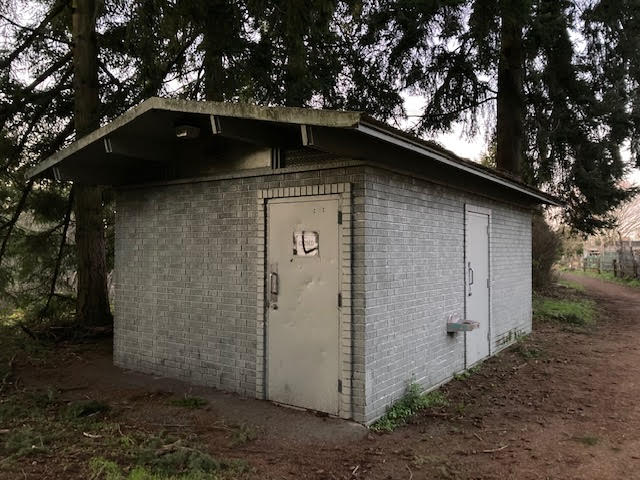 (Photo courtesy Kay Kirkpatrick)
PARKS PROJECTS: First one presented was the south Westcrest Park restroom rebuild. Planner Tizai Mauto was introduced as Parks’ Southwest District planner and brought his team, including Justin Martin, a landscape architect from MIG, who gave most of the presentation on the restroom project. It’s in a conceptual design phase with three options. This is meant to replace the old long-closed restroom (photo above). A secondary goal is to remove infrstructure left over from an old long-removed play area near there, and to replace picnic tables and benches. Total budget for the restroom and the play area: $1.35 million.
Martin said the P-Patch and trails account for the major share of how the nearby area is used. The old restroom building probably won’t be removed but instead will be converted to storage. They expect to protect the big conifer trees near the building. The two ADA parking spots will be redone, with a curb ramp. They evaluated six potential sites; three southeast of the current site are being. considered right now. They’re looking at using the Portland Loo type of restroom structure, since it’s “more vandal resistant” and better for the lower use level they expect from this. Just one stall, like Ballard Commons, and it’s single-occupancy. They’re robust but not cheap, was the explanation.
Then he opened the door to Q&A. First attendee to speak offered more comments than questions about being baffled at how often restrooms are vandalized. They appreciated Concept 3 the most, with its proximity to picnickers. The Portland Loo design means less seclusion for people who want to vandalize, he noted. Second commenter also liked 3. Third commenter agreed and also appreciated the line-of-sight entrance from the middle of the lot. Fourth commenter noted that this area of the park wasn’t discussed much when the rest of the park was developed. Planner Mauto suggested mentioning ideas in the project survey, for building down the road. Fifth, Kirkpatrick mentioned the future public market/housing site for African Community Housing and Development at the end of Henderson should be considered, too. She also pointed out that the dog park area needs better restroom access, which Option 2 would provide. Kirkpatrick also noted long-neglected public art that might be relocatable to the eventual area.
More project info is here; you can answer a survey about the project here.
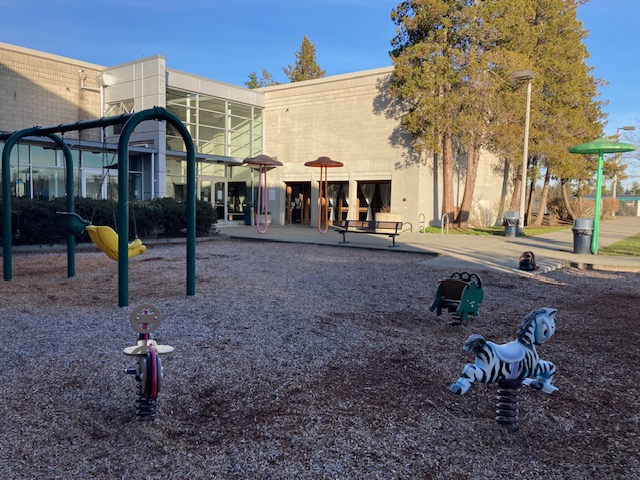 (Photo courtesy Kay Kirkpatrick)
Next, the Southwest Teen Life Center play-area overhaul, presented by project manager Colin Campbell, who said planning is resuming after a yearlong pause; he brought equipment option info.
What’s not in the budget — He said this is the perfect time for community members to advocate for features they might not see, so they could perhaps be priorities. He noted a variety of grant funds that could be sought too.
The current play area is being repalaced because it’s 20 years old ad at the end of its life cycle. Construction is likely to happen next year. Landscape archiutect David Vader said it’s a “fun” project – he clarified that it’s not the play area up on the forer Denny IMS site, which is school district owned, but this one is city-owned, immediately behind the Teen Life Center/Pool building.
The budget would cover the replacement of the play equipment and wood-fiber surfacing, They want to keep – and repaint – the mushroom structures in the area, he mentioned.
Three options as detailed here – adventurous, less so, traditional.

Option 1 is a “spider web net” type structure that many kids can use at once. It would include a teeter-totter with some unconventional moves. Part of it would match the blue and red colors of nearby Chief Sealth IHS.
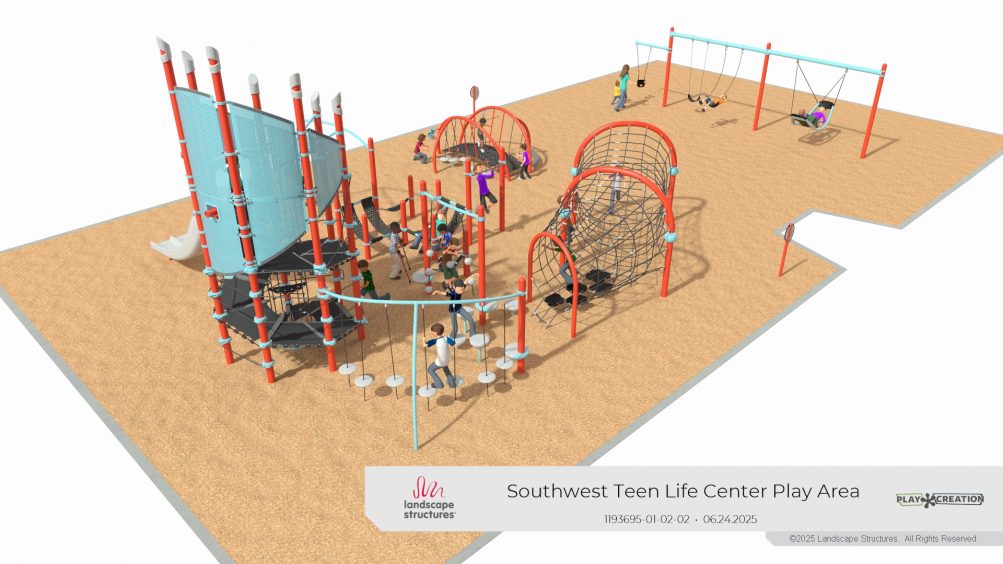
Option 2 has a spiral area that even a kid with mobility issues could climb.

Option 3 is more an “in-kind replacement” “post-and deck system.”
This project too has a survey (open until mid-February). It’s early enough in design that they “still could pivot,” the team said.
Though the center is for teens, lots of younger kids go to the pool with their families.
What about outdoor ping-pong tables? asked Kirkpatrick. Campbell said they’ve talked about “things like that, smaller, contained,” like Tek Ball. Maybe some outdoor gym equipment for older kids? suggested another attendee.
Places to sit are really important, said an attendee describing herself as a mom. Someone else elaborated, “Seating options with shade” – sonce that’s a mostly paved area and can get hot.
In other park projects, Kirkpatrick asked about the money for Riverview Playfield turf and indicated community interest in early engagement on that; Mauto pointed her at the person doing the project planning.
For seeking grants to enhance projects, Campbell said the Parks CommUNITY Fund has possibilities, and has ongoing info sessions.
WHAT’S NEXT: HPAC meets many months on the fourth Wednesday; watch hpaction.org for updates.
By Tracy Record
West Seattle Blog editor
Updates on Morgan Junction’s two big city projects were at the heart of tonight’s quarterly Morgan Community Association meeting, held at Alki Arts (the gallery at 6030 California SW), facilitated by MoCA president Deb Barker.
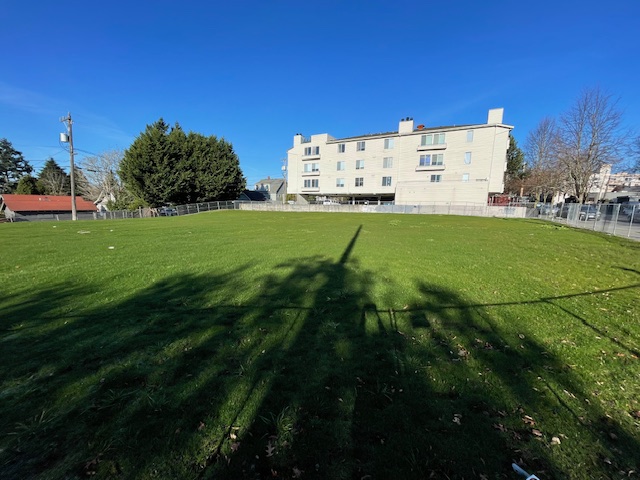 (WSB photo of Morgan Junction Park expansion site, today)
MORGAN JUNCTION PARK EXPANSION: The grass that was hydroseeded at the now-filled excavation site is growing, Barker said with optimism, to kick off the update. Olivia Reed from Seattle Parks joined remotely to provide the newest information: First she mentioned the City Council approval of $700,000 extra to cover the expansion’s “skate dot” project, as championed by District 1 Councilmember Rob Saka on behalf of MJAWA, the community advocacy group that dreamed up the “skate dot.” They’re working on incorporating it into the current schematic design, said Reed. As for schedule, they expect “late winter” (around February) completion of schematic design, followed by a public-engagement opportunity in spring, design completion in fall (by the end of this year), out to bid early next year, construction starting in spring of next year. Otherwise, they are “working across departments” and looking at alternatives for design in the right-of-way between the old park and the expansion site. The hydroseeding grass is growing slowly so the fence isn’t likely to come down until “mid-spring.” She said it’s been a “tough year for hydroseeding” all around the region, and they don’t want to open the space up and have it torn up in a manner that will require re-seeding. In Q&A, she revealed that there’ll be some “scope reduction” and cost revisions before the schematic design is complete. She also said they’re looking at “streamlining” options for the somewhat lengthy process involved with transferring the jurisdiction of the street between the two park parts.
Later in the meaning, a slightly different view, from the community members who have long fought to get the “skate dot” into the project:
MJAWA: Morgan Junction All-Wheels Association‘s Matthew Lee Johnston opened with a shoutout for Councilmember Saka. Then, he revealed that MJAWA discovered the current Parks team did not have the complete schematic documents that MJAWA had funded with a city grant and turned over to the department quite some time ago. But – “They have them now and are working with all the information,” The integration of their project into the rest of the park, though, “just stopped” and “hasn’t happened,” Johnston said. So they’re trying to get the skatepark designer Grindline back to the table to work on that. “I think we’re good from the MJAWA side of things (but) I’m concerned about this matter of bringing the project back to the community,” as in that could result in more scope changes – he said they feel informing the community is important but gathering yet another round of feedback, as Parks struggles with budget challenges that mean other features could be dropped, might be confusing.
MJAWA’s Josh Radick also said he’s hopeful but “it was pretty disheartening to hear (Parks’) take on things and that they ‘basically only have money for an open field at this point’.” Johnston said that as a result they’re hoping the community won’t say “well, then, if there’s money for this skateable area, why not use it for the features that were dropped?” Even more ominously, Radick said, they’ve heard rumblings that the $700,000 approved by the council “still might not be enough” even just to cover the skate dot (aka all-wheels feature).
Other topics:
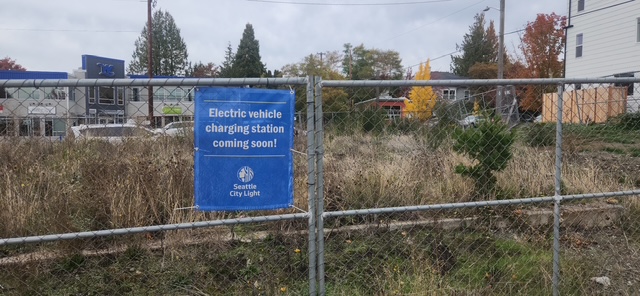 (WSB photo of future EV lot, last November)
MORGAN JUNCTION EV CHARGING LOT: Barker said the Seattle City Light project‘s point person Lizzy Kay has told her they’re still getting everything lined up and are moving toward construction, but don’t have a start date yet. All the work for the station will be done off Morgan, rather than on the north (Fauntleroy) side of the project site – that could affect a bus stop, for one. Barker also has been trying to find out more about the plan to trench across Fauntleroy Way between 41st and 42nd as part of the project. The permit looks like ~40 days might be needed – but they won’t be able to close the street during commute. times. Barker is optimistic the work will be started by MoCA’s next quarterly meeting in April.
MoCA VP Conrad Cipoletti said it’s vital that the city coordinate with WSDOT since this will have an affect on drivers/riders who use Fauntleroy Way.
MORGAN’S EMERGENCY COMMUNICATION HUB: This year is a “let’s get back in the saddle” re-energization year for hubs around the peninsula, Morgan included, said Cindi Barker. (If you’re not familiar with hubs, read this!) Training is planned on March 14. Then in April, a tabletop drill, and in May, “a broader community event to discuss preparedness,” followed by an Urban Skills fair during the Gatewood Elementary carnival on May 31, and the annual citywide exercise June 7, with one place in West Seattle chosen to bring everyone together.
SOUTHWEST PRECINCT POLICE: Community Service Officer Phil Bowen presented the same year-in-review stats we reported in coverage three community meetings last week. The only Morgan Junction-specific stat he brought was that there were two confirmed gunfire incidents (aka “shots-fired”) in Morgan last year.
MoCA FINANCES: $11,000 in the bank, with expenses including a business-license renewal and Zoom subscriptions.
MoCA BOARD: This year’s slate of candidates was announced tonight, with the vote happening in April. These are the candidates who came forward to express interest – all current holders of these positions;
president Deb Barker
vice president Conrad Cipoletti
secretary Christopher Miller
treasurer Michael Brunner
business liaison Sierra Shay
The election will be held at the April meeting, and anyone present will be eligible to vote (no required membership or dues). The board had a retreat recently and agreed to work on a workplan for this year. Barker said they plan to send out a community survey to help shape the finished plan.
NEXT MEETING: MoCA usually meets on the third Wednesday in January, April, July, and October, so that’ll be April 15.
In the early weeks of Mayor Katie Wilson‘s administration, she’s rolled out announcements of multiple department-head changes, as usually happens when a new mayor takes over. The latest group, announced today, include leadership changes for both Parks and Recreation and Neighborhoods. For the. Parks change, the announcement is brief:
AP Diaz will be leaving as director, and Michele Finnegan will serve as Interim Director.
Former Mayor Bruce Harrell hired Diaz from Los Angeles in fall 2022. Finnegan was promoted last year to senior deputy superintendent.
As for Neighborhoods, that part of the announcement has more details:
The Department of Neighborhoods is dedicated to help neighbors connect, build strong communities, improve their quality of live, and engage with city government. Jenifer Chao will be leaving the Department of Neighborhoods, and Sam Read will fill her role until Quynh Pham becomes Acting Director.
Quyhn is currently the Executive Director of Friends of Little Saigon (FLS), a community development organization dedicated to preserving and enhancing Little Saigon’s cultural, economic, and historical vitality. Her 14 years of nonprofit development experience have shaped local policy, advanced opportunities for Southeast Asian artists and cultural practitioners, and increased investments in BIPOC initiatives around equitable development and small business resiliency. She is also the mother of two toddlers, who continue to fuel her drive to ensure they grow up in a culturally rich, accessible, and diverse community.
Other new department leaders announced include Andréa Akita at the Office of Housing, Amy Nguyen at the Office of Arts and Culture, Beto Yarce at the Office of Economic Development, and Lylianna Allala at the Office of Sustainability and the Environment. For full details on today’s announcements, here’s the official news release.
By Tracy Record
West Seattle Blog editor
The Alki Community Council heard the same Seattle Police stats on Thursday night as two other neighborhood groups earlier in the week – but unlike the other two groups, they got a delegation of five SPD employees. But crime/safety was only one of the meeting’s many topics.
ACC SURVEY: As noted here, the group circulated an online survey for Alki residents earlier in the week “to find out what’s important to neighbors,” said ACC president Charlotte Starck, who reported 173 responses had come in over three days. The “high-level snapshot” of those replies (see it here) included love for Alki’s natural beauty and concern about encampments/RVs (particularly residents in the east Alki area) as well as the lack of a community center. Starck talked about frequently fielding questions about why city-owned Alki Bathhouse is “so often empty.” (Alki Community Center, meantime, was converted to a child-care-only facility years ago and is currently closed even for that purpose because of the school construction next door.)
Regarding the open-ended final question on the survey, requesting a message for the mayor, the #1 theme “consistent, visible public-safety enforcement “so Alki feels safe day and night.” Also, “traffic speed, reckless driving, vehicle noise” comprise a problem for which survey respondents said they would like to see enforcement. (A question came up, does the Traffic Unit even exist? Brown confirmed – “yes, it does.” We’d add that you can hear them radioing in from enforcement spots including Admiral Way, West Marginal, 35th SW, and other places. Listen for call signs that start with “T,” though regular-duty officers can sometimes be heard too.)
Summed up, the ACC hopes to “work collaboratively to keep Alki safe, welcoming, and vibrant.” Now, on to those stats:
POLICE: Seattle Police had four uniformed officers at the meeting (three of whom said they hadn’t been to meetings before, including one who said he’d been on the force a year and at the Southwest Precinct just a few wweeks) plus interim Crime Prevention Coordinator Matt Brown (his position is a civilian job). Brown brought the same precinct-wide data presented at Tuesday’s Admiral Neighborhood Association meeting (WSB coverage here) and Fauntleroy Community Association meeting (WSB coverage here), saying total reported crime in West Seattle/South Park last year was down 19 percent. For Alki specifically, reported crime in 2025 was down 10 percent, 177 reported crimes, down from 200 – mostly property crime – both reports taken in person or filed online/by phone. Brown explained, “Any way that you report allows us to (include it in the data) and that enables us to ask for resources … your reports show us what you need.” One attendee said people are tired of reporting if they feel they’re not going to get a response; Brown said he regrets that, but begs people, please report it so they can get the resources. Even if you’re not sure – like maybe, maybe not shots fired – call in and report it. As we’ve reported before, Brown confirmed the non-emergency line does get answered part of the time now.
Why can’t you just set up an email account for minor reports? one attendee asked. That would be something to request from the city, Brown said. ‘
Then he went back to another crime category, noting 91 shots-fired calls confirmed in the precinct jurisdiction last year, and that’s down. But – this was information we hadn’t heard previously – the number of casings per incident is going up – 4 to 5 in 2023, last year about double that. Alki had 10 shots-fired incidents last year, no injuries, no deaths. Twice as much as a year earlier, though, with the highest amount in August. Working with Park Rangers to close off areas (like Don Armeni Boat Ramp) seemed to help, and they plan to do it again this year, Brown said.
Brown also talked about encampments and Mayor Wilson’s recent decision to put a Ballard cleanup on hold. The Unified Care Team will continue to work, evaluating and responding to encampments, though (as the mayor’s office told us earlier in the day). He also briefly addressed the drug-use policy misinterpretation that erupted recently (“nothing changed with the policy” is the true bottom line, he said). Has ICE been seen in the Alki area? one attendee asked. Short answer: No confirmed sightings.
TRANSITION TEAM MEMBER: South Seattle College student Russell McQuarrie-Means, a member of Mayor Katie Wilson‘s 60-person transition team (and featured here a year ago), said he wasn’t present to be a spokesperson for the mayor but to be an advocate “for all of you.” Starck asked McQuarrie-Means what youth are concerned about, since his official role on the team is as a student/youth adviser. He said they’re worried about ICE and about affordability, to mention two, declaring that this city is unaffordable for his generation,.
EMERGENCY HUBS: Another guest appearance was by Cindi Barker, a longtime volunteer with the Seattle Emergency Communication Hubs. The what? you ask. That was her point: “Did you know you have a disaster gathering place here on Alki?” In case of catastrophe, neighborhoods need to fend for themselves, at least for a while – as Barker pointed out, “there are 800,000 of us (residents), but only 204 firefighters on duty at any given time” – so it’ll be neighbors helping neighbors if disaster strikes. Know where your hub is and how you’d help. West Seattle and South Park have 15 hubs right now. “Why do I not know this?” asked one woman. “Because we’re not part of the city, don’t have a budget, etc.,” Barker replied. She explained simply how the hubs will help collect info post-disaster, so people can come to them and find out what’s going on if regular communication channels are disrupted – information circulation will be done with the help of amateur=radio operators in some cases. They’ll be able to communicate hub to hub, neighborhood to neighborhood, with white boards of info available. Find out more, including hub locations, by going here.
GIVEAWAYS AT POLAR BEAR SWIM: Vice president Zak Nyberg talked about the emergency blankets ACC gave away at the beach on New Year’s Day (see one in our coverage). Starck said next year they want to budget to give out even more.
ALKI HOLIDAY LIGHTS: Nyberg also recapped the biggest-yet holiday event held the weekend before Christmas – carolers, Santa, a DJ, drinks, food, and the Christmas Ship. “It was a really great event!” As shown in our coverage, there was a “wish wall,” and that was brought to this meeting so the wishes could be shared with attendees. The wishes were heartfelt “wonderful messages,” Starck daid.
NEW BANNERS: As first shown here Wednesday, new flags (banners) are up along Alki – “to bring back vitality and neighborhood identity, to celebrate the beauty of the place,” Starck said.
40 YEARS OF ACC: 2025 marked the 40th anniversary of the ACC. Starck said that pages on the ACC website celebrate and detail their history – look at the accomplishments page, for one.
STATUE OF LIBERTY PLAZA MAINTENANCE: For more than a decade and a half, the ACC has overseen the plaza’s basic maintenance contract with Seattle Parks, based on excess funds from the plaza’s publicly funded creation. Starck said there’s maybe eight years worth of funding left and it’s time to start talking about how to keep that going.
COMMUNITY GARDEN: Attendee Gretchen talked about the Beyers Bulldog Community Garden P-Patch in South Alki, featured here last year, saying volunteers want more people to get involved. They’ve received a Small Sparks city grant for some improvements – they’re having a meeting at 11 am January 24. (The P-Patch is at 54th/Edmunds.)
NEXT MEETING: The ACC usually meets on third Thursdays, 7 pm at Alki UCC (6115 SW Hinds), so February 19th is up next.
Among this week’s main events, the Morgan Community Association‘s quarterly gathering on Wednesday night, this time at a new venue – Alki Arts, the event venue/gallery at 6030 California SW. The full agenda (which includes a link if you’d rather attend online) is here. It includes updates related to Morgan Junction’s two big city projects-in-waiting – the park expansion’s future “skate dot”/all-wheels area, and the EV-charging lot – plus leadership election and a business spotlight. All welcome, 7 pm Wednesday (January 21); here’s our coverage of last quarter’s meeting, held in October.
Here are our toplines from another of this week’s community-organization meetings – this time, the Admiral Neighborhood Association gathering Tuesday night at Admiral HUB, facilitated by ANA president Joanie Jacobs.
SEATTLE POLICE: The night’s main guest was Crime Prevention Coordinator Matt Brown representing SPD. He first presented 2025 stats for the precinct’s coverage area, West Seattle plus South Park:
-3,718 reported crimes
down 19 percent from year before
-415 reported crimes in Admiral last year
down 17 percent from year before
Typical of most if not all areas city-wide, Brown said, also noting, “The majority of crime is property crime.” Violent crime in Admiral held steady – 44 last year, 41 a year earlier. Confirmed gunfire for the entire precinct area – 91 total instances, 6 involved injuries, no deaths; 9 of the gunfire incidents were in Admiral, most recently in October. Brown said the department continues to closely track this. If you think you hear gunshots, even if you’re not sure, call 911. In all cases, even if you’re not 100 percent sure something’s an emergency, if it’s happening now or just happened, better to call 911 than not to – they’ll redirect you if needed.
Regarding personal safety, Brown offered some advice, having just taught a class earlier in the day. Be aware of everything. happening around you, was his top tip. But “if you’re constantly on high alert, you’re going to be exhausted.” Also: “Trust your feelings … trust yourself if you have a gut feeling about something, someone,” or some situation. Have a plan for what you might do in a specific situation. Evaluate your home’s security characteristics – you can replace a window with safety glass, for example, that resists breakage for longer. How bright are your lights? President Jacobs, who manages the coffee shop West Seattle Grounds, talked about reporting problems. What about if you’re not comfortable in a situation? Don’t jump in – but on the other hand, don’t ignore the impulse to try to help, like calling 911. He talked about alternate responders and their roles. “Go ahead and talk to them” if you see them at a scene or event.
There was also discussion of the 988 hotline, as well as the CARE Team – for dispatch of the latter, it all starts with a call to 911, Brown reiterated. And in response to a question from Jacobs, Brown said there are resources for businesses to work on crime, safety, and damage repairs.
ANA board member Ryan Crompton asked about police hiring. Despite the “huge hiring” success last year, the department still has a lot of ground to gain to get back to what’s considered full staffing. SPD remains “very optimistic about the numbers.”
Have we had any ICE activity in West Seattle? another attendee asked. While cautioning that he may not be the best authority, Brown said, not that he’s heard of. And in general, he said that if you see someone looking as if they’re being kidnapped, call 911, officers will respond and will sort it out if it turns out to be federal law enforcers.
MEMBERSHIP: New levels are available to support the ANA and its community work and events, ANA board member Dan Jacobs said. One businessperson who got a shoutout for offering major “All in for Admiral” support is Paula Kennedy from Timeless Kitchen Design (also a WSB sponsor), for example. Community support via membership is a huge reason why the ANA has been able to expand the size and number of events offered. There was talk of how to increase residential membership too – if you sign up for a $40 membership, what does that money do? They’re working on clear communication of the answer to that question. One attendee suggested that even features at events – like portable toilets! – could feature signage saying “Your membership dollars helped pay for this!” Also noted: A mistaken assumption that Admiral is, like The Junction, a “business improvement area” (BIA) with dues and funding. In short – it’s not. Some residents may in fact have the assumption that ANA is just a business group, Kennedy suggested – but it isn’t, at all (in fact, business involvement has been relatively recent, after a few attempts at creating an Admiral business group ebbed). Brainstorming ensued, including ways to network with other Admiral residents – dog walking? crafting? gardening? microneighborhood activities?
2026 EVENTS: Less than six months till this year’s Fourth of July Kids’ Parade! Joanie Jacobs said volunteer power aplenty is needed, as always, to make it work. “And it’s a great way to connect and meet people!” she enthused. This year’s Admiral Music in the Parks – last three Thursdays of July – will again be at three different parks (even though Hiawatha, the longtime venue will finally have reopened by then), and that needs volunteer help too. The Admiral Block Party also needs “lots of volunteers” – fourth Saturday of August. Then there’ll be a neighborhood cleanup too, maybe even two.
NEXT MEETING: March 10, also at the Admiral HUB. (And before then, Dan Jacobs reminded everyone, and as was announced here in mid-December, Hiawatha Community Center‘s grand reopening celebration is set for February 21st – the city is organizing that, so details are yet to come.)
-Tracy Record, WSB editor
| 3 COMMENTS