
West Seattle, Washington
14 Tuesday
The Blowout Heavies Brass Band is providing the soundtrack tonight at Highland Park Improvement Club‘s First Fridays gathering on the past-and-future HPIC site at 12th/Holden. We counted about 100 people having a great time, including everybody helping judge the 18 pies entered in the Bake-Off:
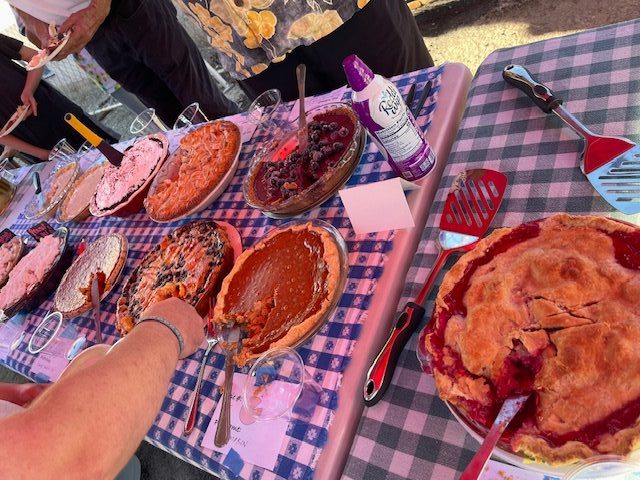
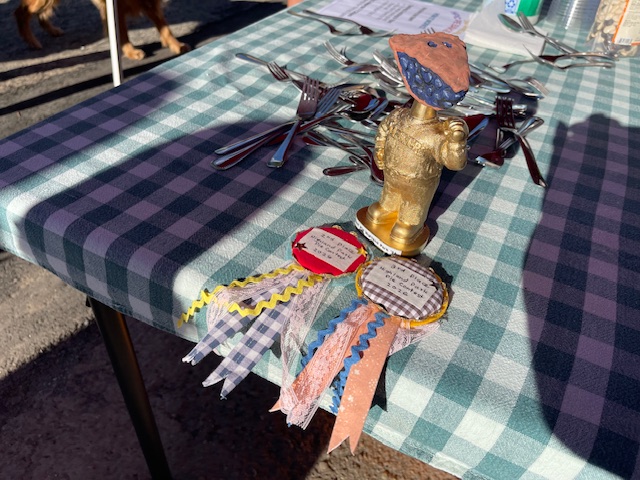
Flavors ranged from “plumberry” to chocolate pecan – right about now, they’re tallying votes and deciding who gets these:
Tonight’s First Fridays party had savory treats as well as sweet:
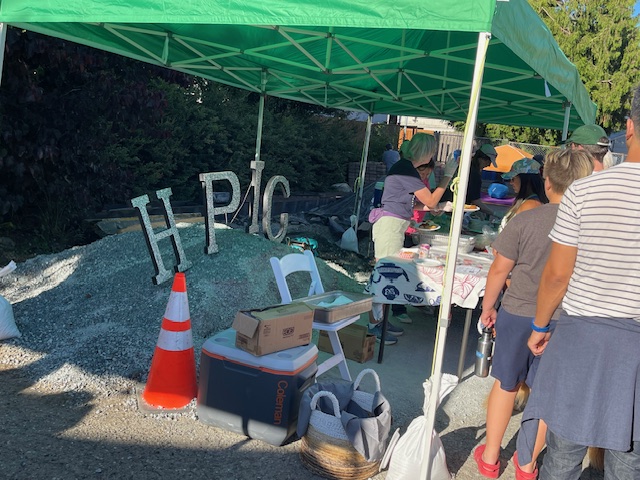
$7 got a plate in what was dubbed the “Bite of Southwest Seattle.” The party goes on until about 8:30 tonight:
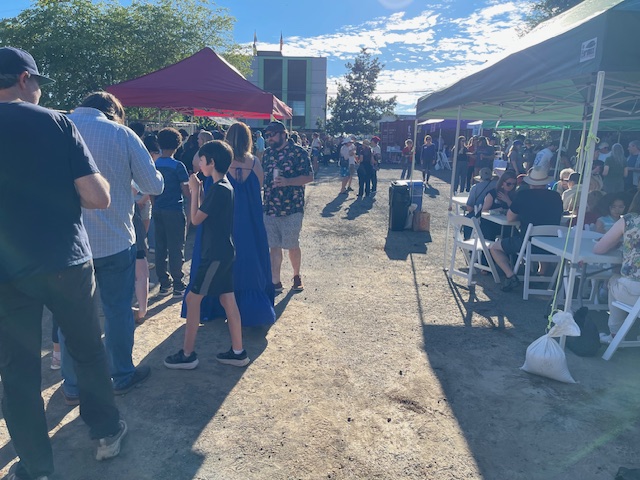
All ages – there’s a little play area for kids too. Next First Fridays celebration: Friday, August 7.
The video and report are from Nicole in Highland Park:
Our home is having construction done in the backyard. Someone brazenly walked onto our property and stole a bike. Younger bald white male wearing a gray T-shirt, black jacket, and dark jeans. If you have any tips, please help.
We don’t have a police report # yet but will add when we do.
By Macey Wurm
Reporting for West Seattle Blog
The city of Seattle’s Summer Food Service Program (SFSP) will be back this season beginning tomorrow (June 24). For more than 50 years, the program has existed as a means of filling the gap in the period when children lose access to lunches provided throughout the school year.
“At a time when groceries and other living expenses are on the rise, the Summer Meals Program helps take pressure off families and makes sure children and teens can get healthy food during the summer. No child in Seattle should go hungry because cafeterias are closed,” said Mayor Katie Wilson in a news release.
The announcement of the program’s return this summer comes after a late April announcement by the Mayor’s Office that Wilson will be implementing free school meals for all Seattle Public Schools students this upcoming fall. The initiative will be funded with the Families, Education, Preschool, and Promise levy which passed last year.
SFSP is led by the Seattle Department of Human Services in collaboration with Seattle Public Schools, Seattle Parks and Recreation, and United Way of King County. It is federally funded through the U.S. Department of Agriculture.
Last year, the program provided more than 80,000 meals to children aged 1-18 during the summer months in the form of breakfast, lunch, and snacks. This year, 50 sites across the city and 8 in West Seattle and vicinity will be serving food. No ID, proof of address, application, or paperwork is required to receive a meal.
Here are the closest locations, dates of operations, types of meals provided, and service times:
High Point Community Center
6920 34th Ave SW
Monday – Friday
June 24 – August 21
Lunch: 12:00-1:00 p.m.
Snack: 3:00-3:30 p.m.
Closed July 3
Highland Park Playground
1100 SW Cloverdale
Monday – Friday
June 29 – August 20
Lunch: 12:00 – 1:00 p.m.
Snack: 2:00 – 3:00 p.m.
Closed July 3
Roxhill Park
2850 SW Roxbury St
Monday – Friday
June 29 – August 20
Lunch: 11:00 a.m. -12:00 p.m.
Snack: 1:00-2:00 p.m.
Closed July 3
Seattle Housing Authority (SHA) @ Salish Landing
6955 Delridge Way SW
Monday, Wednesday, Friday
June 24 – August 21
Snack: 3:00- 4:00 p.m.
Closed July 3
Dick Thurnau Memorial Park
11050 10th Ave SW
Monday, Wednesday, and Friday
June 29 – August 21
Lunch: 12:30-2:00 p.m.
Closed July 3
South Park Community Center
8319 8th Ave S
Monday – Friday
June 24 – August 21
Lunch: 12:00-1:00 p.m.
Snack: 3:00 – 3:45 p.m.
Closed July 3
Southwest Boys & Girls Club
9800 8th Ave SW, #105
Monday – Friday
June 24 – August 21
Snack from 3:00 – 4:00 p.m.
Closed July 3
Steve Cox Memorial Park
1321 SW 102nd St
Monday – Friday
June 29 – August 21
Lunch: 12:00 to 1:30 p.m.
Closed July 3
The return of the program will be commemorated with a celebration on Friday, July 17, from 11 a.m. to 2 p.m. at Highland Park Playground. A bouncy house, kid-friendly activities, and free food will be provided, according to the Mayor’s Office news release.
For questions about the Summer Food Service Program you can email sfsp@seattle.gov. Additional meal resources near you can be found using the USDA’s summer meals site finder.
12:31 AM: Police are investigating another West Seattle 7-Eleven robbery -this time, the Highland Park store, at 16th SW and SW Holden. Around midnight, according to police radio, two men – described so far as Black, 18-25, around 5-9, one in a black mask, one in a brown mask – robbed the store of cash. No weapon reported seen; police are reviewing store video.
1:06 AM: Police have said that they believe this robbery is related to another tonight elsewhere in the city – apparently east of downtown.
11:45 PM: Police and SFD are arriving at what’s reported as the scene of a shooting in the 7700 block of 11th SW [vicinity map]. Updates to come.
11:48 PM: One victim is reported to have multiple gunshot wounds. Officers just told dispatch the shooting “may have happened at Riverview Playfield,” so they’re going there to look for evidence.
11:54 PM: Medics reported over emergency radio that the victim was shot in the torso and rump. So far, no information about circumstances nor any description of who did it. Police are still trying to figure out exactly where it happened, suspecting it was someplace other than where the victim was found.
12:13 AM: Officers report finally having found “the scene: Near 12th/Holden. They say a witness told them two SUVs sped out of the area shortly after the gunfire, including a white one with its rear window shot out.
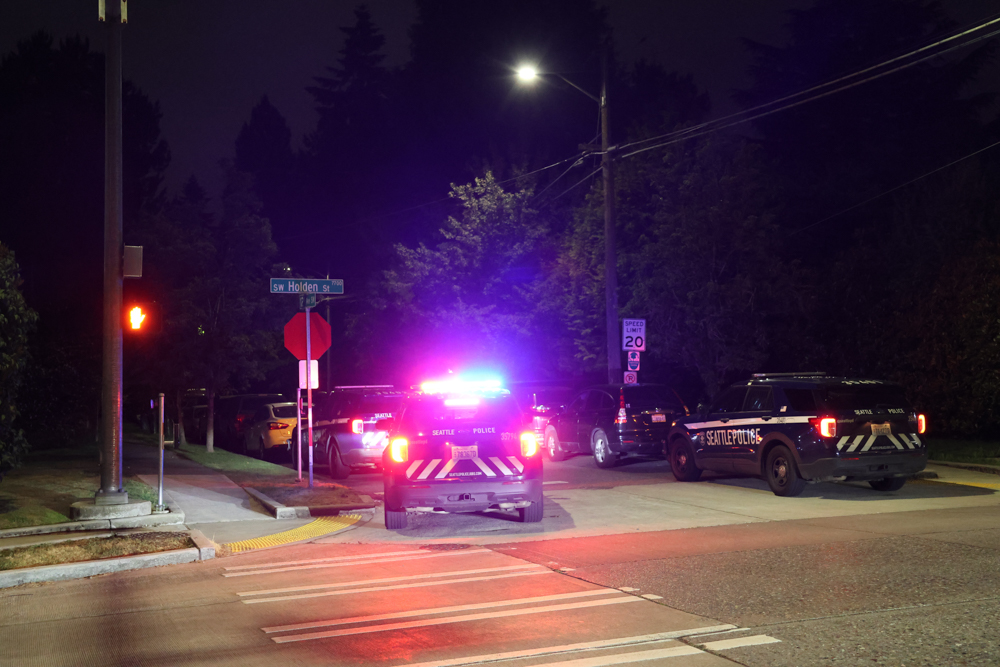
12:52 AM: Our photographer says the police, while he was there, were searching around the residential buildings on the south side of the 12th/Holden intersection.
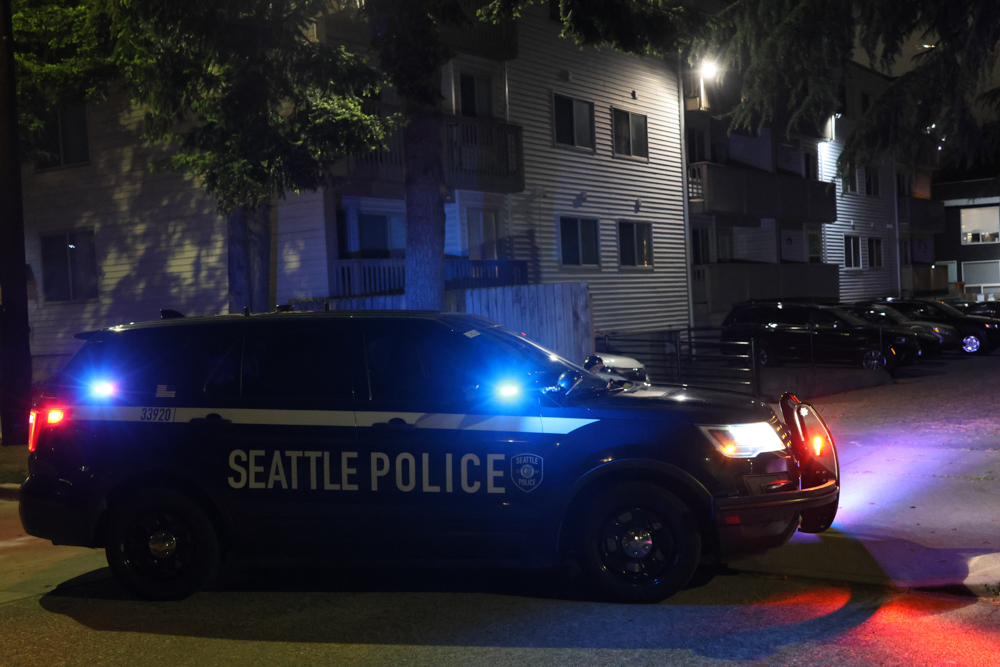
8:43 AM: No update from police yet but SFD just told us the victim is 18 years old and that he was in serious condition when transported to Harborview Medical Center.
11:11 AM: Here’s what we obtained from SPD:
On 6/3/2026 at approximately 11:37 p.m., officers responded to a report of shots fired near Riverview Playfield. While dispatched officers were on the way an update was received, that family members reported that an 18-year-old man arrived at his home in the 7700 block of 11th Avenue Southwest, with two gunshot wounds to the torso. Officers located the victim and provided aid. The man would not provide any details about the shooting. Seattle Fire Department arrived and transported the victim to Harborview Medical Center (HMC) in serious condition. Later officers located a shooting scene near 12th Avenue Southwest and Southwest Holden Street. Officers processed the scene and canvassed the area for possible video footage.
Gun Violence Reduction Unit responded to HMC and interviewed the victim. Once again, he did not provide details about the incident.
The victim remains in stable condition. No suspect currently in custody.
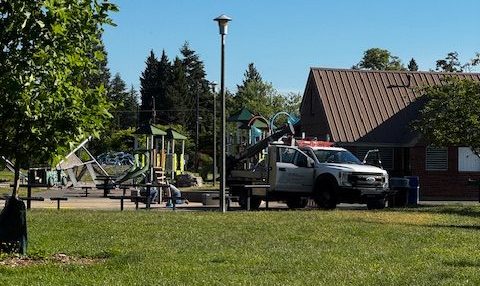
Thanks for the tips and photo. A texter sent the pic on Tuesday morning, wondering if Highland Park Spraypark – the only spraypark in West Seattle – was being dismantled; we asked Seattle Parks, and while awaiting the answer, another reader clarified that the “bucket dumper feature” was removed, saying that resulted in “a lot of disappointed kiddos, including mine.” We got the explanation from Parks spokesperson Christina Hirsch this afternoon:
A tower failed and has been removed at the Highland Park spraypark. We are evaluating options about what returns in its place, however we don’t expect we’ll be able to bring something back this season.
The rest of the spraypark – which opened 13 years ago in the space that had previously held a wading pool – remains open, 11 am-8 pm daily. The park is at 1100 SW Cloverdale.
If the usual times and places for local blood drives don’t work for you, this week brings one that might: Bethany Community Church in Highland Park is hosting a blood drive Thursday (June 4), 12:30 pm-6 pm. Donors get $15 e-gift cards. Here’s the direct link for appointments. The church is at 8600 9th SW.
By Tracy Record
West Seattle Blog editor
 The HPAC meeting usually rotates locations but this time, the community coalition for Highland Park, Riverview, and South Delridge met online, with co-chair Kay Kirkpatrick facilitating.
SOUTHWEST PRECINCT POLICE: Precinct commander Capt. Krista Bair first reminded everyone that the Precinct Advisory Council community meeting is tomorrow. Then she addressed the 18th SW gunfire response concerns reported and discussed here. Capt. Bair said she looked at the call and “we had people answer up on the radio … within nine minutes,” and also noted there were multiple case numbers, primarily 26-145289. The call came out around 10:20, she said, and police recovered four shell casings. Several officers were in the area and were pointed in a certain direction while trying to tell dispatch what people were telling them, she added, so the scene might have seemed somewhat chaotic. She mentioned officers being called back for more casings, and she reaffirmed that those are considered evidence, like fingerprints – “the bullet gets used, and when it gets used by a gun, the gun makes a ‘fingerprint’ on that casing,” so casings are sent to analysts who might be able to match multiple shootings to the same gun. She said you’re hearing about more casings or damage because “more trigger switches” are being used.
She also pitched the Connect Seattle voluntary registry for private security cameras so that if investigators are looking for cameras in a certain place, they’ll know who has them (though even if you’re registered, you are not obliged to turn over your video). “Surveillance cameras are the number one tool for catching (criminals),” she emphasized. An attendee asked if SDOT cameras are accessed during pursuits. Police can ask, she said, but “they don’t give up that footage easily … you may even need to (get) a search warrant.”
A Riverview resident who said it was their first time at an HPAC meeting was concerned about property crime potentially linked to unsanctioned area encampments and wanted to know how to report concerns such as abandoned or illegally parked vehicles. Find It Fix It was discussed; Capt. Bair explained that an online report labeled as “closed” does not necessarily mean “resolved,” though she wishes it did. She also explained the Unified Care Team‘s regular meetings and how encampments are evaluated for sweeps. The bar is high, she noted. Another attendee said that one problem with filing Find It Fix It complaints is that there’s no standalone category for an unauthorized solo camper, if they’re not part of a group meriting the “encampment” label. She also talked about the Delridge city-owned site where a shooting happened at an encampment last month before it was finally cleared. Capt. Bair said she got fairly testy in a discussion of that before the clearance: “Why can’t I just send my officers over now, there are no-trespassing signs up everywhere.” She said she was told, because it had been allowed so long, they couldn’t just suddenly move in without warning. So outreach came in quickly and the site was cleared. And, Capt. Bair said, they told neighbors “if you even see one tent, report it immediately” so the camp wouldn’t be re-established.
She also mentioned that the precinct has a new second-in-command, Lt. Pat Daly; his predecessor Lt. Nate Shopay is now working with an assistant chief downtown. Community liaison Officer German Barreto, she said, is now working with the chiefs too.
The discussion segued to what was planned to be the next major topic anyway, the future changes planned on the Highland Park Way hill, meant to slow traffic. What about enforcement? Capt. Bair said there’s just not enough personnel to do that consistently. An attendee expressed concern because of friends who were seriously injured in DUI crashes on the hill. Capt. Bair noted the department “doesn’t even have a DUI unit any more,” though there are a few officers with that focus, and they do work out of the Southwest Precinct sometimes. She also said the city does have data that would show whether impairment or speeding is the major cause of life-safety issues on the hill – probably SDOT.
That segued into Kirkpatrick talking about HPAC’s views of the project, which would convert one downhill driving lane into foot/bike space. They’re asking SDOT to “slow down” on the project, she said, and provided the letter sent to SDOT’s acting director Angela Brady:
Acting Director Brady,
We are writing regarding the 2026 early design options for the Highland Park Way SW Connection Project with an urgent request: Hit pause on this project until SDOT can make a genuine commitment to work in collaboration with the community on design and to elevate their aim to accomplish a project that provides quality, multimodal infrastructure on Highland Park Way that will serve our fast-growing community for decades to come.
In 2024 SDOT did robust community outreach on this corridor and we do not feel that the current designs are responsive to that feedback or account for concerns communicated within their report. This letter outlines our concerns and asks for next steps.
Safety concerns that are not addressed in 2026 early design options:
To slow driving speeds and reduce accidents, SDOTs proposal forces all downhill traffic left, directly adjacent to uphill drivers speeding up a road with 11% grade, rounding a blind curve without any plans to install a median barrier. This proposal does not support reduction of sideswipe accidents which are the most common type on the route (SDOT Volume & Crash Data). Instead, drivers are being forced to become traffic calming devices, endangering themselves, their families and their personal vehicles. We feel strongly that a physical center barrier is essential to delivering a safe project.
Current design accommodations for the two un-signaled entry and exit points on the hill – SW Othello neighborhood & Pioneer Industries – appear to us to be little more than an afterthought rather than a proposal that fully considers the challenges our neighbors will face entering and exiting Highland Park Way, when there is an unbroken flow of downhill traffic during commute hours. At a recent meeting with SDOT, residents of the SW Othello neighborhood walked away feeling their safety concerns were unheard. This design process should be an opportunity to address these safety concerns as well as the lack of pedestrian infrastructure on the north (uphill) side of the road, despite three active bus stops.
Rather than expanding and improving bike infrastructure using available City owned land, we see in the current design multiple risks for unsafe interactions between pedestrians and cars, pedestrians and bikes, cars and cars, and buses with bikes.
As we know from recent history, Highland Park Way is one of only three regional routes for entry and exit to all of Southwest Seattle both during normal operations AND times of extreme emergency. It also runs through a landslide zone where on the upside slope and moving slides and trees significantly blocked traffic lanes on at least 2 occasions in the past nine years.
We have concerns over the community engagement process and lack of response to community feedback:
Despite having at least two team members specifically tasked with public engagement, the Highland Park Way SW Connection project team has been notable for their lack of followup and communication with the community during the timespan of this project to date. Emails are not answered, deadlines are not met, and requests for information are met with FOIA request requirements instead of simple direct conversations.
As you consider our safety and community process concerns, please also keep in mind the gateway nature of this route as an entry point to the Highland Park, Riverview and South Delridge neighborhoods. Projects like this are an opportunity to reflect our values with the infrastructure investments we make.
Our vision is that Highland Park Way be re-considered as- Highland Parkway – a greener, gentler entry/exit/connection to this area. The Duwamish Greenbelt it bisects is a vast City owned space and park for future generations, supporting rich natural habitat, and providing easy access to trails that provide respite from the urban environment. This space promises to be a resource increasing in importance and value over time with swelling population density.
We note the thoughtful design and landscaping solutions SDOT recently rolled out on the beautiful, functional East Marginal Way Corridor Improvement Project, and nearby Georgetown to South Park Safety Project. We are asking for the same consideration for our chronically underserved neighborhoods, which have been historically red-lined and lack attention to our urban infrastructure.
Again, please “push pause” to give our community an authentic voice in the decision making and prioritization and let’s together develop a Highland Parkway that is an elegant and functional roadway for all, pedestrians, bikers and drivers.
We believe that SDOT engineers are up to this task. Please give them your direction and support!
Thank you,
Kay Kirkpatrick & Barb Biondo, Co-Chairs
One other toic:
GLASSYARD COMMONS: Will local campers get priority when the RV/tiny-house site at 7201 2nd SW opens? Some, as Kirkpatrick said, and as we have heard at briefings. Another attendee recapped what site operator LIHI had said at the community meeting about the site (WSB coverage here), that if they only opened it to local RVs, then RV residents from around the region would flock here to be in queue. Kirkpatrick also mentioned some concerns about the Cloverleaf Village tiny-home site now planned in South Park in a “toxic industrial zone.” The meeting ended with a wide-ranging discussion about how to hold the city accountable for ensuring camping problems don’t get out of control, and ensuring that sanctioned campsites are distributed equitably – a concern inflamed by the fact two of the first new sites, both Glassyard Commons and Cloverleaf Village, and existing tiny-house village Camp Second Chance, are relatively close to each other: “It feels like it’s all coming down in our direction,” including the unsanctioned camps that set up like satellites around sanctioned sites.
NEXT MEETING: Watch hpaction.org for updates.
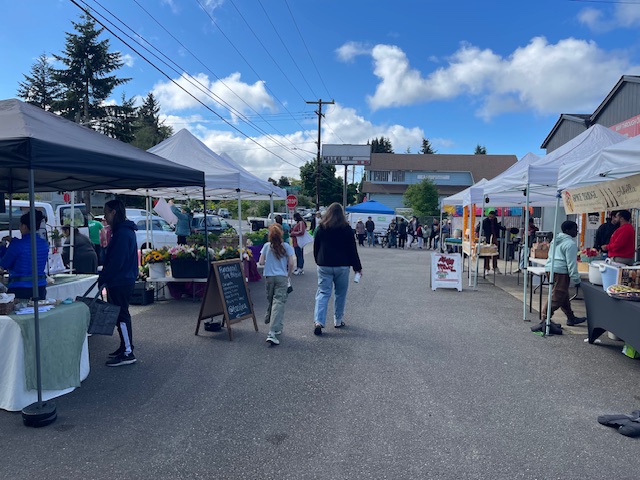
SATURDAY REPORT: The new site of the Delridge Farmers’ Market is larger than it looks! In addition to the lot out front of the former Morning Star Mini-Mart building at 9th/Henderson, it stretches around the west and north sides.
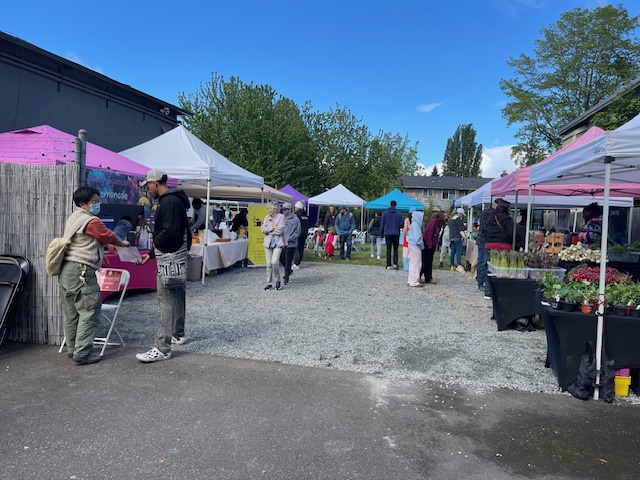
All sides of the market were packed for the ribboncutting celebration including Mayor Katie Wilson and City Councilmember Rob Saka:
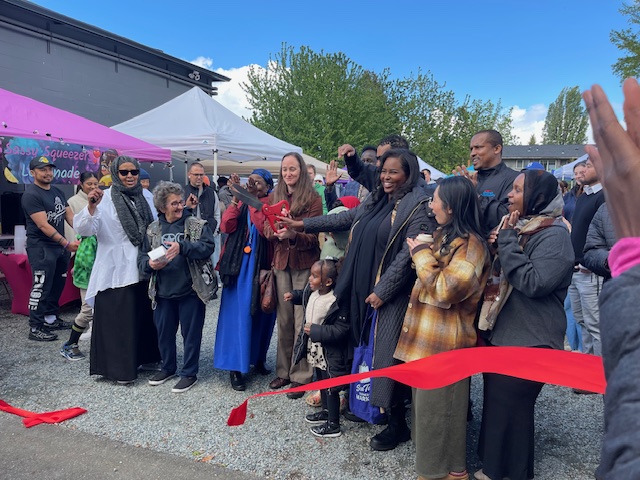
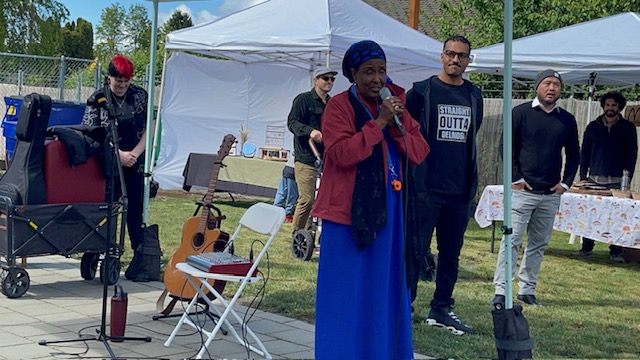
They had speeches, of course – noting the market is as much about community as it is about food – we’ll add video later. Also speaking was the CEO of market-presenting African Community Housing and Development, Hamdi Abdulle:
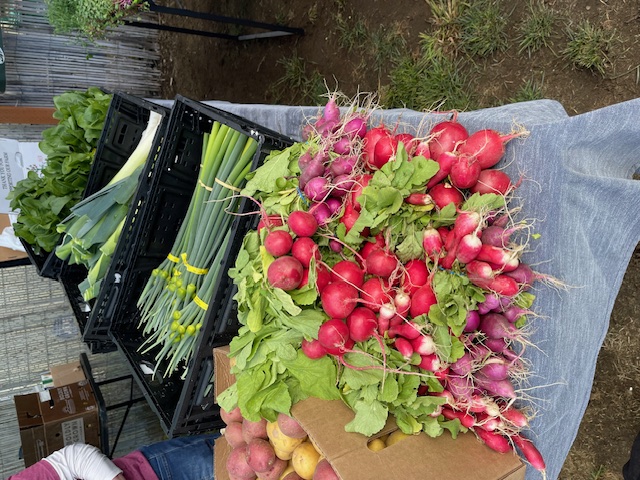
Vendors offered prepared food as well as fresh produce like this grown by Aash Farms:
Multiple coffee sellers including Daniel and Cat at Alchemy Harvest, based in West Seattle:
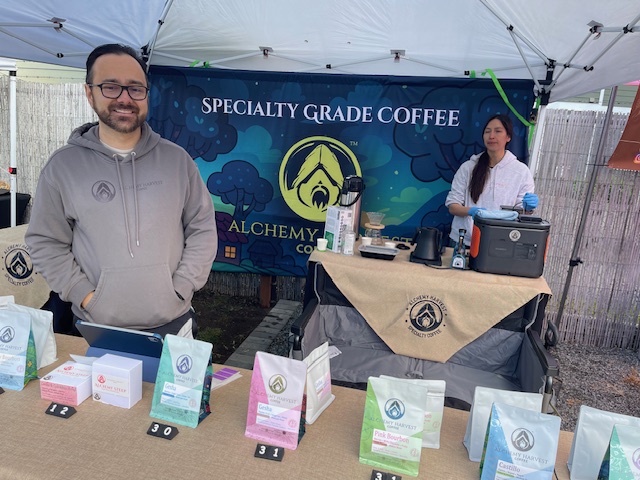
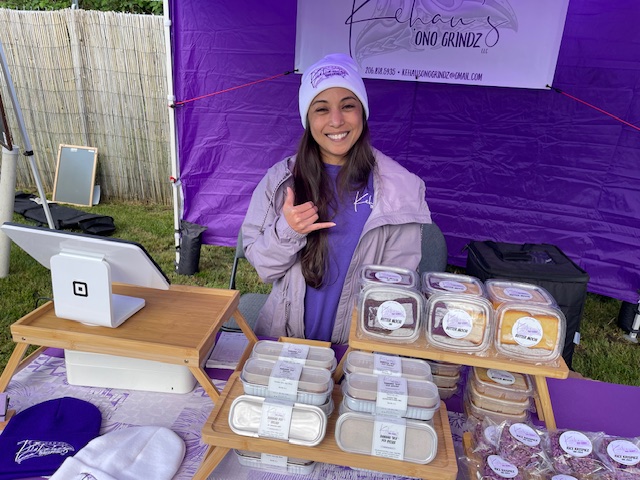
They sell coffee grown in Colombia, including the Yellow Bourbon roast from beans grown by Daniel’s dad. We also talked with returning vendor Kehau, whose Ono Grindz are what you might call Hawai’i fusion treats:
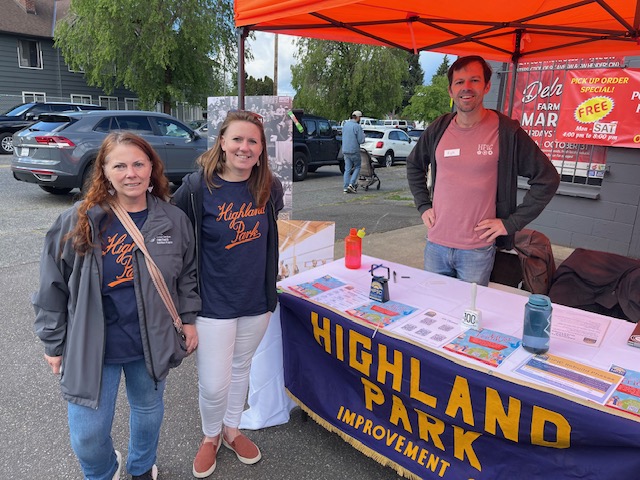
And you can get community info from Highland Park Improvement Club reps toward the south end of today’s market:
The market is open until 2 pm.
ADDED SUNDAY: As promised, video from Saturday’s ceremony – here are ACHD vice predident Bilan Aden and Councilmember Saka:
And Mayor Wilson followed by ACHD’s CEO Abdulle:
The market will be open every Saturday through the end of October.
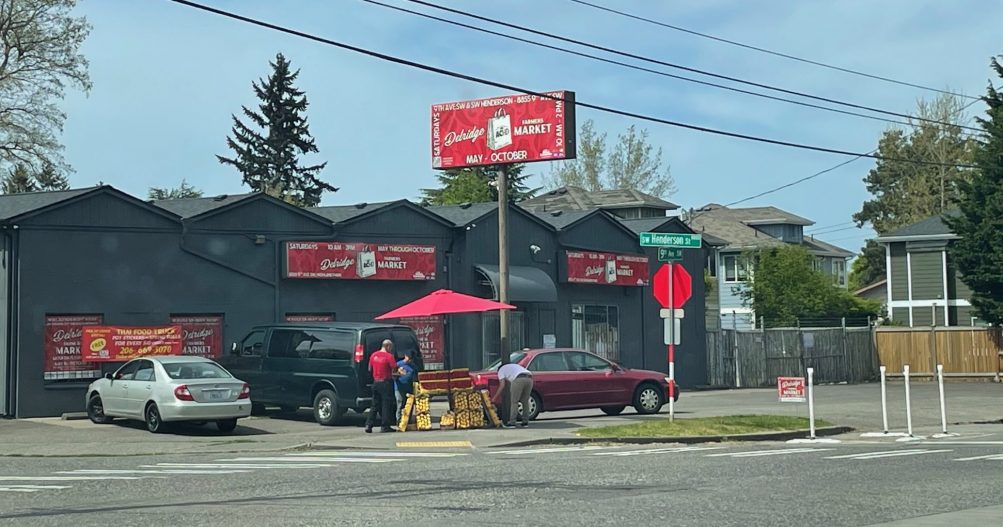 <(WSB photo - new Delridge Farmers' Market site at 9th/Henderson)
Five weeks after we first told you about the Delridge Farmers Market moving to a new location this year, its first session of the season is just days away: 10 am-2 pm Saturday (May 16). The market is presented by African Community Housing and Development, which will have a ribboncutting at the start of the day, with Mayor Katie Wilson and District 1 City Councilmember Rob Saka scheduled to participate. And tonight we have the opening-day vendor list, from ACHD’s Indra Budiman:
FARMERS:
Umoja N’Inguvu Farm (spinach, arugula, turnips)
Fruitfull Means (Chelan Valley apples, apple chips)
La Huertita Farm (duck and quail eggs, local seasonal veg)
Aash Farms (microgreens, mixed veg, plant starts)
Heu’s Blooms and Greens (greens and flower bouquets)
Mycology Mushrooms Medicine (local culinary/medicinal mushrooms)HOT FOOD:
Afella Jollof (Senegambian cuisine)
Amara Kitchen (Kenyan cuisine)
El Mextico (aguas frescas, tamales, etc)
Apapacho Mexican Treats (sweet Yucatan marquesitas)PREPARED/PACKAGED FOODS:
Alchemy Harvest (direct trade sustainably sourced coffee)
Queen Sugar Baking Company (Southern comfort baked goods)
Sassy Squeezers Lemonade (freshly squeezed lemonade)
Butter Bandit Bakery (Asian sweet treats)
Kehau’s Ono Grindz (Hawaiian treats)
Black Stash Coffee Roasters (hot coffee, South Asian snacks)
Tozi Teas (herbal medicinal teas)
Mixt Cafe (PNW/Filipino fusion beverages and pastries)
Nura Renüa (refreshing coconut-based drinks inspired by Puerto Rican recipes)ARTISAN:
Avea Glow (shea butter based skin care)
Amaj Scents (candles, scents, skincare)
Marooned Gifts (handcrafted jewelry)
Inspired x Chey (pressed botanical jewelry)
Heartful Rootz (herbal medicine, topical salves made with local botanicals)COMMUNITY
Burien Little Seed Library (free seeds!)
Seattle Parks and Rec (blender bike and youth engagement)
Highland Park Improvement Club (local neighborhood engagement)
White Center Solidarity (community potlucks)
The market’s new location was long the site of Morning Star Mini-Mart, famous for its barbecue until it closed almost five years ago. Its previous location was on the grounds of Hope Academy on 18th north of Roxbury. As we noted in our April report, one big reason for the move is to call attention to the ACHDO-owned land across the street, where the organization plans to build and open a permanent “public market.”
3:26 AM: The 7-Eleven at 16th SW and SW Holden in Highland Park has just been robbed, according to police radio, and officers are searching for the robber. The preliminary description they’re circulating is a Black man in his 20s, 5’8″, heavy build, beanies, black, white, and blue jacket, black pants, black-and-white shoes, armed with a gun, last seen running westbound. A K-9 is expected to join the search, which means neighbors might hear siren chirps and/or PA announcements. The robber is reported to have taken an unspecified amount of cash; no injuries reported so far.
3:43 AM: Officers told dispatch the robber might have been associated with a white SUV.
10:39 AM: The short police summary for this robbery adds only one thing to what we’ve reported: “He did not appear to have worn gloves in the surveillance footage and an item he dropped was placed into evidence to be processed for latent fingerprints.”
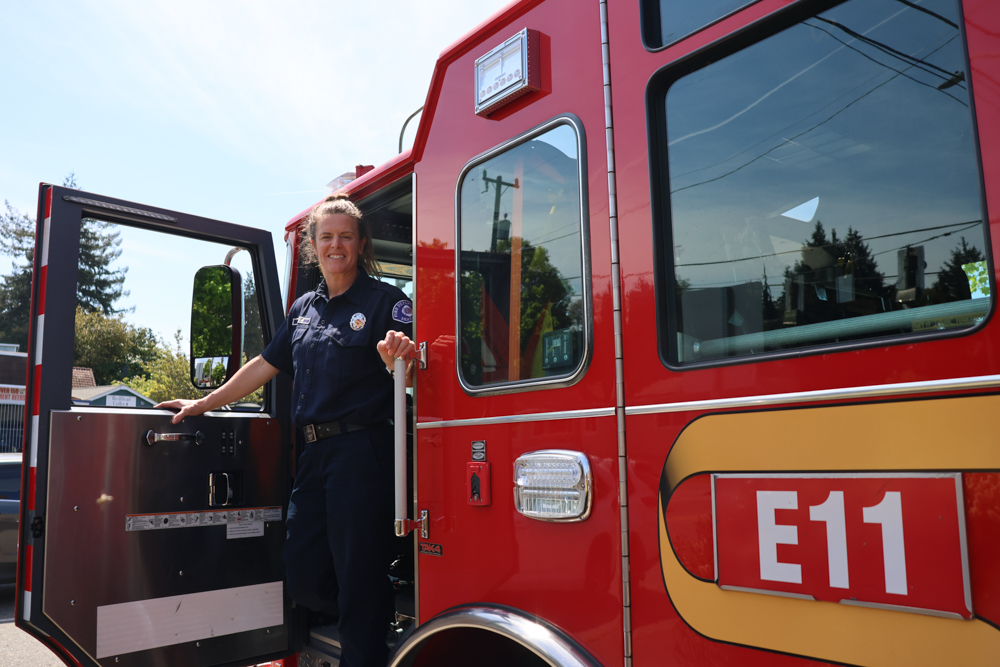 (WSB photos by Torin Record-Sand)
Annie Olson is one of the firefighters on duty today at Station 11, 16th SW and SW Holden in Highland Park, one of the SFD stations all over the city open to visitors right now as part of the city’s Neighbor Day. Station 11 is one of five fire stations (11, 29, 32, 36, 37) in West Seattle; firefighters remain on duty, and it’s been a busy day, so we can’t guarantee who you’ll see when you visit one – the open house lasts until 3 pm. (More pics later.)
ADDED EARLY SUNDAY: As promised, more photos:
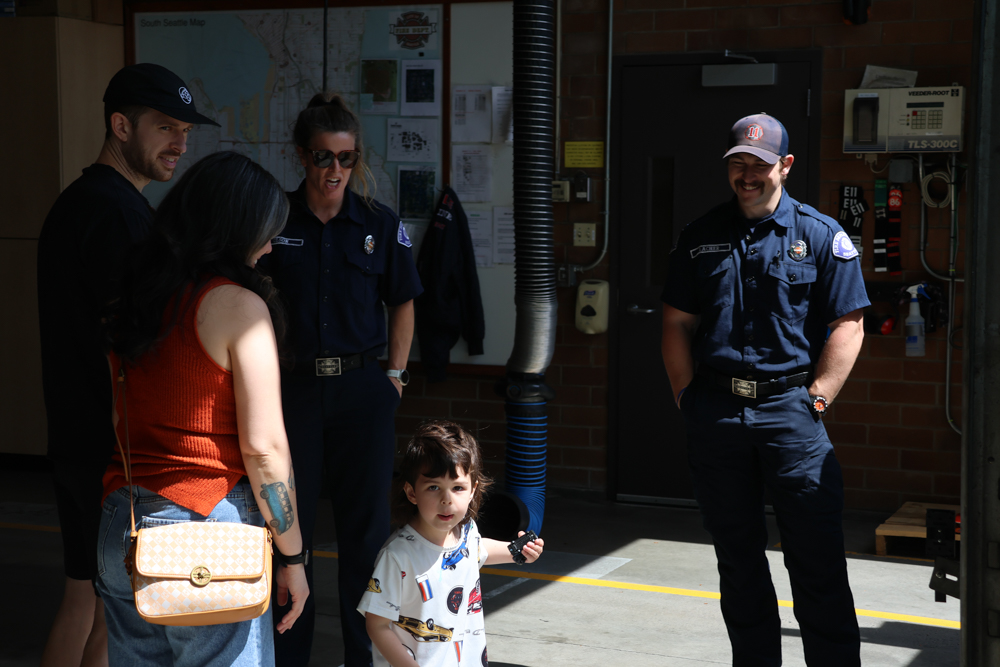
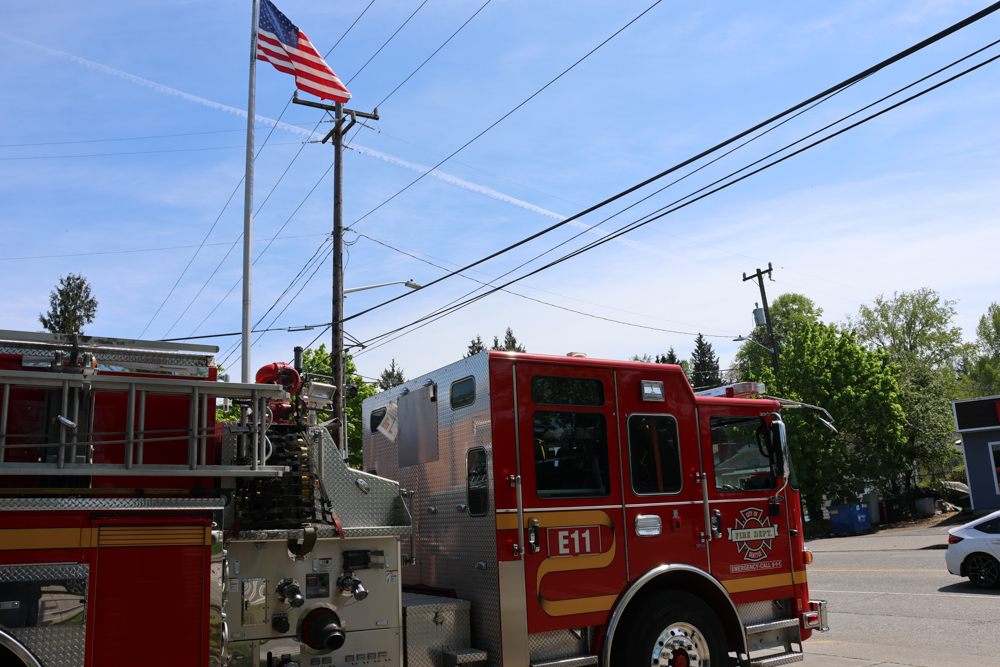

And the whole crew:
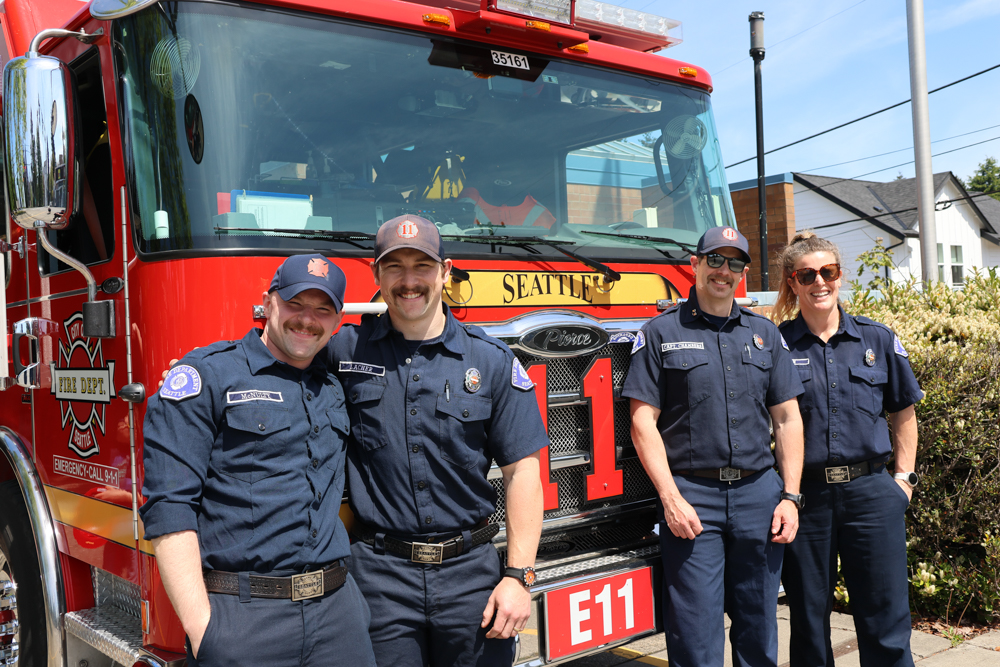
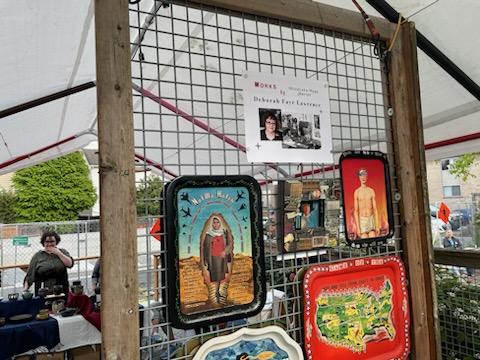
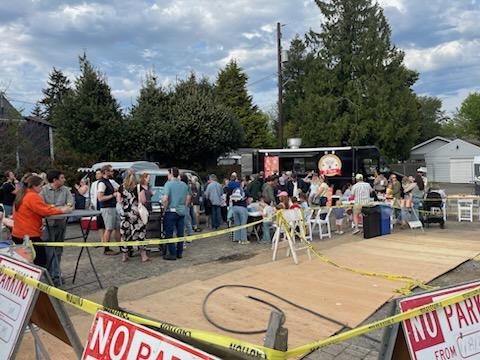
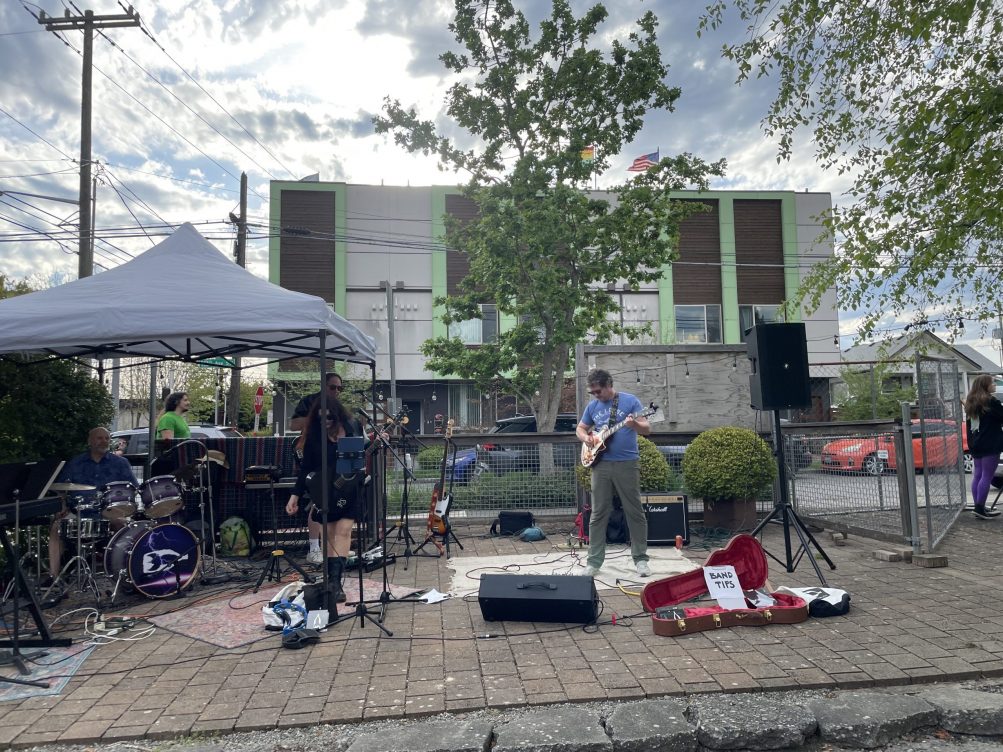
Get out and enjoy the evening at Highland Park Improvement Club‘s secpnd First Fridays party of the year! Art by local makers, music, food (empanadas!), and drink await you at 12th/Holden.
You’ll find information too – African Community Housing and Development is there to answer questions about the Delridge Farmers Market‘s new location in south Highland Park (as we first reported last month):
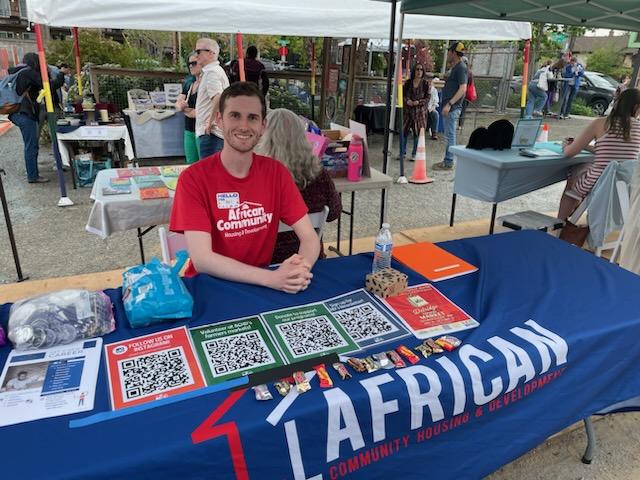
The market opens two weeks from tomorrow, on Saturday, May 16. And the First Fridays party continues at HPIC until 8:30 tonight!
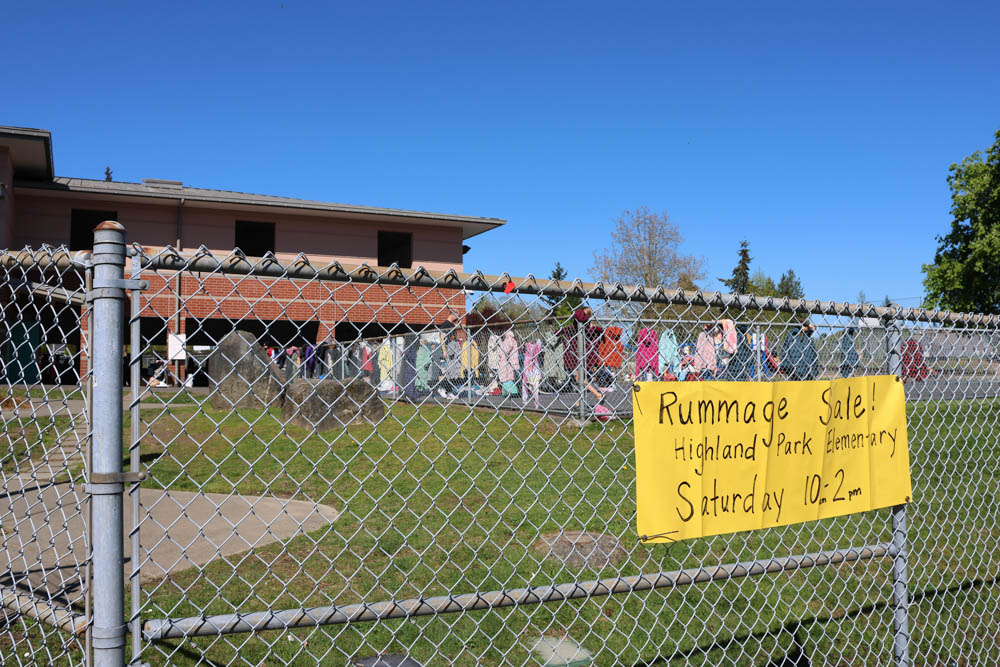
Though the sign says 2 pm, the Highland Park Elementary PTA‘s donation-only “rummage sale” at the school is planned to continue until 3 pm, so you still have some time to get there. Lots of shopper interest!
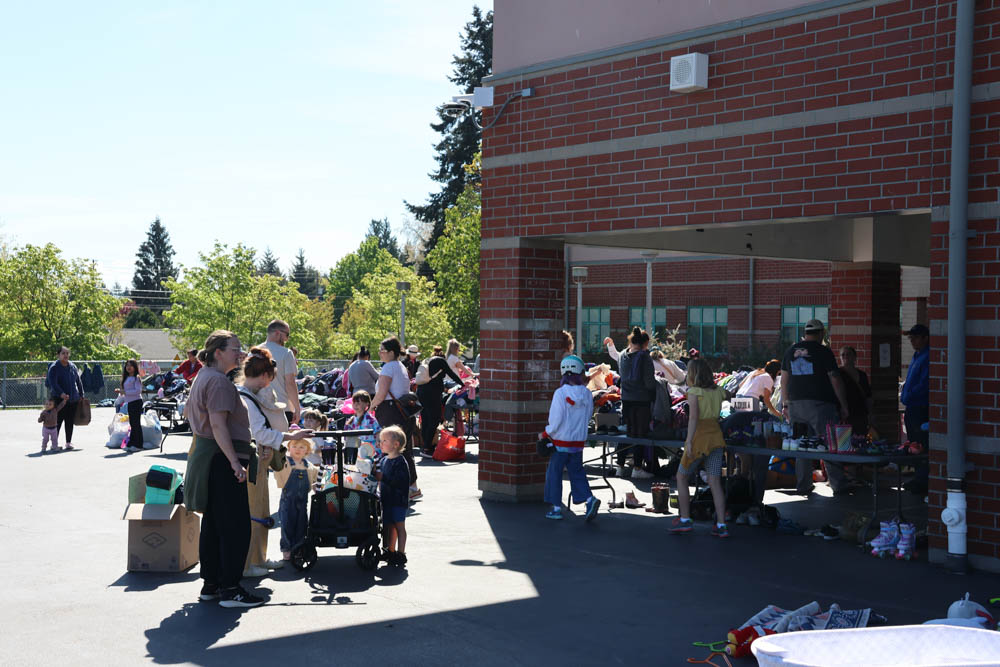
What makes it “donation only” is two-fold – donated items, and also, “everything is free, pay what/if you can, proceeds are donations to the HPE PTA.”
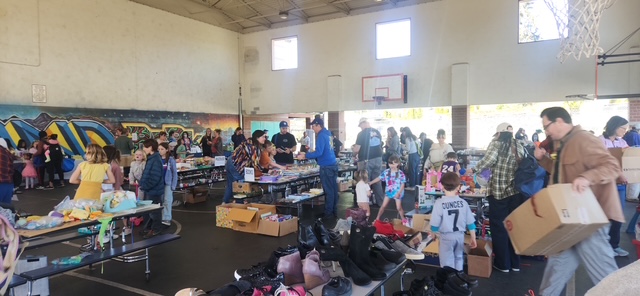
Lots of kid stuff, of course! The school is at 1012 SW Trenton.
By Tracy Record
West Seattle Blog editor
Two pending projects were in the spotlight during last night’s monthly meeting of HPAC, the community coalition for Highland Park, South Delridge, and Riverview, facilitated by co-chair Kay Kirkpatrick. Her’s how it went:
CRIME TRENDS: The meeting opened with SPD Officer German Barreto saying that most Highland Park crime categories are down, year to date. One exception: Burglaries, some of which involve vacant homes. Another: Confirmed gunfire. As he noted, shell casings that are collected go into a database and investigators can see if they match other incident. No word of any revelations from that process so far this year; Officer Barreto said the area has seen eight incidents so far in 2026, compared to six by this time last year: “Not really good.” The officer also mentioned walking through some encampment areas like one off SW Detroit, and he said he’s been notifying the Unified Care Team about what he finds. He said he’s hopeful the UCT will get to that area, but doesn’t know when. That led to several attendees voicing encampment-related concerns; one asked about 24th/Barton/Henderson, and Officer Bareto said he’s aware of that because that area is reoccupied repeatedly. Kirkpatrick said they’re in contact with City Councilmember Rob Saka‘s office on that too. Another attendee said fires are a concern with the encampments in greenbelts. Officer Barreto suggested people keep reporting via Find It Fix It, and include photos, albeit ones taken from a safe distance. One person with property in south Highland Park mentioned a problem one of her tenants had had – but the tenant hadn’t reported it to police. “Please report it, we’re data-driven,” said Barreto. He also mentioned the option to report online, provided the crime in question isn’t something that’s happening right now (if it is, call or text 911).
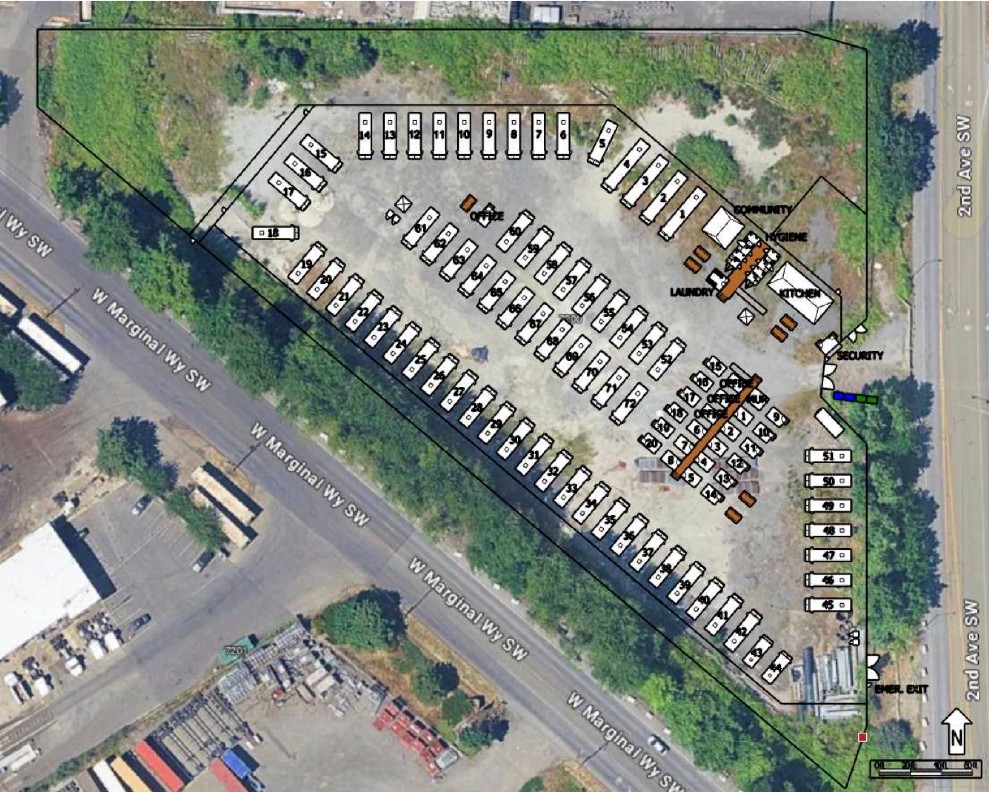 (‘Site plan’ from city permit filings for Glassyard Commons, with 72 RV spaces and 20 tiny houses)
GLASSYARD COMMONS: Marta Kidane from the Low-Income Housing Institute, which will operate the tiny-home/RV-lot site Glassyard Commons at 7201 2nd SW, was the next guest. (We’ve been reporting on the plan since breaking the story about it in January.) She first explained the concept of tiny homes – 8 x 12, “the dignity and privacy of having a closed door, heat (and A/C in the newer ones),” in villages, with shared spaces where people can cook and eat, plus hygiene trailers with showers, sinks, toilets, etc. And they have 24/7 staffing, with sign-in sheets, case managers there during weekday business hours, to help people negotiate the system. They also have behavioral-health providers at many sites.
Glassyard Commons would be LIHI’s second RV lot, twice as big as the now-dismantled first one, which Kidane said led to the demolition/removal of 67 RVs (entering a lot like this means you agree to eventually give up your RV). People are in their programs for an average of six months before moving on to housing.
One attendee wondered if the Glassyard Commons plan – on state-owned land – is a done deal. The answer was, pretty much yes. Another attendee who said they still had questions lingering from LIHI’s public meeting in Georgetown (WSB coverage here) such as, what’s the definition of “surrounding area” and what will be done about people already camping in the nearby greenbelt? She didn’t have information on that, but, “I think it’s all about developing relationships” which the UHeights Vehicle Outreach Team working with them will be trying to do.
One attendee mentioned someone often seen at Highland Park Way/Holden seemed like a perfect candidate for a tiny home. Could she refer him to LIHI’s partners? Kidane asked for information.
Kirkpatrick brought up the letter that HPAC had sent to the city and said one unaddressed point was the request for proactive cleanup for a mile each way from the facility. “They’ve only adopted 500 feet, which is only going to take us to the edge of the block,” she said. Kidane contended that “tiny house villages often make the area around them safer … there’s a level of activation” resulting from their presence. She offered to take people on a tour of a current tiny-house village. “I think when you see it you really get an idea” of how it works. (West Seattle already has one, Camp Second Chance on Myers Way. Expanding it remains a possibility, Kidane said in response to a later question.)
One attendee asked for more details on what happens to the RVs that are turned over when their owners get housing. Are they resold? No, they’re scrapped, Kidane said. (Before the RVs are brought on site, they’re decommissioned, including rendering their bathrooms unusable, meaning the RV residents have to use the hygiene trailers too.)
She mentioned an outreach team working in the area, so that led to questions such as, what happens to people who decline shelter/services? That’s more a question for the outreach team, Kidane said. But for RV dwellers, they appreciate having some control of their own space. Is the outreach for Glassyard Commons going to start in Highland Park? Yes, reiterated Kidane. But it won’t be limited to people found in West Seattle.
Can people smoke and drink in their tiny houses? Smoking is prohibited, and they have smoke detectors, but otherwise, there aren’t prohibitions about what they can do behind closed doors, though, she noted, they are made aware that recovery services are available. (Weapons and even guests from outside the site are prohibited too.)”
Kirkpatrick noted that HPAC has signed up to participate in the Community Advisory Council for Glassyard Commons, once it’s launched. Meantime, we asked Kidane after her appearance if there was any update on a timeline for costruction, as it had been said repeatedly that this site was on a fast track. Short answer, no,
SDOT’S HIGHLAND PARK WAY HILL PROJECT: Kirkpatrick said HPAC’s been talking to Councilmember Rob Saka‘s office about longrunning concerns regarding the lane-conversion plan, but it appears his office won’t be “intervening,” so feedback should be shared at the “agency” (SDOT) level. She asked attendees to list their concerns/observations about the project (and also invited supporters to speak up). Several concerns were voiced, including:
-A SW Othello resident said city reps have not yet made good on their promise of a walk-through with neighbors
-There are options not being addressed and a conversation needs to be had with engineers
-Restricting downhill to one lane means there’d be no way to get out of the path of a dangerous oncoming driver. “They need to re-engineer the whole road,” suggested an attendee. (Kirkpatrick noted that Saka had called for a Vision Zero audit, as we previously reported)
-Enforcement could make a big difference. Kirkpatrick said she was just back from a road trip in other West Coast states and they saw lots of it.
-One attendee said they expect there’ll eventually be a two-lane result. The discussion devolved briefly into a cacophony of other suggestions.
HPAC meets fourth Wednesdays most months; watch hpaction.org for updates.
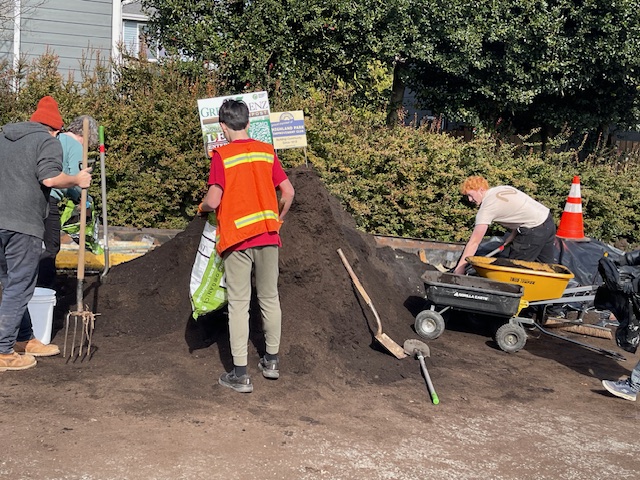 (File photo from recent compost giveaway in Highland Park)
Tomorrow’s the day that GROW will be sponsoring a compost giveaway at Westcrest Garden P-Patch (9000 8th SW) – 10 am to 2 pm Saturday or while the free compost lasts. It’s in partnership with Seattle Public Utilities and the Department of Neighborhoods as well as the Westcrest P-Patch community team. Bring your own bucket and shovel
 (Photo from Westcrest compost giveaway last year)
Another chance to pick up free compost in West Seattle! Here’s the announcement sent to us to share with you:
GROW will be sponsoring a FREE compost event at Westcrest Garden P-Patch (9000 8th SW) on Saturday, April 11, from 10 AM to 2 PM or until compost runs out. Seattle Public Utilities and the Department of Neighborhoods have worked together with us and the Westcrest P-Patch community team to supply the neighborhood with up to 60 yards of compost. Bring a bucket and a shovel if you have one.
“
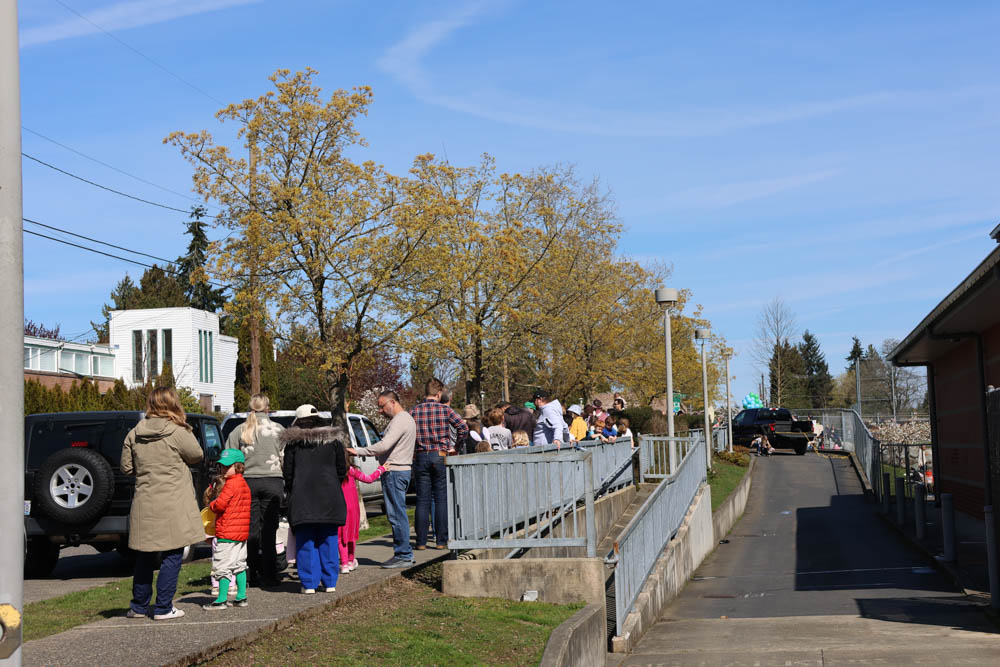 (WSB photos by Torin Record-Sand)
What just might have been the biggest crowd at a West Seattle egg hunt today was lined up and waiting before the start of the event presented by Bethany Community Church and community partners at the Highland Park Elementary playground.
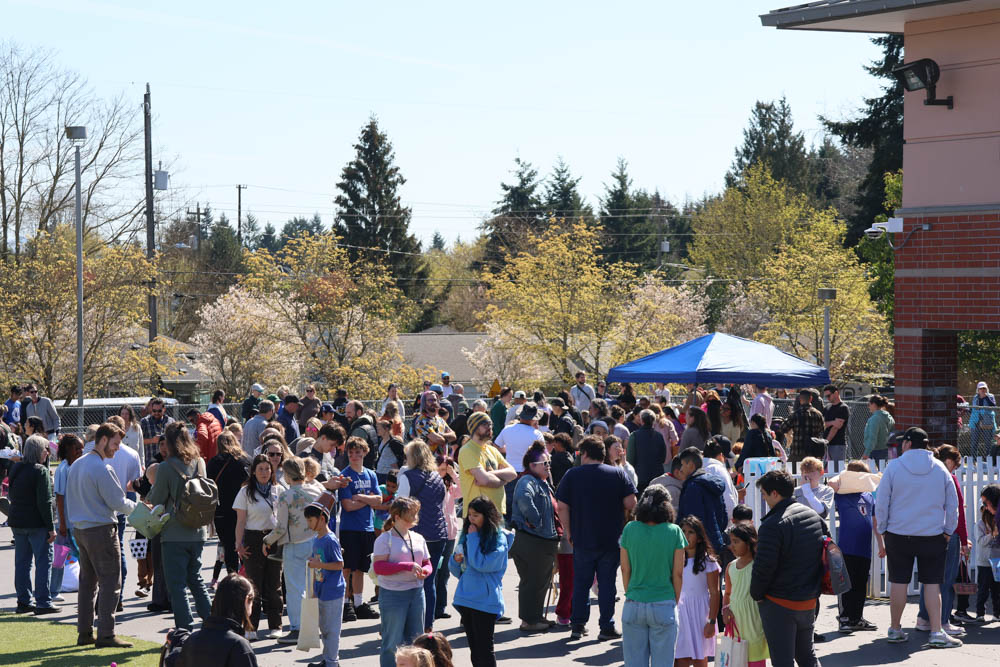
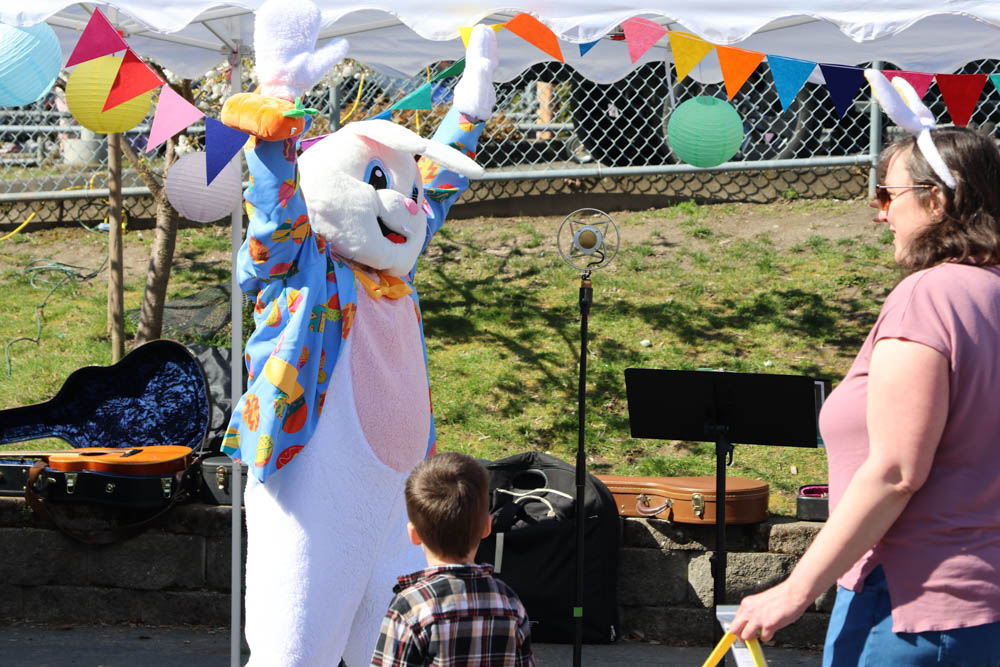
The Easter Bunny was even there to greet the estimated 500+ kids:
Egg-hunting of course was a thrill all its own:
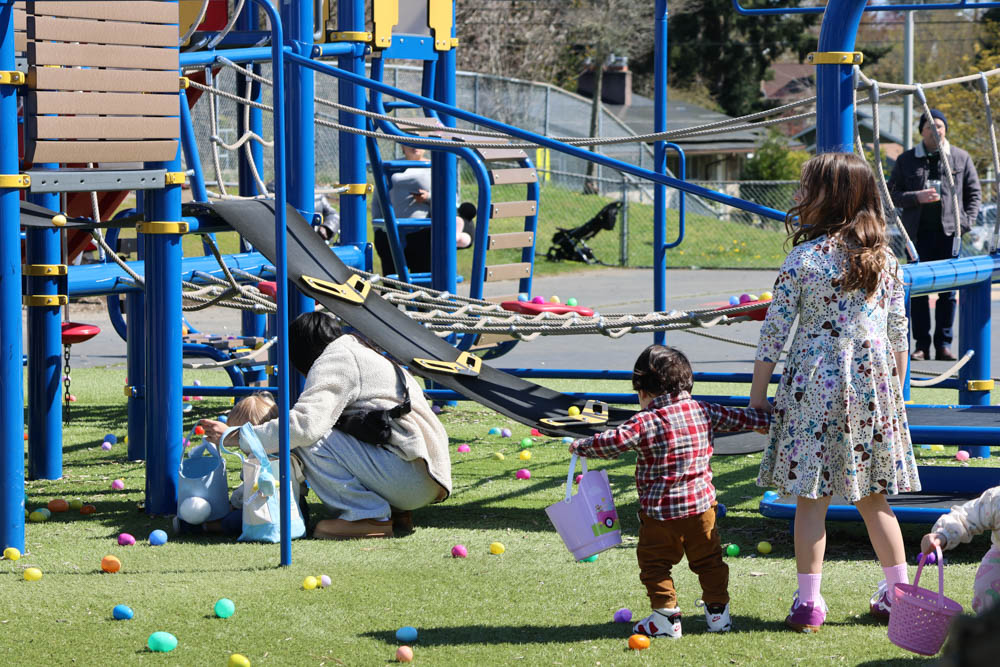


The little ones also got to frolic in a sort of ball-pit setup:


And bubbles!

The Highland Park Corner Store‘s famous Tip Top Ice Cream was part of the fun:
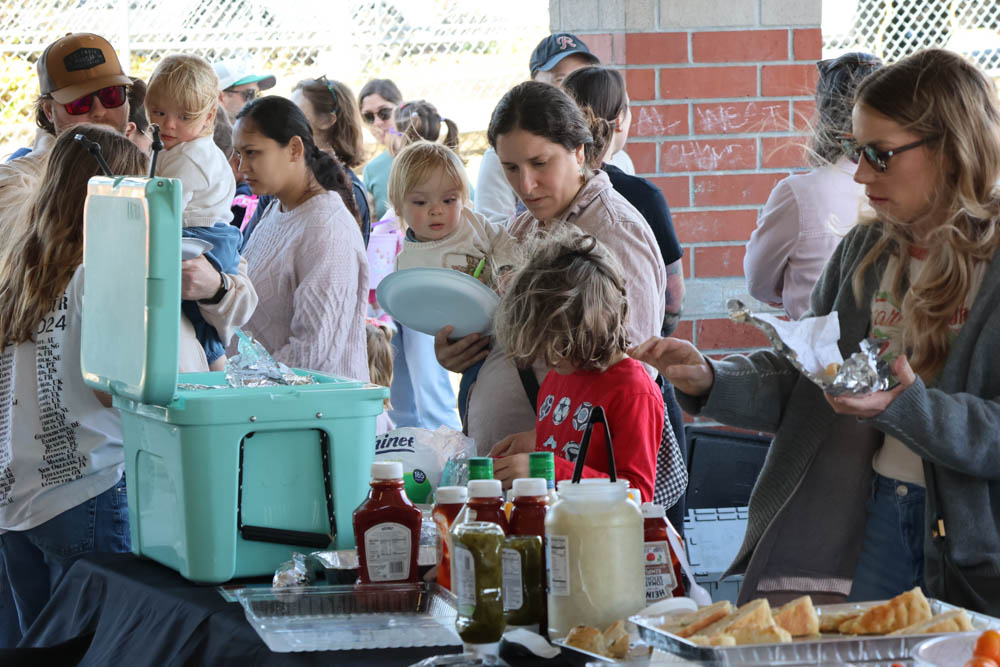
The remaining West Seattle egg hunts are smaller ones held in conjunction with some of tomorrow’s Easter services.
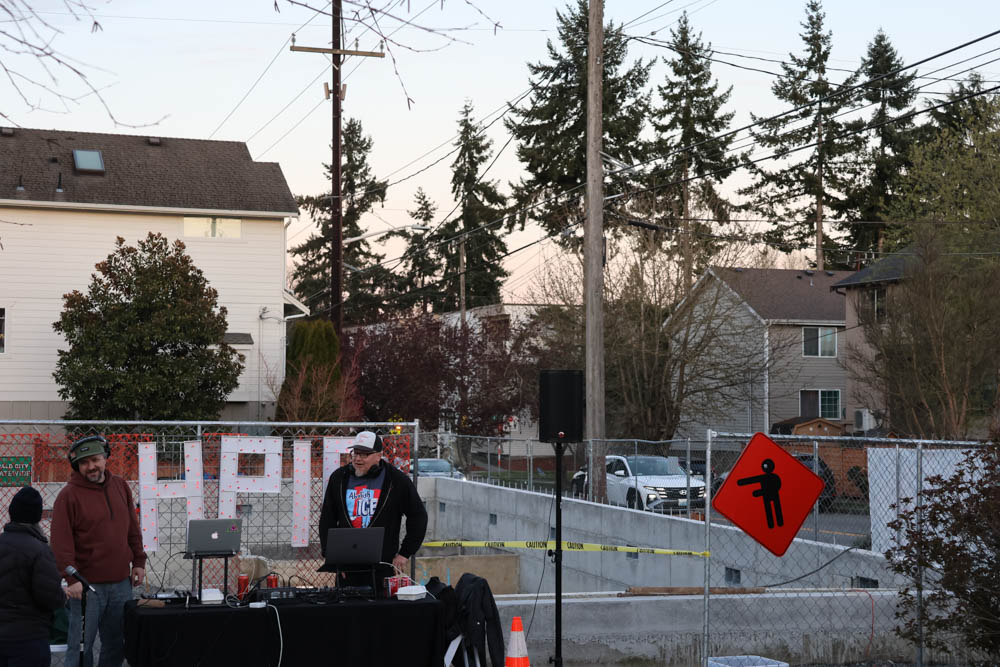
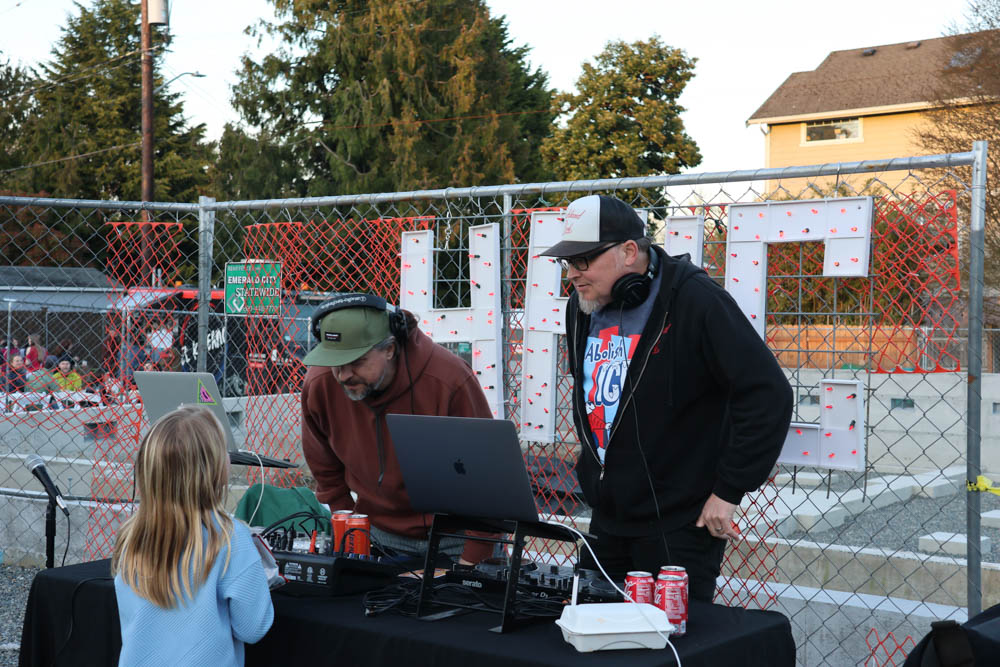
While continuing to raise money for the rebuild of their fire-gutted ex-HQ, Highland Park Improvement Club is also continuing to find creative ways to serve the community at its site. One way. – spring and summer “First Fridays“ – launched the 2026 season tonight.
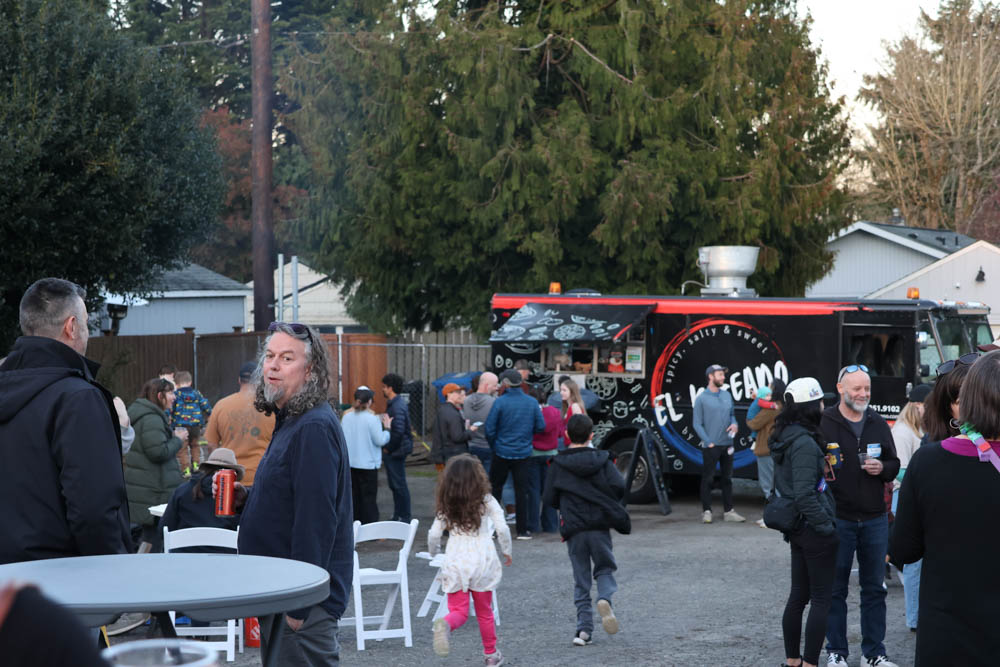
The El Koreano food truck served up dinner, while DJs Mighty Moss and Rich served up music:
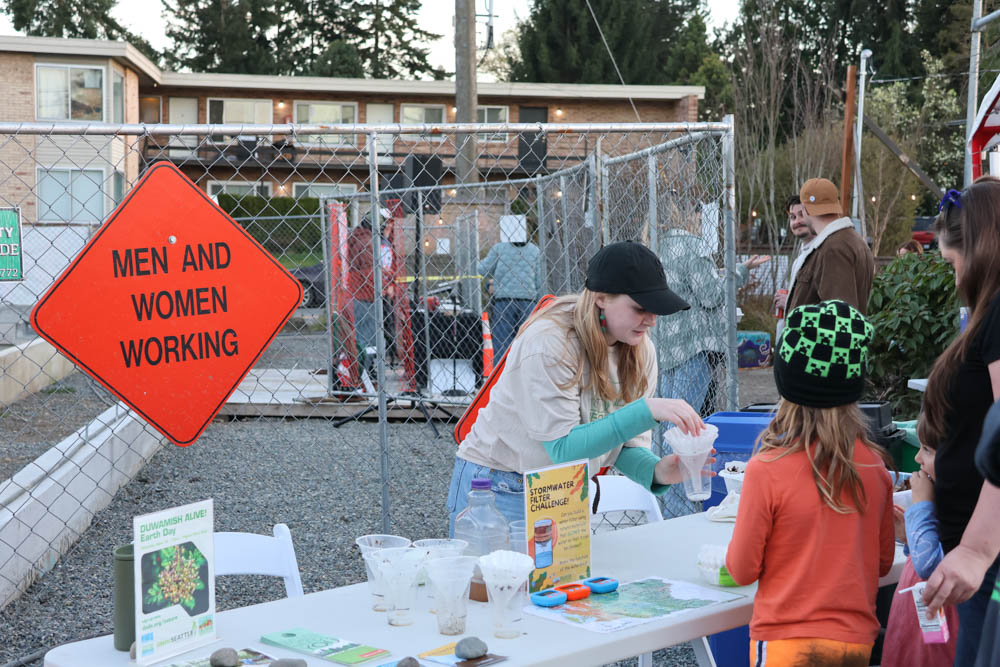
Environmental education and art was courtesy of DNDA:
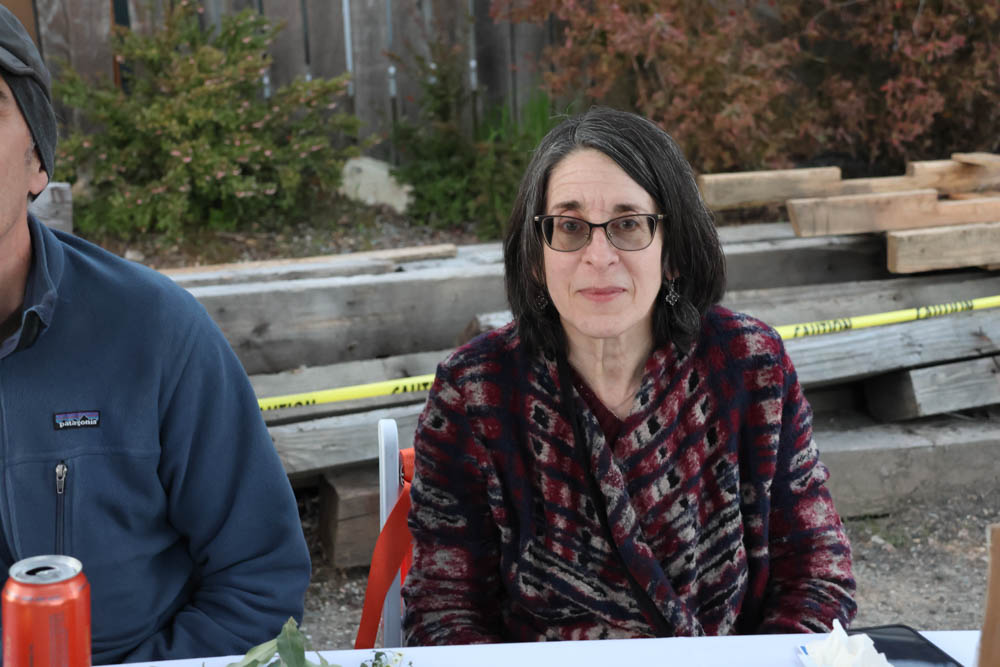
And Linda Hornberg, with her book “Picture a Garden“:

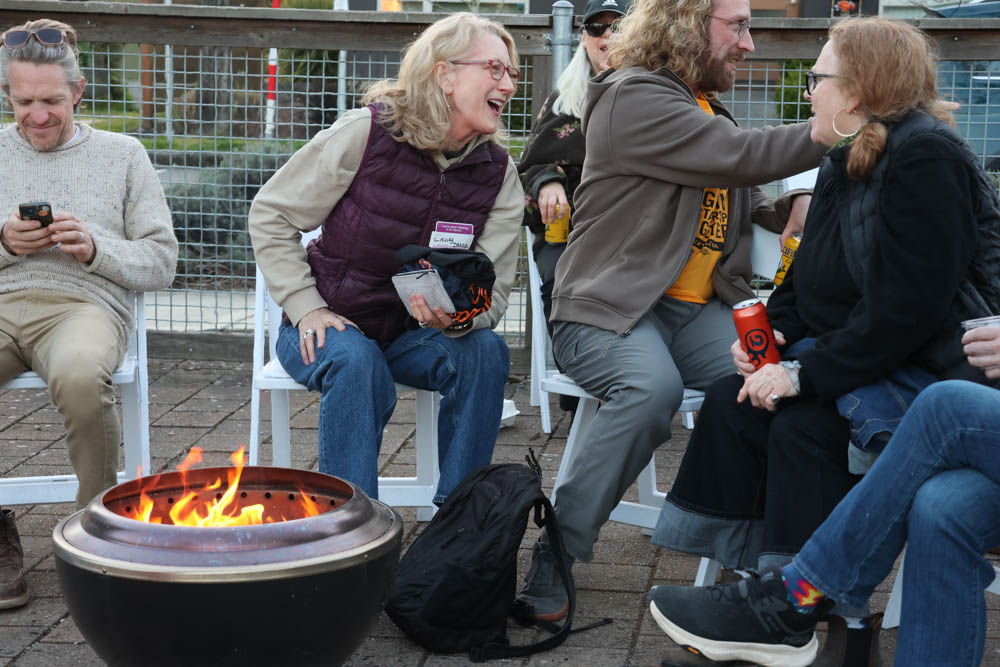
Hanging out with neighbors was at the heart of it all:
Next First Friday – May 1st, 12th/Holden.
By Tracy Record
West Seattle Blog editor
SDOT‘s contention is that converting a downhill lane on the Highland Park Way hill will make the road safer.
“For bikes or cars?” asked an attendee at last night’s HPAC meeting, loudly.
“For people!” retorted another attendee.
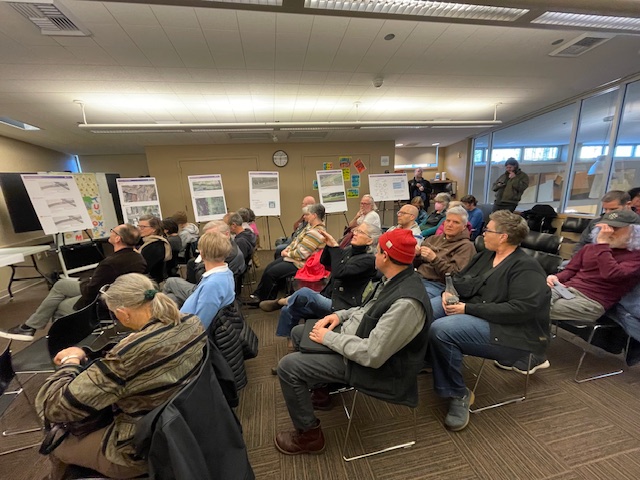
HPAC – the community coalition for Highland Park, Riverview, and South Delridge – has long been asking SDOT for an in-person meeting to answer questions about the lane-conversion project, which is fiercely opposed by drivers who say removing a driving lane will lead to traffic jams on one of the few ways out of West Seattle. Last night, they got that meeting. Judging by various bursts of applause and jeering – which HPAC co-chairs Kay Kirkpatrick and Barb Biondo tried to discourage – that viewpoint dominated among the 50+ people who filled the Southwest Library meeting room, but at least a few supporters were present too.
SDOT has remained resolute that driving-lane removal is not up for debate, but other aspects of the project are. Earlier this week, they unveiled another option for configuring the bottom of the hill, where Highland Park Way meets West Marginal Way. Before that, they announced they would separate the converted lane from the vehicle lane via jersey barriers that could be removed in case of catastrophe like another West Seattle Bridge long-term closure requiring restoration of the second downhill lane. But that didn’t seem to placate those whose memories of the 2020-2022 bridge closure remain fresh. Two people even brought signs, one reading “Fix Existing Problems Before Creating New Ones.”
Last night’s meeting was held in three parts – first, SDOT reps recapped where things stood, then everyone was invited to engage them in conversation around the room, and finally a reconvening of the full room for questions/comments. We recorded the first and third parts on video. Here’s part one:
SDOT reps who spoke were project manager Tony Roberts, project engineer Luke Larson, and project communicator Dan Anderson. They opened by trying to clarify a statement made at the online meeting earlier this month, in which this was described as a “safety project” rather than a “bicycle project.” Yes, but, they said, the money – $4 million – comes from Bicycle Master Plan funding and Vision Zero. In addition, the bicycle lane is intended to address a gap in how riders can get from West Seattle to the Duwamish River Trail. Regarding the newly unveiled Option 2B for handling traffic at the bottom of the hill, SDOT feels that its configuration means two lanes aren’t needed to feed into it any more. Larson said they’d done “modeling” to verify this. They also intend to use plastic center-line posts (like Sylvan Way and Alki/Harbor Avenues) and a high-friction surface treatment – all that will be part of a separate project but concurrent with construction on the lane-conversion. They reiterated that putting jersey barriers on the center line is not an option because they need two feet of width.
When the time came to circulate, about half the attendees did, while the other half stayed in their seats until the full-group session – here’s our video of that:
One of the first to comment declared, “You need to give precedence to the cars over the bikes, I’m sorry.” Anderson acknowledged “this is where we get into disagreement … there’s a lot of expertise … we feel with this it will still work OK.”
In the face of repeated contentions that “this will make it worse,” he insisted, “We don’t believe it will.”
The “what if the West Seattle Bridge goes out?” question also repeatedly arose. Larson said the jersey barriers could be removed to reopen a car lane “within a couple of days.” Anderson also tried to use this to reinforce that SDOT had listened to feedback on some points, saying that SDOT did not expect feedback to include “what if the West Seattle Bridge goes out?”
Another attendee declared, “You’re not solving the crashes – you need to separate the downhill and uphill. Put in some trees like you did on Delridge.”
Then, the question, why not improve the existing sidewalk on the downhill side?
“There’s not room,” said Larson, saying it’s six to eight feet now but they need 10 to 12 feet, adding that the steep dropoff from the existing sidewalk would require “tens of millions of dollars (to be spent) on retention walls.”
A man who spoke in favor of the lane conversion said he’s biked up Highland Park Way “100 times, and downhill maybe once” because of the bumpy path. When this is built, he said, he can put his kids on a bike and ride to South Park. “I will not be driving that street in the future if I can ride the street safely” – one less car, he noted.
A number of concerns were raised by people who live on Othello, a southward turn off the hill. Anderson said SDOT would come out to talk with those residents before long. He also acknowledged that the concept of adding a traffic signal there was mentioned at the meeting, though it hadn’t come up previously.
The SDOT replies to concerns didn’t win over the doubters. One concern about “so much road rage” on the hill was met with a reply that it would be less prevalent with one lane of traffic, if you’re only looking at a car directly in front of yours. That drew derisive hoots.
If the goal is to slow drivers down, why not speed bumps? someone asked. Larson said they’re generally not installed on slopes steeper than eight percent – HP Way is 11 percent.
What about a speed camera? someone else asked. Short answer: That would have to be enabled by state law (which currently limits speed cameras to school zones; the HP Way hill is not part of one).
What about widening the path on the uphill side? Kirkpatrick reminded everyone that the uphill side has had slides, and trees fall fairly frequently.
The SDOT team kept trying to reassure the room that they had “looked at a lot of concept.” Larson mentioned Alki and Green Lake. Those are flat, someone countered. Yet another attendee who described himself as “the most seasoned cyclist in Highland Park”
“By reducing the number of lanes, you’re reducing our quality of lives!” someone said. Another: “This plan is pitting drivers against bikes, but we should be working together.” Another: “This is planning for the future.”
Meantime, alternatives were suggested. Rumble strips? Turtles?
One person also noted that Highland Park has been saddled with a lot over the years, dating back to the municipal-jail proposal that HPAC fought tooth and nail more than a decade and a half ago, and multiple encampments, both RVs and tents, not to ention the future Glassyard Commons tiny-homes-and-RV-lot site close a short distance east of the Highland Park Way hill.
Another tried a final line of questioning: “Is there a date by which you have to spend the funding for this?”
SDOT didn’t really answer that, but Roberts noted that construction is currently set for next year.
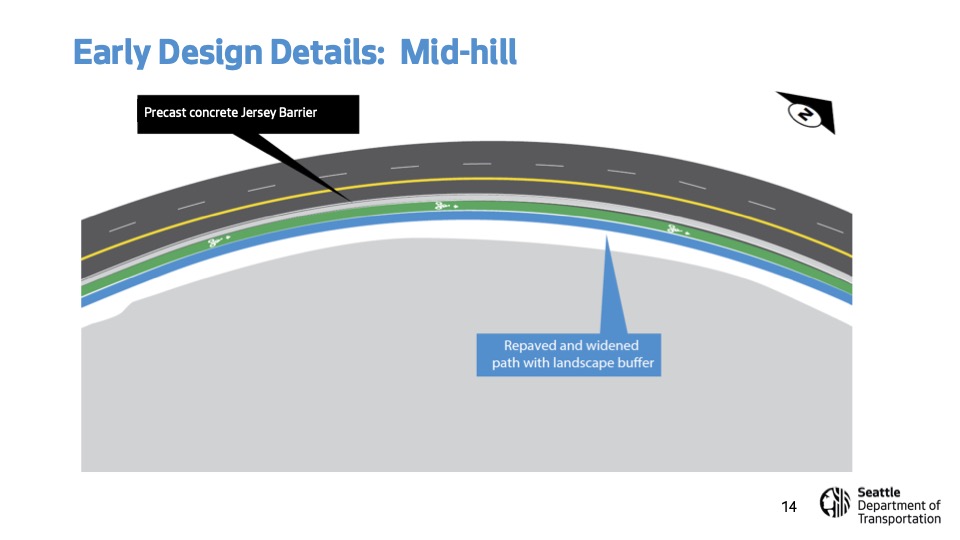
When SDOT held an online meeting earlier this month about the Highland Park Way lane-conversion project (WSB coverage here), community group HPAC‘s co-chair Kay Kirkpatrick got the project team to commit to something the coalition had long been requesting – attending an HPAC meeting to answer community questions. They’re keeping that promise this Wednesday (March 25), 6 pm at Southwest Library (9010 35th SW). HPAC’s meeting announcement says they’re hoping SDOT team members’ in-person appearance will allow “in-depth conversation with the community and a chance to really drill down into the work they are doing.” The project would convert the outside downhill driving lane on the Highland Park Way hill to a bicycle/pedestrian path; the newest version of the plan would separate that path from the remaining driving lane via removable jersey barriers as shown in graphic above), so it could revert to a driving lane in case of a major event like the 2020-2022 West Seattle Bridge closure. HPAC also hopes to update the Glassyard Commons RV/tiny-home site project at Wednesday’s meeting.
After 911 calls reporting what sounded like gunfire in or near Westcrest Park, a police officer just told dispatch they’ve found evidence – shell casings in “the main parking lot.” No report of anyone hurt, so far.
Most of West Seattle’s only official off-leash area, at Westcrest Park, will close for four days next week, according to this announcement from Seattle Parks:
We need to temporarily close the Westcrest Off Leash Area (OLA) from March 23rd through March 26th.
During this time, crews will deliver wood chips (Engineered Wood Fiber) to the terraced area near the shelter and picnic table. We planned this maintenance effort in close consultation with our COLA stewards at Westcrest Park to improve the play space for your pets.
While the main area is closed, the small and shy dog area will remain open and accessible to all dog owners. Because this space is much more confined than the main park, please pay close attention to your dog’s behavior to ensure a safe environment for all visitors.
We recognize this temporary closure might disrupt your routine, and we appreciate your understanding and cooperation as we work to maintain the park. If you have any questions or concerns about this project, please call us at 206-684-4075.
| 1 COMMENT