
West Seattle, Washington
16 Saturday

That’s a photo sent recently by John, showing a beaver along Longfellow Creek, which parallels much of Delridge Way. In some areas along the creek, beavers are just part of the ecosystem – but Seattle Public Utilities says their work is posing a potential problem in one area, and is pursuing this project, announced in a recent Land Use Information Bulletin (note that the same notice covers the West Seattle proposal and a similar one elsewhere in the city):
Beavers have recently constructed dams immediately upstream of the pedestrian footbridge over Longfellow Creek … and dams in SPU’s Meadowbrook Pond Stormwater Detention and Flood Control Facility in the Meadowbrook neighborhood.
The dams may lead to localized flooding of nearby residential properties during the rainy season. This proposal would deploy beaver dam management interventions at the dams at both sites. Specifically, the proposed work would install four pond levelers by notching the dams and then installing exclusion fences. The fencing would extend 16-feet upstream from the top of the dam. Notching assists in
preventing beavers from detecting stream flow through the dam and the fencing prevents them from effectively plugging the notch.These interventions are intended to control water levels and flows in Longfellow and Thornton creeks and are preferred alternatives to relocating the beavers or removing or breaching an established beaver dam that maintains hydrology of a nearby wetland or pond. The proposed design provides unimpeded fish passage while preventing beavers from constructing effective dams at the pedestrian \ bridge at the Longfellow Creek site and in Meadowbrook Pond at the Thornton Creek site.
The Project includes the following major work elements:
1. Creating a notch in the beaver dam
2. Installation of metal t-posts and welded-wire fencing with a mesh size of 4 inches by 6 inches to create a box in the notch of the beaver dam.
3. Extend the wire fencing box 16-feet upstream from the beaver dam.
This is in/near the 2500 block of SW Graham [map], according to the city notice. What the city published, specifically, is a Determination of Non-Significance, meaning it doesn’t believe a formal environmental-impact study is needed for this. Here’s the full-length “checklist” document, below and here:
You can comment by June 3rd by emailing Kevin Buckley at SPU, kevin.buckley@seattle.gov; you can also formally appeal the Determination of Non-Significance, deadline June 10th, as explained in the notice.
Thanks to Kevin Freitas for sharing that view of urban wildlife going head-to-head in his neighborhood southeast of The Junction. When he first published it on Twitter, general consensus was that the rabbit was defending a nearby nest, and it is indeed baby-bunny season. For info on rabbits, you can check out the state’s “Living with Wildlife” species-specific guide.

Thanks for more beautiful West Seattle bird photos! Here’s a new Sunday afternoon gallery. First, two from Jerry Simmons – a Canada Goose family on a walkabout above, a young Barred Owl below:

Mark Wangerin photographed the next two – a Red-breasted Sapsucker:

And a Bewick’s Wren (click the link and listen to the audio – they’re singing everywhere):

Gentle McGaughey perfectly captured the distinctive “hairstyle” sported by Steller’s Jays:

Trileigh Tucker photographed this Band-Tailed Pigeon:

This Crow at a feeder is from Michelle Green Arnson:

James Tilley photographed the next two – the celebrity Bald Eagle “Bey”:

And an Osprey with a snack:
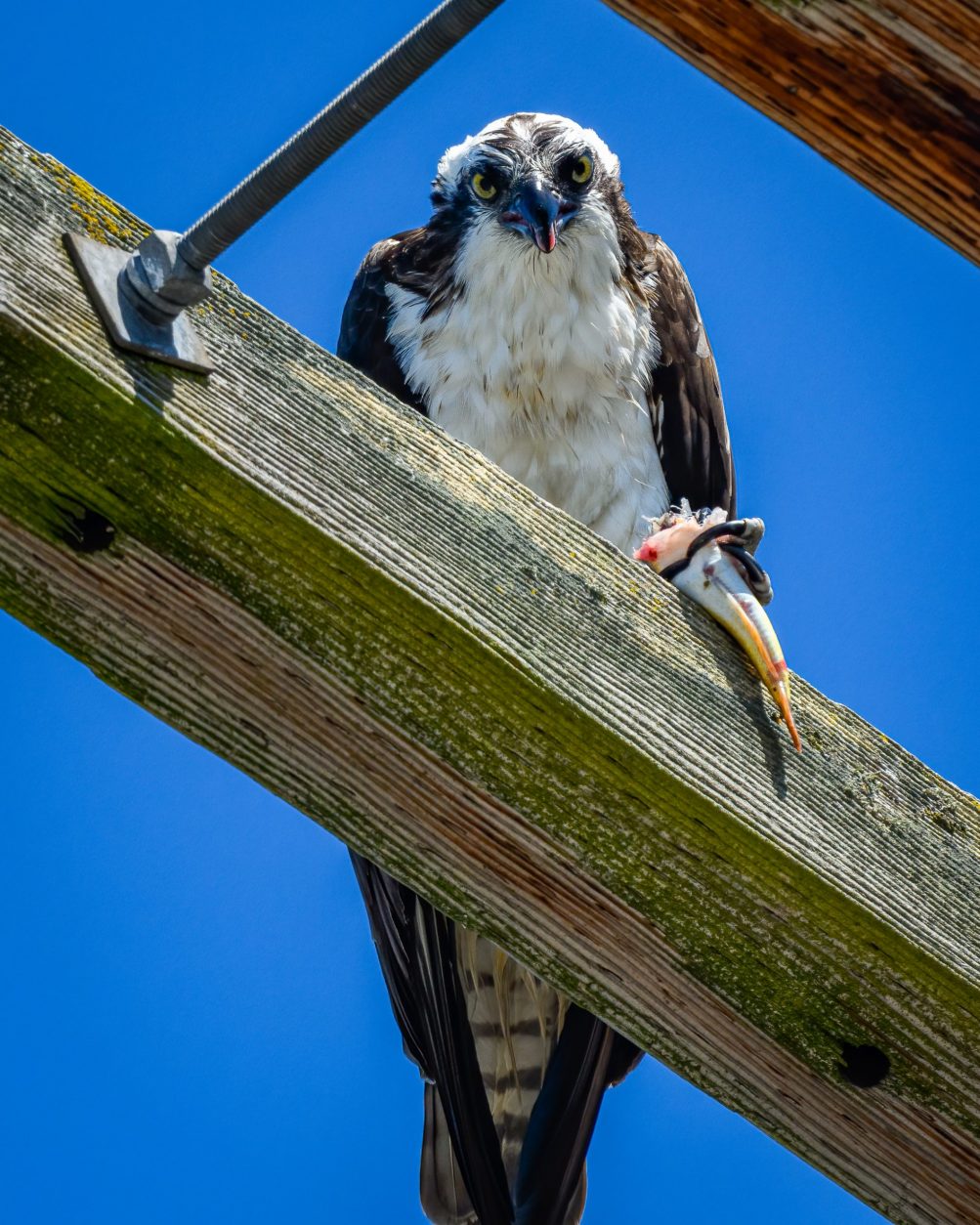
We conclude this gallery with a Willow Flycatcher, which Lawrence Heeren says is the first one he’s seen in 21 years in West Seattle:

From birds to breaking news, we appreciate the photos you share – westseattleblog@gmail.com if it’s not urgent, or text 206-293-6302 if it is!
9:15 AM: Transient orcas are in view across the Sound from West Seattle, passing Southworth right now, “northbound, quickly,” reports Kersti Muul of Salish Wildlife Watch. Let us know if you see them!
9:33 AM: Update from Kersti – they’re now in view off Blake Island.
 (WSB photo)
As we’ve been reporting, the pandemic didn’t stop the Salmon in the Schools program – determined and creative teachers and volunteers made educational fish-raising happen even with long-closed campuses. Four months after eggs were distributed, it’s time for the fry to be released into upper Fauntleroy Creek. Above, volunteer Dennis Hinton assists a Louisa Boren STEM K-8 student during a release on Friday; below, preschoolers from The Cove School waited their turn at creekside on Wednesday.
 (Photo courtesy Salmon in the Schools)
Four more schools plan to visit the creek in the next week and a half to release fry, according to volunteer Judy Pickens. Fauntleroy Creek is one of the few creeks in the city to which salmon still return to spawn – though the return numbers widely year to year, and no spawning was observed last fall.

10:21 AM: The photo is from David Hutchinson, after he spotted baby Canada Geese along Harbor Avenue for the first time this year. He’s photographed them over the years and shared photos with us to share with you, but more than the cuteness factor, this serves as a warning to drivers and riders in the area too – Canada Goose families are known to cross the street (here’s another photographer’s view from a decade ago), so please be extra-careful in the area.
ADDED 3:37 PM: Theresa Arbow-O’Connor just sent these photos, also taken off Harbor Avenue:


David Hutchinson‘s view of a Great Blue Heron nesting on Pigeon Point gives wing to a warning as we start this gallery of bird photos contributed by West Seattle photographer/birdwatchers. The warning actually comes from Trileigh Tucker, along with this photo of a Killdeer:

She told us:
Yesterday’s low tide brought a nice encounter with a Killdeer, who posed for some portraits. But it also reminded me to ask folks to please be especially careful this time of year, on dry gravelly areas above high tide. From the sounds these killdeer were making, I could tell there was a nest nearby. (Photos are with a long zoom lens.) These nests are just shallow scrapes in gravel and very vulnerable to being accidentally kicked or purposefully harassed by crows and other predators. They can also be very difficult to see if you’re walking nearby.
So if people hear a Killdeer calling loudly, back off. And if you see one displaying its orange back and looking injured, it’s actually trying to distract you from a nearby nest—you should back far away as quickly as possible. Don’t try to “help” it.
The nesting alert covers many birds … whether you’re exploring the beach or the forest or doing work in a yard. Here’s a nesting Bushtit photographed by Mark Wangerin:

Back to shorebirds – here’s a Gull with a skate, photographed by Mark MacDonald at Alki:

Also with a snack, a Caspian Tern photographed by Kersti Muul:

She notes that the terns returned right on schedule, two weeks ago. (You’ve probably heard their raspy call.) Which leads us to another warning/reminder: As noted here on Friday night, it’s migration time for millions of birds. Tonight thousands are expected to fly over Seattle. Do them a favor and leave your outdoor lights off. As for the birds who are already here – Vlad Oustimovitch got a bird-bath visit from a Cooper’s Hawk:
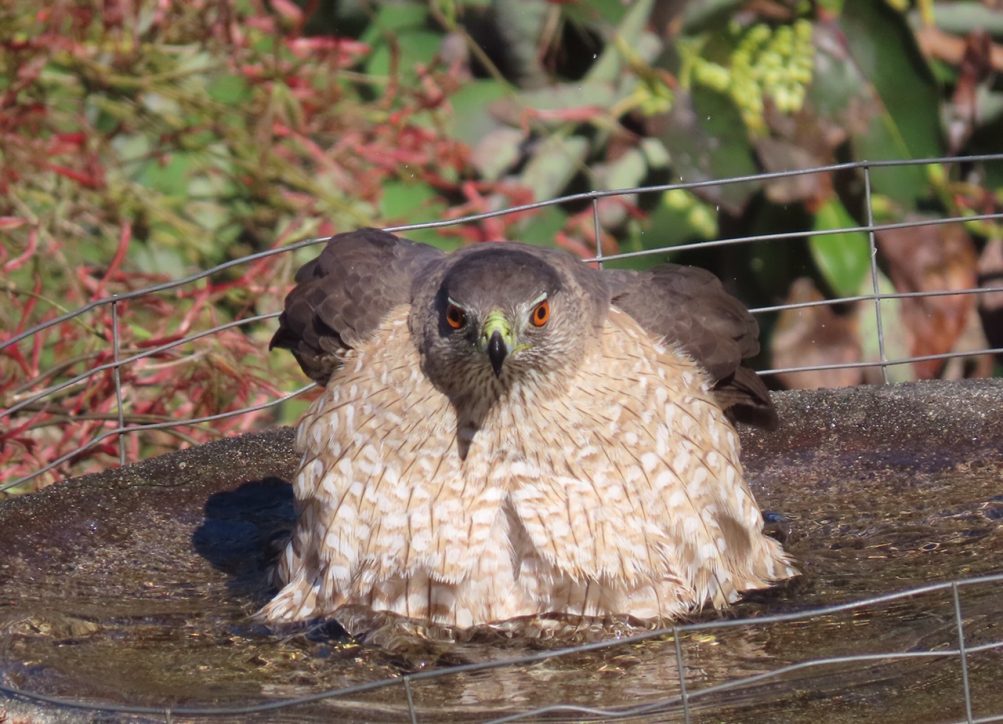
Swimming in a somewhat larger body of water – Seola Pond – this baby waterfowl photographed by Jim Clark:

Seen in saltwater, Pigeon Guillemots – Lawrence Heeren sent the photo:

Two from Gentle McGaughey – a Bewick’s Wren:

And a Song Sparrow:

Also singing, a White-crowned Sparrow photographed by Cindy Roberts:

And last but by no means least, West Seattle’s famous Bald Eagle “Bey” demonstrating, as photographer Jerry Simmons described it, “air superiority”:

Thanks to everyone for continuing to share photos of local birds and other interesting sightings – westseattleblog@gmail.com any time!
 (Aeroecolab image)
Thanks to the texter who pointed this out: Tonight millions of migrating birds are expected to fly over our state – thousands over Seattle – and you can help them by turning off your outdoor lights. This Audubon webpage explains:
Every year, billions of birds migrate north in the spring and south in the fall, the majority of them flying at night, navigating with the night sky. However, as they pass over big cities on their way, they can become disoriented by bright artificial lights and skyglow, often causing them to collide with buildings or windows. While lights can throw birds off their migration paths, bird fatalities are more directly caused by the amount of energy the birds waste flying around and calling out in confusion. The exhaustion can then leave them vulnerable to other urban threats.
Here’s more about what you can do. Tonight’s not the only night for migrating – you can check on other upcoming nights here.

Thanks to Brandy DeWeese for sending the photo of a sea-star sighting this morning on the shore at Lincoln Park. It wasn’t even a minus tide – those start tomorrow, and before the week’s out, we’ll see low-low tides. From our favorite tide chart:
Tuesday (4/27): -1.6 feet, 11:52 am
Wednesday (4/28): -2.5 feet, 12:34 pm
Thursday (4/29): -3.0 feet, 1:19 pm
Friday (4/30): -2.9 feet, 2:07 pm
Saturday (5/1): -2.3 feet, 2:59 pm
If you walk on the beach at those times, please be very careful of the exposed animal and plant life. Wondering what you might see? Here’s a field guide from the Seattle Aquarium (whose volunteer beach naturalists will be out during low-low tides later this spring and summer).

Another unusual flyby reported over Alki tonight. Last night, military helicopters – tonight, Pelicans! Brittany sent the photo taken by her husband Jeffrey; we believe these are American White Pelicans.

The last sighting for which we received photos/reports was in November 2013.

That’s a Mountain Bluebird, as seen by West Seattle photographer Mark Wangerin. He tells WSB, “Although rare on this side of the mountains, a few have been seen west of the Cascades in the past few weeks. There are 3 (all males) along the Duwamish by South Park. What a treat! I was going to go east of the mountains this week searching for them.” They are “the most migratory of the bluebirds,” Seattle Audubon explains here.

Thanks to Kersti Muul of Salish Wildlife Watch for a rare sighting – an elephant seal off West Seattle. She saw this one from shore south of Brace Point, watching the transient orcas that swam by on Saturday. Checking WSB archives, we have two past photos from elephant-seal sightings, both from Seal Sitters – in 2011 and in 2017.

“Bey” the rescued Bald Eagle, photographed by James Tilley as she fended off competition for food, starts our gallery of readers’ West Seattle bird photos. Staying on the shore, we have two from Lawrence Heeren – Sanderlings in flight:

And Brant:

Two forest birds from Mark Wangerin – a Downy Woodpecker:

And a Dark-eyed Junco:

Trileigh Tucker sent this photo to show that the Rufous Hummingbirds are back:

A Spotted Towhee, photographed by Mark MacDonald:

Matthew Olson sent this photo of a Finch:

Theresa Arbow-O’Connor calls this Steller’s Jay “Bluebell”:

Thanks again to everyone sharing bird photos – westseattleblog@gmail.com is our best address for non-breaking news.
11:49 AM: Just in from Kersti Muul of Salish Wildlife Watch: Transient orcas are southbound, just north of Discovery Park, headed this way.
12:35 PM: Still headed this way, Kersti reports in a comment.
1:14 PM: Another update from Kersti – passing Alki Point.

A week and a half after her post-rehab release in North Admiral, the Bald Eagle nicknamed “Bey” is still in our area. We received photos of two sightings in the past day-plus – Mike Russell spotted her atop a tree by the Admiral Way Bridge over Fairmount Ravine this morning and watched for about 20 minutes until she flew away – the photos above and below are his.

On Friday afternoon, Frank Smith was driving through the ravine when he happened onto “Bey” and prey:

In both cases, the birdwatchers saw the green band verifying her identity, placed while PAWS Wildlife Center was caring for her after her rescue from Don Armeni Boat Ramp a month ago and subsequent internal-bleeding diagnosis.
Today we checked in with Kersti Muul of Salish Wildlife Watch, the local advocate/steward who was involved in the rescue. She is continuing to track “Bey” and reports that the eagle did eventually reunite with her mate “Jay.” If you see her you can contact Kersti at kersti.e.muul@gmail.com. But whatever you do, don’t approach “Bey” (or any other wildlife). Kersti adds, “I would absolutely advise giving her a wide berth. As with any wild animal, but especially her right now. She just recovered from an infection that almost killed her. And the infection was from an environmental exposure, perhaps something she ate. She’s better but is just a week and a half out of rehab.” Kersti also notes that “when birds on the ground are startled, they flush and fly straight up quickly, often right into the grill of a car.” So help save wildlife by keeping your distance.

(Pine siskin, 2017 photograph by Mark Wangerin)
Back in January, we reported on a warning about bird feeders, and a recommendation that you remove yours to keep a deadly outbreak of salmonellosis from spreading among birds, particularly Pine Siskins, which have been gathering in larger-than-usual numbers. This week, a reader emailed to ask if it’s safe to put the feeders back up again. We contacted state Department of Fish and Wildlife‘s Chris Anderson – who gave this presentation a few weeks after the original warning – and he pointed to a recent update of their original post:
UPDATE: A drop in the number of reports of sick or dead birds across Washington and other northwest states means backyard bird feeders can be put up again around April 1, but with caution.
An outbreak of salmonellosis in pine siskins and other songbirds had WDFW staff asking people with bird feeders and baths to put them away for a few months earlier this winter to discourage wild birds from congregating and potentially passing salmonella bacteria to each other. When birds flock together in large numbers at feeders, they can transmit the disease through droppings and saliva.
Since WDFW first put out word of the outbreak in early January, reports of sick or dead birds have decreased substantially, but they are still coming in.
“The disease is still circulating, and we could see the numbers jump back up if we ease precautions too quickly,” said WDFW veterinarian Dr. Kristin Mansfield. “If you usually feed birds at multiple feeders, consider putting up only one or two – widely spaced on your property – to start.”
You may also wish to use feeders that accommodate fewer birds (such as tubes rather than platforms) and continue to keep the ground below bird feeders clean by raking or shoveling up feces and seed casings that could spread salmonella. Provide only enough feed to last a day or two — in support of regular cleaning efforts within that same span; and to help keep wastage underneath the feeders down and manageable for cleaning under feeders. These measures assist in spreading birds out and keeping seed fresh and feeders clean. There is a possibility that handling infected contaminated bird feeders can spread the salmonella bacteria to humans. When filling or cleaning feeders, be sure to wear disposable gloves and wash hands thoroughly afterward.
The state still wants to hear from you if you see a sick or dead bird – you can report it here.
 (Photos and video courtesy PAWS)
Three weeks after her rescue at Don Armeni Boat Ramp, the ailing Bald Eagle nicknamed “Bey” has recovered and been released at another West Seattle park. First word of the successful release came from local wildlife advocate Kersti Muul, and today we have video, photos, and information from PAWS Wildlife Center, the regional nonprofit that helped “Bey” get well so she could return to the wild. Here’s what happened when her carrier was first opened Tuesday at Hamilton Viewpoint Park:
And here she is, flying free:
PAWS wildlife naturalist Jeff Brown reports:
We released her at a safe place where she had plenty of room to take off. She immediately left the carrier when the door was opened but spent a few minutes gaining her bearings before flying off. She has been spotted in West Seattle multiple times since release. She was banded with a visual Identification band that is easier to read with binoculars.
We rely on observation from the public to keep track of banded birds. If anyone spots a banded eagle, or any banded raptor in the area, please report the sighting to reportband.gov. Please note the alpha-numeric code, the color of the band, the color of the numbers, which leg is banded, and the location (GPS or address). This data is very important to us, and we appreciate you all putting the extra time to report sightings to the bird-banding lab!
If you missed the previous coverage – the eagle was spotted at Don Armeni, lingering on the ground, listless, and local wildlife advocates organized a rescue on February 25th, with Washington Department of Fish and Wildlife agents and even Seattle Police part of the operation to capture her and transport her safely to PAWS’ rehab center in Snohomish County (which is donation-supported). Veterinarians there diagnosed her with, and treated her for, anemia from internal bleeding.
 (February 25th photo by Kersti Muul)
Good news if you’ve been following the story of the ailing Bald Eagle rescued last month from Don Armeni Boat Ramp, where it had been hanging around on the ground, clearly ill or distressed: The PAWS Wildlife Center veterinarians who have been treating her for internal bleeding say she’s continuing to improve. PAWS spokesperson Laura Follis tells WSB that might mean they can release her soon:
The eagle was evaluated on Monday, March 8, and her blood values are continuing to improve. She was moved to our flight pen and is flying well. She is due for another veterinary check tomorrow with the hope that her blood values will be back to normal. If they are, we will be releasing her back to the wild that day.
She’s believed to be half of a resident pair nicknamed “Bey and Jay,” after the married musicians.

To brighten your drippy Sunday, here are more West Seattle birds, thanks to your neighbors who have been sending in photos! Above, the always festive Northern Flicker, photographed by Michelle Green Arnson. Below, a Dark-eyed Junco, photographed by Mike Russell:

From Mark MacDonald, a Chestnut-backed Chickadee at Lincoln Park:

You can’t miss this orange-and-black bird if it shows up in your yard – a Varied Thrush that Max Welliver reports he was “surprised to see”:

Two leucistic birds showed up at local feeders – Samantha Burton photographed this Goldfinch:

This Hummingbird contribution is by someone who asked to be anonymous:

In the Duwamish Head Greenspace, J. Way encountered two Barred Owls, and caught this one on camera:

Finally, four awesome views of local Bald Eagles. First, from Jim Borrow:

From Danny McMillin:

From Chris Frankovich:

And from Jamie Kinney, an Eagle with an in-flight snack:

(If those photos have you wondering about the ailing, rescued Bald Eagle, we hope to have another update this week!)
Thanks again to everyone sharing photos, from breaking news to cool sightings – westseattleblog@gmail.com, or text 206-293-6302 if it’s happening now!

Quick bird break – two pheasants! For all the bird photos we’ve published over the years, this is the first time we’ve featured a Ring-necked Pheasant; two people sent us photos – the one above is from Stewart L., who saw it at Don Armeni Boat Ramp (the other sighting was near Alki Point). Below, a pheasant we’ve seen a few times over the years – Josh Niederberger photographed this Golden Pheasant near Hillcrest/Genesee:

Thanks again to everyone who shares bird photos – we have some others in queue for a gallery next weekend!
Along with direct action to save endangered orcas, education is key. A West Seattle resident who specializes in that – as well as research – has just been honored with a statewide award. Jeff Hogan of Killer Whale Tales has received the Outreach Award from the Washington chapter of The Wildlife Society. From the organization’s announcement, prepared for an upcoming edition of its newsletter:
Since 2000, Jeff Hogan has dedicated himself to Killer Whale Tales. Jeff had an idea that would pull together his Orca research experience with theatrical storytelling, science, and childhood education. His decision to put everything on the line to start a nonprofit is indicative of just how committed he is to ensure that the next generation understands the way consumer behaviors impact the environment, and also that science is cool!
For the first 10 years of the program’s existence, Jeff ran the program, creating and updating the program materials, delivering the program, fundraising, analyzing data, accounting, marketing, and scheduling almost entirely by himself. More recently, as the program has evolved to include more-robust data reporting and communications, Jeff has been able to rely on board members to help with some of the back-end functions, but the program materials, delivery, relationship building with teachers / researchers / major funders / other similar organizations still falls mainly on Jeff’s shoulders.
He has brought engaging environmental education to 125,000 elementary school students throughout the West Coast and Canada, and over 60,000 students have completed and returned “Kids Making a Difference Now” conservation worksheets, meaning they have taken action at home to reduce their family’s environmental footprint and help the whales. Jeff has continuously been the driving force in this nonprofit and has sacrificed personally to keep it going.
Jeff has some kind of a magical presence that inspires everyone he meets to take interest in the Southern Resident killer whales, science, and/or the environment. It is truly a remarkable talent that very few others possess. Killer Whale Tales have now converted over to online learning due to the pandemic and as odd as it may sound, it has opened up a whole new set of opportunities. Jeff is now working with children and families across the globe – from India, to the UK, and up and down the eastern seaboard of the U.S., he has “pods” of young future scientists sprouting up all across the planet!
Jeff also is a researcher. He co-authored recently published research showing that vessel noise interrupts Southern Resident Killer Whales’ feeding, especially females. Vessel noise is a major focus for advocates trying to increase the chances of saving the endangered orcas from extinction.
P.S. Killer Whale Tales is a nonprofit; here’s how to support its work.
 (February 25 photo by Kersti Muul)
Good news about the ailing Bald Eagle rescued at Don Armeni Boat Ramp one week ago today. We checked back with PAWS Wildlife Center, where she’s being cared for – here’s what PAWS wildlife veterinarians Dr. Nicki Rosenhagen and Dr. Bethany Groves report:
Her veterinary re-check found a significant improvement in her anemia. This means she is starting to regenerate red blood cells, crucial for continued improvement along with many other factors which determine if an animal can recover from injury or illness. She is strong and eating well and the plan is to allow her another week to recover before moving her to our larger flight pen to assess her flight and then allow time to recondition before her hopeful release.
She had been on the ground, listless, for some time on the lawn at the park before local wildlife advocates/experts and state/local officers teamed for the rescue. Those advocates included Kersti Muul, who reported here that this Eagle is a mated West Seattle resident known as “Bey.”
 (Thursday photo by Kersti Muul)
Four days after a listless Bald Eagle was rescued from Don Armeni Boat Ramp, it’s in “stable” condition. That’s according to PAWS spokesperson Laura Follis, who had told us on Friday that vets had diagnosed “severe anemia” and internal bleeding. In our exchange today, Follis added, “Our wildlife veterinarians are re-checking the blood tomorrow and we will have a statement of progress Wednesday morning.” The eagle was taken to the PAWS Wildlife Center after local wildlife advocates teamed with state and local officers to safely capture it for transport to be cared for.
 (Thursday photo by David Hutchinson)
We’ll follow up again on Wednesday.

| 17 COMMENTS