
West Seattle, Washington
03 Sunday
 (WSB photos)
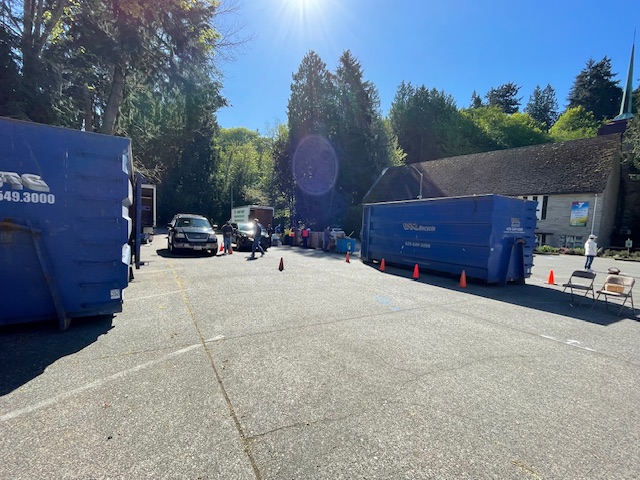
Though volunteers tell us drivers were lined up down the street when the spring Fauntleroy Church Recycle Roundup began at 9 am today, there’s no waiting now, and traffic is expected to be steady through the duration of the dropoff event, until 3 pm (don’t wait until the last minute, though, unless you can’t get there any sooner).
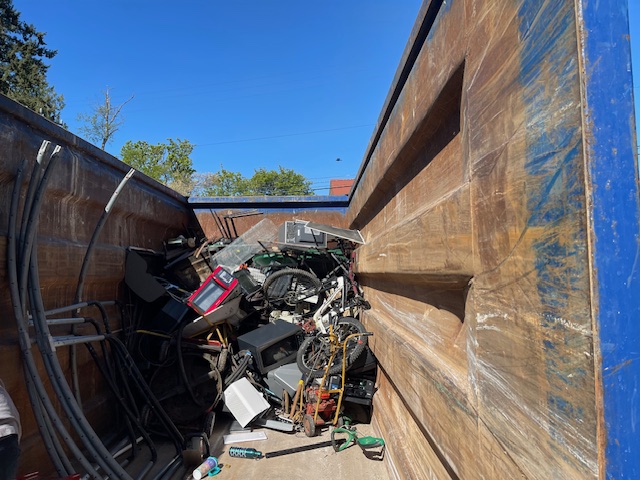
That’s just some of what people have brought – here’s the official list of what they’re accepting, and not accepting, this time.
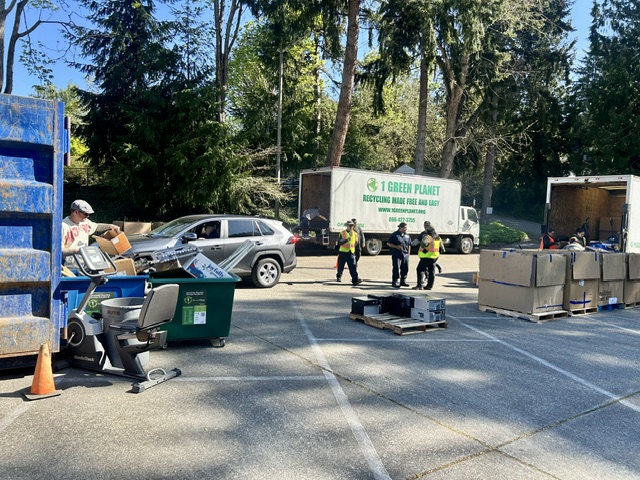
1 Green Planet is the longtime recycling partner with the church, which is at 9040 California SW. Dropoffs are free but volunteers are happy to accept monetary donations if you can chip in to support this twice-yearly event (next one, by the way, is set for [corrected date] Saturday, October 3).
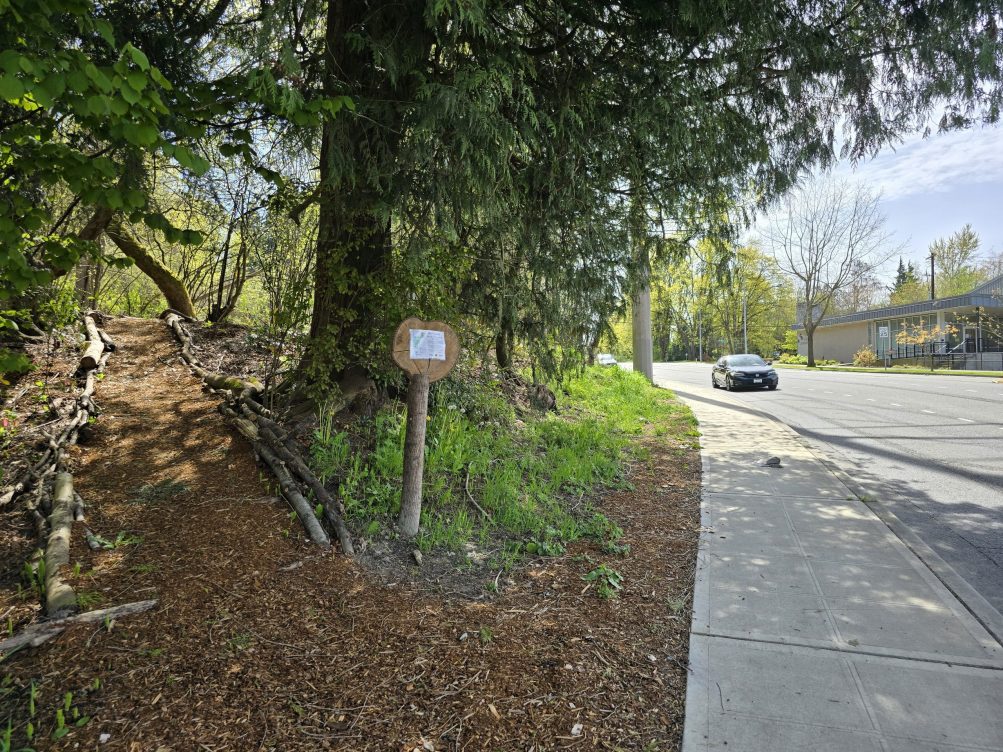 (Photo from Daniel)
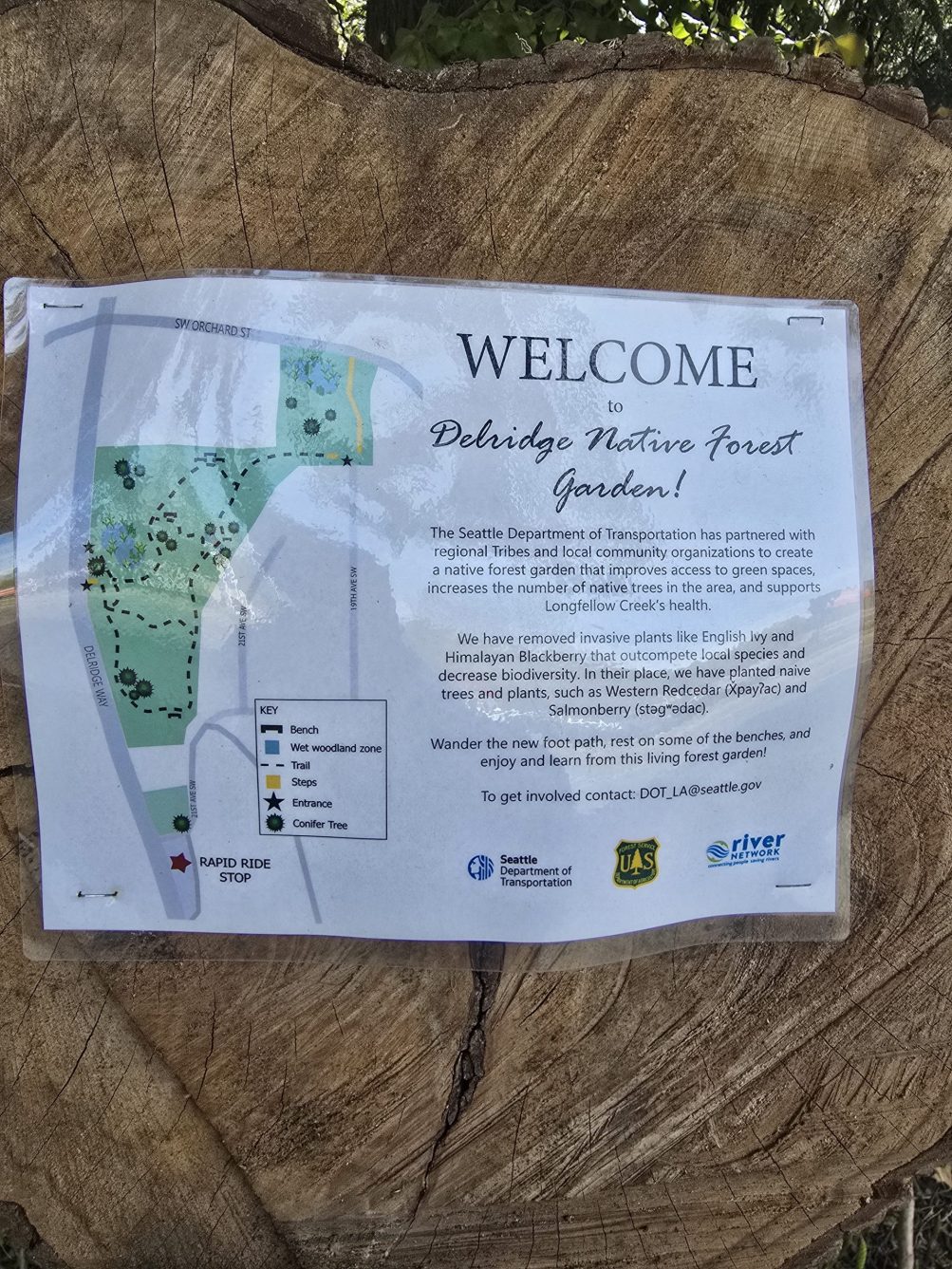
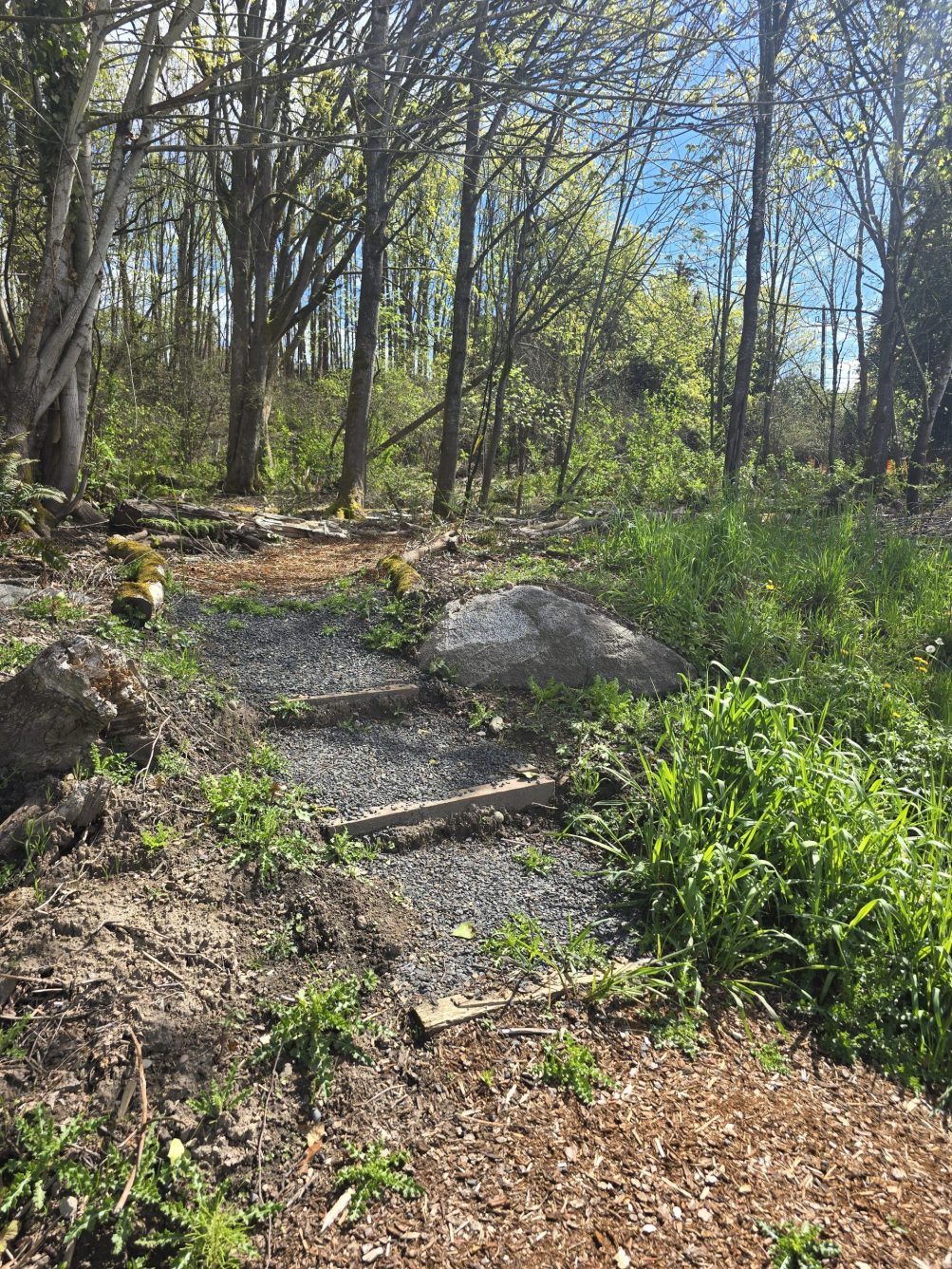
Last weekend, we published Daniel‘s reader report reminding people about the roadside Delridge Native Forest Garden as a potential spot to take a walk. Today, in fact, SDOT has announced a Tree Walk for the site – actually three walks on the afternoon of Friday, May 15. RSVPs are required and you’ll find the links, along with more details, here.
 (Volunteer Ann Dunbar helped students measure a torso in centimeters)
Story by Judy Pickens
Photos by Tom Trulin
Special to West Seattle Blog
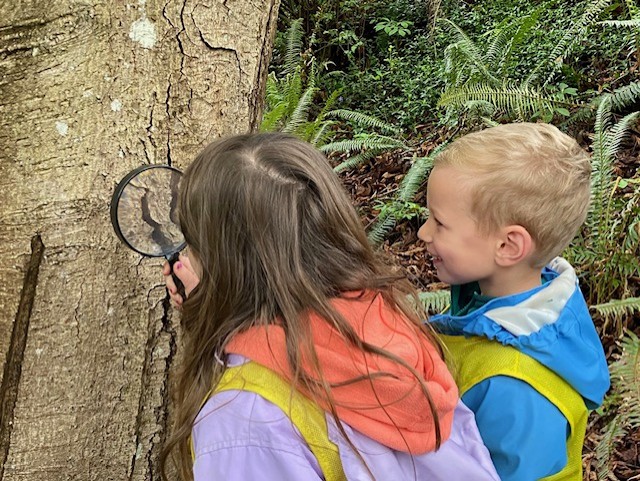
Students from the Urban Nature Preschool got a taste of scientific research on Thursday when they did the annual survey of stonefly exoskeletons in lower Fauntleroy Creek.
As nymphs, stoneflies are a major food source for juvenile coho. Mature stoneflies crawl out of the water in the spring and leave their exoskeletons behind as they take flight, and students have been counting and measuring them since 2000. Their findings are a way to track both quantity of food available to the fish and how clean the water is.
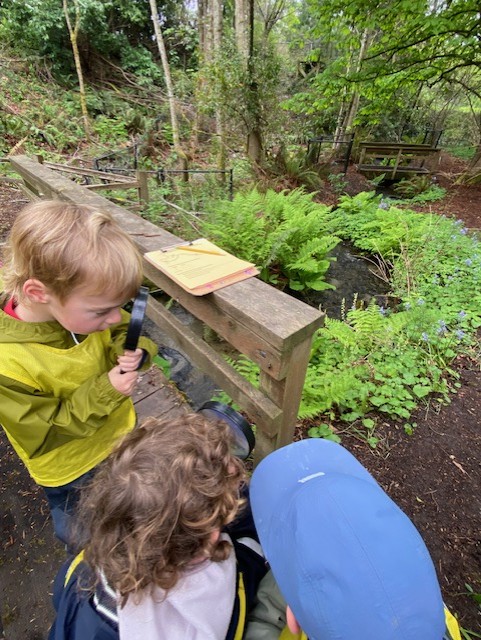 (Finding exoskeletons on bridges required close examination)
With the school’s outdoor focus, the four-year-olds already knew a lot about the creek and, with support from teachers and volunteers, they were up to the challenge of following study protocol. Three teams closely examined trees and bridges while a fourth measured torsos as adults recorded the numbers.
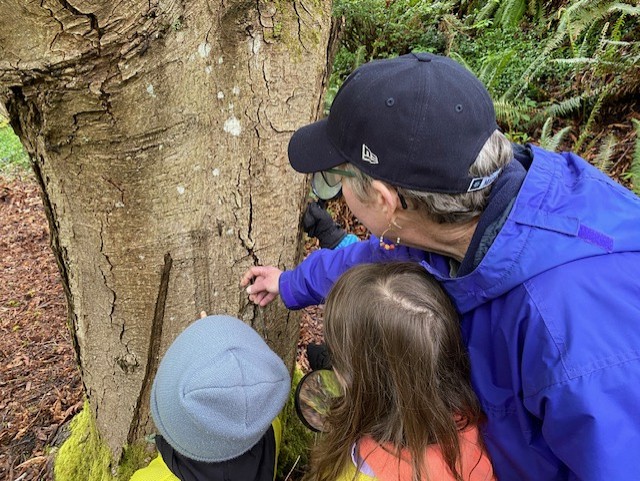 (Volunteer Ann Dunbar helped students measure a torso in centimeters)
After teams reported their findings, volunteer Alana Khayat added the numbers to line graphs so students could see how they compared to findings since 2015.
 If you couldn’t get to yesterday’s free shredding event at Village Green West Seattle (WSB sponsor) – good news – there’s another one coming up this weekend, this time at High Point Library (3411 SW Raymond). Between 10 am amd 1 pm Sunday (April 26), you can bring up to four boxes of personal shreddables to the library.
P.S. And if you have other recyclables, remember the Recycle Roundup in Fauntleroy on Saturday!
With the tax deadline just past, you might have old paper documents you’re ready to shred and recycle. Just announced – a chance to do that for free this Wednesday (April 22), 1-4 pm!
Got sensitive documents piling up at home? We’ve got you covered! Join us for a FREE community shredding event with Liberty Shredding at Village Green West Seattle!
Secure, on‑site shredding
FREE (up to 3 boxes per person)
Just drive up and shred with confidence! Hearthside Driveway (building two)
Village Green West Seattle (WSB sponsor) is at 2615 SW Barton.
 (Photos by Macey Wurm unless otherwise credited)
By Macey Wurm
Reporting for West Seattle Blog
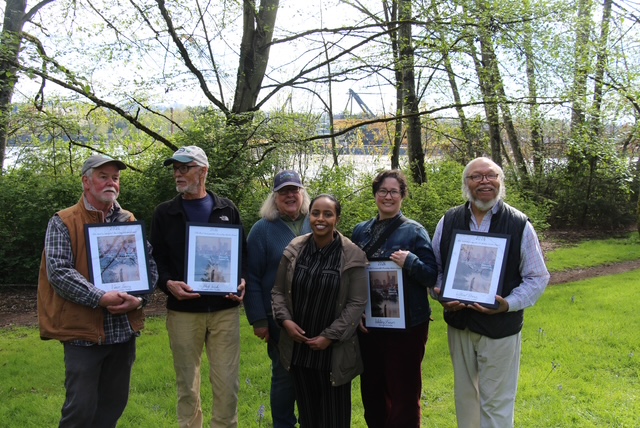
The Duwamish Alive! Coalition hosted the spring version of its twice-annual multi-site volunteer work party today, after taking time to recognize four people with the John Beal Environmental Stewardship Award.
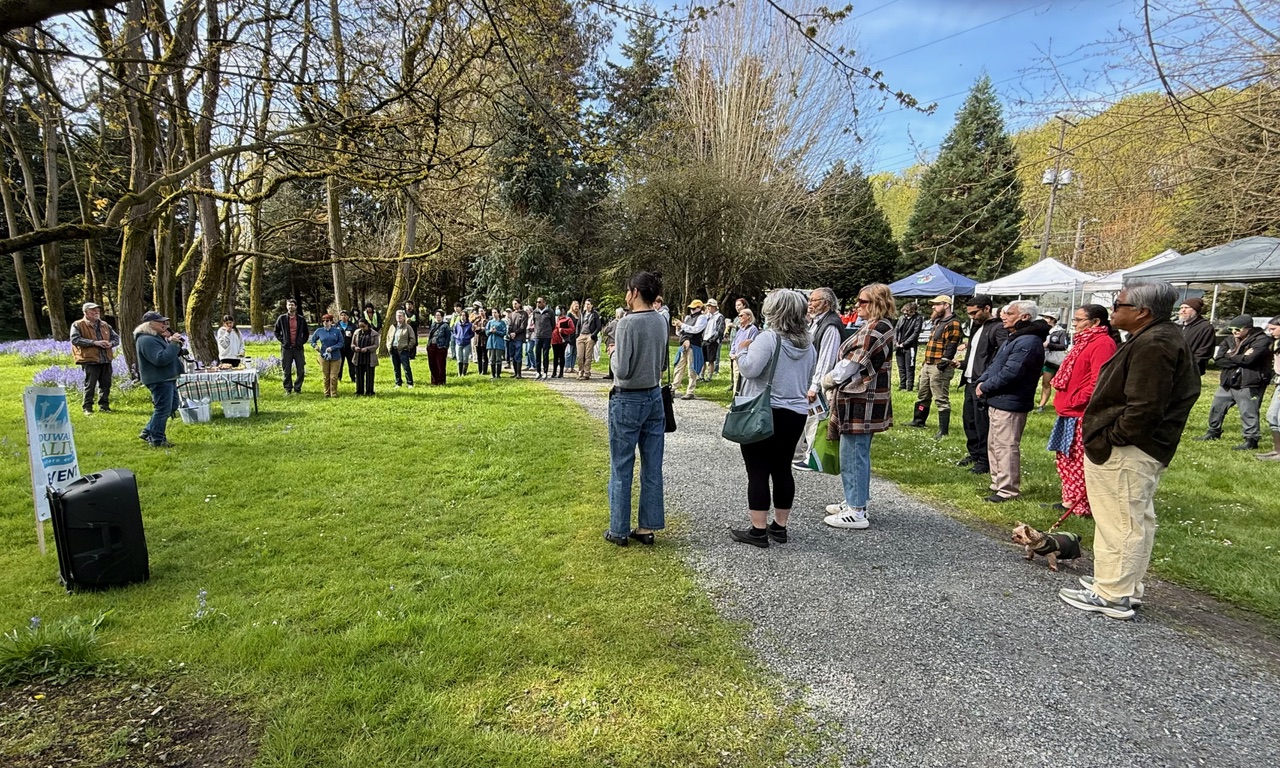 (Photo by Don Brubeck)
The day was kicked off by coalition executive director Sharon Leishman. She noted that typically, Puget Soundkeeper and the River Access Paddle Program would usually be part of the day via an on-water cleanup, but they had to do it last weekend (WSB coverage here) because today’s tide was too low. Last weekend’s cleanup, she announced, brought a quarter-ton of trash out of the river. She then introduced q́wat́ələmu, or Nancy Bob of the Duwamish Tribe, who performed a traditional welcome chorus.
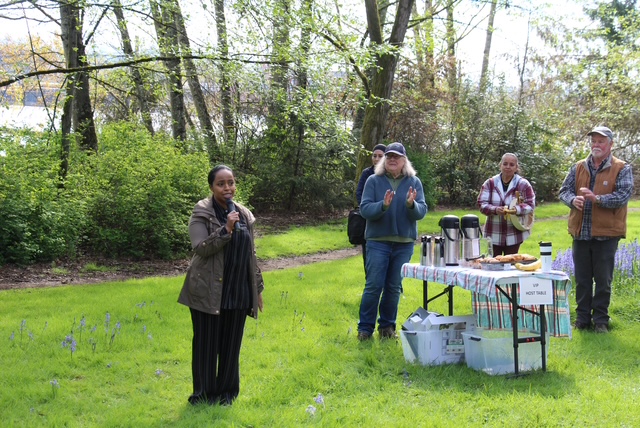
Seattle Port Commissioner Hamdi Mohamed thanked the coalition and volunteers. She shared thoughts on her two-month-old daughter’s future stewardship of the land, and expressed hope that her daughter’s children would also someday have an opportunity to engage in stewardship. “The investments we make today ultimately decide what that looks like,” she observed.
Leishman preceded the awards with the backstory of their namesake. John Beal was a Vietnam War veteran, who after suffering some serious medical issues, was informed that he only had four months to live. Within those four months, he dedicated himself to cleaning up Hamm Creek, which feeds the Duwamish River, and was one of the first to acknowledge the Duwamish as a river instead of a waterway, leading to increased stewardship and care. He ended up living 27 years past this initial prognosis, and died in 2006.
The award in his name is not given out often, but this year the coalition honored four individuals – Bob Weeks, Willard Brown, Vince Savery, and Whitney Fraser.
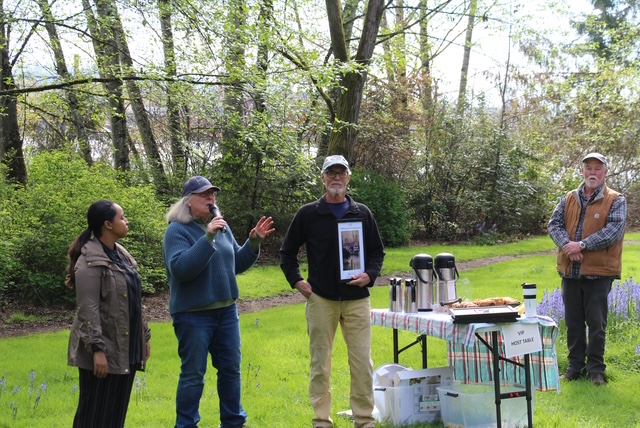
Bob Weeks of Seattle City Light was honored for his extensive work transforming a site at North Wind’s Weir, a transitional zone where freshwater and saltwater mix. The area, which is very important to juvenile salmon, was completely transformed into an incredible area of biodiversity after being dominated by invasive species.
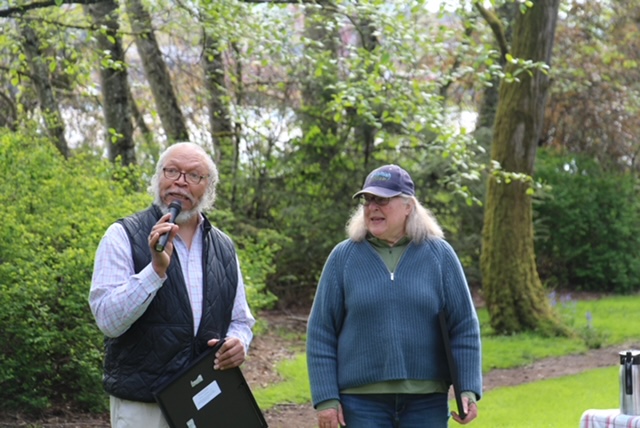
Willard Brown, long known for his work with the Delridge Neighborhoods Development Association, has spent many years connecting school and community groups to the river and surrounding lands. “When you talk about boots on the ground in the community making a meaningful difference, Willard’s the first name that comes to everybody’s list,” said Leishman.
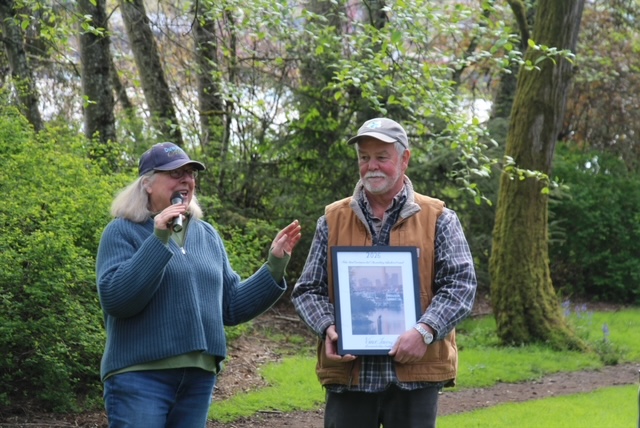
Vince Savery, with the Port of Seattle, stewarded a site on the lower Duwamish to take it from highly industrialized to a significantly healthier environment. The area serves as the last habitat for salmon before they go into Elliott Bay. He also started the local chapter of Pollinator Pathway.
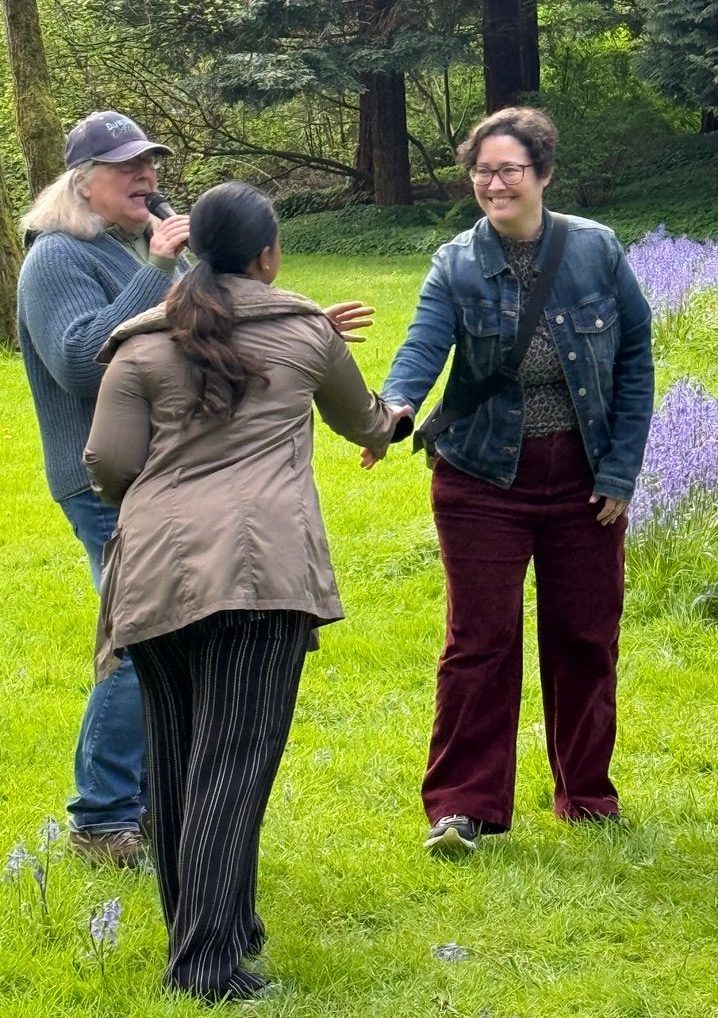 (Photo by Don Brubeck)
Whitney Fraser of Puget Soundkeeper Alliance is (corrected) a longtime volunteer with the salmon survey that raised awareness of their pre-spawn mortality rates. Puget Soundkeeper was one of the first organizations to focus on Longfellow Creek in West Seattle. Fraser had advice for the audience of volunteers: “Start showing up and keep showing up, and learn, and try to make it a better place as much as you can.”
After the awards were presented, Andrew with Dirt Corps instructed the volunteers to follow different group leaders to their respective parks to get started on the work party. The Green Seattle Partnership occupied Herring’s House Park, with Dirt Corps at həʔapus, and a smaller group headed to Pigeon Point Park.
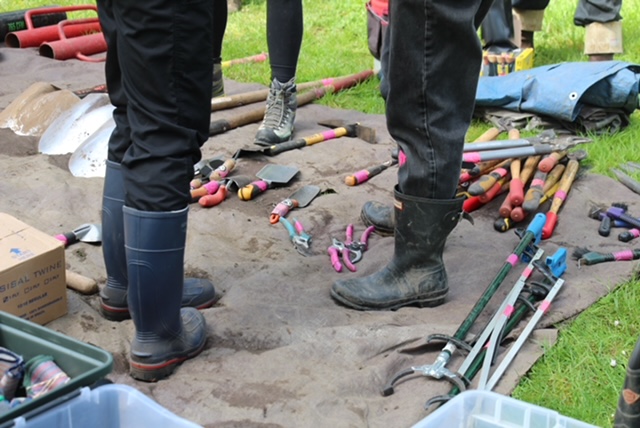
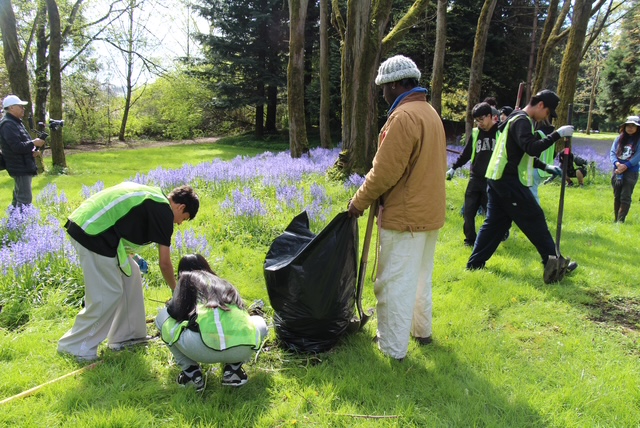
The Dirt Corps group went to work on removing the bluebells in the area. They aren’t a native species and are aggressive with their growth, and removing them gives native plants a better chance to thrive.
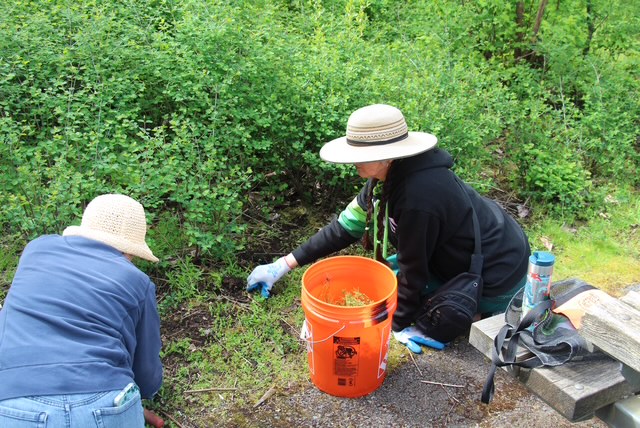
Green Seattle Partnership volunteers worked to weed and mulch so that the existing plants will be able to survive the upcoming hot summer. These preparations aided a long-term Herring’s House project, aimed at creating a native plant species area and an eventual incorporation of a native sculpture at the entrance of the park.
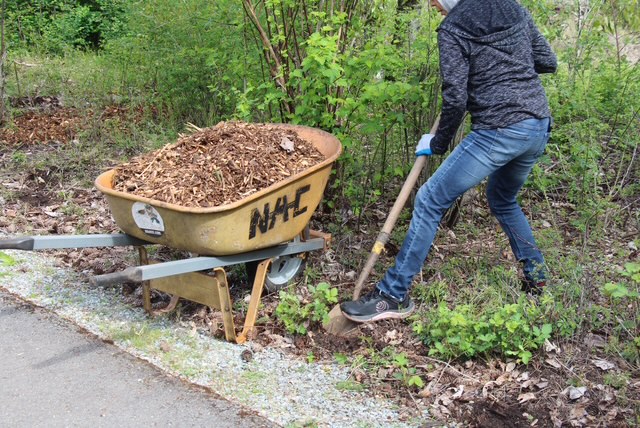
The Duwamish Alive! Coalition will muster volunteer groups at sites along the river and in its watershed again this fall – October 17 is the date, and when it gets close, volunteer opportunities will be listed at duwamishalive.org.
 (WSB photo, April 2023 Recycle Roundup)
Another reminder that one week from today – on Saturday, April 25 – it’s the spring Recycle Roundup at Fauntleroy Church (9140 California SW). Drive up, ride up, walk up with your items that are recyclable but not routinely picked up on curbside. But before you load up, check to be sure that your items are on the list of what the church’s partner 1 Green Planet is accepting this time – see the will-and-won’t-accept list here. The event starts at 9 am and continues until 3 pm – organizers ask that you not show up at the last minute unless you absolutely can’t get there sooner, so they don’t have a line still waiting at 3 pm; they usually have multiple trucks to fill so you don’t have to rush to be there right at the start, either. (And if you miss this one – they usually do it again in fall!)
Thanks to Daniel for the photos! If you’re looking for someplace different to walk this non-rainy weekend, and missed the hiking opportunities in today’s event list, how about the Delridge Native Forest Garden? Daniel noted we last mentioned this site in December:
I see the last update was a while ago and with the nice weather more people might enjoy knowing about the improvements there.
I see a lot of people assuming those paths were made by unhoused people and that the area is full of encampments just out of sight. But I just walked there today and it is a nicely maintained area with no tents. There’s a nice winding mulch path with some rustic wood benches.
I hope more people feel comfortable exploring the area.
The project page has a map showing where along Delridge you can access the site. (For reference, the top photo looks southwest, with the Southwest Precinct at Delridge/Webster in the background.)

(WSB file photo)
The forecast looks good, so if you can spare a few hours at midday Saturday, get out and help Seattle’s only river thrive! 10 am-2 pm Saturday (April 18) at multiple locations from West Seattle southward, both inland (Pigeon Point Park) watershed and right along the shore (the port-owned parks off West Marginal Way SW), you can volunteer for the spring Duwamish Alive! mega-work party, with various restoration/planting activities. Scroll the Duwamish Alive! home page to see the locations where you can still sign up now to help tomorrow.
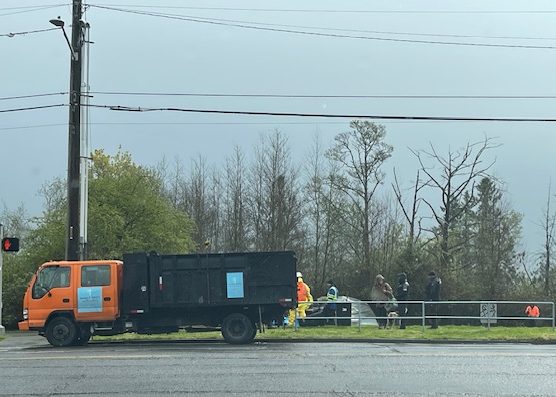 (WSB photo, Wednesday morning, 35th/Edmunds)
As promised, we asked the city followup questions about the sweep on Wednesday in the encampment area east of 35th, from West Seattle Stadium to Camp Long. Here are the answers we received late today:
WSB: How much stuff was removed?
REPLY: “During the restoration, approximately 2.5 tons of debris were removed.”
WSB: How many people were connected with shelter?
REPLY: “(The Unified Care Team) connected five people with shelter and one with case management services.”
WSB: What’s next?
REPLY: “Planning is underway in coordination with multiple City departments to maintain the area so that it remains clean and accessible for public use.”
We also noted that there was no hint of the sweep plan when the city answered our inquiry last Thursday about plans for the site; the notice we showed on Monday said it had been posted Friday, so it was clearly in the planning phase when we inquired. The city’s response noted: “The UCT does not share specific resolution dates externally due to staff safety and possible changes in scheduling due to resource constraints.”
By Macey Wurm
Reporting for West Seattle Blog
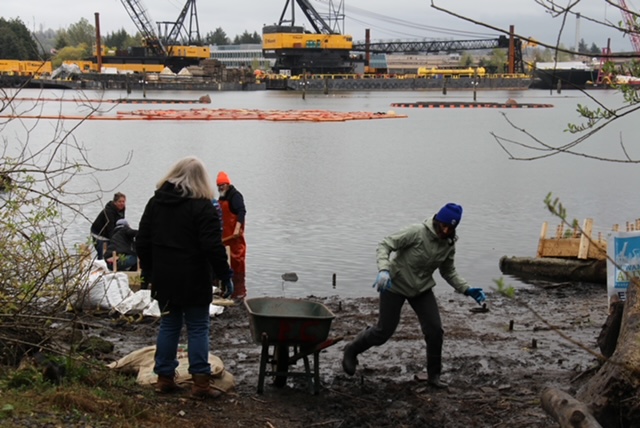
After eight weeks of planning and construction, 9th graders from Maritime High School are bringing their floating-wetlands pilot project to a close in West Seattle waters, another step toward saving salon.
The school’s entire freshman class – 23 students – worked together learning how to use hand tools, power drills, and a newfound understanding of a human-made floating wetland’s restorative role in the Duwamish River’s ecosystem.
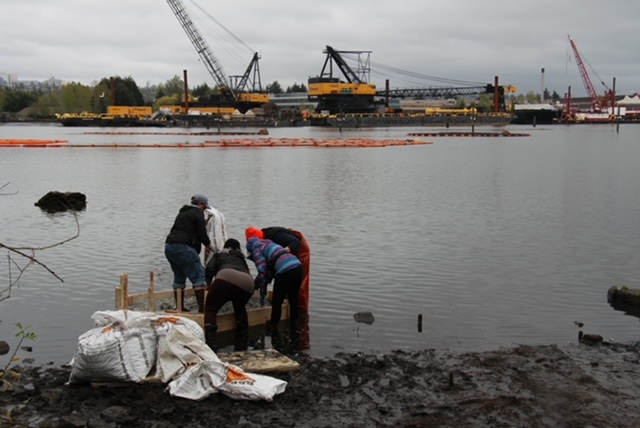
The project was a partnership with the River Access Paddle Program and the Port of Seattle, funded by the Rose Foundation. Saturday morning at Herrings House Park on the river, community members were invited to be involved with the construction of the last two floating wetlands, with the first two entirely built and planted by the students two weeks ago.
Floating wetlands are being used to provide habitat for juvenile salmon. The lower part of the Duwamish River is highly industrialized and the banks are mostly “armored,” which means rock without a place for juvenile salmon to feed, as explained by Sharon Leishman of the Duwamish Alive Coalition. These juveniles need their bodies to adapt to go from freshwater to saltwater, and the wetlands help create a space for these necessary changes.
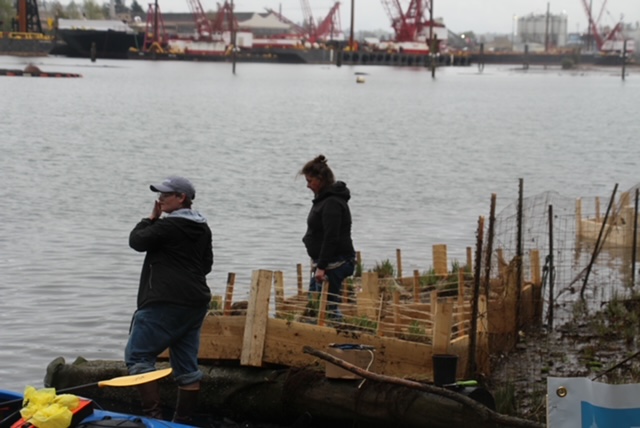
Leishman was also involved in a floating-wetlands project with the University of Washington in 2019 in Lake Union. This project differs in that these use air-infused recycled glass instead of plastic for buoyancy. This change was made in an effort to eliminate the harms of microplastics.
This was the first floating wetlands project taken on by Maritime High School, and its continuance in the future will depend on whether or not the program can secure a location for more wetlands to go. In this case, George Blumberg with the port helped the school to find the location – a dock space on Harbor Island that the port can’t rent out by the port because it’s too small for boats.
Regardless, the school will continue with projects that incorporate similar learning outcomes. “The thing that really works for us and that we want to replicate is: How do we combine some of that construction skills training that we want to do with restoration?” mused Tyson Trudel, who works at Northwest Maritime, which brings the “intensely maritime parts” of the curriculum to the school.
Coinciding with the community assistance in building the second two floating wetlands was the semiannual kayak cleanup organized by the Duwamish Alive Coalition. In the spring, this garbage cleanup project is hosted with salmon retention in mind. The first group of kayakers went out at 10:30 Saturday morning, with the second deploying around 12:30.
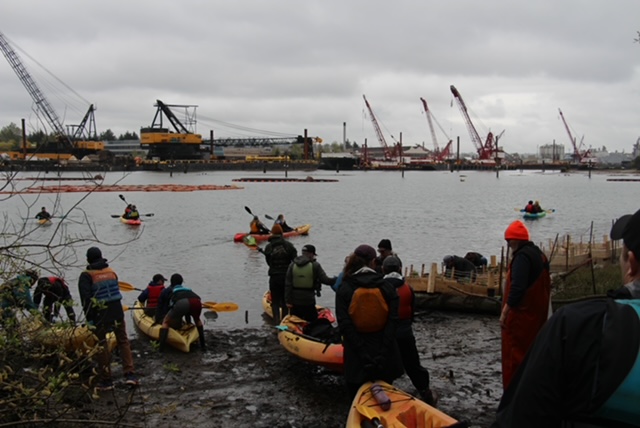
Both projects are centered around taking care of the Duwamish River and its surrounding land. “This area right here has such huge environmental, social, and historical significance because Seattle would not be the place it is today without the industry that started in this valley,” Leishman said.
You have a chance to help next Saturday in the spring edition of the mega-work party Duwamish Alive! Partner organizations include Dirt Corps and the Green Seattle Partnership. Dirt Corps, an organization specializing in developing skills for green jobs, will be at həʔapus park, and Green Seattle will be at Herring’s House. The Duwamish Alive Coalition also plans to present awards to four dedicated volunteers in the opening event at Herring’s House park. To volunteer Saturday at a Duwamish Alive! site, go here.

(File photo from a reader – that long stretch of greenbelt is the WDG)
Just west of Seattle’s only river, in eastern West Seattle, you’ll find the city’s longest unbroken stretch of forest, the West Duwamish Greenbelt. Last year we reported on a survey asking your thoughts about it, conducted by the Ridge to River Coalition. Now the results are out, and we’ve received this announcement summarizing it and looking ahead to what’s next:
Last year, the Ridge to River Coalition (R2R) invited the community to share experiences and ideas for the West Duwamish Greenbelt, Seattle’s largest forest. 589 people completed an online survey. That is an impressive response! To see the results, visit the R2R website r2rduwamish.org. R2R thanks all who participated.
Survey findings will help shape a community vision for the greenbelt that supports environmental stewardship and addresses the needs of the surrounding communities.
Key findings include:
-The West Duwamish Greenbelt is widely viewed as a critical environmental resource and a valued refuge for nature, recreation, and community wellbeing.
-Respondents most frequently engage with the Greenbelt through walking, hiking, nature observation, and informal recreation.
-Environmental protection, personal safety, encampments, wayfinding and maintenance emerged as overall priorities.
-Many respondents expressed concern about balancing improved access with preservation of sensitive ecosystems.
-Top priorities for trail development were wayfinding, developing longer, continuous hiking routes within the greenbelt, and making trails usable in wet weather.
-Community members demonstrated strong interest in continued involvement and stewardship.
R2R is currently inviting adjacent neighbors and landowners to meet for “coffee hours” for more input. Later this year, R2R will return to gather public feedback on options for planning concepts for trails and restoration. Herrera Environmental Consultants is leading a team to perform environmental studies and planning.
The Ridge to River Coalition includes West Seattle and Duwamish Valley community organizations, individuals, and the Duwamish Tribe. This project is funded by grants from the King County Parks Levy Fund and the King Conservation District. Seattle Parks Foundation is the fiscal sponsor of R2R. Seattle Parks and Recreation is reviewing the work as it proceeds. Technical assistance is being provided by the National Park Service’s River and Trail Corridor Assistance Program.
For any questions or comments, please contact info@r2rduwamish.org
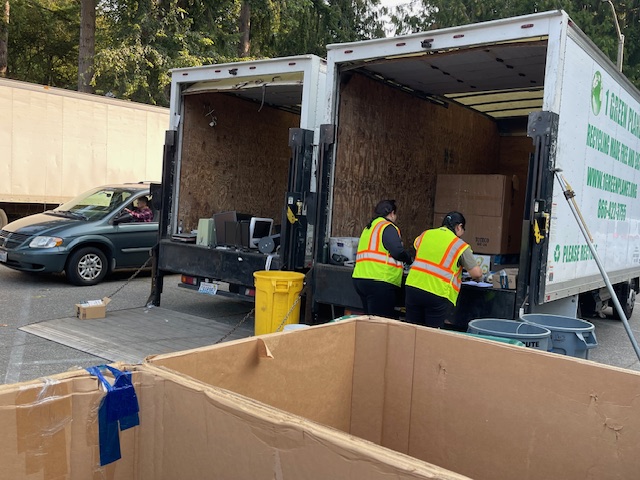 (WSB photo, September 2025 Recycle Roundup)
If the return of the rain has you spending some time indoors today and wondering what to do – sort your recyclables for West Seattle’s next big free-dropoff recycling event. We’re now exactly two weeks away from the spring Recycle Roundup at Fauntleroy Church (9140 California SW), 9 am-3 pm Saturday, April 25 – here’s the list of what will and won’t be accepted. Twice a year, the church partners with 1 Green Planet to offer this free service to the community; since it’s a six-hour window, they request that you come earlier rather than later, to avoid a last-minute backup.
 (WSB file photo)
In two and a half weeks, if you can spare just a few hours, Seattle’s only river – much of which runs along our peninsula – needs you. April 18 brings the spring “Duwamish Alive!” multi-site work party – here’s the announcement from the Duwamish Alive! Coalition:
Duwamish Alive! Celebrate Earth Month by Caring for Our Duwamish River
Volunteer on Saturday, April 18, 10 am-2 pmJoin us in celebrating the 20th anniversary of Duwamish Alive! while caring for Seattle’s only RIVER — the Duwamish, as we work together to improve its health. Volunteers will be restoring native habitat on in multiple urban parks and open spaces from Seattle to Kent in the ongoing effort to keep our river alive and healthy for our communities, salmon and the Puget Sound. Proving that by working together, we can make a substantial difference in improving the health of our region. We be working at sites, from Kent to Seattle to restore and preserve our areas of native habitat in the river’s watershed.
The river’s watershed includes forested areas such as the Duwamish Greenbelt, one of the largest in the lower section of the river, provides important air and water filtration of pollution, especially storm runoff one of the major sources polluting our waters. Tree canopy cover also reduces our summer heat domes, unequally affecting low income, communities of color to a greater degree. The river’s ecosystem supports 5 salmon species including the threatened Chinook salmon which is a critical food source for our Southern Resident Orcas; along with wildlife that includes river otters, beavers, bald eagles, and blue herons. Each of our habitat sites supports this web of life while providing important environmental benefits to our communities – we are all connected.
We are honored to help steward these locations which are the ancestral lands and waters of the Duwamish Peoples who have been here for thousands of years. Join us in caring for these special places. Family friendly, ALL are welcome. Tools and instruction are provided.
To volunteer, visit DuwamishAlive.org to see the different volunteer opportunities and register for the site of your choice.
Thanks to AH for sending the flyer that’s up for an “all hands” community cleanup tomorrow (Saturday, March 28) in South Delridge/White Center:
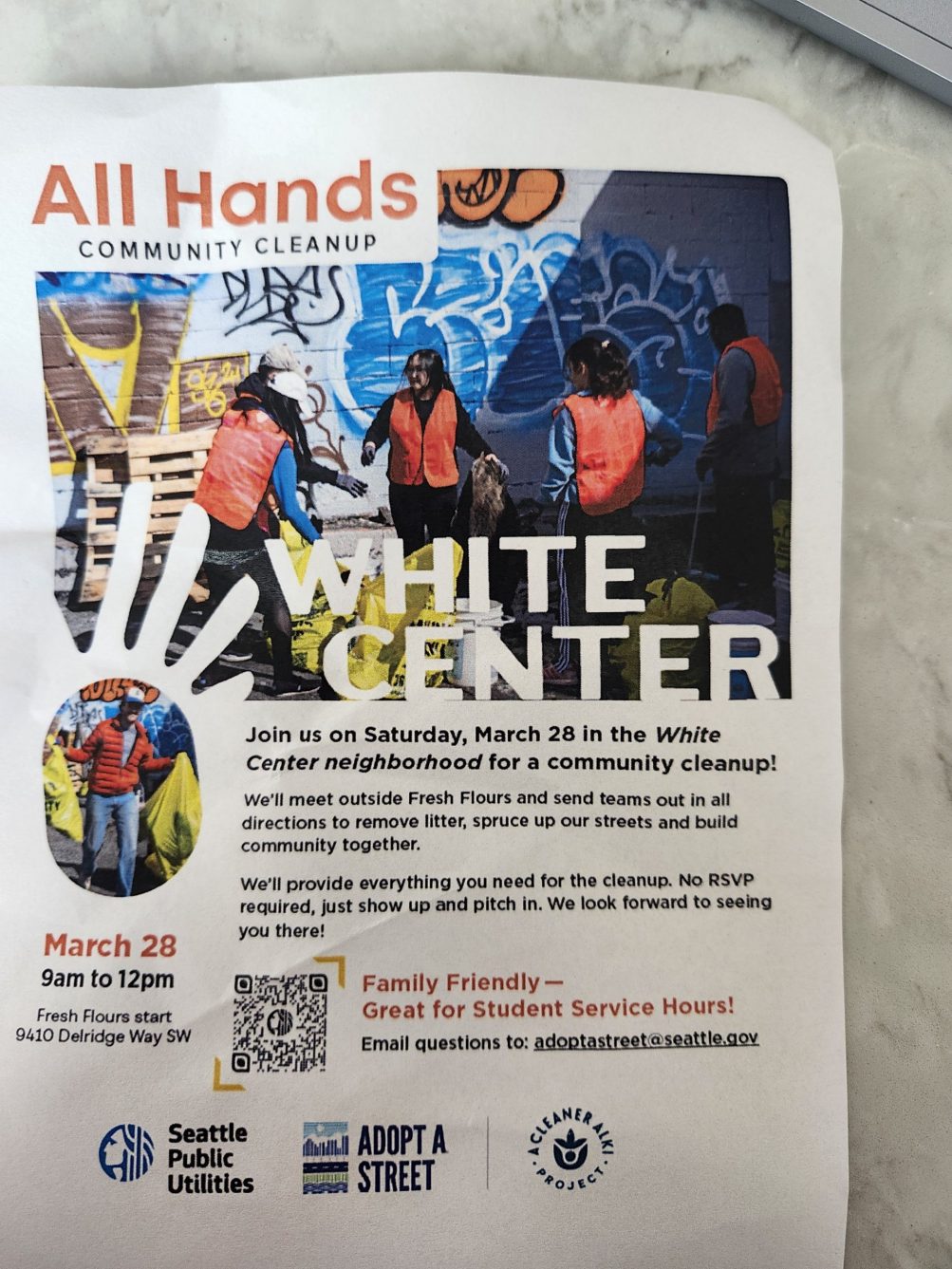
No RSVP required – show up, 9 am at 9440 Delridge Way SW, and you’re in!
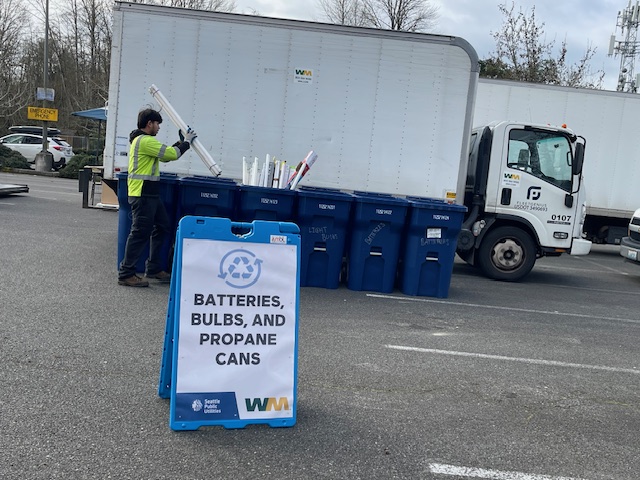 (WSB photo, Saturday)
If you took recyclables and/or shreddable paper to last Saturday’s event at South Seattle College (WSB sponsor) presented by the West Seattle Junction Association and West Seattle Chamber of Commerce, you were one of 503 participants. The local organizations’ partners at Waste Management also reported, “We saw 84% of residents coming from single-family homes, 11% of residents coming from apartments/condominiums, and 5% of residents coming from townhomes. The most popular items that were donated by number of households were appliances/electronics, shredded paper, and batteries/lightbulbs. The least popular items were propane canisters and clothing/textiles. An interesting note is that we saw a 50% reduction in the amount of foam collected (likely due to less amount of Styrofoam packaging being created).”
If you missed it, there’s annther big free-dropoff recycling event coming up in a month, the spring Recycle Roundup at Fauntleroy Church (9140 California SW), exactly one month away, 9 am-3 pm Saturday, April 25 – here’s the list of what will and won’t be accepted.
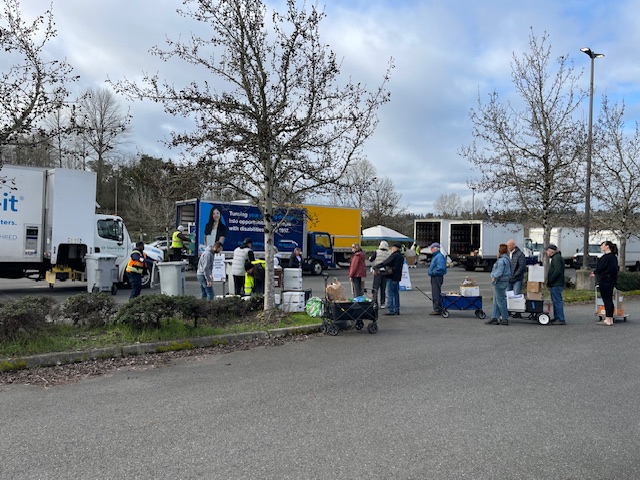
We’re in the south lot at South Seattle College (6000 16th SW; WSB sponsor), new location for the annual free recycle/reuse/shred event presented by the West Seattle Chamber of Commerce and West Seattle Junction Association with a variety of partners. (Here’s what they will and won’t take this year.) First thing we noticed: No backup on 16th. You can approach from either direction. Not much of a wait once you’re in the lot. The line at the shredding truck is the main wait – see our top photo. It’s a two-step process this year – park, and take your stuff over to the trucks (there are volunteers with carts if needed).
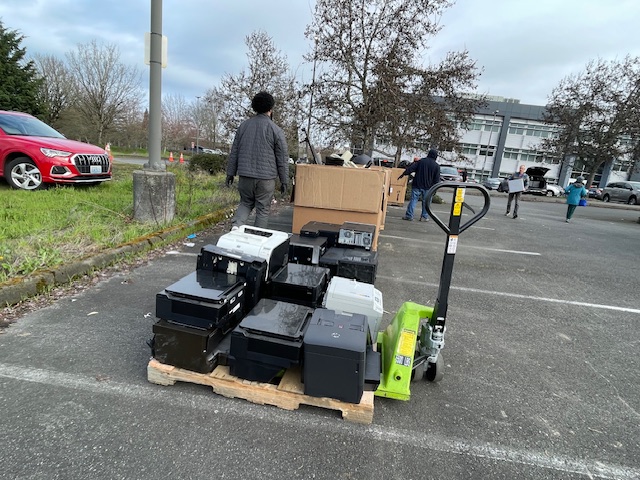
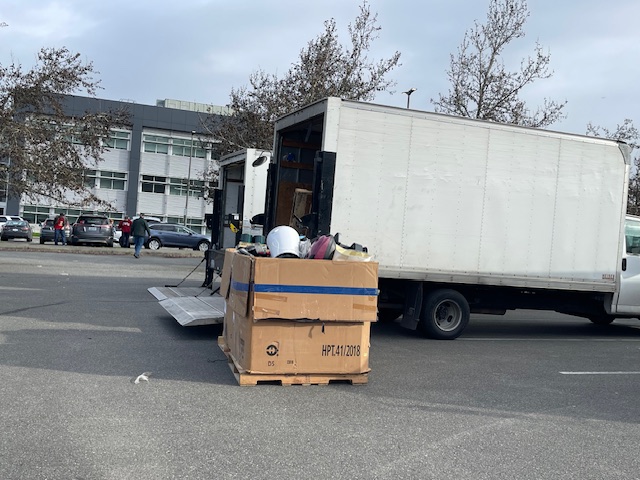
This continues until noon.
 (WSB file photo)
A spring tradition is just two days away – this year’s free dropoff recycle/reuse/shred event is Saturday, 9 am-noon, this time in the south parking lot of South Seattle College (6000 16th SW; WSB sponsor) instead of the north as in past years. It’s presented by the West Seattle Junction Association and West Seattle Chamber of Commerce; WSJA provides this bring-and-don’t-bring list:
What Can You Bring?
We’re collecting hard-to-recycle and reusable household items, including:
Small, empty propane canisters
Fluorescent tubes and bulbs (no broken bulbs, 4 ft max)
Household batteries (no damaged batteries)
Clothing, bedding, and curtains in good condition
Small electronics (TVs, computers, cellphones)
Small appliances (non-freon only)
Foam blocks (polystyrene only)
Paper for shredding (limit: 4 boxes)
Home goods and toysWhat We Can’t Accept
Furniture
Hazardous waste
Bicycles/tricycles
CRT tube TVs
Mattresses
AC units
Car seats
Stained, ripped, or worn-out fabrics
Automotive waste
Construction debris
Garbage, compost, or regular curbside recyclables
Mismatched items (like single shoes)
,
By Macey Wurm
Reporting for West Seattle Blog
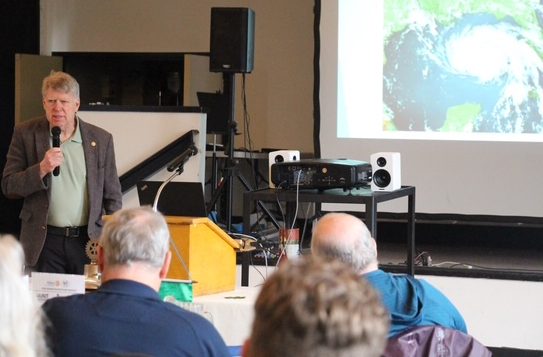
“There are folks who are climate deniers, and there are folks who are climate alarmists. The alarmists think that we’re going to be ending humanity in the next 25 years, which is not going to happen. We’re going to adapt.”
This was an assertion made by this week’s Rotary Club of West Seattle speaker, Dave Spicer. Spicer, a Rotarian for 40 years, is currently serving as chair of Rotary District 5030’s Environmental Sustainability Committee; he has done extensive work through Rotary on 57 water projects and humanitarian aid trips. (Here’s more on his background.)
His presentation covered all things environment – situating the audience in our current situation, both locally and globally, and delving into widespread environmental issues before beginning to discuss potential mitigation strategies, and wins.
Spicer outlined the fundamental reason that climate change is happening: the release of fossil fuels into the atmosphere. He explained that methane gas and carbon dioxide are working together to contain heat within our atmosphere, after which he explained the physical effects.
In our state, he noted, Washingtonians are experiencing flooding and water scarcity simultaneously, in different regions. A drought has plagued Eastern Washington for 4 years, while some Western Washington residents experienced extensive flooding in December, damaging 4,000 homes, leading to the evacuation of 100,000 people.
On a global scale, a lot of the damage outlined by Spicer concerned oceans, especially damage to coral reefs, which provide a habitat for 25% of the marine population. He called the potential for the coral reefs to continue on this trajectory as “quite cataclysmic”. The Ph is also lowering in the ocean due to warming, and concern lies in how this temperature rise will affect the frequency of hurricanes and marine life in general.
He then moved to outline how this environmental deterioration has had, and will continue to have, an impact on man-made societal structures. Insurance and deductibles for businesses are going up because of the increased risk for destruction of property due to extreme weather events – weather events that result in at least $1 billion in property damage. The damage from the floods in December was estimated at more than $182 million, for which Governor Ferguson submitted a request for federal help.
Climate change has also had an impact on human health issues, Spicer said, including potential risks for people with respiratory issues and higher risks for skin cancer in extreme heat. He also referred to the term “Climate Trauma,” saying it has emerged in mental-health spheres as a diagnosis.
As it may read now, Spicer acknowledged the anxiety-inducing nature of our current climate crisis. “I don’t mean to be overwhelmingly sobering… but I do want you to have a sense of the trajectory,” he said. “There are a lot of positive trends. Renewable energy is in many countries, including our own area and other parts of the country; [these energy sources] are really on the increase, primarily air and solar.” He emphasized the importance of nuclear power, noting that currently 10 percent of Washington State’s power is nuclear.
In the legal realm, Spicer brought up the Inflation Reduction Act of 2022, which incentivizes industries to move forward on the use of solar and wind power, and encourages the transition to domestic energy sources. Additionally, a 2024 Montana Supreme Court ruling upheld a landmark climate ruling concerning state residents’ constitutional right to a clean environment.
On an individual level, Spicer gave advice on several actions people can take to reduce their own environmental harm. These include taking a carbon-footprint test, educating yourself about climate change, and smaller individual actions such as turning temperatures down at night, taking shorter showers, using electric vehicles or public transit, among other suggestions.
“It’s not going to go away, It is going to get worse, but we can mitigate it. Spicer said. And there’s potential for all of it to play a role for our children and our grandchildren, because 50 or 100 years from now, if you don’t do enough, you will have let them down. That’s the reality.”
After those closing thoughts, Spicer answered three questions, all that organizers said time would allow.
The first question was about concern over the current administration’s disengagement with national and international climate matters. “What will be the impact of our dismissive attitude over four years?”
Spicer began by noting that the United States is home to some of the “best creative entrepreneurial energies, some of the most incredible scientists, and some of the finest people in this field.” He added that these people are now being limited in their involvement to be part of the solution. “Those regions like ours that are richest have to figure out a way to support those that are most impacted.” Spicer emphasized that since our country helped to create this problem, we have a responsibility to come to the aid of those most affected by it.
The second question acted more as a statement, expressing concern over the direct impact of fossil fuels on nations and wars. The Rotarian said, ‘We’re going to have more of that if we don’t wean ourselves off oil,” to which Spicer agreed.
“We can’t extricate gas overnight,” he said. He talked about the necessity to develop a plan for the next 20-30 years to transition to solar, wind, water, and nuclear power. “It just absolutely has to happen, frankly.”
The last question pertained to Rotary members specifically – whether a Rotary program exists to educate populations about the impacts of climate change who don’t necessarily acknowledge it. Drawing from his extensive experience as a Rotary member working around the world, Spicer observed that the last 10 years have been “mind-shaking” for most people. He explained that most Rotarians understand the extent of the crisis, specifically mentioning branches in Asia and Africa who diligently take care of their ecosystems.
SIDE NOTES: One Rotary member recommended the book “Parable of the Sower” by Octavia Butler to learn more about what a country in a water crisis looks like. Another mentioned extensive New York Times coverage on the Thwaites Glacier in Antarctica and the effects of its dwindling.
The Rotary Club of West Seattle meets most Tuesdays at noon. Here’s what to do if you’re a non-member interested in attending.
Often, stories about saving trees involve trees in the path of development.
Not this one – a tree so wide and gangly, we have to show it to you on video rather than just a photo.
The threat to this weeping willow tree in Upper Alki is not development, but another d-word … drainage – according to its owner.
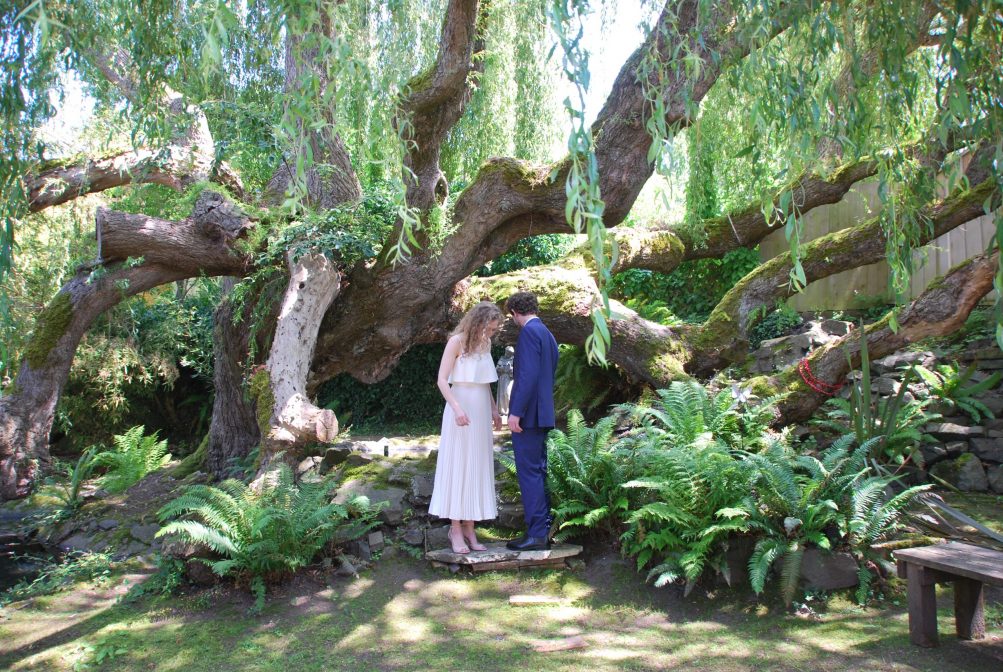
The tree is in Irene Trimble‘s yard in Upper Alki, along SW Spokane east of 59th SW. It’s a landmark – “I’ve given the community access to the tree for engagement, prom, and senior photos as well as wedding ceremonies at no charge to anyone. A lot of memories have been made here by folks in West Seattle.” She provided this photo of one couple:
Part of the tree hangs over her fence, and she’s let people into the yard to visit it.
But it’s dying because of too much underground water just inches below the south side of the yard after a shift in the flow, which she has been told is a natural phenomenon. Irene says an arborist estimates the tree will die in about a year unless the excess water is drained away and rerouted. She’s been told that can be done – for about $9,000.
A friend suggested she try crowdfunding to cover some of that cost, and set up this GoFundMe campaign.
It describes the tree as “ancient” – that’s a relative term, as willows go; Irene says this one is believed to be at least a century old. She bought the property six years ago, and says it didn’t come with any history of the tree, such as who planted it there and why.
All that’s clear is that too much of a good thing – water – is killing it. And for those who know it and appreciate it, Irene says they have a chance to help save it. At least its human fans do – it has wildlife fans too, like this video Irene provided from a duck family’s visit:
Irene says the tree is registered with Plant Amnesty as one of Seattle’s remaining “heritage trees,” and if she is able to save it, it could live to be cherished by at least another generation.
 (WSB file photo)
Another reminder: The next West Seattle recycle/reuse/shredding event is now less than a week away, presented by the West Seattle Junction Association, West Seattle Chamber of Commerce, and partners next Saturday (March 21). To ensure you’re ready, we’re again publishing the list of what you’ll be able to drop off during the 9 am-noon event. And remember that the location is changing – now in the south parking lot at South Seattle College (6000 16th SW; WSB sponsor) – drive/ride/walk in via the southernmost SSC entrance off 16th.
The list:
ACCEPTED ITEMS include:
Small propane canisters
Fluorescent tubes and bulbs
Household batteries
Clothing, bedding, curtains in good condition
Small electronics (TVs, computers, cellphones)
Small appliances (non-freon)
Foam blocks (polystyrene only)
Paper for shredding (limit: 4 boxes)
home goods and toysNON-ACCEPTED ITEMS include:
Furniture
Hazardous waste
Bicycle/tricycles
CRT tube TVs
Mattresses
AC units
Car seats
Stained, ripped or worn-out fabrics
Automotive waste
Construction waste
Garbage, compost and household recycling items
Mismatched items (single shoes, etc.)
For suggestions about disposing of those items or others not mentioned at all, check out this Seattle Public Utilities lookup tool. And note that a wider variety of electronic items will be accepted next month at the Fauntleroy Church Recycle Roundup – 9 am-3 pm Saturday, April 25.
 (WSB file photo)
By Tracy Record
West Seattle Blog editor
Saving salmon – and in turn, saving animals that need them, like Southern Resident Killer Whales – is a painstaking job.
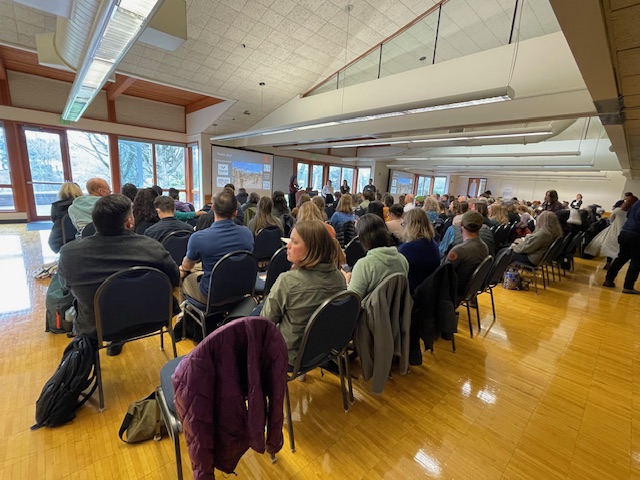
Just ask the dozens of people who gathered steps from the Duwamish River’s southern stretch this past Tuesday to share strategies and successes about restoring the river’s habitat. We accepted an invitation to cover their presentations.
Much of what we hear about cleaning up and restoring the Duwamish River and its watershed focuses on pollution, contamination, and the multi-billion-dollar, decades-long work of cleaning it up. But those gathered for the Duwamish River Habitat Symposium (held at Tukwila Community Center) are the ones who take over after that – turning former industrial sites back into places where fish, plants, insects, and people can flourish.
The presentations touched on common problems – Canada Geese seeing restored habitat as a tasty buffet, for example. They also celebrated successes – at a Harbor Island site owned by Vigor, it was declared triumphantly that, “Juvenile salmon are feeding.” That’s at an area that hasn’t been “heavily used” since World War 2, right by the mouth of the Duwamish. They’re ultimately restoring it for insects, too.
A duo from the Port of Seattle livened up their presentation with “habitat restoration bingo,” underscoring how everyone in the room was dealing with similar challenges and triumphs.
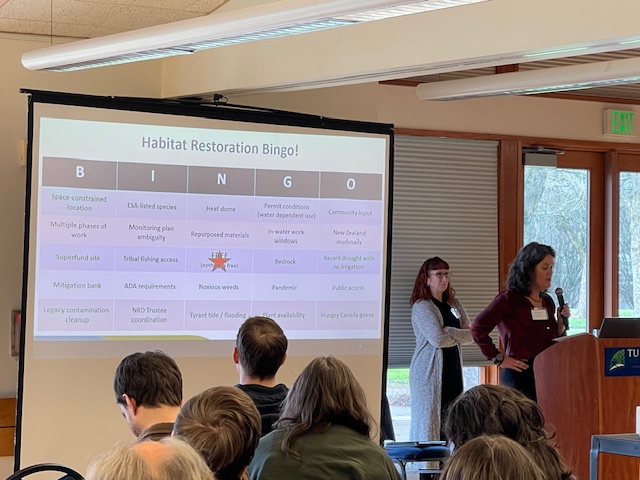
The sites discussed at the gathering were along many miles of the Duwamish/Green River, from its mouth on Elliott Bay deep into the southern reaches. That’s where another presentation was focused, a six-acre site that had hed a rundown hotel, demolished 10 years and yielding 250 tons of asbestos. Lessons learned from that site: Don’t put wood where it doesn’t belong; the fish weren’t interested; the choice of restoration materials is important Also, be ready for surprises – they discovered a significant amount of stormwater drainage that had to be rerouted. Here, like other sites, they had to work on repelling geese – they even took over a pole that was meant for osprey.
Now, after a few years. the plants are growing well, and an ecologist who grew up in the area says it’s “magical to see … important and valuale to bring all that nature right to where people see it all the time.” (This site has some noise challenges, though – it’s in earshot of a rifle range.)
Back toward the north, a West Seattle site just south of the former T-105 Park (now known as t̓uʔəlaltxʷ Village Park and Shoreline Habitat), is owned by a subsidiary of Nucor (WSB sponsor), and its restoration project is in construction right now, almost complete. Past and present photos were shown:
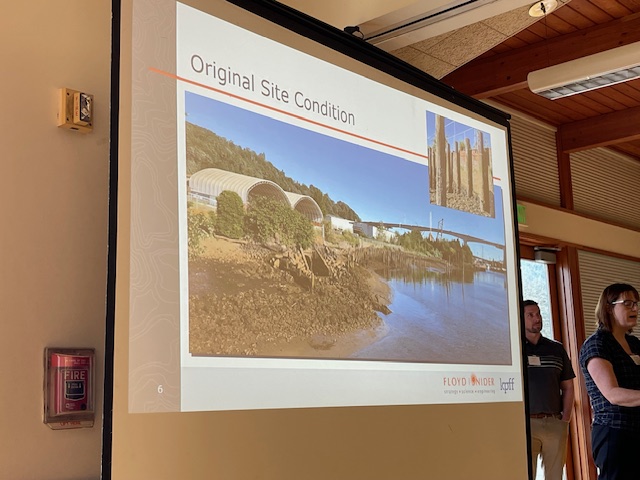
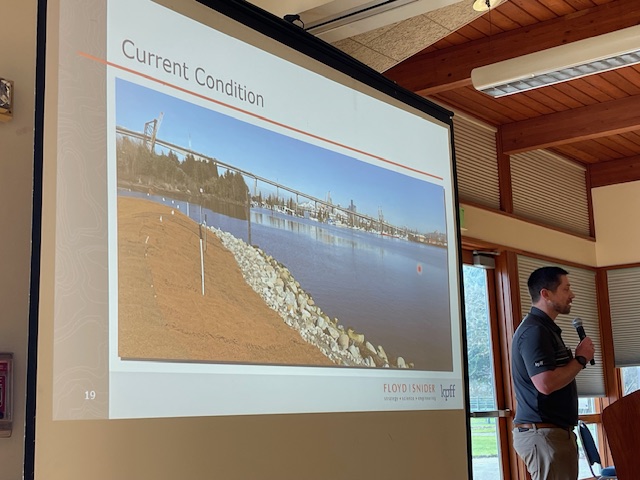
The challenges on this site range from creosote pilings to a rail line that takes scrap steel to Nucor and has had “some past derailments,” the symposium was told. They had to “clear 3 1/2 feet of contaminated fill” and remove a steel bulkhead, eventually resulting in almost three acres of habitat area, half of it “intertidal.”
The firm KPFF worked on this site as well as the aforementioned Vigor site and said the two were “really different” – among other discoveries, they found “an old concrete bunker filled with cable and a “huge outfall … draining a large part of West Seattle.” This presentation was one of several that mentioned another common challenge – boaters that don’t observe the speed limit and therefore churn up wakes that can damage the restoration zones.
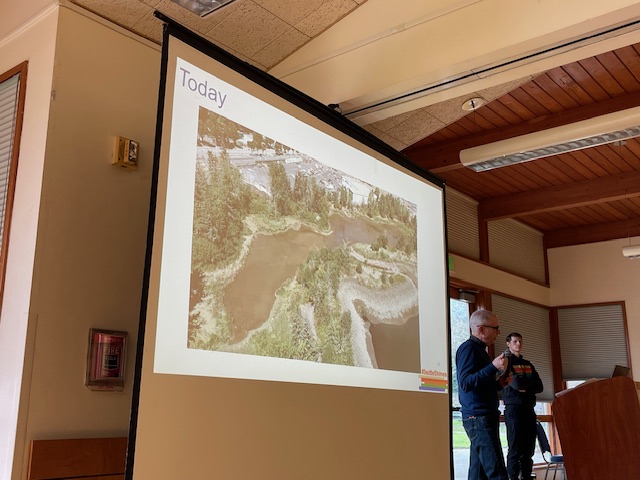
Also on the West Seattle stretch of the river, two Seattle Parks reps, David Graves and Matthew Hilliard, talked about one of the earliest projects, at
Herring’s House Park (Tualtwx) – you might recall Graves from West Seattle projects including the restoration of shoreline at Lowman Beach. He said it was important to recall “there was a place here” before there was a park. The siute includes “the last remaining oxbow on the river,” he added; the Duwamish was once a winding river before it was straightened in the name of industry. The city took over the site in the ’90s and took on a 17-acre restoration, 11 of the acres intertidal, 6 upland, completed in 2000.
The fish, however, haven’t been so interested in using this habitat, they said, so the question now is, how to make it better? They’ve hired a consultant for a feasibility study.
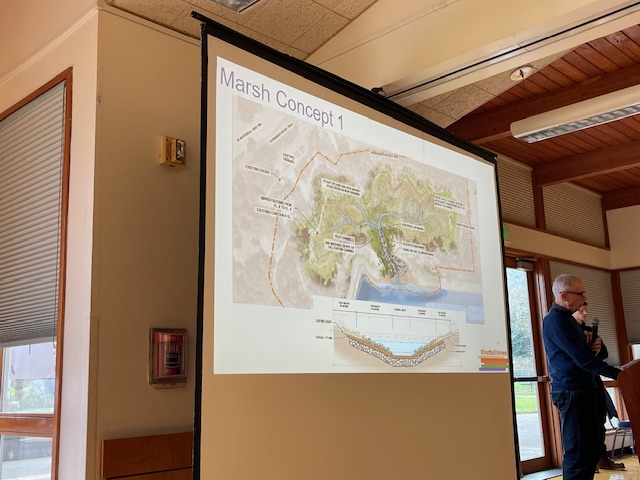
With all that, they’re at 30 percent design on projects; they’re planning for a “loop trail” to replace the “social trail worn throughout the years,” noting they’ve tried to “discourage” it over the years with fencing but that had been “destroyed three times” before they finally gave up. Park users also have put up problematic signs, Hilliard noted, such as “no minors.” In non-human challenges, the parks pair echoed others regarding geese. “You’ve got to goose-proof your plants or they’re going to be decimated.”
Back down to the Tukwila area, Mike Perfetti from the city spoke about two habitat-restoration projects, the Duwamish Gardens – near the mentioned-earlier Chinook Wind site – and a flapgate-removal project on Riverton Creek. The Duwamish Gardens site was an “abandoned derelict farm” (backstory here) bought by the city for a park. The cleanup required here was traced back to chemical contamination from years of farming, including DDT; cultural resources had to be respected as well. They had to excavate 30,000 cubic yards; 1,000 yards of that were able to be reused as a viewpoint.
One thing notable about this presentation – it was a reminder that some restoration sites include public access, some – mostly because they’re on an industrial site – do not.
The Riverton Creek project was aimed at restoring salmon access into the creek, by taking out flapgates and culverts, requiring many agreements and easements to work out. But in the end, the stream was daylighted and the shoreline restored. And – the fish are back.
One last jump back to the north: Duwamish River People’s Park and Shoreline Habitat, the Port of Seattle-owned site in South Park. This higlighted another point common to some presentations – the process of acquisition, cleanup, and restoration often takes many years; in this case, the port acquired the site in 2000, it was cleaned up 2012-2014, and park construction was 2020-2022. Now they’re in a “monitoring” phase that will continue until 2032.
Here, they built a sort of “macrame” fence to exclude geese, who had even kicked out nesting ospreys. Here too, the fish are back – far more chum than chinook – and the chum draw other predators, like river otters. Another challenge: South Park’s “king tides,” although the habitat features survived them.
Even for a layperson, the day was a fascinating peek into what it’s taken to try to bring stretches of “Seattle’s only river” back to life.
WHAT YOU CAN DO: Help with habitat restoration!
 (WSB photo, spring 2024 Duwamish Alive!)
This spring, for example, you can join the Duwamish Alive! Coalition – which organized the symposium – at the twice-yearly, multi-site work party that will show up here soon.
 (WSB file photo)
Last weekend, we noted that the next West Seattle recycle/reuse event was exactly a month away. Now, courtesy of one of the lead organizers – the West Seattle Junction Association – we have details on what you’ll be able to drop off during the 9 am-noon event on Saturday, March 21, so you can start planning. First, a reminder that the location is changing – now in the south parking lot at South Seattle College (6000 16th SW; WSB sponsor), which is accessible via the southernmost SSC entrance off 16th.
Now the list:
ACCEPTED ITEMS:
Small propane canisters
Fluorescent tubes and bulbs
Household batteries
Clothing, bedding, curtains in good condition
Small electronics (TVs, computers, cellphones)
Small appliances (non-freon)
Foam blocks (polystyrene only)
Paper for shredding (limit: 4 boxes)
home goods and toysNON-ACCEPTED ITEMS (which are included but not limited to):
Furniture
Hazardous waste
Bicycle/tricycles
CRT tube TVs
Mattresses
AC units
Car seats
Stained, ripped or worn-out fabrics
Automotive waste
Construction waste
Garbage, compost and household recycling items
Mismatched items (single shoes, etc.)
If you’re looking for suggestions about how to best dispose of those items or others not mentioned at all, check out this Seattle Public Utilities lookup tool. And a wider variety of electronic items will be accepted (though we don’t have the official list yet) at the Fauntleroy Church Recycle Roundup – which is exactly two months from today, on April 25.
| 1 COMMENT