
West Seattle, Washington
01 Friday

Thanks to Stewart L. (above) and Theresa Arbow-O’Connor (below) for sharing photos of otters from the Alki shoreline today!

Just a reminder if you’re new here – these are river otters, not sea otters, even though they’re hanging out in saltwater. And be careful while driving – you’ll see them crossing the shoreside street on occasion. (Sometimes they’ll go even farther inland!)
P.S. And another reader asked us to remind you to give wildlife their space, wherever you see them.
 (Southern Residents J56 and J31, photo by researcher Mark Sears, permit #21348)
The orcas we’ve been seeing in local waters lately are transient killer whales, but the Southern Residents are expected soon. When they get here, some advocates want to be sure they’re not hounded by whale-watching boats – especially considering three of the endangered whales are pregnant. Today those advocates, including West Seattle-based The Whale Trail, are issuing a challenge to whale-watching operators to take this pledge:
On behalf of my company, I pledge to increase protection for the Southern Resident orcas and give the pregnant orcas in all three pods the best possible chance of having healthy calves, by giving them more space and quieter waters to find food and communicate with each other. Between now and September 2021:
• We will stay 1/2 nautical mile (1,000 yards) away from the southern residents.
• We will focus our tours on other ecotypes of killer whales and other wildlife, and will not intentionally plan or route trips to view them.
• If we encounter southern residents incidentally while viewing other whales, we will slow down (as Washington State law requires) to reduce our vessel noise, but will not approach or follow them.
• If we encounter southern residents incidentally while in transit, we will slow down (as State law requires) and not approach or intentionally follow them while continuing to transit. If it is unsafe to maintain a 1/2 nautical mile distance while transiting we will maintain the distances required by State law.
See the full letter here. The problems caused by noise, particularly from whale-watching vessels, was discussed at The Whale Trail’s February meeting – more than 100 operating in the region, morning through night. The Southern Resident population is down to 72, barely above its historic low, and advocates fear that further losses could put this species on an irreversible path to extinction.
Earlier this week, we published a report from a reader who got dive-bombed by an owl at Lincoln Park. We’ve since received this, from Molly:
At approximately 6:50 pm (Monday) night, I was attacked by a very large (and beautiful) owl on the upper south/west trail of Schmitz Park, not far from the wood carving trail (which I was heading toward). The owl silently dove and grabbed my scalp at my very long ponytail. Scared the crap out of me as it felt like a person clawing at my head. I spotted the owl watching me as I backed away down the trail. Not sure if it is nesting right there, liked my hair, hated my mask, or hates the increase of people using its yard as their playground.
I am totally ok. Owl is ok. Either way – wanted to give fellow neighbors the heads-up and to remind everyone to be mindful of being in animals’ territories.
In addition, our neighbor’s kids were sleeping out in their trampoline (the same) night and this owl sat on the top of the trampoline net and watched the kids for a while.
We’ve had past reports in this park too, same time of year.
11:08 AM: Right around sunset last night, transient orcas were headed this way again. This morning, Kersti Muul tells us they’re back in the area, seen southbound, north of Blake Island, within the past half hour. Let us know if you see them!
11:58 AM: Thanks for the updates in comments! We also got a text from Jay reporting that they’re off Dilworth (Vashon), still southbound.
 (Photo by Eilene Hutchinson)
Those two harbor-seal pups are swimming in more-secluded waters after a weekend rescue in West Seattle. The report and photos are from Seal Sitters Marine Mammal Stranding Network:
On Sunday, Seal Sitters MMSN rescued two young, weaned harbor seals from the Duwamish Head area.
The pups, nicknamed Tango and Foxtrot (L-R above), had been using the highly visible and accessible beach to rest, coming and going over the past days. We began to receive troubling reports of people touching and harassing the pups after ignoring warnings and barriers.
One pup also had a fish hook in his mouth that had to be removed by a veterinary team from SR3. Thankfully that injury was slight. The pups’ proximity to fishing piers and the boat dock made them vulnerable to further entanglement. The decision was made to relocate them for the safety of the pups and the public.
(Photo by David Hutchinson)
With the assistance of SR3, WDFW Marine Mammal Investigations and World Vets, the pups were captured, given a medical exam, and taken by boat to a secluded South Sound island. Videos show Tango and Foxtrot frolicking in their new waters and Seal Sitters volunteers are gratified that the pups could be relocated together.
Harbor seal pupping season is currently underway in our area and seal pups will be trying to rest onshore. Please remember to stay away from pups, leash your pets, and call Seal Sitters at 206-905-7325 if you see a stranded marine mammal in West Seattle.
“Stranded” also covers marine mammals in possible distress offshore – even though some reports sometimes mistake normal behavior for trouble, SSMMSN would rather know than not know!
Every few years, we get a report about a divebombing owl attacking someone. Last night, Kate sent this:
(Sunday) around 8 pm, I got attacked by an owl (probably barred owl). I think my high, very floppy bun was to blame. (Map of Lincoln Park location) This is exactly where I saw owls hang out in trees before. Anyway, just wanted to warn people to watch out when they run on that trail. I am all good, just a scratch on my ear.
This 2011 reader report is from the same time of year, same area of the park. This state Fish and Wildlife info sheet explains (though we’re not quite to winter yet), “In winter owls establish territories, build nests, and rear young. During this period, adult birds may engage in belligerent behavior, such as attacking creatures many times their size. In this case, the owls are simply trying to protect their homes, their mates, or their young.”

Seems like a good day for another compilation of cool bird photos sent by readers (THANK YOU!). The bird in the first two is a newsmaker, explains Sharon Wada: “Wanted to share a few images for the birders who were quite excited to see a precious Wandering Tattler foraging in the rocks along Alki. Appears that the Tattler was finding lots to eat including a small crustacean in the seaweed.”
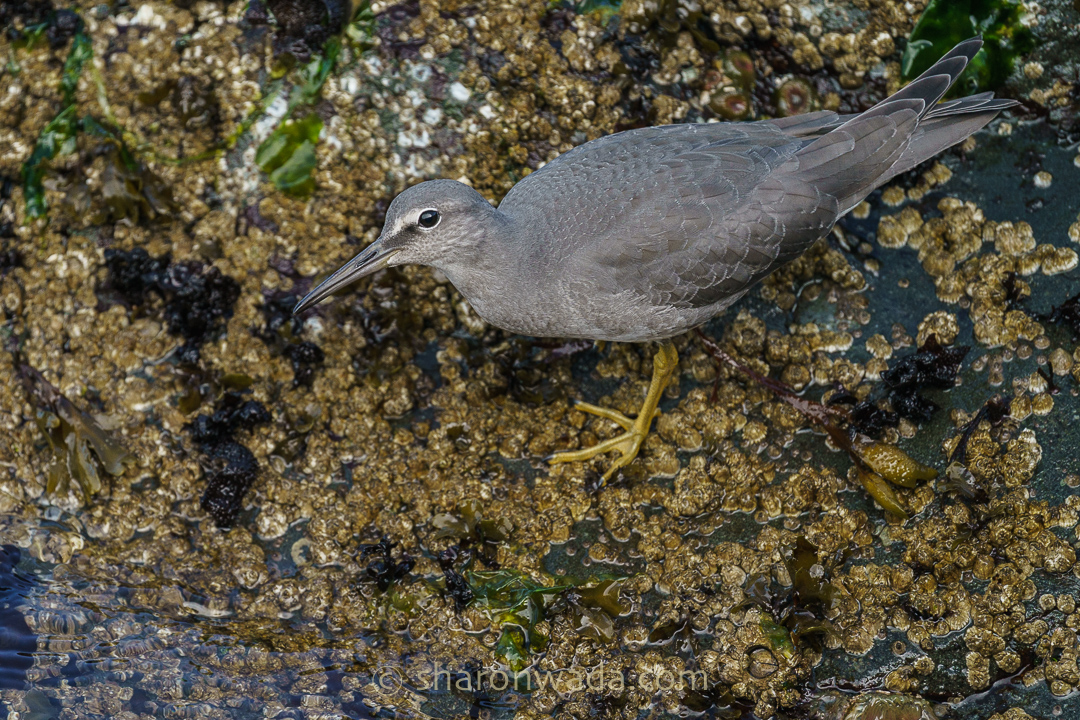
For the hundreds of bird photos we’ve published over the years, that’s the first Wandering Tattler!
The next two bird photos are from Mark MacDonald – first, a Caspian Tern fishing at Jack Block Park:

Next, a Kingfisher:

Another royally named bird, a Golden-crowned Kinglet, photographed by Mark Wangerin:

From Michael Oxman, a close look at a Barred Owl:

Larry Gilpin photographed this juvenile Bald Eagle in Schmitz Park:

Elton Pinto spotted a Great Blue Heron hanging out in a tree near Alki Point:

And Ashley Wong photographed – through binoculars – an Osprey atop the lights at Terminal 5:

Thanks again to everyone who shares photos – from wildlife to breaking news! Email westseattleblog@gmail.com or text 206-293-6302 any time.
 (Added: Photo by Danny McMillin)
Transient killer whales are back in our area! Kersti Muul sends word they’re southbound, off Alki Point right now.

That Cooper’s Hawk fledgling is looking to you for help. The photo is by Kersti Muul, who also brought this call for volunteers to our attention. It’s from the recently founded Seattle chapter of the advocacy group RATS – Raptors Are The Solution. Their goal is to save wildlife – and pets, too – from rat poison, by documenting its use and urging users to switch to eco-friendly methods of rodent control. For example, their call to action notes, “The owls are hooting about Seattle University, which has rid its campus of poisons and is safely managing rodents using integrated pest-management strategies.” The organization also notes:
As of May 2020, an on-going research project to evaluate effects of rodenticides on raptors by the Urban Raptor Conservancy has studied 60 deceased urban raptors (20 barred owls). They were taken to PAWS in Lynwood and tested for rodenticides in their livers.
Overall, 82% of the birds tested positive for at least 1 anticoagulent rodenticide
73% of those birds had 2 different rodenticides
55% had 3 or 4 different rodenticides
The percentage is even higher for owls alone because they eat rodents almost exclusively and their livers cannot metabolize the poisons as well.2 Barred owls were rescued from Key Arena during construction. One died with the highest levels of second generation rodenticides of any raptor studied to date. The other was treated with Vitamin K and released.
We have hundreds of raptor (Coopers Hawks, Merlin, Barred Owl, Osprey, Bald Eagle, Merlin, Peregrine) nests in the City of Seattle. Most raptors eat rats.
Here’s what they need help with:
We need volunteers to help count rat poison bait boxes that are placed in urban bird and wildlife habitats. We will have a brief data collection training session and organize folks for social distance walk-abouts. We need to know where the rat poison is being used so that we can contact business owners and organizations’ facilities managers to urge them to use nontoxic Integrated Pest Management methods for managing rodents. Rat poison is not only killing rats; it is killing their natural predators (raptors) and poisoning the entire foodweb.
For more info, including who to contact, see this flyer.

11:18 AM: The photo and report are from Kersti Muul: Orcas southbound off south Bainbridge Island, so they could be visible off west-facing West Seattle with binoculars. Let us know if you see them!
3:39 PM: Now they’re northbound, says Kersti – most recently reported between Blake and Bainbridge Islands.

11:14 AM: Transient orcas are back in the area and heading this way. Kersti Muul says they are southbound off North Bainbridge, toward the west side of the channel, so you’ll need binoculars to look for them.

1:31 PM: Update from Kersti – the orcas are in Elliott Bay, between West Point and Alki, headed southwest as of about 15 minutes ago – “long, long down times.”

4:41 PM: Thanks to Jamie Kinney for the above three photos, from the orcas’ pass by Constellation Park. (added) And thanks to Dan Ciske for the photo below, showing a research boat with the orcas (which were off The Arroyos, still southbound, at last report).


If you see a seal on the beach – keep your distance, for their sake. David Hutchinson of Seal Sitters Marine Mammal Stranding Network sent this report and photos after another rescue:
Seal Sitters MMSN responded Wednesday to the second orphaned harbor seal pup in the last 2 weeks. This thin pup was first reported in the morning on private property along Beach Drive SW. He returned to the water early in the afternoon and just after 5 PM, Seal Sitters’ Hotline received a call about a pup on Alki Beach at 55th Ave SW. Spot comparison photos confirmed that this was the same animal.
A perimeter was set up to keep people back and First Responders monitored the tiny pup while answering the many questions from folks out enjoying the sunny day. The pup stayed ashore only briefly, but returned to the beach around 7 PM. He was observed at that time to be very lethargic with tremors. Phone calls were placed to NOAA’s regional stranding coordinator to see what options were available to rescue the pup from this dangerous location and stabilize overnight. When the incoming tide began to roll the weakened pup in the surf, he was removed from the water by the Seal Sitters’ First Responder and placed above the high tide line. NOTE: Only authorized members of NOAA’s Marine Mammal Stranding Network are allowed to handle seal pups.
Casey Mclean, SR3 Executive Director and Veterinary Nurse, agreed to come for an evaluation and removal from the beach. The pup weighed 8 kg (17.6 lbs). His glucose level was very low, he was dehydrated and was suffering from hypothermia. A small umbilical stump was noted and age estimated at a week or so. Casey began some preliminary treatment including starting fluids. If this pup survives, it is hoped that he can be transferred to one of the scarce rehabilitation spots that are available.
Harbor seal birthing season is from late June through September in our area of Puget Sound. These pups would normally spend from 4-6 weeks nursing before having to face life on their own. About 50% don’t make it through their first year.
Seal Sitters would like to thank the individuals who reported this struggling animal to our Hotline. We have had to adjust some of our normal procedures because of the COVID-19 restrictions, but will be doing our best to respond to your calls.
Based on the urban location, it is highly likely this newborn seal was abandoned due to human activity. Always stay back when you see a seal pup on the beach and call Seal Sitters’ Hotline at 206-905-7325 (SEAL).
Here’s the report on last month’s rescue.
Thanks to Kersti Muul for the report – transient orcas are southbound off Eagle Harbor (Bainbridge Island), “more east in the channel.” Let us know if you see them!
Before we get back to The News – a bird break! Three beach photos:

The Bald Eagle above was photographed by Raul Baron; the next two photos are by Larry Gilpin – an Osprey:

And a Great Blue Heron:

(Sorry, we don’t know what The Catch Of The Day was!)

The photos and report are from David Hutchinson of Seal Sitters Marine Mammal Stranding Network:
On Wednesday, Seal Sitters’ volunteers responded to the first harbor seal pup in West Seattle this 2020 pupping season. Early in the morning our Hotline received a report of a small pup swimming by the steps along the Alki promenade. The pup, nicknamed “Echo”, finally settled on one of the lower steps.
While Seal Sitters is the official NOAA stranding network for West Seattle, we partner with other groups to provide specialized health evaluations and care. SR3 (headquartered in Des Moines) sent their vet to do a visual assessment. Echo still had an umbilical stump present. This usually dries up and falls off by a week to 10 days after birth, so this was a very young pup. A seal pup’s best chance for survival is always with its mother, so it was decided to monitor Echo throughout the day in hopes that she might reunite with her mother at some point. The chances of a pup being abandoned due to disturbance is much higher in a busy urban environment. After many hours of rest, Echo returned to the water with the rising tide around 5:00 that evening and after a brief detour as far as the Alki Bathhouse, was seen swimming offshore to the west toward the Alki Lighthouse.
On Thursday morning, Echo was reported on a private beach west of the promenade. With the consent of the property owner, Seal Sitters responded and watched over the pup until the arrival of SR3 staff. The pup appeared thinner and there was no evidence of an attending mother. Because of this, it was decided to remove Echo and transport her to PAWS for rehab. Seal Sitters received a report yesterday morning from PAWS – Echo is female, just under 30 inches long and weighs a bit less than 20 pounds. She arrived at their facility thin and dehydrated and the hope is that she will do well in rehab.

Harbor seal pupping season is from late June through September in our area, so you may come across more pups on our West Seattle beaches over the next few months. This is typical behavior as they need to rest and warm up. Please remember to keep back and ask others to do the same. Always keep dogs on a leash and at a distance. As soon as possible, contact Seal Sitters’ Hotline at 206-905-7325.
The request in bold is extremely important – another wildlife advocate told us about Echo just before we heard from Seal Sitters, and noted that spectators were way too close and abundant when she was at the public beach, which could have led to her mother abandoning her.
 (Added 8:57 pm, photo by Jamie Kinney)
6:12 PM: Thanks to Jay for the tip! He says orcas just passed Dilworth on Vashon Island’s eastern shore, northbound, so they could be visible soon from west-facing West Seattle.
7:02 PM: Eastbound – toward West Seattle! – in the Fauntleroy ferry lanes, says Kersti Muul.
 (Seal pup “Squally” in 2019)
Seal Sitters Marine Mammal Stranding Network has an important reminder:
Harbor seal pupping season has begun in Puget Sound, and pups will soon appear on West Seattle beaches.
DON’T TOUCH SEAL PUPS! Seals regularly haul out to rest and get warm. Undisturbed, stress-free rest is crucial for their survival. Please don’t pick them up, put them in the water, or attempt to feed them.
DO NOT APPROACH! If a nursing pup has become separated from the mother, she will be scared away by humans and dogs and may not return to her pup. It’s a matter of life and death for young seals.
When you see a seal on the beach, stay back, leash your dog, and call Seal Sitters at 206-905-SEAL (206-905-7325). We respond to reports of marine mammals, both dead and alive.
How far should you stay away from seals? NOAA guidelines say 100 yards, which is the length of 15 parked cars or one city block. At our public beaches, it may be hard to to keep that distance, but simply put: if the animal notices you, begins to fidget, or starts to flee into the water, YOU ARE TOO CLOSE. Please, back off.
Because of COVID-19, Seal Sitters may not be setting up yellow tape perimeters as in the past and may not be present at all times. You can help by respecting our signage, alerting others and asking them to leash their pets. Marine mammals are protected by law; disturbing them is considered harassment and is illegal. Please report violations to the Seal Sitters hotline at 206-905-7325.
For more information, check out the Blubber Blog at BlubberBlog.org. (Seal Sitters has temporarily suspended our volunteer training until the COVID situation improves.)
Orcas are visible off West Seattle again – heading northbound along the east side of Blake Island at last report. Thanks to Kersti Muul for the tip!
Before we get back to the news … a break for online birding.

First, two from Mark Wangerin – above, a Barred Owlet; below, a Black-headed Grosbeak:

Next, a Wilson’s Warbler, photographed by Mark MacDonald:

Robin Sinn sent the next two photos – a Great Blue Heron …

And a White-crowned Sparrow:

Finally, two backyard sightings – Alex has made friends with Fluffy the Steller’s Jay:

And Lise Thivierge spotted a Brown-headed Cowbird – which has a distinctive gurgling call:

All the bird-species names above link to BirdWeb pages where you can hear as well as see the birds!
Thanks to Kersti Muul for the tip! Orcas are in the area again, just seen southbound off Blakely Rock, across the Sound from Alki. Let us know if you see them!
Transient orcas, seen in the area a few days ago. are back – reported off Fay Bainbridge State Park and heading southwest about an hour ago, so you’d definitely need binoculars, but this is a heads-up to be on the lookout. (Thanks to Kersti Muul for the tip!)

Somebody texted a while ago to report a beaver at Don Armeni. We suspect it’s the same critter Sharon Wada photographed earlier today, sending the pics and noting, “This guy looks like he’s surfing! So many people I talked to said this was the first time they’ve seen a beaver walking and swimming in the tideoools before swimming along the edge towards Elliott Bay. Feel free to post these pictures of what looks to be a beaver; however, some have asked if it was a nutria.”

11 years ago, a similar sighting in a Junction yard resulted in a commenter consensus of “marmot.” Here are infopages for beavers, nutria, and marmot (seems unlikely). Thoughts?

Thanks to David Hutchinson for sending photos from orcas’ visit to Elliott Bay on Thursday evening.

These were transient orcas, not the Southern Residents.

Unlike the resident whales, transients’ food sources include other mammals – seals, sea lions, even other whales.

David’s photos were taken from Duwamish Head and the Alki promenade.

| 6 COMMENTS