
West Seattle, Washington
22 Monday
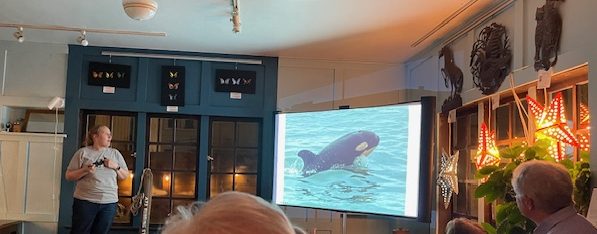 (Maya Sears showing a photo of the new Southern Resident Killer Whale calf)
By Tracy Record
West Seattle Blog editor
The newest Southern Resident Killer Whale – the K-Pod baby born just days ago – is looking good.
That was the word last night from two of the researchers who have seen the calf up close, Mark Sears and Maya Sears, the West Seattle-based father-and-daughter team who were guest speakers at The Whale Trail‘s Winter Gathering.
The heart of the event hosted by Whale Trail founder/executive director Donna Sandstrom at C & P Coffee Company (WSB sponsor) was a celebration of Mark’s half-century of work with the orcas; the Sears family has had a front-row seat for Puget Sound, whales and more, as multigenerational resident caretakers for Colman Pool on the shore at Lincoln Park. When the Southern Residents are in central Puget Sound, they head out too, partnering with other organizations to gauge the health of the endangered 74-orca population.
How the Southern Resident population dwindled so low was part of the discussion, revisiting the painful years in the 1960s and 1970s when Puget Sound’s orcas were allowed to be rounded up and captured to be put into captivity at commercial aquariums and amusement parks. Mark explained that knowledge and understanding of the giant marine mammals was woefully lacking – there was a prevailing misconception that the population numbered in the thousands, when in reality it was only hundreds. At least four times the current number, he said, but that was decimated soon enough – and the indignity and injustice was compounded by the deaths of many during, or shortly after, capture operations … and the anguish of the family members left behind, some of whom followed boats transporting orcas out of the area. Some of the whales fell prey to the capturers because they didn’t want to leave their families, he added. The captures “completely short-circuited the entire Southern Resident community” for a generation.
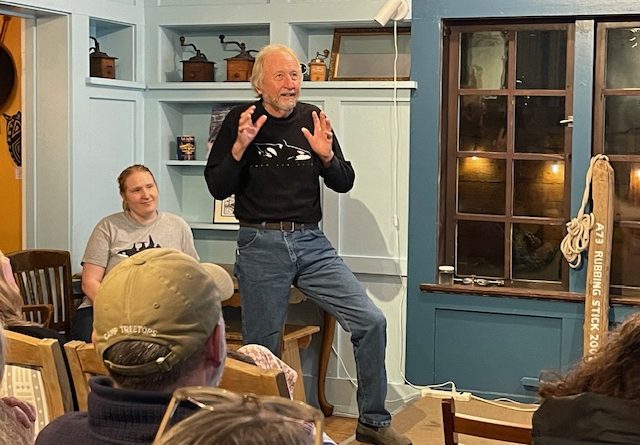
Speaking of generations – Mark’s been involved with the orcas since 1976; Maya became a NOAA-certified researcher in 2018. She was described as “known far and wide as the best identifier of the whales” – she can see a patch, a dorsal fin, and know which whale it is.
Mark explained that he got involved by being “a reliable reporter of whales” when the movement to protect them grew to include the need for information on when they were present in Puget Sound. He laughed at the memory of a hotline that people often called “collect” (back when it cost extra for phone calls depending on how far away the caller was from the person or place they were calling; if you didn’t want to pay the extra charge, you could make a “collect” call asking the recipient to be charged instead).
His many memories over the years included the honor of naming a whale – J35, Tahlequah, who has gained sad fame in recent years as the mom orca who swam for days while carrying her dead calves. She was born in 1998 and named after the South Vashon community that held a lot of importance for the orcas.
Also on the subject of Vashon, he told his side of the story of rescued Northern Resident orca Springer, the historic rescue that brought Sandstrom even more deeply into the world she had shared with whales for 20 years by then, and that she had recapped at the start of last night’s event (she’s published an award-winning book about it too, Orca Rescue). Mark said a friend of his who worked for Washington State Ferries would call him when WSF became aware of orcas in the area. His friend told him about this lone young whale; Mark verified its presence and “then started making calls … this animal just glued itself off North Vashon for weeks.”
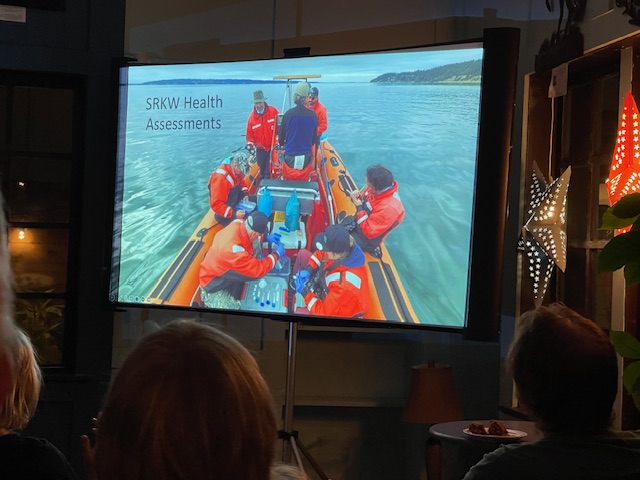
When he yielded the stage to Maya, she shared some of her secrets about identifying which whale is which – with patches and fin shapes. And she talked about the work they do gathering mucus and fecal samples – not glamorous, but vitally important: “We’re really trying to understand what is going on inside a killer whale,” such as whether they’re absorbing nutrients. They partner with researchers/veterinarians from the San Diego Zoo and Sea Doc Society in this work, as well as with NOAA, and what they learn about what the whales are eating helps advocates push for protection of species on which the whales rely to stay alive. Largely, Maya said, they’re eating chinook salmon, chum salmon when they come down here in the fall (because they’re “big and numerous,” she explained). She also had a whimsical aside explaining how the orcas like to play with their food and might toss a big salmon around for a bit before dining on it.
Maya and Mark said the new baby orca in K-Pod, which visited the area this week, looks “promising” – so many calves don’t survive, and some look borderline from the beginning, but this one seems healthy so far. They showed a photo of the baby, whose sex is not known yet, with other older females from the pod. Its mom is K36, Yoda, 22 years old.
Sandstrom had pointed out earlier that this birth brings the Southern Resident orca population to 74, and that’s important in a glass-half-full way – rather than dwelling on “only 74,” she contends, it should be noted that the population includes 11 calves under six years old, seven of the female: “The future is here now.”
But keeping it a hopeful future, she said in her opening remarks, will require ongoing advocacy. Growing the Southern Resident population has been by no means just a matter of not capturing any more; the population built back to almost 100 when the captures stopped, but then other trouble intensified – noise, lack of fish, pollution, and more. She ticked off a list of action that’s helping, much of it springing from the Southern Resident Killer Whale Recovery Task Force formed by former Gov. Jay Inslee (Sandstrom was part of that group). Action you take to lessen thse pressures doesn’t have to be herculean, Sandstrom noted – help the salmon by watching what you put down drains, for example. And whale-watching from shore instead of from sea. And then, as the actions of so many compound and the Southern Residents pull back from the brink, Sandstrom told attendees, “You can say ‘we did that’.”
After some Q&A for Mark and Maya, they were honored with a toast – to the years they’ve worked with and for the whales, and to hopefully “many more to come.
LAST CALL FOR ‘WELCOME THE ORCAS’: The Whale Trail’s “Welcome the Orcas” activities – including a Pod Passport and a special menu item at Arthur’s in Admiral – run through Monday; read about them here.
8:42 AM: Orcas are in the area, southbound and in view from northwest West Seattle, reports Kersti Muul, with more headed this way. She says the whales include “multiple males” – more visible because of their larger dorsal fins – and are “spread out … from Constellation, north Blake Island, and some still coming north of Restoration Point.”
9:27 AM: Kersti says in a comment that these are confirmed from K-Pod – which has a brand-new calf.
If you care about Puget Sound’s resident orcas, The Whale Trail‘s winter gathering is the place to be this Thursday night, Here are updated details:
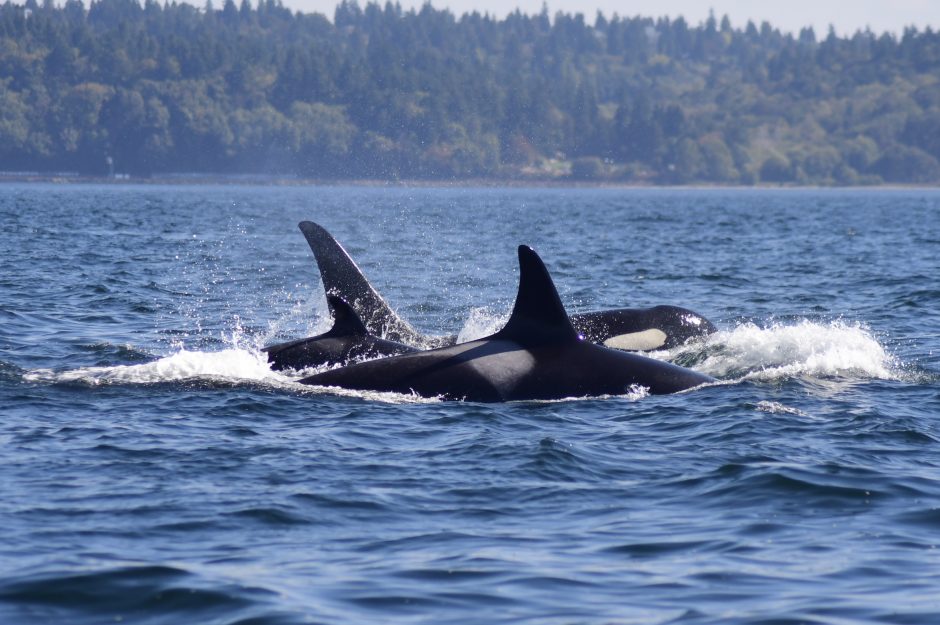
(J pod in Puget Sound. Front to back: J40 [Suttles], her daughter J63 [as yet unnamed], her brother J45 [Se-Yi’-Chn’. J63 is the newest calf in the southern resident population, currently 74 individuals [Maya Sears, Permit 27052])
The Whale Trail Winter Gathering 2025
Celebrating 50 Years of Puget Sound Orca Research
with Mark Sears and Maya SearsPlease join us for our Winter Gathering as we celebrate orca researcher Mark Sears and his 50 years of contributions to our understanding of orcas and other whales in central Puget Sound.
Mark has been a participant in and witness to the history and evolution of orca research in this region. His career as an orca researcher began in 1976, when he participated in the first Orca Survey following the last capture of orcas in Puget Sound. Over the past five decades he’s documented the presence and behaviors of whales in central Puget Sound, often assisted by his daughter Maya. In 1998, Mark was the first researcher to spot Tahlequah (J35) shortly after she was born, and given the opportunity to name her.
In 2002, Mark confirmed the sighting of a young orca near Vashon Island. She was soon identified as Springer (A73), an orphaned orca who was 300 miles away from home. While NOAA considered her fate, Mark monitored her behaviors – and discovered she liked to play with sticks! Later that summer Springer was rescued, rehabilitated and returned to her pod on the north end of Vancouver Island. Today she is thriving, with three calves of her own.
Animal behaviorist Maya joined her father as a NOAA-permitted orca researcher in 2018. Their work has been critical to broadening our knowledge of the diets, behaviors and life histories of the endangered southern resident orcas. Mark and Maya will share photos and findings from recent encounters with southern residents, including two superpods.
What: The Whale Trail Winter Gathering
Celebrating 50 Years of Puget Sound Orca Research with Mark Sears and Maya Sears.
When: Thursday December 11, 7 PM to 8:30
Doors open at 6:15
Where: C&P Coffee Company, 5612 California Ave SW
Tickets: $10 suggested donation, kids under 12 free.
Advance tickets: brownpapertickets.comJoin us to celebrate the season and the remarkable work of local orca heroes. Get tickets now, this will likely sell out!
Also, it’s not too late to help Welcome the Orcas! You have until December 15th to submit a poem or story for The Whale Trail’s Writing Contest, or participate in the community Pod Passport game. Learn more at The Whale Trail website.
Just heard from Kersti Muul, who says orcas are reported to be breaching off Alki. No further details yet, but there’s almost an hour of sunlight left if you decide to go look!
Orcas are “milling” off Duwamish Head right now. That’s the word from Kersti Muul. Let us know if you see them!
The sun’s out, and orcas are out there. Kersti Muul tells us a “large group of orcas is heading northbound from north end of Vashon Island,” likely from at least three families of transient orcas. Let us know if you see them!
Transient killer whales are northbound off west-facing southwest West Seattle, headed toward the Fauntleroy ferry lanes, reports Kersti Muul. She says they’re closer to this side than Vashon/Kitsap. Let us know if you see them!
Kersti Muul reports Southern Resident orcas from all three pods are southbound just passing through the Bainbridge-Seattle ferry lanes.
UPDATE: They’re northbound.
3:51 PM: Orcas are in the area! Kersti Muul sent word of a small group southbound off Bainbridge Island as of about an hour ago.
4:13 PM: Update from Kersti: The orcas are now approaching the Fauntleroy/Vashon ferry lanes.
4:33 PM: She says they’re close to shore as they pass Brace Point.
Thanks to Kersti Muul for the tip. Orcas are southbound off West Seattle, approaching Lincoln Park. (And if you don’t catch up with them before they’re south of here, remember that it’s eventually a dead end so they’ll have to head back this way eventually!)
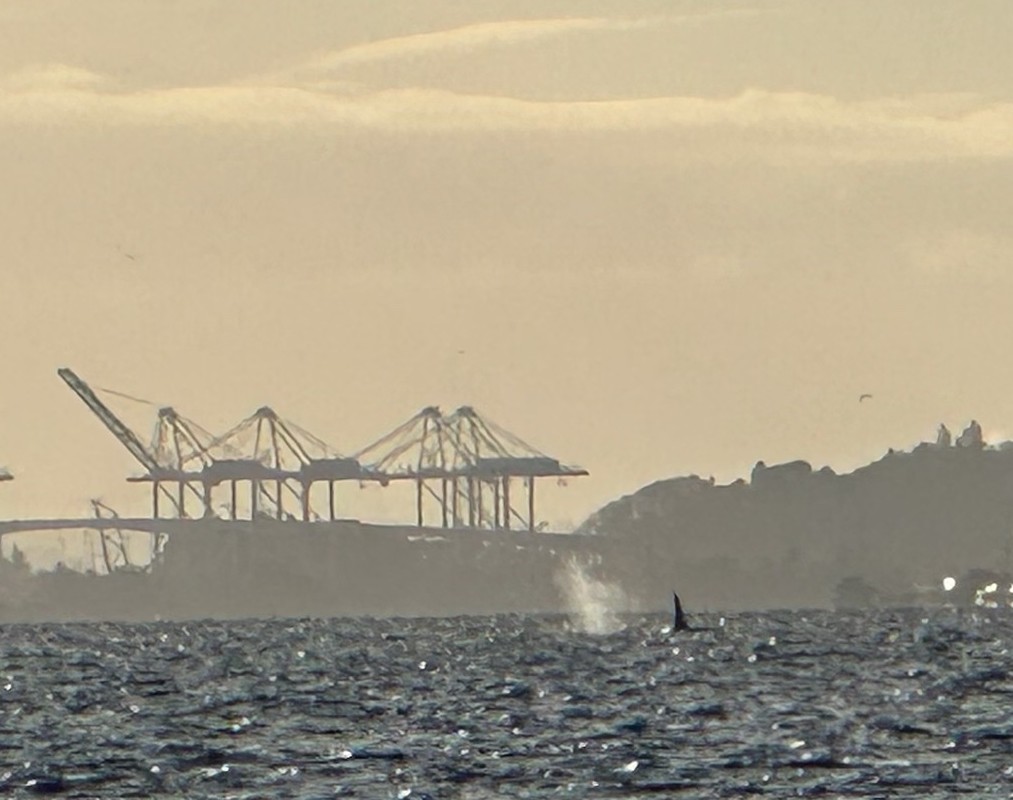 (Added: Photo from 8 am hour, texted by reader)
8:42 AM: Thanks for the multiple tips that orcas are in Elliott Bay again this morning, currently southbound toward Alki Point.
11:26 AM: They’re still in the area; most recent comments have them southbound past Fauntleroy.
But there’s sad news too; calf J64 has apparently died. The Center for Whale Research announced this in a post Saturday, saying the baby was nowhere in sight in their most recent encounter with her family. She was first seen less than two months ago, and most recently a week and a half ago.
1:33 PM: Meantime, today’s visitors are still out there. Patrick W emailed a few minutes ago to say, “Orcas moving north from Des Moines. Both USCG Port Security units are with the pod, oddly enough. We’re observing from Tramp Harbor on Vashon.”
Up for Saturday afternoon whale-watching? Kersti Muul tells us Southern Resident Killer Whales from J and K pods are in Elliott Bay – “lots and lots of whales.”
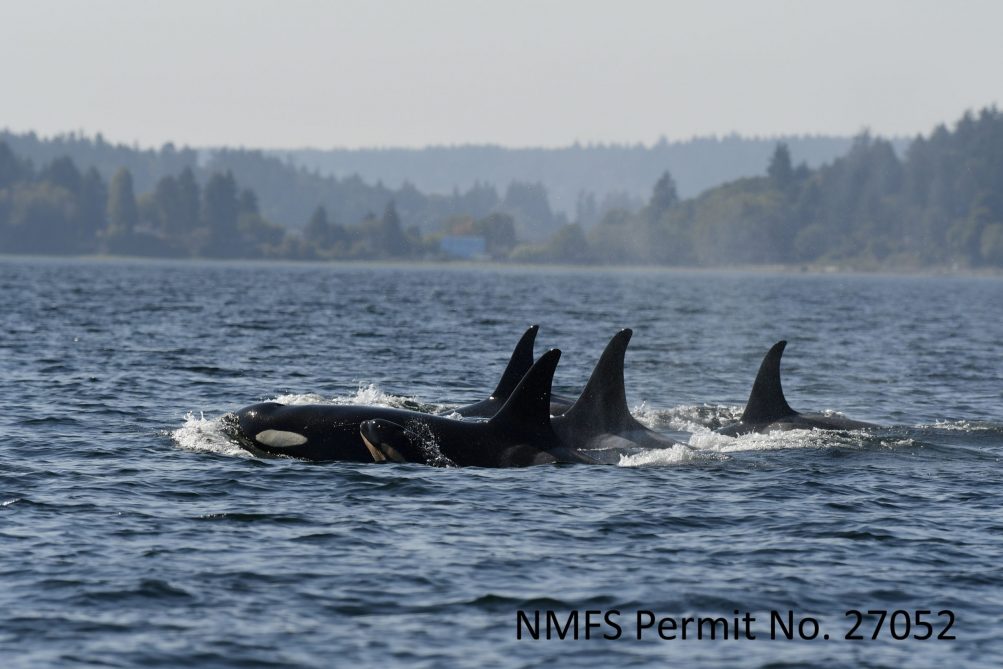 (Photo of new calf J64 and mother J42 by M. Sears, permit # 27052)
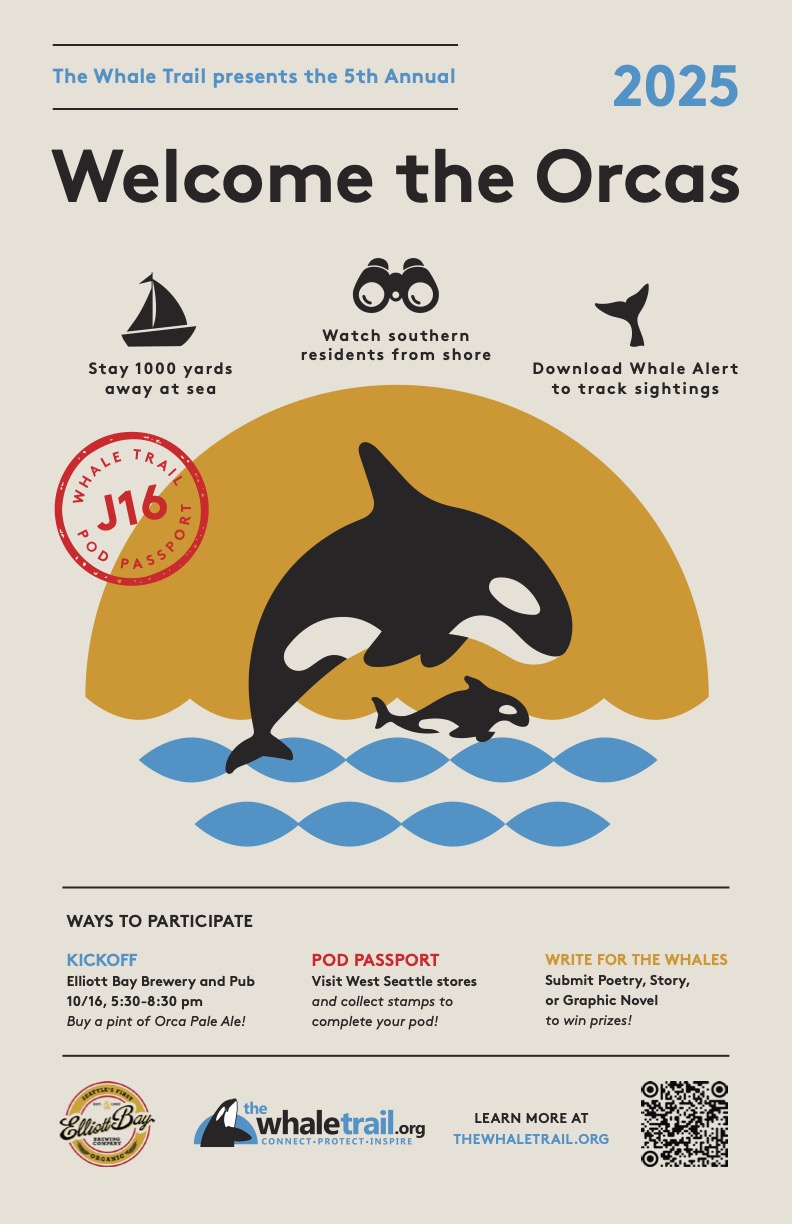
West Seattle-based The Whale Trail is presenting three activities to celebrate the season of the endangered Southern Resident Killer Whales’ return to this area – here’s the lineup:
Welcome the Orcas 2025
The southern resident orcas return to central Puget Sound each year, following winter salmon runs. Welcome the Orcas is a series of community events to celebrate their return.This year’s activities include a kickoff at Elliott Bay Brewery, a Pod Passport game, a writing contest, and of course, watching southern residents from shore. Join us for one or all! Visit thewhaletrail.org to learn more.
Kickoff, Elliott Bay Brewery (West Seattle), Thursday, October 16th, 5:30 to 8:30. Celebrate the orcas with the Whale Trail Board and special guests. For every pint of Orca Pale Ale sold, Elliott Bay will donate $1 to The Whale Trail!
Pod Passport Activity. We’re partnering with businesses around the peninsula for this fun and free community game. How it works:
-Participating businesses will display a poster in their windows. Each poster includes the unique ID (letter and number) of a specific orca.
–The passport cards contain the matrilines, or family trees, of J, K and L pod. The goal is to find all members of a pod.
-Visit businesses to get the orcas checked off. Take a picture of your completed card and upload to our website for a chance to win an orca-themed prize!
-The passport activity will launch at West Seattle Harvest Fest on October 26 and go to December 15th.
–Calling all businesses! We’re looking for passport partners to put a poster in their window! We need 75 storefronts so there’s a poster for every orca. Sign up on our website or reach out to info@thewhaletrail.org.Writing Contest. Tell us a story, write a poem, or create a short graphic novella about the southern resident orcas. Submit your work by 12/15. Three winners will be selected for each age category. We can’t wait to read and see your work!
The Whale Trail is a nonprofit advocacy group that, among other accomplishments, has led the installation of dozens of interpretive signs along the West Coast “whale trail” – explaining the Southern Residents and other marine mammals to shoreline visitors and viewers.
9:55 AM: If you’ve been seeing the Southern Resident Killer Whale updates in recent days but couldn’t get down to the water to look, maybe today’s your day. Kersti Muul reports J-Pod orcas are back in the area, southbound from just north of West Seattle at last report.
2:31 PM: Donna Sandstrom of The Whale Trail says they are northbound again, currently off north end of Blake Island, and she’s at Emma Schmitz Overlook (across from Me-Kwa-Mooks, 4500 block Beach Drive SW) with binoculars to share.
2:45 PM: Donna says they’re closer to Bainbridge now, so she’s heading toward the Alki area.
3:55 PM: She ended up staying at Emma Schmitz Overlook and says more J-Pod whales were headed north in Colvos Passage along the west side of Vashon Island.
8:25 AM: Southern Resident Killer Whales are back in the area this morning. Kersti Muul says it’s J-Pod again and that they are coming into view off Constellation Park, southbound. She also says one of them has a new calf.
8:36 AM: Donna Sandstrom of The Whale Trail says she’ll be at Emma Schmitz Memorial Overlook (across from Me-Kwa-Mooks) again this morning with binoculars to share.
8:42 AM: Kersti says the new calf is in view off Emma Schmitz/Me-Kwa-Mooks “with the J 16s” (family group).
9:26 AM: See comments for updates (and photos!). They’ll eventually head back north, and if we hear about that in the hours ahead, we’ll update this story.
8:32 AM: Whale advocates have sent word that Southern Resident Killer Whales from J-Pod are headed this way again. Kersti Muul reported they were in the Seattle/Bainbridge Island ferry lanes as of about an hour ago and says they are currently off Blakely Rock. Donna Sandstrom of The Whale Trail says she plans to be at Emma Schmitz Memorial Overlook (across from Me Kwa Mooks park, 4500 block Beach Drive SW) with binoculars to share. Good luck whale-watching!
7 PM: We did a bit of that with The Whale Trail at the overlook before sunset, as the whales headed back north, close to the west side of the Sound, so most of what we saw was just blows, but exciting enough!
8 AM: Kersti Muul tells us a large group of Southern Resident Killer Whales is off West Seattle right now, northbound, headed toward Lowman Beach.
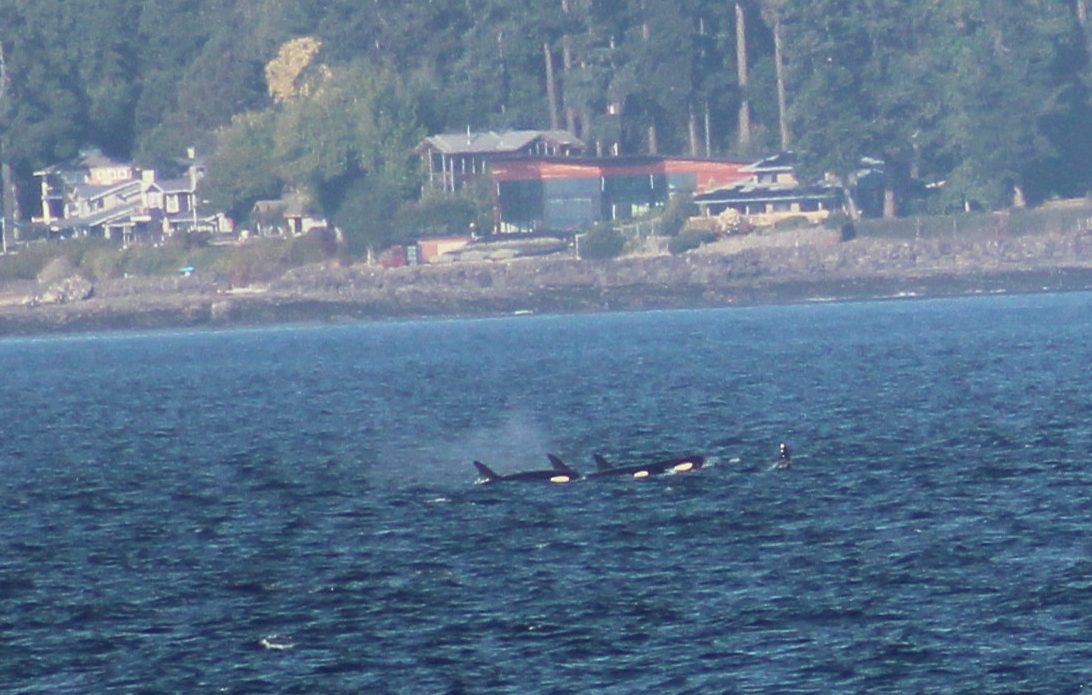
6:25 PM: Thanks to Robin Sinner for sending the photo of J-Pod whales as seen from Constellation Park this morning!
2:38 PM: The Southern Resident Killer Whales of J-Pod have been seen in central Puget Sound, “coming south all day” per Kersti Muul. That would be their first visit of the season, she adds. But they’re in the news today for a sad reason – a loss. Another newborn calf has died, the Center for Whale Research reported:
Late in the morning on September 12th, several sources alerted CWR researchers to apparent sightings of a southern resident killer whale pushing a deceased calf in Rosario Strait. CWR researchers arrived in the area in the early afternoon, and sadly were able to confirm that southern resident J36 was pushing a deceased female neonate, with umbilical cord still attached.
Based on the size of the calf, we estimate that the calf was either full term or near full term. It is unclear if this was a stillbirth or if the calf died shortly after birth. Based on when we last observed J36, this calf would have been born within the last 3 days.
Researchers from SR3, SeaDoc Society, and the Whale Museum soon arrived on scene and conducted further documentation and measurement. We will share more when we can, and work with the other research teams to piece together what information we can about this calf and J36’s status.
Kersti notes that the mom, J36, has lost one of her offspring before – J52, whose death at age 2 1/2 we noted eight years ago.
2:41 PM: Just as we were publishing the notes above, we heard from Donna Sandstrom of The Whale Trail, who plans to be at Emma Schmitz Overlook (across from Me Kwa Mooks, 4500 block Beach Drive) with binoculars to share. She estimates the orcas might be in view from West Seattle, looking north, by about 3:15 pm.
3:01 PM: No orca-watching after all – Donna just told us the orcas turned around at West Point (northwest edge of Elliott Bay) and are headed northbound.
10:02 AM: Holiday-weekend whale visit! Kersti Muul just told us the T137s – transient killer whales – are in Elliott Bay, by Pier 70, so in binoculars-enhanced range, but let us know if you see them closer in!
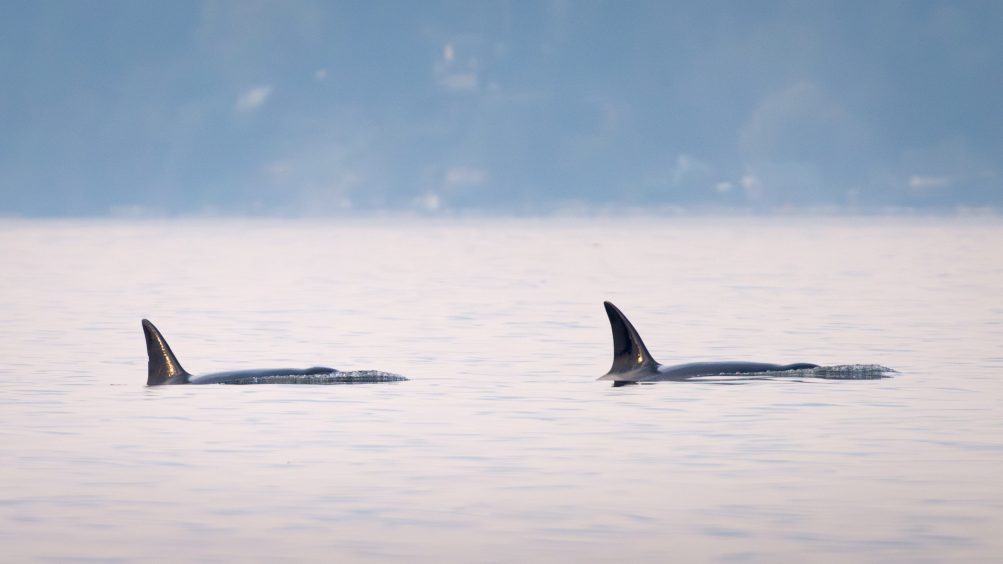
1:53 PM: Thanks to James Tilley for the photos, taken when the orcas were in view off Constellation Park south of Alki Point.
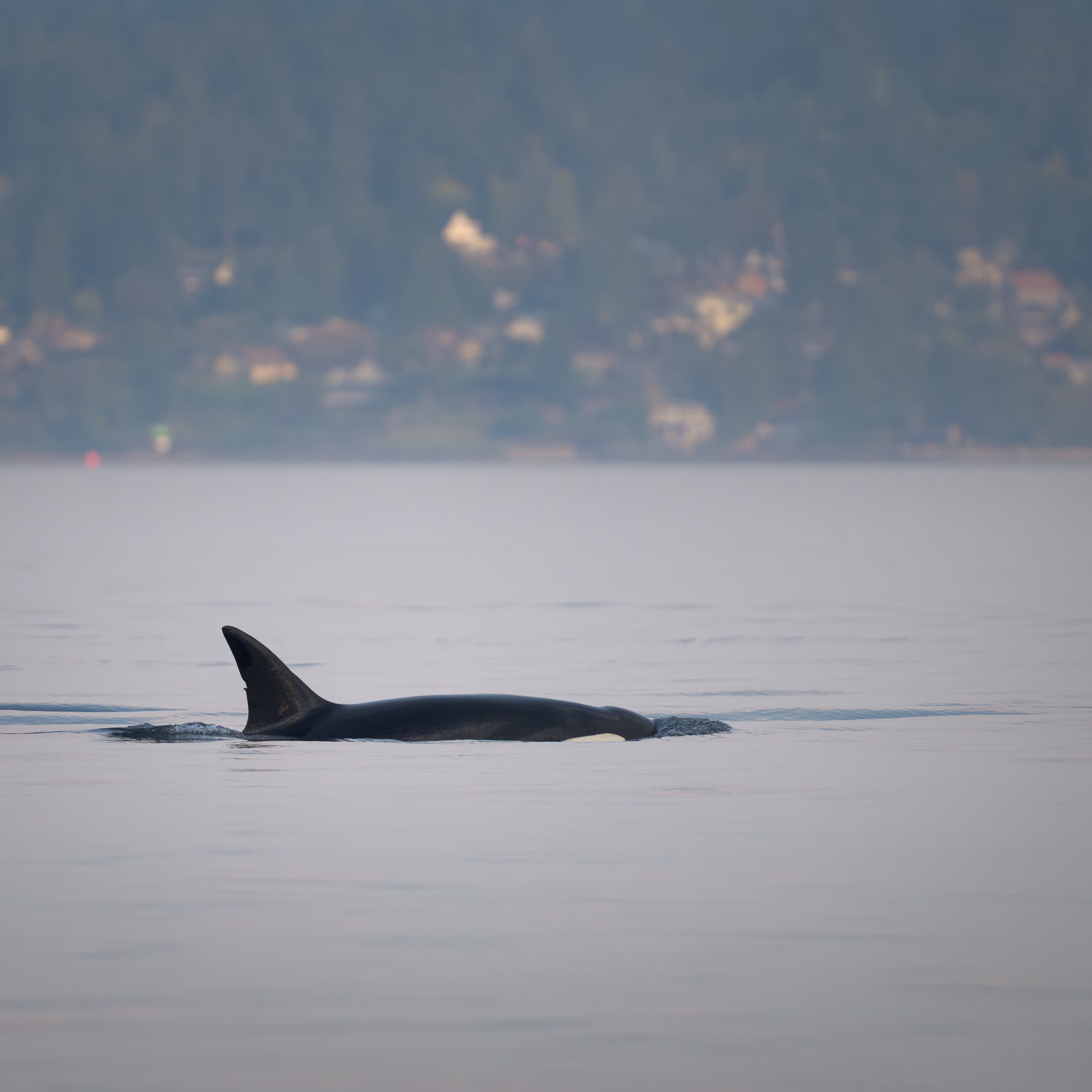
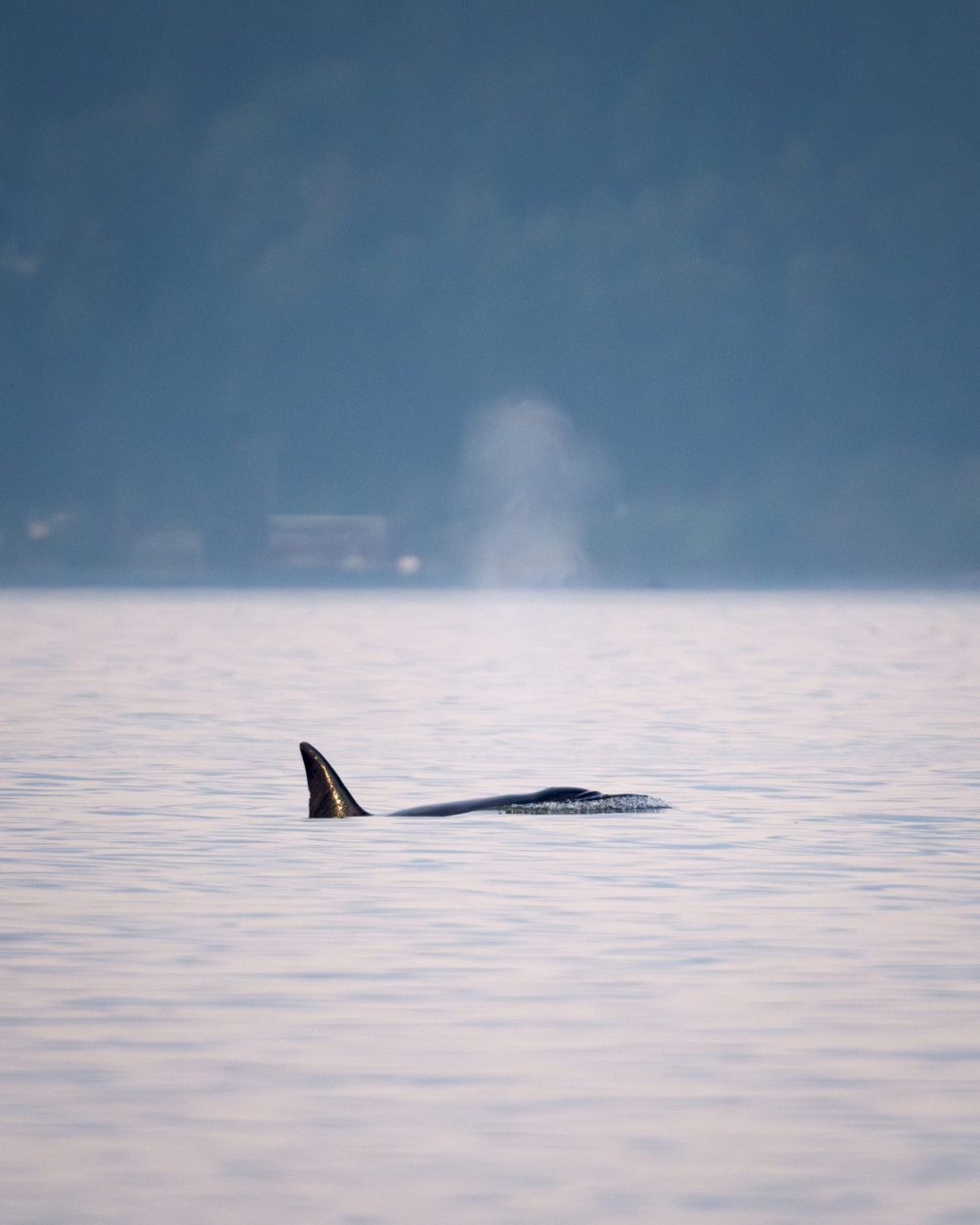
Ready for Sunday whale-watching? Kersti Muul reports orcas are headed southbound “toward Lowman Beach,” mid-channel so binoculars are likely needed. Let us know if you see them!
Just in from Kersti Muul, “humpback southbound from north end of Vashon, mid-channel.” Let us know if you see it!
Two humpback whales are in view northbound off Constellation Park, Kersti Muul tells us, “possibly headed for downtown” (into Elliott Bay). Let us know if you see them!
Two young humpback whales are in the Seattle-Bainbridge ferry lanes, reports Kersti Muul. Let us know if you see them!
| 1 COMMENT