
West Seattle, Washington
30 Monday
Thanks to AH for sending the flyer that’s up for an “all hands” community cleanup tomorrow (Saturday, March 28) in South Delridge/White Center:
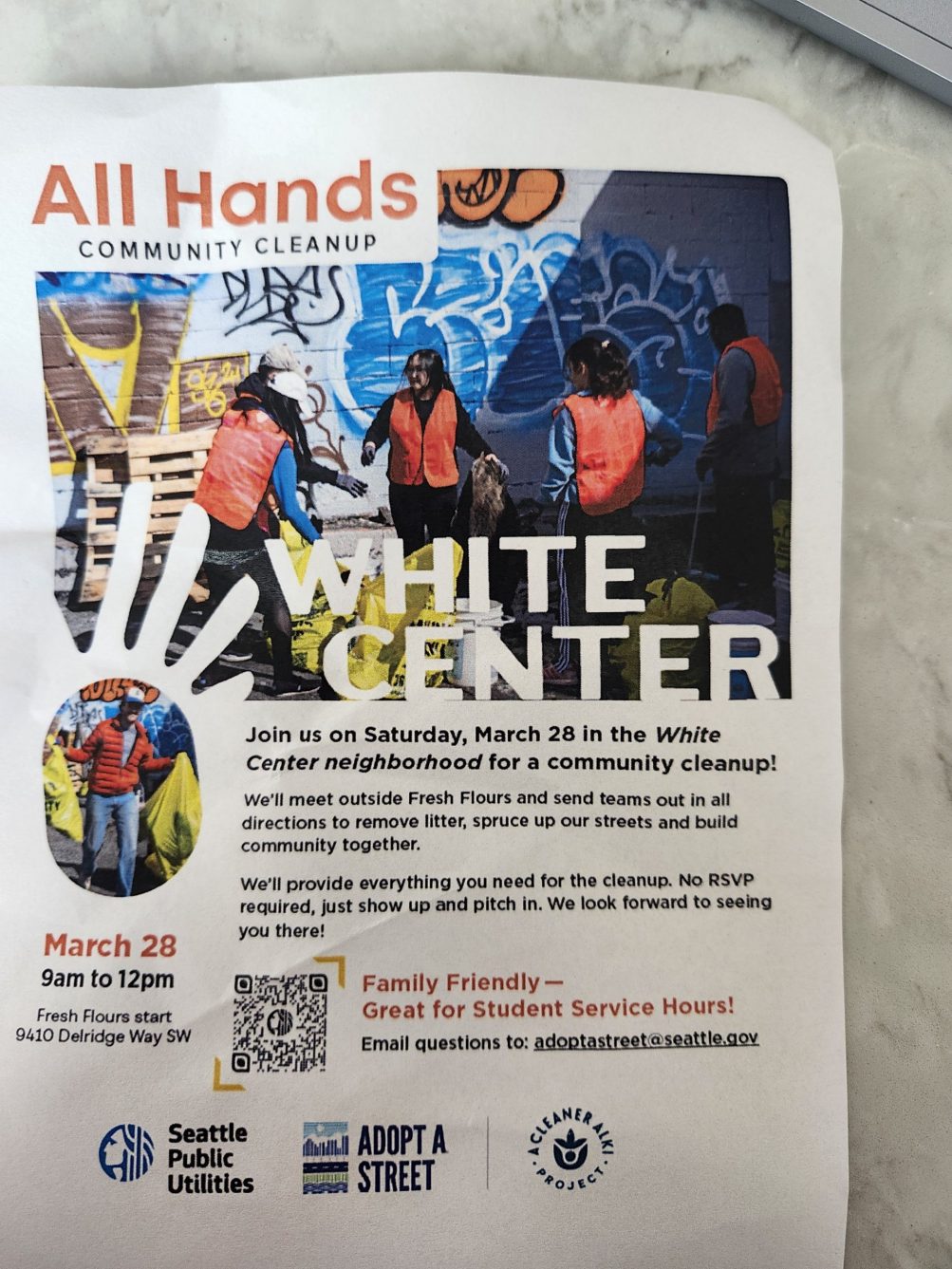
No RSVP required – show up, 9 am at 9440 Delridge Way SW, and you’re in!
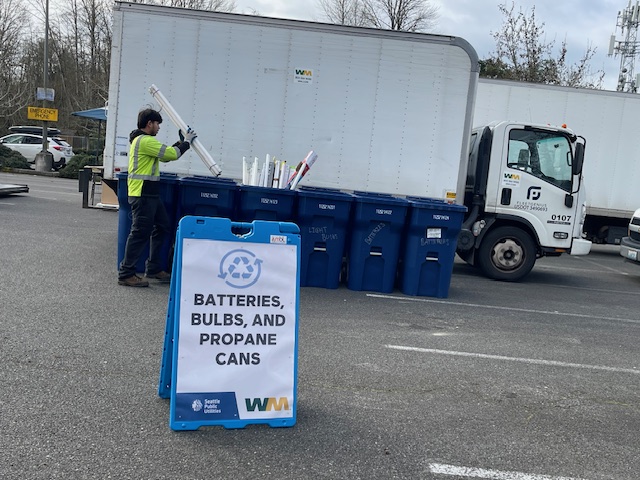 (WSB photo, Saturday)
If you took recyclables and/or shreddable paper to last Saturday’s event at South Seattle College (WSB sponsor) presented by the West Seattle Junction Association and West Seattle Chamber of Commerce, you were one of 503 participants. The local organizations’ partners at Waste Management also reported, “We saw 84% of residents coming from single-family homes, 11% of residents coming from apartments/condominiums, and 5% of residents coming from townhomes. The most popular items that were donated by number of households were appliances/electronics, shredded paper, and batteries/lightbulbs. The least popular items were propane canisters and clothing/textiles. An interesting note is that we saw a 50% reduction in the amount of foam collected (likely due to less amount of Styrofoam packaging being created).”
If you missed it, there’s annther big free-dropoff recycling event coming up in a month, the spring Recycle Roundup at Fauntleroy Church (9140 California SW), exactly one month away, 9 am-3 pm Saturday, April 25 – here’s the list of what will and won’t be accepted.
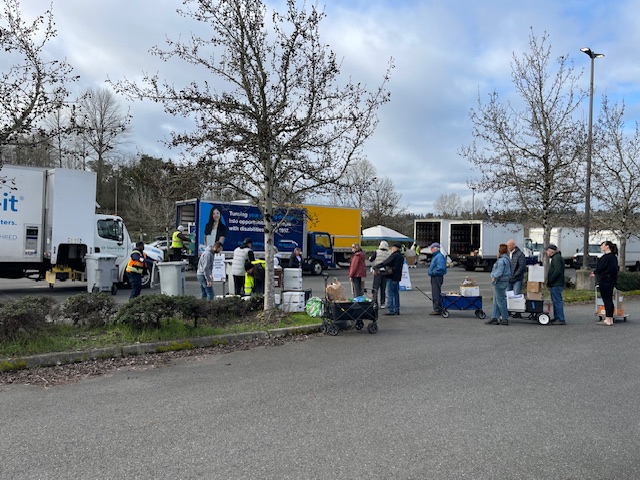
We’re in the south lot at South Seattle College (6000 16th SW; WSB sponsor), new location for the annual free recycle/reuse/shred event presented by the West Seattle Chamber of Commerce and West Seattle Junction Association with a variety of partners. (Here’s what they will and won’t take this year.) First thing we noticed: No backup on 16th. You can approach from either direction. Not much of a wait once you’re in the lot. The line at the shredding truck is the main wait – see our top photo. It’s a two-step process this year – park, and take your stuff over to the trucks (there are volunteers with carts if needed).
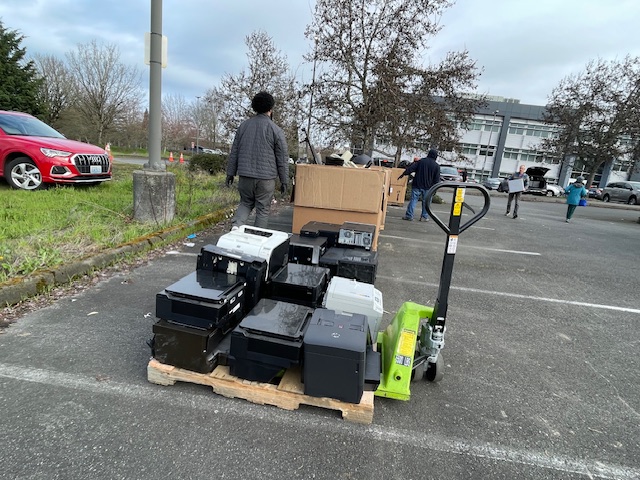
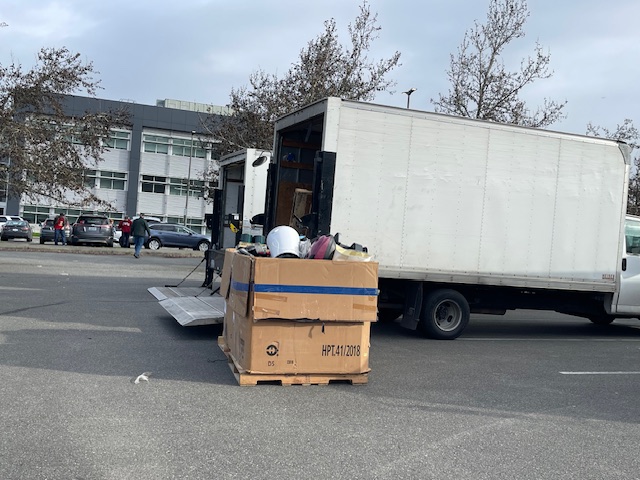
This continues until noon.
 (WSB file photo)
A spring tradition is just two days away – this year’s free dropoff recycle/reuse/shred event is Saturday, 9 am-noon, this time in the south parking lot of South Seattle College (6000 16th SW; WSB sponsor) instead of the north as in past years. It’s presented by the West Seattle Junction Association and West Seattle Chamber of Commerce; WSJA provides this bring-and-don’t-bring list:
What Can You Bring?
We’re collecting hard-to-recycle and reusable household items, including:
Small, empty propane canisters
Fluorescent tubes and bulbs (no broken bulbs, 4 ft max)
Household batteries (no damaged batteries)
Clothing, bedding, and curtains in good condition
Small electronics (TVs, computers, cellphones)
Small appliances (non-freon only)
Foam blocks (polystyrene only)
Paper for shredding (limit: 4 boxes)
Home goods and toysWhat We Can’t Accept
Furniture
Hazardous waste
Bicycles/tricycles
CRT tube TVs
Mattresses
AC units
Car seats
Stained, ripped, or worn-out fabrics
Automotive waste
Construction debris
Garbage, compost, or regular curbside recyclables
Mismatched items (like single shoes)
,
By Macey Wurm
Reporting for West Seattle Blog
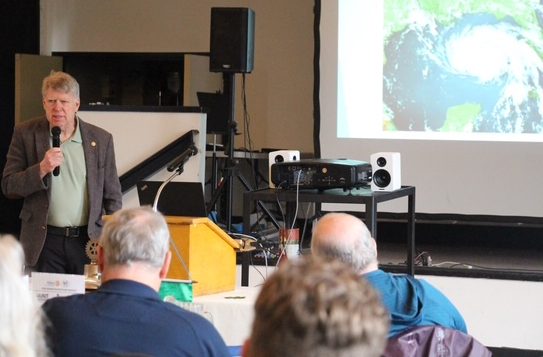
“There are folks who are climate deniers, and there are folks who are climate alarmists. The alarmists think that we’re going to be ending humanity in the next 25 years, which is not going to happen. We’re going to adapt.”
This was an assertion made by this week’s Rotary Club of West Seattle speaker, Dave Spicer. Spicer, a Rotarian for 40 years, is currently serving as chair of Rotary District 5030’s Environmental Sustainability Committee; he has done extensive work through Rotary on 57 water projects and humanitarian aid trips. (Here’s more on his background.)
His presentation covered all things environment – situating the audience in our current situation, both locally and globally, and delving into widespread environmental issues before beginning to discuss potential mitigation strategies, and wins.
Spicer outlined the fundamental reason that climate change is happening: the release of fossil fuels into the atmosphere. He explained that methane gas and carbon dioxide are working together to contain heat within our atmosphere, after which he explained the physical effects.
In our state, he noted, Washingtonians are experiencing flooding and water scarcity simultaneously, in different regions. A drought has plagued Eastern Washington for 4 years, while some Western Washington residents experienced extensive flooding in December, damaging 4,000 homes, leading to the evacuation of 100,000 people.
On a global scale, a lot of the damage outlined by Spicer concerned oceans, especially damage to coral reefs, which provide a habitat for 25% of the marine population. He called the potential for the coral reefs to continue on this trajectory as “quite cataclysmic”. The Ph is also lowering in the ocean due to warming, and concern lies in how this temperature rise will affect the frequency of hurricanes and marine life in general.
He then moved to outline how this environmental deterioration has had, and will continue to have, an impact on man-made societal structures. Insurance and deductibles for businesses are going up because of the increased risk for destruction of property due to extreme weather events – weather events that result in at least $1 billion in property damage. The damage from the floods in December was estimated at more than $182 million, for which Governor Ferguson submitted a request for federal help.
Climate change has also had an impact on human health issues, Spicer said, including potential risks for people with respiratory issues and higher risks for skin cancer in extreme heat. He also referred to the term “Climate Trauma,” saying it has emerged in mental-health spheres as a diagnosis.
As it may read now, Spicer acknowledged the anxiety-inducing nature of our current climate crisis. “I don’t mean to be overwhelmingly sobering… but I do want you to have a sense of the trajectory,” he said. “There are a lot of positive trends. Renewable energy is in many countries, including our own area and other parts of the country; [these energy sources] are really on the increase, primarily air and solar.” He emphasized the importance of nuclear power, noting that currently 10 percent of Washington State’s power is nuclear.
In the legal realm, Spicer brought up the Inflation Reduction Act of 2022, which incentivizes industries to move forward on the use of solar and wind power, and encourages the transition to domestic energy sources. Additionally, a 2024 Montana Supreme Court ruling upheld a landmark climate ruling concerning state residents’ constitutional right to a clean environment.
On an individual level, Spicer gave advice on several actions people can take to reduce their own environmental harm. These include taking a carbon-footprint test, educating yourself about climate change, and smaller individual actions such as turning temperatures down at night, taking shorter showers, using electric vehicles or public transit, among other suggestions.
“It’s not going to go away, It is going to get worse, but we can mitigate it. Spicer said. And there’s potential for all of it to play a role for our children and our grandchildren, because 50 or 100 years from now, if you don’t do enough, you will have let them down. That’s the reality.”
After those closing thoughts, Spicer answered three questions, all that organizers said time would allow.
The first question was about concern over the current administration’s disengagement with national and international climate matters. “What will be the impact of our dismissive attitude over four years?”
Spicer began by noting that the United States is home to some of the “best creative entrepreneurial energies, some of the most incredible scientists, and some of the finest people in this field.” He added that these people are now being limited in their involvement to be part of the solution. “Those regions like ours that are richest have to figure out a way to support those that are most impacted.” Spicer emphasized that since our country helped to create this problem, we have a responsibility to come to the aid of those most affected by it.
The second question acted more as a statement, expressing concern over the direct impact of fossil fuels on nations and wars. The Rotarian said, ‘We’re going to have more of that if we don’t wean ourselves off oil,” to which Spicer agreed.
“We can’t extricate gas overnight,” he said. He talked about the necessity to develop a plan for the next 20-30 years to transition to solar, wind, water, and nuclear power. “It just absolutely has to happen, frankly.”
The last question pertained to Rotary members specifically – whether a Rotary program exists to educate populations about the impacts of climate change who don’t necessarily acknowledge it. Drawing from his extensive experience as a Rotary member working around the world, Spicer observed that the last 10 years have been “mind-shaking” for most people. He explained that most Rotarians understand the extent of the crisis, specifically mentioning branches in Asia and Africa who diligently take care of their ecosystems.
SIDE NOTES: One Rotary member recommended the book “Parable of the Sower” by Octavia Butler to learn more about what a country in a water crisis looks like. Another mentioned extensive New York Times coverage on the Thwaites Glacier in Antarctica and the effects of its dwindling.
The Rotary Club of West Seattle meets most Tuesdays at noon. Here’s what to do if you’re a non-member interested in attending.
Often, stories about saving trees involve trees in the path of development.
Not this one – a tree so wide and gangly, we have to show it to you on video rather than just a photo.
The threat to this weeping willow tree in Upper Alki is not development, but another d-word … drainage – according to its owner.
The tree is in Irene Trimble‘s yard in Upper Alki, along SW Spokane east of 59th SW. It’s a landmark – “I’ve given the community access to the tree for engagement, prom, and senior photos as well as wedding ceremonies at no charge to anyone. A lot of memories have been made here by folks in West Seattle.” She provided this photo of one couple:
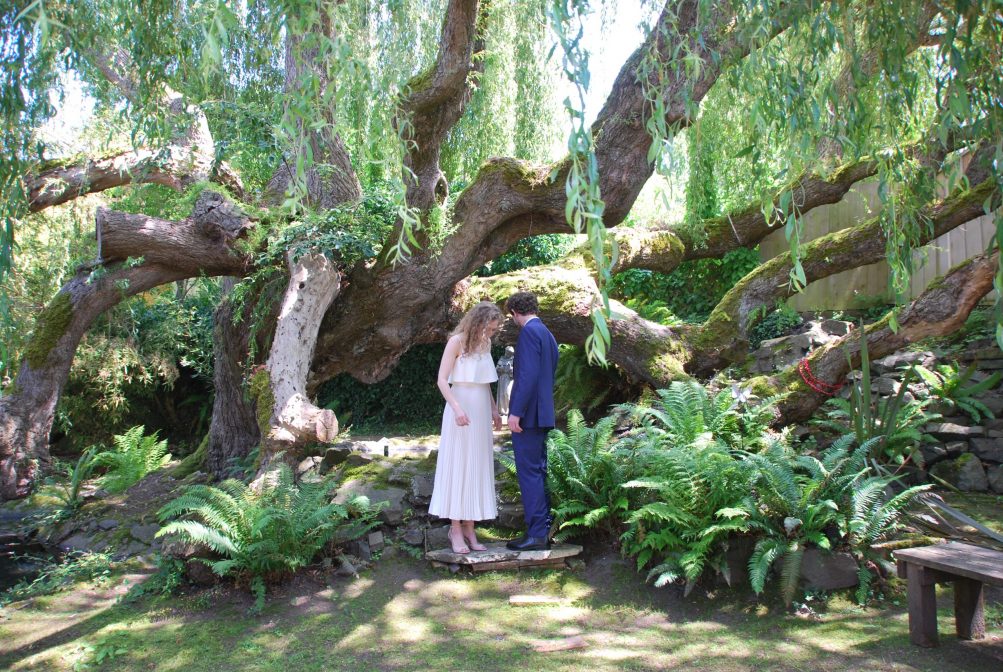
Part of the tree hangs over her fence, and she’s let people into the yard to visit it.
But it’s dying because of too much underground water just inches below the south side of the yard after a shift in the flow, which she has been told is a natural phenomenon. Irene says an arborist estimates the tree will die in about a year unless the excess water is drained away and rerouted. She’s been told that can be done – for about $9,000.
A friend suggested she try crowdfunding to cover some of that cost, and set up this GoFundMe campaign.
It describes the tree as “ancient” – that’s a relative term, as willows go; Irene says this one is believed to be at least a century old. She bought the property six years ago, and says it didn’t come with any history of the tree, such as who planted it there and why.
All that’s clear is that too much of a good thing – water – is killing it. And for those who know it and appreciate it, Irene says they have a chance to help save it. At least its human fans do – it has wildlife fans too, like this video Irene provided from a duck family’s visit:
Irene says the tree is registered with Plant Amnesty as one of Seattle’s remaining “heritage trees,” and if she is able to save it, it could live to be cherished by at least another generation.
 (WSB file photo)
Another reminder: The next West Seattle recycle/reuse/shredding event is now less than a week away, presented by the West Seattle Junction Association, West Seattle Chamber of Commerce, and partners next Saturday (March 21). To ensure you’re ready, we’re again publishing the list of what you’ll be able to drop off during the 9 am-noon event. And remember that the location is changing – now in the south parking lot at South Seattle College (6000 16th SW; WSB sponsor) – drive/ride/walk in via the southernmost SSC entrance off 16th.
The list:
ACCEPTED ITEMS include:
Small propane canisters
Fluorescent tubes and bulbs
Household batteries
Clothing, bedding, curtains in good condition
Small electronics (TVs, computers, cellphones)
Small appliances (non-freon)
Foam blocks (polystyrene only)
Paper for shredding (limit: 4 boxes)
home goods and toysNON-ACCEPTED ITEMS include:
Furniture
Hazardous waste
Bicycle/tricycles
CRT tube TVs
Mattresses
AC units
Car seats
Stained, ripped or worn-out fabrics
Automotive waste
Construction waste
Garbage, compost and household recycling items
Mismatched items (single shoes, etc.)
For suggestions about disposing of those items or others not mentioned at all, check out this Seattle Public Utilities lookup tool. And note that a wider variety of electronic items will be accepted next month at the Fauntleroy Church Recycle Roundup – 9 am-3 pm Saturday, April 25.
 (WSB file photo)
By Tracy Record
West Seattle Blog editor
Saving salmon – and in turn, saving animals that need them, like Southern Resident Killer Whales – is a painstaking job.
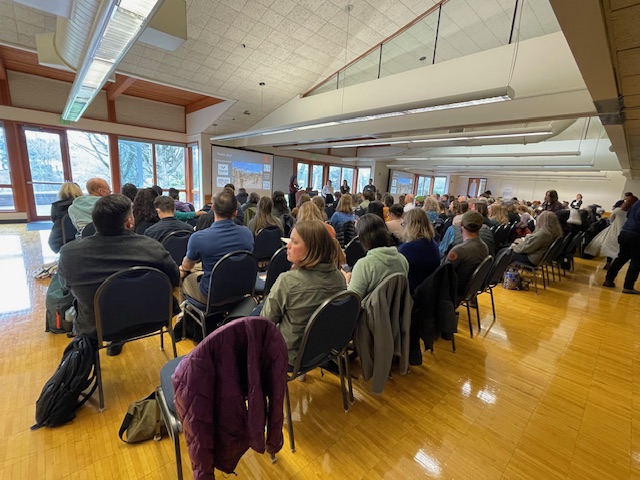
Just ask the dozens of people who gathered steps from the Duwamish River’s southern stretch this past Tuesday to share strategies and successes about restoring the river’s habitat. We accepted an invitation to cover their presentations.
Much of what we hear about cleaning up and restoring the Duwamish River and its watershed focuses on pollution, contamination, and the multi-billion-dollar, decades-long work of cleaning it up. But those gathered for the Duwamish River Habitat Symposium (held at Tukwila Community Center) are the ones who take over after that – turning former industrial sites back into places where fish, plants, insects, and people can flourish.
The presentations touched on common problems – Canada Geese seeing restored habitat as a tasty buffet, for example. They also celebrated successes – at a Harbor Island site owned by Vigor, it was declared triumphantly that, “Juvenile salmon are feeding.” That’s at an area that hasn’t been “heavily used” since World War 2, right by the mouth of the Duwamish. They’re ultimately restoring it for insects, too.
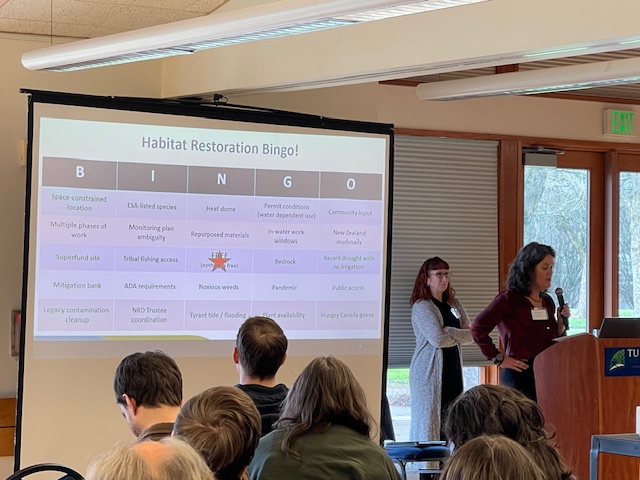
A duo from the Port of Seattle livened up their presentation with “habitat restoration bingo,” underscoring how everyone in the room was dealing with similar challenges and triumphs.
The sites discussed at the gathering were along many miles of the Duwamish/Green River, from its mouth on Elliott Bay deep into the southern reaches. That’s where another presentation was focused, a six-acre site that had hed a rundown hotel, demolished 10 years and yielding 250 tons of asbestos. Lessons learned from that site: Don’t put wood where it doesn’t belong; the fish weren’t interested; the choice of restoration materials is important Also, be ready for surprises – they discovered a significant amount of stormwater drainage that had to be rerouted. Here, like other sites, they had to work on repelling geese – they even took over a pole that was meant for osprey.
Now, after a few years. the plants are growing well, and an ecologist who grew up in the area says it’s “magical to see … important and valuale to bring all that nature right to where people see it all the time.” (This site has some noise challenges, though – it’s in earshot of a rifle range.)
Back toward the north, a West Seattle site just south of the former T-105 Park (now known as t̓uʔəlaltxʷ Village Park and Shoreline Habitat), is owned by a subsidiary of Nucor (WSB sponsor), and its restoration project is in construction right now, almost complete. Past and present photos were shown:
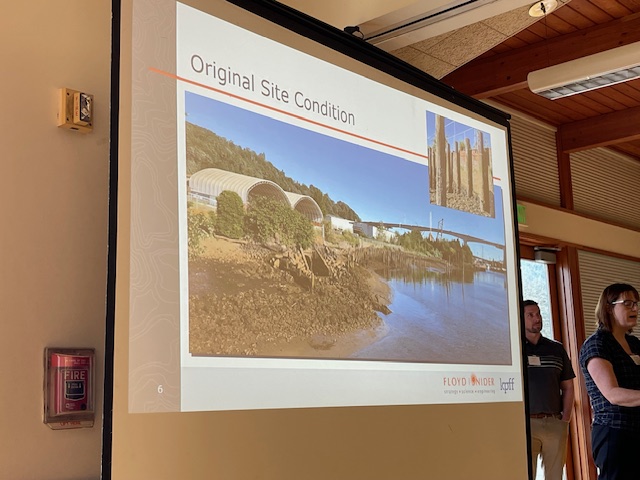
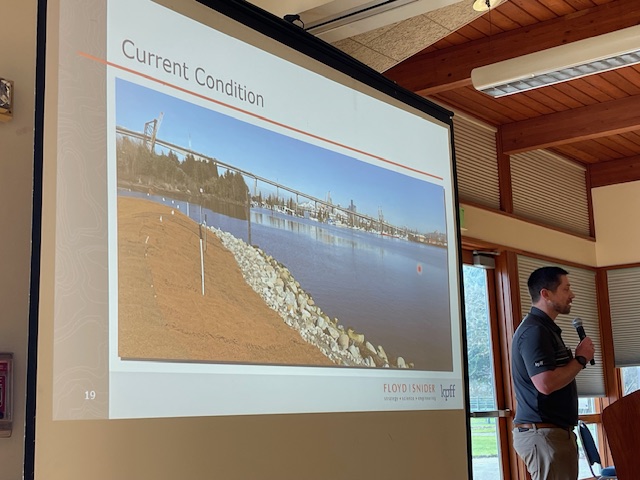
The challenges on this site range from creosote pilings to a rail line that takes scrap steel to Nucor and has had “some past derailments,” the symposium was told. They had to “clear 3 1/2 feet of contaminated fill” and remove a steel bulkhead, eventually resulting in almost three acres of habitat area, half of it “intertidal.”
The firm KPFF worked on this site as well as the aforementioned Vigor site and said the two were “really different” – among other discoveries, they found “an old concrete bunker filled with cable and a “huge outfall … draining a large part of West Seattle.” This presentation was one of several that mentioned another common challenge – boaters that don’t observe the speed limit and therefore churn up wakes that can damage the restoration zones.
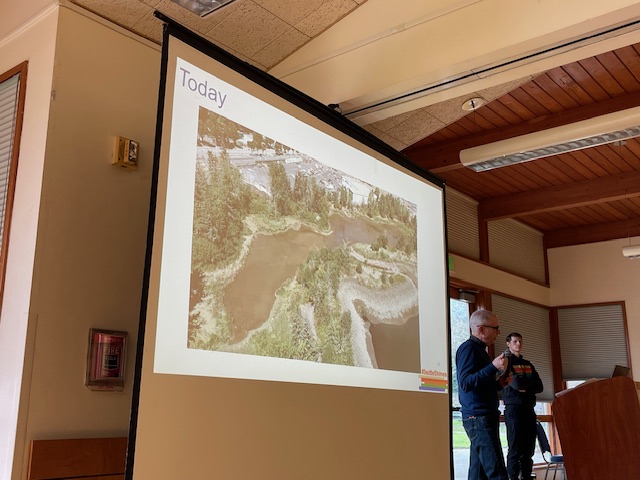
Also on the West Seattle stretch of the river, two Seattle Parks reps, David Graves and Matthew Hilliard, talked about one of the earliest projects, at
Herring’s House Park (Tualtwx) – you might recall Graves from West Seattle projects including the restoration of shoreline at Lowman Beach. He said it was important to recall “there was a place here” before there was a park. The siute includes “the last remaining oxbow on the river,” he added; the Duwamish was once a winding river before it was straightened in the name of industry. The city took over the site in the ’90s and took on a 17-acre restoration, 11 of the acres intertidal, 6 upland, completed in 2000.
The fish, however, haven’t been so interested in using this habitat, they said, so the question now is, how to make it better? They’ve hired a consultant for a feasibility study.
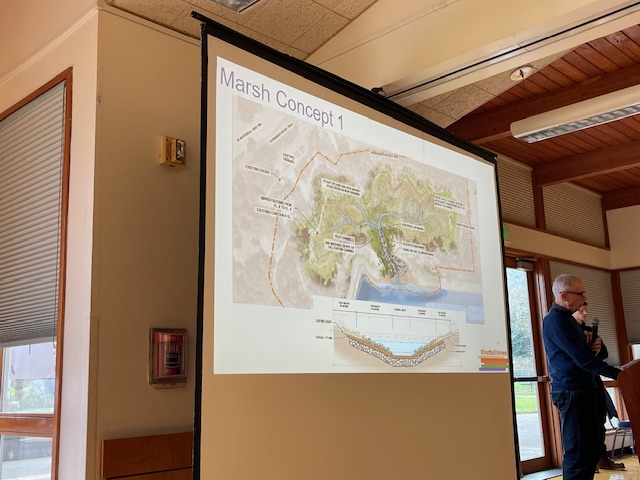
With all that, they’re at 30 percent design on projects; they’re planning for a “loop trail” to replace the “social trail worn throughout the years,” noting they’ve tried to “discourage” it over the years with fencing but that had been “destroyed three times” before they finally gave up. Park users also have put up problematic signs, Hilliard noted, such as “no minors.” In non-human challenges, the parks pair echoed others regarding geese. “You’ve got to goose-proof your plants or they’re going to be decimated.”
Back down to the Tukwila area, Mike Perfetti from the city spoke about two habitat-restoration projects, the Duwamish Gardens – near the mentioned-earlier Chinook Wind site – and a flapgate-removal project on Riverton Creek. The Duwamish Gardens site was an “abandoned derelict farm” (backstory here) bought by the city for a park. The cleanup required here was traced back to chemical contamination from years of farming, including DDT; cultural resources had to be respected as well. They had to excavate 30,000 cubic yards; 1,000 yards of that were able to be reused as a viewpoint.
One thing notable about this presentation – it was a reminder that some restoration sites include public access, some – mostly because they’re on an industrial site – do not.
The Riverton Creek project was aimed at restoring salmon access into the creek, by taking out flapgates and culverts, requiring many agreements and easements to work out. But in the end, the stream was daylighted and the shoreline restored. And – the fish are back.
One last jump back to the north: Duwamish River People’s Park and Shoreline Habitat, the Port of Seattle-owned site in South Park. This higlighted another point common to some presentations – the process of acquisition, cleanup, and restoration often takes many years; in this case, the port acquired the site in 2000, it was cleaned up 2012-2014, and park construction was 2020-2022. Now they’re in a “monitoring” phase that will continue until 2032.
Here, they built a sort of “macrame” fence to exclude geese, who had even kicked out nesting ospreys. Here too, the fish are back – far more chum than chinook – and the chum draw other predators, like river otters. Another challenge: South Park’s “king tides,” although the habitat features survived them.
Even for a layperson, the day was a fascinating peek into what it’s taken to try to bring stretches of “Seattle’s only river” back to life.
WHAT YOU CAN DO: Help with habitat restoration!
 (WSB photo, spring 2024 Duwamish Alive!)
This spring, for example, you can join the Duwamish Alive! Coalition – which organized the symposium – at the twice-yearly, multi-site work party that will show up here soon.
 (WSB file photo)
Last weekend, we noted that the next West Seattle recycle/reuse event was exactly a month away. Now, courtesy of one of the lead organizers – the West Seattle Junction Association – we have details on what you’ll be able to drop off during the 9 am-noon event on Saturday, March 21, so you can start planning. First, a reminder that the location is changing – now in the south parking lot at South Seattle College (6000 16th SW; WSB sponsor), which is accessible via the southernmost SSC entrance off 16th.
Now the list:
ACCEPTED ITEMS:
Small propane canisters
Fluorescent tubes and bulbs
Household batteries
Clothing, bedding, curtains in good condition
Small electronics (TVs, computers, cellphones)
Small appliances (non-freon)
Foam blocks (polystyrene only)
Paper for shredding (limit: 4 boxes)
home goods and toysNON-ACCEPTED ITEMS (which are included but not limited to):
Furniture
Hazardous waste
Bicycle/tricycles
CRT tube TVs
Mattresses
AC units
Car seats
Stained, ripped or worn-out fabrics
Automotive waste
Construction waste
Garbage, compost and household recycling items
Mismatched items (single shoes, etc.)
If you’re looking for suggestions about how to best dispose of those items or others not mentioned at all, check out this Seattle Public Utilities lookup tool. And a wider variety of electronic items will be accepted (though we don’t have the official list yet) at the Fauntleroy Church Recycle Roundup – which is exactly two months from today, on April 25.
 (WSB photo, last year’s recycling event)
Reminder, with one month to go – on the first full day of spring, you’ll get a chance to jump-start spring cleaning and de-cluttering with the first big recycling event of the season. New location this time for the 9 am-noon Saturday, March 21, event – the south lot at South Seattle College (6000 16th SW; WSB sponsor) instead of the north lot. We’re still awaiting the official list of what will be accepted at this free event coordinated by the West Seattle Junction Association and West Seattle Chamber of Commerce, but typically it’s a variety of recyclables/reusables, and shredding.
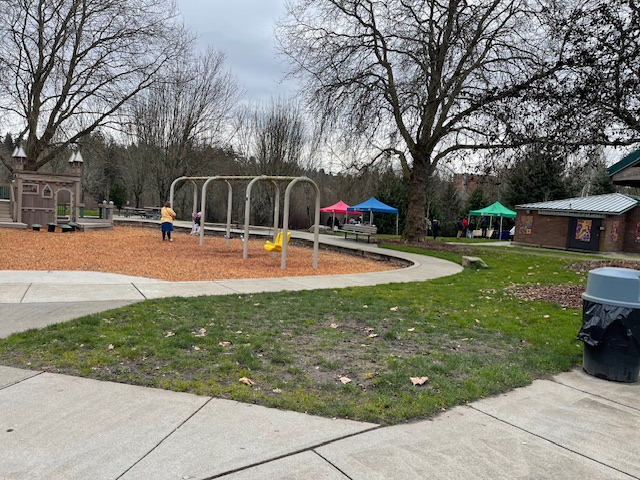
By Tracy Record
West Seattle Blog editor
The colorful canopies in the background of our Roxhill Park photo were the only hint from a distance that something “huge” was being celebrated this morning – the successful experiment to restore part of the park’s peat bog, one of the few remaining in the region, at a site that historically fed into Longfellow Creek, and the Duwamish River beyond.
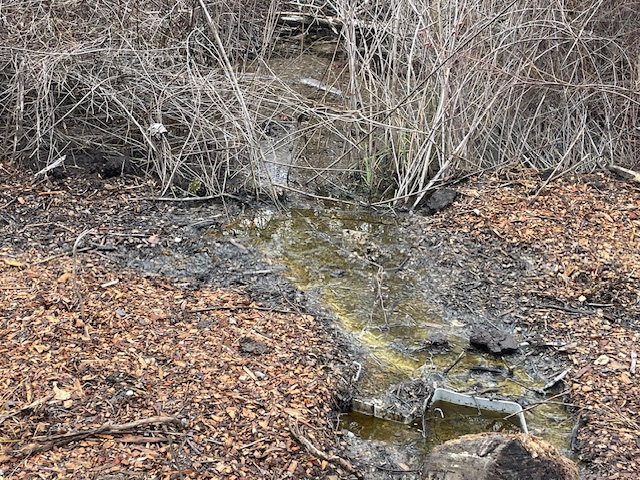
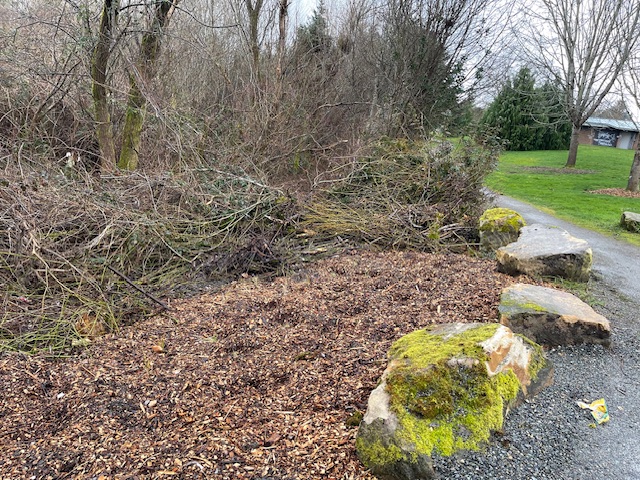
As we showed you after our preview visit to the bog earlier this week, the experiment, more than a decade in the making, is returning a dried-out bog “cell” to the wetland it is meant to be. Under the bark chips, a 300-foot-long vinyl barrier was installed late last year to keep water where it should remain, likened at one long-ago meeting to “fixing a bathtub.” The main architect of the pilot solution, Steve Winter of Natural Systems Design, was among the people who spoke as light snow fell – last one in our 28-minute video, after Duwamish Alive Coalition‘s Sharon Leishman, deputy Parks superintendent Daisy Catague, DNDA‘s interim executive director Shannon Woodard, and Neina Chapa from American Rivers:
Winter explained that the root of the problem was what was done during rapid development in the ’50s and ’60s, as with so many cities – water was something “to be moved through our systems really quickly. What we’re doing here … is really reversing that acceleration.” So they studied the groundwater and figured out how to “get in front” of it – so the barrier went eight feet under Cell 4, “so [the water] you see is about four feet higher than it was for many, many decades,” and now it’s rehydrating the peat. As for the future, he said, “there’s three other cells where we could do this, and that’s where the power of this project is,” including synergy with a Seattle Public Utilities project that could bring stormwater back to the bog too, meaning this is bringing the bog “one step closer to restoring the headwater of Longfellow Creek.”
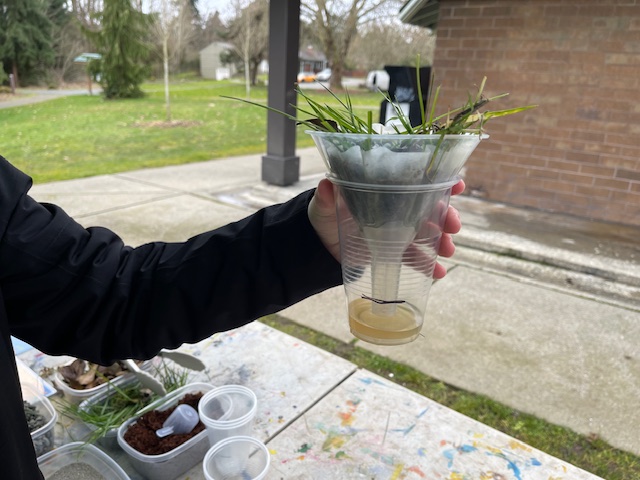
This morning’s celebration event, which Winter and Chapa jokingly dubbed a “peat party,” wasn’t just speeches – it also offered hands-on projects, such as a mini-stormwater filter you could build with Mikaela Ebbeson, DNDA environmental-education coordinator:
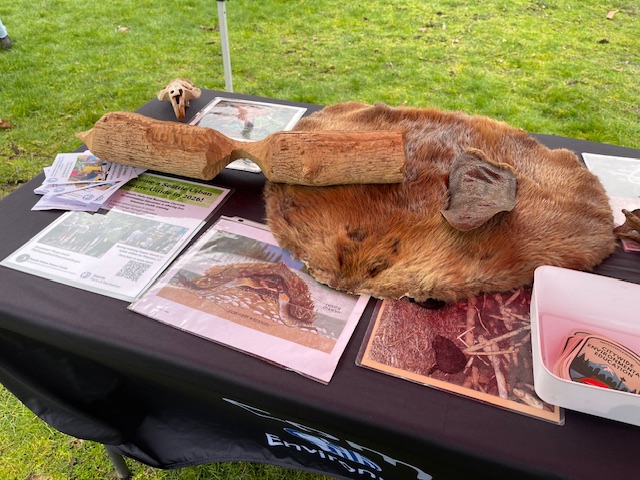
At the Seattle Parks table, environmental education program specialist Nicole Parish-Andrews was offering bracelet-making and wildlife displays (that’s a beaver skull at top left):
Emceeing the event, Leishman repeatedly hailed the power of community in making this day possible – and reiterated that it’ll be vital in figuring out how to go forward and build on this first successful test. Meantime, you can see the restored area for yourself by walking just a short distance east from the park’s play area and looking south of the trail, beyond the chips. You can also watch the DNDA calendar for Roxhill restoration volunteer events – hundreds of plantings are busy taking root already.
By Tracy Record
West Seattle Blog editor
Far beneath the bark chips, the reason for Thursday’s Roxhill Bog celebration is literally dug in and doing its job.
It’s a vinyl barrier, about 300 feet long, installed last fall as a test, to see if it could help keep water in the part of the historic peat wetland, which has been a source of concern over the years as it’s run dry. Now, the simple sight of standing water thrills those who’ve worked on the problem for years. Through a tangle of branches, here’s what we saw Monday on the south side of Roxhill Park:
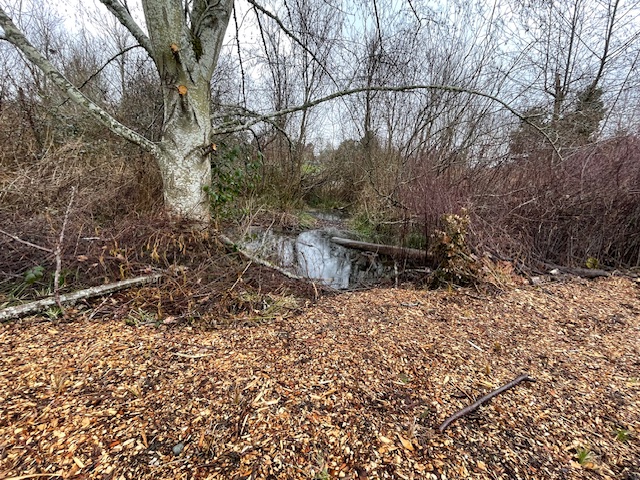
This water is evidence the test barrier is working. And the rain that fell Monday brought more water to the wetland, while dousing us during a mini-tour with Sharon Leishman of the Duwamish Alive Coalition and Danielle Devier of Seattle Parks. They were two of the key participants in a 2021 online meeting we covered laying out the plan for “fixing the bathtub via blocking groundwater from leaving it, with a barrier – not just to save the bog, but to save the park, where trails and bridges have been sinking as the bog dries out.
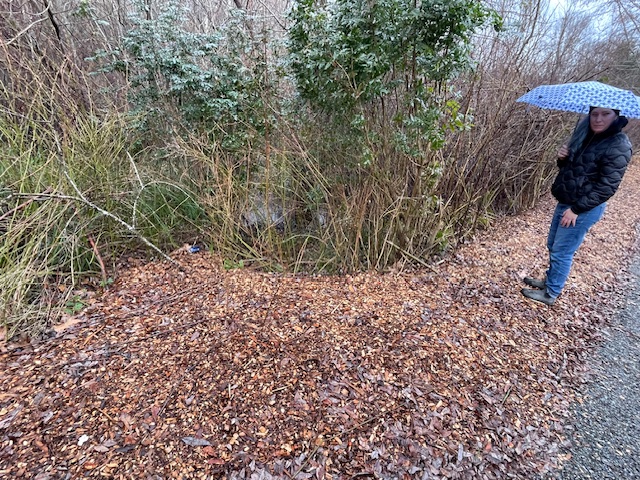
They explained how the vinyl barrier was deemed to be the least damaging way to block it – they wouldn’t have to tear up so much of the bog in the process. Leishman stressed the collaboration that led to the plan, including Natural Systems Design and the Delridge Neighborhoods Development Association, which has been organizing volunteer restoration-work parties in the park – look closely at this photo and you’ll see a tiny starter clump of grass planted during one of those events:
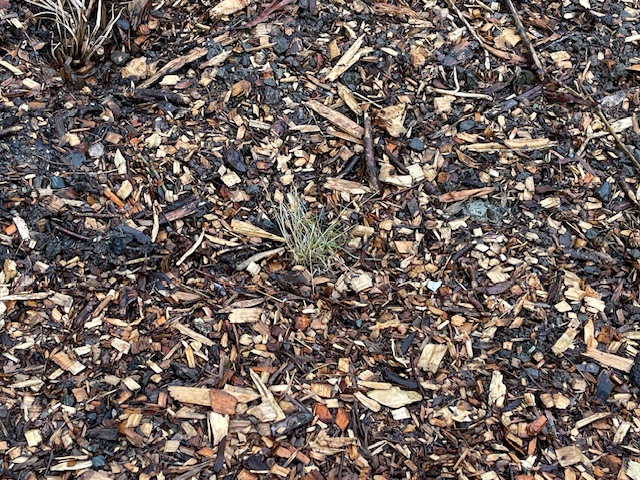
Bog restoration projects are more common outside the U.S., we learned during the mini-tour, and they also serve an educational purpose – to teach people about peat’s role in carbon sequestration. All the harvesting of peat that’s sold or gardens is releasing a lot of it. So what’s happening at Roxhill Bog is just a start – more of the bog could be restored, and an outdoor education lab could follow, for example. Past surveys have shown area residents have an intense interest in access to more natural areas, and they hope to see some of them at the celebration Thursday, 10:30 am to noon, which will include art, speakers, and most importantly, guided bog tours so you can see and hear about all this firsthand,
 (File photo, courtesy Urban Homestead Foundation)
The future of the former Seattle City Light substation across from Genesee Hill Elementary remains unsettled, more than a decade after the city decided to put it and other former substations up for sale. Tonight the nonprofit that formed in 2016 to try to buy the 50th/Dakota site, the Urban Homestead Foundation, announced it is ending its attempt to buy the site for educational/environmental use – but says the nonprofit Forterra will take the campaign on. Here’s what the UHF told its supporters tonight:
A new way forward to conserve the Dakota Homestead land!
We are pleased to announce that Forterra – Land for GoodTM, a well established land conservation nonprofit in King County, will be taking the Dakota Homestead project into the future, effective immediately. Forterra is committed to continuing the vision that so many of us in West Seattle have held for more than a decade. Urban Homestead Foundation will transfer its remaining financial assets (donations received) to Forterra in the coming months and dissolve our foundation in accordance with state law.
There are so many people to thank for bringing this work to successful completion.
● To the original dreamers whose passion for community, land use, and environmental education launched the mission and raised the rallying cry to preserve this piece of our neighborhood.
● To the City of Seattle, who continued to hold onto the property during our community-led efforts to purchase the land.
● To the numerous non-profit organizations and government agencies who pledged their support.
● And most importantly, to all of you, the individuals who donated time and money to our organization over the years. The financial seeds you planted will continue to grow.
We’d also like to acknowledge that this land is not just a parcel to be preserved, but a part of the ancestral home of the Duwamish people since time immemorial. In so doing, we’d like to express gratitude to the Duwamish people, past, present and future, for their stewardship of the land we live, work and play on.
For a small organization to garner such visibility and support across the city is a huge undertaking, and this partnership with Forterra to preserve the land is an incredible win. We couldn’t have done it without all of you – thank you.
Please take a moment today to visit the website of Forterra – Land for Good at <strong>https://forterra.org to learn about their mission. We think you’ll understand why we feel so strongly that our original vision will live on and be realized.
Finally, the work to preserve this property is not done yet! Forterra will still need to close the funding gap to complete the purchase of this land. Therefore, if you’d like to continue to support this project, you can donate directly to Forterra at the following link https://forterra.org/donate-web and specify “Dakota Homestead” in the “additional comment/notes” field.
Thank you all and see you in the community!
Sincerely,
The Board of Directors, Urban Homestead Foundation
We had inquired last September with UHF about the project’s status and while they acknowledged our inquiry at the time, they hadn’t been ready to comment until this announcement. We’re following up with them regarding the unspecified “funding gap” that remained, and we’ll be following up with Forterra tomorrow.
OTHER SITES: Of the other ex-substation sites the city declared “surplus” at the same time, one other has become an environmental-education site, Delridge Wetland Park. Another, on Pigeon Point, has become “tiny townhouses”; the 16th/Holden site in north Highland Park awaits future redevelopment as affordable housing; and two other sites in Fauntleroy and south Highland Park also remain vacant.
By Macey Wurm
Reporting for West Seattle Blog
 Today is the last day you can vote to elect a member of the King Conservation District Board of Supervisors for District 3, encompassing Seattle, Vashon/Maury Islands, and parts of Renton and Tukwila.
As we reminded you in previous coverage, the KCD is a special-purpose district, or a limited-purpose local government that specializes in a specific function. The KCD serves to provide “technical assistance to private residents in forest management, farm conservation planning, wildfire preparedness, and streamside and shoreline enhancement,” according to the KCD website. They also work with cities and public organizations to assist with community-oriented conservation like community gardens and urban-forest canopies.
The vote is between three candidates – Erica Chung, Csenka Favorini-Csorba, and Chris Porter, whose full statements can be found here. Porter, a former supervisor, is from West-Seattle, with Chung residing in Queen Anne, and Favorini-Csorba, a current supervisor, in White Center.
Voter turnout has increased a bit since our last report, from 5,467 people or 1% of eligible voters to 7,221 or 1.48%. This election is held completely separate from the standard cycles, so you didn’t get a ballot in the mail. Ballots can be returned electronically using the online ballot access system accessible through KCD’s website. The portal works with most smartphones and web browsers. You have until 8 p.m. tonight to vote, if you haven’t already.
Always lots of interest in shredding opportunities, so here’s news of your next one: As announced by Seattle Parks – Shred-it is coming to Delridge Community Center, 10:30 am-12:30 pm on Saturday, February 14:
$15 per person, residents only, no businesses. Please remove any paper clips or staples before shredding. Two standard garbage bags per car.
Delridge CC is at 4501 Delridge Way SW. After this, the next local event we know of is the March 21 recycle/reuse event presented by the West Seattle Junction Association and Chamber of Commerce, details TBA.
By Macey Wurm
Reporting for West Seattle Blog
Today marks one week left to vote for one member of the King Conservation District Board of Supervisors, whose elections often get overlooked since they’ve been separate from other voting cycles and ballots. You’re voting to choose one of three candidates – two of whom are West Seattleites – to serve on the five-member board responsible for overseeing KCD operations, budget, and setting policy.
First, here’s what the King Conservation District is: A special-purpose district under the Washington State Conservation Commission, focused on promoting “the sustainable use of natural resources,” according to its website. The KCD collaborates with private residents, cities, and organizations to provide technical assistance in resource management. It is primarily funded by a per-parcel fee and does not receive money from the state’s General Fund. (Here’s a simple breakdown of some of what the KCD does.)
KCD elections – which choose three of the five supervisors – are subject to historically lower voter turnouts because they are not a part of regular King County ballot. When the Conservation Districts were created in 1939, the Washington State Conservation Commission was made responsible for establishing electoral procedures (RCW 89.08), that do not fall under the state statute for general elections (RCW 29A).
That could change soon – HB 2499, primarily sponsored by State House Rep. Mia Gregerson, is currently in committee. The bill would effectively permit conservation districts to choose to hold their elections under RCW 29A, alongside other federal-, state-, and local-office elections, potentially bringing in more votes.
As of today at 12 PM, 5,467 ballots have been returned out of a total 488,692 eligible voters in the district, approximately 1%.
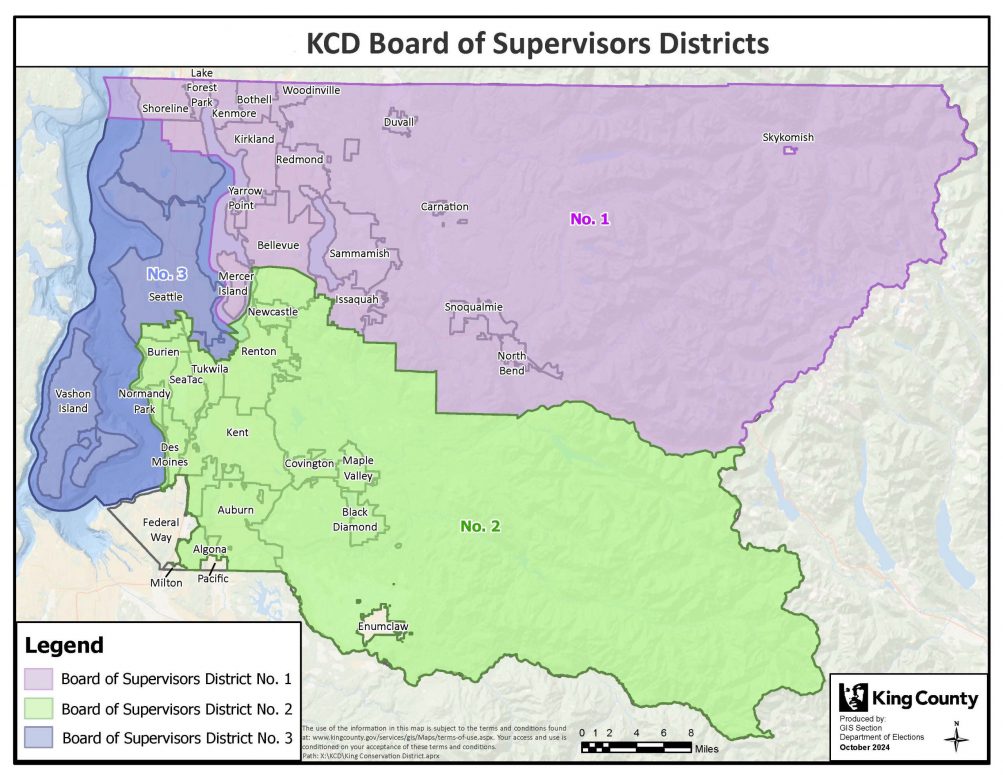
The current election pertains to District No. 3 of the KCD, developed after the Board of Supervisors voted to expand its three elected seats into three separate board districts based on location. District No. 3 represents western King County, including Seattle, Vashon/Maury Islands, and parts of Renton and Tukwila. All eligible voters and candidates must reside within District 3.
Three candidates are running to fill the board seat; from their candidate statements, which you can read in full here:
Erica Chung
Chung earned her bachelor’s degree in Economics and International Studies at University of California Los Angeles, with a master’s degree in Public Administration at Evergreen State. She currently works as a strategic adviser in the Commission Office for the Port of Seattle, a position she has held for five years. She has worked on the Wolf Creek Ravine revitalization project and developed an urban forest stewardship plan. Through which she also collaborated with the City of Seattle and the KCD. Through the board position, she aims to enhance its visibility in the community, amplify its work with local elected officials, and build strong public-private partnerships.
Csenka Favorini-Csorba
Favorini-Csorba, a West Seattle resident, is running for reelection, and was chosen as Vice Chair of the board in 2025. She earned her master’s degree in Environmental Sciences, Policy, and Management. During her term, she led a resolution for the Washington Association of Conservation Districts to provide tribal-relations training, has put in continued work to get the KCD election on the general ballot, and has been an advocate prioritizing funds to local environmental-justice organizations.
Chris Porter
Porter, also a West Seattle resident, earned his bachelor’s degree in nursing at San Diego State University, and a master’s on the family nurse practitioner track at Western University. He served on the KCD board once before, from 2020-2023. During his time, he helped to reshape the district’s structure, elections, finances, funding, and relationship with King County. He has a personal passion for conservation, transforming his yard into a wildlife habitat and using a bicycle as his primary mode of transportation. He aims to create a strong sense of community and prioritize conservation efforts.
HOW TO VOTE: Voting began on January 20, 2026 and will end on February 10, 2026 at 8:00 pm. The election relies primarily on electronic ballot access, though physical ballots are also available if you request one ASAP; they must be postarked by February 10 and received by February 19. You can vote online through the KCD webpage.
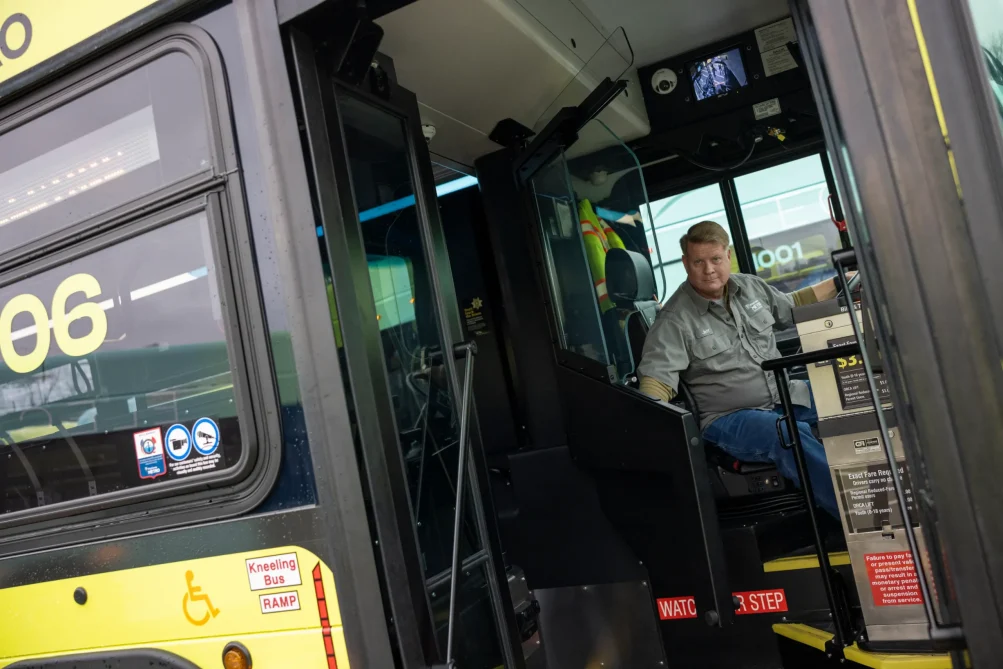 (Metro photo)
Route 128, which includes West Seattle, is one of the routes to which Metro will assign its newest battery-electric buses starting next week. The new GILLIG-manufactured buses, painted “electric yellow and seafoam blue,” are 40 foot long, with a capacity of up to 69 people, and they’re expected to be able to go up to 280 miles on a single charge. Metro’s announcement today also makes note of this distinctive feature:
The new buses are the first in Metro’s fleet to enter service with new operator safety partitions installed. The partitions include a reinforced lower metal panel extending to the operator’s platform, along with a two-part sliding glass system. A larger, extendable glass panel provides increased coverage and visibility, while an additional polycarbonate panel extends to the ceiling for added protection. The partition will remain closed at all times except when transit operators are assisting customers with mobility devices and meets industry safety standards for vehicle windows and operator compartments.
Metro will be adding charging capacity, starting this spring at its Tukwila base, which it says will be able to handle up to 120 battery-electric buses.
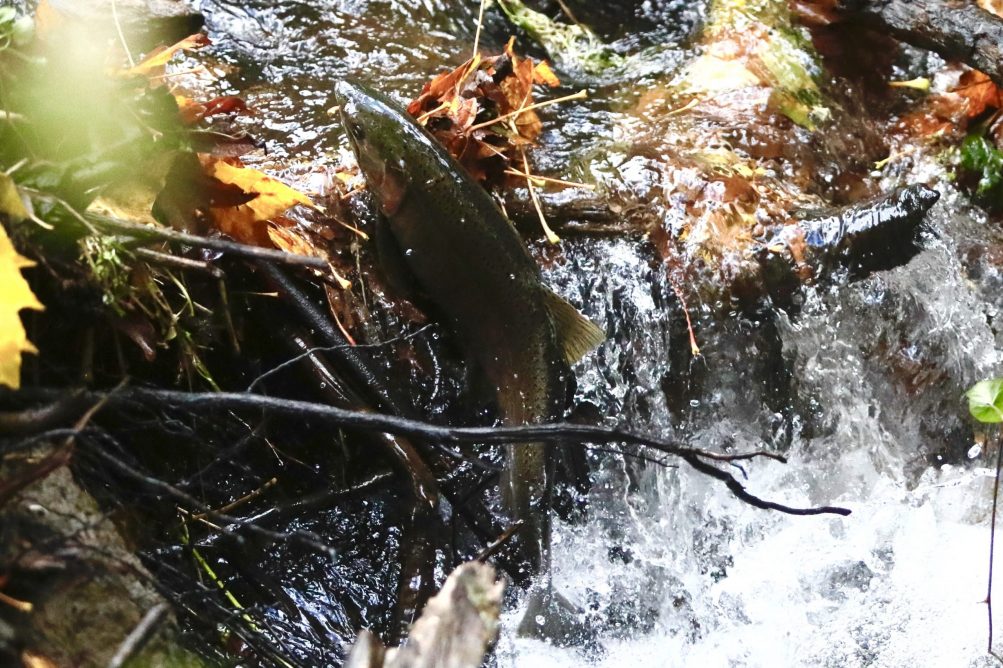 (October photo of salmon in Longfellow Creek by Manuel Valdes)
Puget Soundkeeper has released its full report on the fall salmon season in Longfellow Creek. It’s been monitoring coho salmon in the eastern West Seattle creek for a decade now, with a focus on gathering data about how urban pollution affects salmon survival. As its announcement explains:
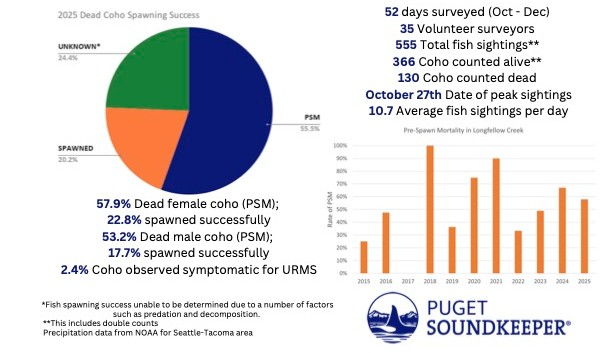
For years, Longfellow Creek has been the epicenter of research studying the effects of 6PPD-quinone – a toxic tire chemical lethal to Coho salmon. Exposure to 6PPD-quinone causes a condition called Urban Runoff Mortality Syndrome (URMS), a disease characterized by symptoms such as disorientation and gasping for air, often killing Coho
within 24 hours. Furthermore, this chemical has been strongly linked to Pre-Spawn Mortality (PSM), where adult salmon die before successfully reproducing. Puget Soundkeeper’s annual Pre-Spawn Mortality Survey analyzes the spawning success of Coho salmon in Longfellow Creek to better understand the impacts of 6PPD-quinone.
Here’s a one-sheet with results of this year’s survey, conducted from October through December. 55.5% of coho in Longfellow Creek died before spawning, and Puget Soundkeeper says that’s consistent with the data it’s been collecting since 2015 – some years up to 90 percent of the fish died before spawning.
So what can be done? Puget Soundkeeper says:
Fortunately, solutions exist. Green Stormwater Infrastructure (GSI) projects, such as raingardens or bioswales, can effectively remove toxins from runoff and prevent harmful chemicals from entering our waters. In addition to GSI projects, policy action is critical. A bill (HB 2421) aimed at removing 6PPD from tires was introduced to the Washington State House and Senate Environment Committees last week. Community members can help move this legislation forward by calling their representatives and voicing their support. [Here’s how]
Puget Soundkeeper will be recruiting the next cohort of salmon surveyors in August; stay tuned to our website for more information. Puget Soundkeeper thanks all volunteers, partners, and donors who make this project possible.
There are also volunteer cleanups during the season; we reported on one back in November.
 Seattle Public Utilities just sent the reminder – this is the last week for “free” composting of Christmas trees and other holiday greenery – either via curbside pickup, or transfer-station dropoff:
Remove all decorations, cut into sections 4-foot or less, and place trees or bundled greens next to your Food & Yard Waste cart on your regular collection day. Apartment residents may place up to two trees next to each Food & Yard waste cart at no charge. You can also drop off up to 3 trees less than 8 feet in length at a Transfer Station.
The “free” tree-cycling continues through Saturday (January 31). After that, you’ll have to chop up your tree so it fits in your yard/food-waste cart, or take it to the transfer station (South, in west South Park, is the closest)
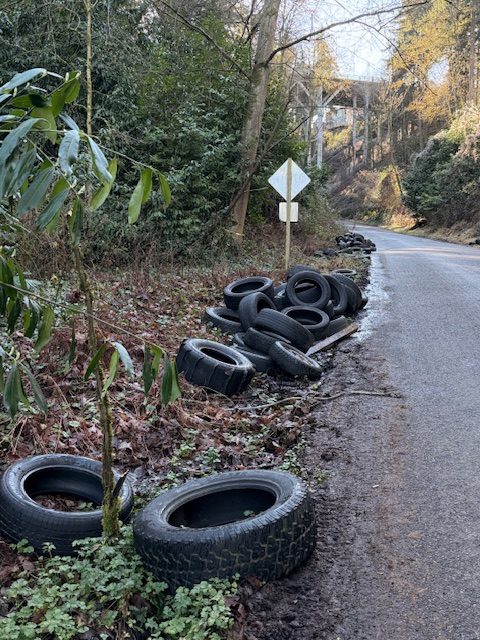
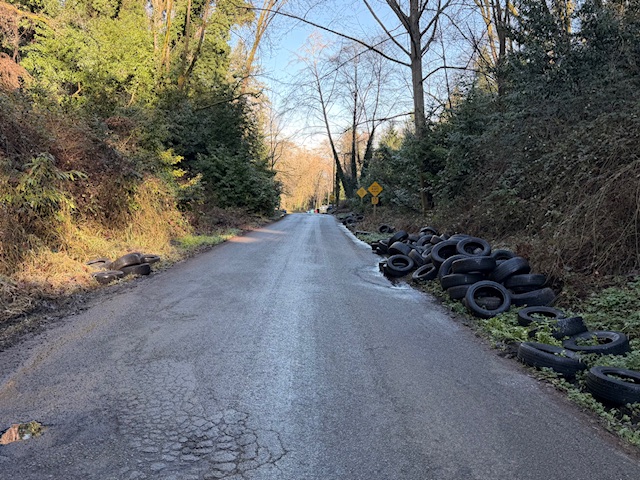
Tire-dumping in West Seattle greenspaces seems to be a recurring problem. After multiple reports in the West Duwamish Greenbelt, tonight word of another location – a texter sent the report and photos:
Someone dumped maybe 50 tires on the side of the road on Fairmount Avenue. It’s kind of a criminal amount of illegal dumping … I just got home from the airport … Sounds like this happened sometime Thursday night or Friday.
That timeframe was according to the texter’s neighbors. The city’s page about illegal dumping explains, among other things, how to report it (and also has a map of recent reports).
P.S. Almost forgot to mention, the dumped-in-Fauntleroy spa chairs shown here earlier this week have been taken away, reports Tom (who sent the original photo of the chairs).
Something else the sunshine brings to mind … spring cleaning, and the free West Seattle recycle/reuse events that can help with it. Here are two dates to save (both Saturdays):
(WSB photo from March 2025)
MARCH 21: The annual recycle/reuse event organized by the West Seattle Junction Association and West Seattle Chamber of Commerce is set for this date. This is in partnership with multiple organizations that accept a variety of recyclable/reusable items. We don’t have this year’s specifics yet – and the location might change from past years – but we’re told you can definitely count on this date.
APRIL 25: This will bring Fauntleroy UCC‘s next twice-yearly Recycle Roundup – one partner but a long list of items they’ll accept, including electronics, and plenty of capacity. (We usually are able to publish that list well in advance; not this early, though.)
UNTIL THEN: Can’t wait to dispose of some items? Find options via the Seattle Public Utilities “Where Does It Go?” lookup.
Two notes about Seattle City Light electric-vehicle charging in West Seattle:
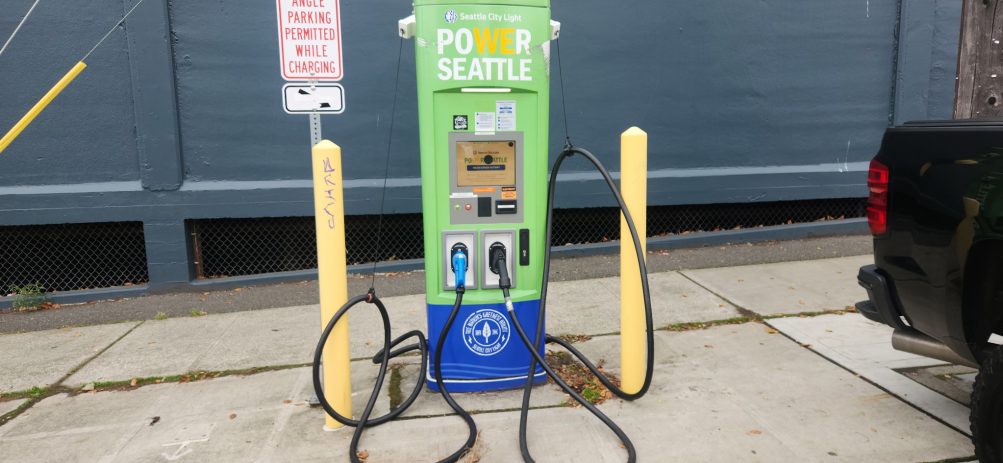 (WSB photo, one of two current chargers on 39th SW, shown in October)
TEMPORARY CLOSURE OF JUNCTION STATION: Starting tomorrow (Tuesday), the two-charger station on 39th SW near West Seattle Bowl will be closed for about a week, according to this announcement we received from SCL:
City Light will replace the two existing 50 kW DC fast chargers with newer 62.5 kW ChargePoint chargers beginning January 13 with anticipated closure of at least 1 week. This projected timeline may change based on weather and site conditions. Please plan for alternative charging during this time as both charging stations will be unavailable.
The project website says this is a prelude to a full-site replacement later this year, to “change the current site layout” and further upgrade the chargers. The station was built in 2020 and has had recurring problems with theft/vandalism in the ensuing years.
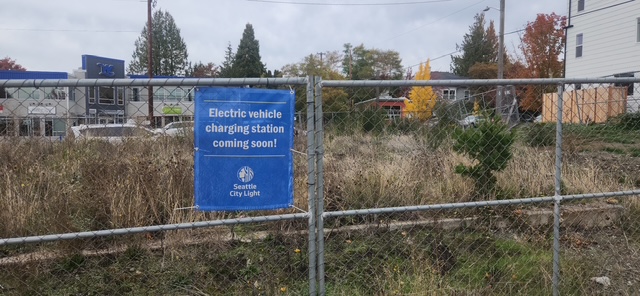 (November photo of Morgan Junction site)
MORGAN JUNCTION EV LOT STATUS: Meantime, City Light has not yet started work at the eight-charger EV lot site in Morgan Junction. Last fall, City Light revised the expected start date of construction multiple times. It’ll likely be a topic at the upcoming quarterly meeting of the Morgan Community Association on January 21st, so we asked SCL spokesperson Jenn Strang if there’s a chance it’ll be under construction by then. Her reply:
The current status of the project is that we are in the pre-construction submittal phase with the contractor. This process includes reviewing and approving requirements such as the safety and environmental plans. It is vital to ensure public safety before starting construction. The official start date of construction will be set once all the required approvals have been obtained.
When we first reported on the charging-lot plan in 2022, the utility was saying construction could start by the end of that year.
Second Thursday arrives on the early side this month – next Thursday, January 8 – so here’s a look at one of this month’s second-Thursday features: Words, Writers, Southwest Stories, presented online by the Southwest Seattle Historical Society. For January, the topic is “Wild in Seattle” – a book by David B. Williams, one of the two guest presenters. Here’s the SWSHS announcement:
Join author David B. Williams for a conversation about his 2025 book, “Wild in Seattle: Stories at the Crossroads of People and Nature.” Published in April, Wild in Seattle contains 47 essays exploring the geology, flora, and fauna around Seattle.
Williams, an award-winning natural-history writer, explores the way both nature and humans have shaped Seattle, from earthquakes and tsunamis to animal migration and architecture. David will be joined by historian Judy Bentley, author of” Hiking Washington’s History” and “Walking Washington’s History,” to discuss how history and geology has shaped our city.
You can RSVP for their 6 pm Thursday presentation – and read more about them – at this page on the SWSHS website.
| 0 COMMENTS