
- This topic is empty.
-
AuthorPosts
-
October 23, 2013 at 6:56 pm #789035
PangolinPieParticipantI really want to thank all the people in this thread; I am fascinated by this issue and it has moved me to the anti-522 camp based mainly on VBD’s coherent comments.
I read this the other day, though, and it has nearly swayed me BACK to pro-522, but not for the reasons you might think:
http://www.marklynas.org/2013/10/why-we-need-to-label-gmos/
I’d be curious to hear what people on both sides think after a careful reading of that article.The author comes from a standpoint that believes GMOs are not harmful, and that labeling will make the concept more comfortable to the consumer. By passing this law, anti-GMO people could be shooting themselves in the foot, as it were.
He says: “I believe that this could radically change the game on GMOs. Suddenly they would be ubiquitous – as indeed they already have been for 15 years. Secrecy breeds fear. Familiarity brings acceptance and understanding.”
I think he could be right, and I frankly think this would not be a bad thing in the long run.
October 23, 2013 at 6:58 pm #789036
JoBParticipantblbl..
i checked the Oregon Tilth organic certification website to find out what they had to say about Bt since their standards are considered pretty universal .. and found this..
yes, Bt is used topically in certified organic farming
but only the use of only non GMO Bt
i am not sure where you got the idea that plants genetically modified to produce their own Bt (GMO)
or GMO Bt are still considered organic… but my basic research indicates that you are wrong.
btw.. a quick primer for those who have no idea what Bt is.. or why they might care…
wwBacillus Thuringiensisw.bt.ucsd.edu/gmo.html
October 23, 2013 at 7:05 pm #789037
DESMemberThanks for your response TanDL and JanS. I understand where you are coming from but I wonder if you would ever be satisfied. For the examples given there were obviously serious problems that showed up, but I’m not sure there was a feasible testing program that would have caught it at the time. Thalidomide was actually an accute effect, acting just during pregnancy. Cigarets were called “cancer sticks” during WW2 or even earlier, it was no secret that they caused cancer or emphysema, they just weren’t regulated so tightly until recently. The tobacco companies certainly suppressed a lot of stuff and lobbied hard and effectively, nonetheless there is a long history of quality sudies linking tobacco to disease, but for GMOs all the quality independent studies find no such link (e.g. http://www.sciencedirect.com/science/article/pii/S0278691508000884 also this article describes exactly how EFSA assesses safety, but the article is behind a paywall, if you are at a university you may have access http://rd.springer.com/article/10.1007%2Fs11248-013-9741-4). Low radiation soil and HRT though are solid examples of unexpected long term risks, though. Safety studies also get better because we learn a lot from incidents like those -cold comfort I know. However, it is just not practical or realistic to expect every drug or soil or GE trait to be field tested for 20 years before its available, but each drug and each GE trait do undergo about a decade of testing in various systems including animal models including models meant to replicate long term exposure. It has been estimated that it costs 100 million dollars to develop new GMOs (from an anti-GMO source: http://www.rodale.com/research-feed/genetically-modified-organisms-huge-price-tag-limited-benefits) and billions of dollars to develop new drugs (http://www.forbes.com/sites/matthewherper/2013/08/11/how-the-staggering-cost-of-inventing-new-drugs-is-shaping-the-future-of-medicine/). Adding another decade to the testing thereby increasing costs and limiting the time a company has to recoup investment before the patent runs out will stop the industry cold. Maybe that’s a goal. All pesticides and herbicides undergo the same extensive testing, but conventioally bred plants and animals do NOT. See the link I posted about the Lenape potatoes in an earlier post or just google Lenape potato for an example of a toxic non-GMO food. Unfortunately it is just the nature of new things that they carry risk and GMOs are no different than any other food or drug. And I-522 labeling wouldn’t help at all in this regard because it does not enable tracking of the individual ingredients. If there were a problem with a GMO it would be with a particular trait, not all of them collectively because they are so different. In your examples say thalidomide, it could be fingered as the culprit because doctors new which medication the women were taking. If they only knew the women took some unspecified medication, we would never know which one caused birth defects.
October 23, 2013 at 7:15 pm #789038
DESMemberJoB,
You are correct re Bt and I initially had the same thought as you. But what I think blbl is saying is that it is hypocritical that the consumer can be exposed to the exact same Bt proteins, however if the bacterial spores are sprayed topically they are organic and awesome but if the plant makes the proteins by itself, they are evil/scary GMOs.
October 23, 2013 at 7:30 pm #789039
DESMemberI have had some of the same thoughts PangolinPie, but in lean economic times for the state I am personally not sure those goals reach the threshold of “worth it”. If it comes down to labeling vs public school teacher salaries, I personally choose teachers every time. As a scientist I also have principled objections to the most vocal anti-GMO folks’ refusal to believe abundant empirical evidence, a la the climate change deniers and anti-vaccine camps.
Mark Lynas is an interesting and well spoken guy in his total reversal of position on GMOs. See these videos, they are long but interesting.
http://www.marklynas.org/2013/01/lecture-to-oxford-farming-conference-3-january-2013/
October 23, 2013 at 7:50 pm #789040
TanDLParticipantOf course I’ll be satisfied. I’m not a conspiracy nut, but I do take history into account and the history of “This is safe – quit worrying about it” products isn’t all that pretty. I want some more time and testing on the books! I want to know if there’s a correlation in the rise of disease, obesity and allergies with GE foods, which all began to accelerate about the same time. I don’t think that’s an unreasonable request and frankly I don’t care what it costs companies or government to find out. When something goes wrong with our food supply, we don’t have much of a choice in how it affects us, unless we want to hunt wild game and grow our own food from seed stock that’s not sold commercially. I don’t live the kind of lifestyle that can sustain that activity, so I’m stuck relying on grocery store shelves.
And I’m not a total anti-GE person. I get that we have to figure out how to feed an expanding world population, I get that changing climates will require changing farming methods and I completely get how important it is to figure out how to improve agricultural processes in order to feed large populations. But, when you start adding foreign DNA into the basic food supply, doesn’t it make sense to be absolutely sure that those foreign substances don’t affect us negatively – especially given the track record in this country of things declared “safe” which hasn’t been all that pristine? So give me a choice while you’re testing. And when you have 10 or more years of testing from today on the books that show these GE products are safe, I’ll be satisfied.
Meanwhile, I’ve already voted FOR 522. It might be stuck down in the courts eventually, who knows? But, I for one want to make a loud statement that says I’m concerned about the safety of our food supply and I don’t want large agri-business telling us everything is perfectly OK without some serious long-term testing of their products.
October 23, 2013 at 8:00 pm #789041
PangolinPieParticipant“And when you have 10 or more years of testing from today on the books that show these GE products are safe, I’ll be satisfied.”
Here are 1,783 studies going back ten or more years. Satisfied?
http://informahealthcare.com/doi/abs/10.3109/07388551.2013.823595
A spreadsheet of the studies:
http://www.geneticliteracyproject.org/wp/wp-content/uploads/2013/10/Ge-crops-safety-pub-list-1.xls
A summary:
“The researchers couldn’t find a single credible example demonstrating that GM foods pose any harm to humans or animals. ‘The scientific research conducted so far has not detected any significant hazards directly connected with the use of genetically engineered crops,’ the scientists concluded.”
So…there’s that.
October 23, 2013 at 8:03 pm #789042
TanDLParticipant“…ten or more years of testing from today…” That’s what I wrote and that’s what I mean. And I’d like to know what they consider “credible.”
October 23, 2013 at 8:15 pm #789043
PangolinPieParticipantOk, fair enough; you’re looking for a total of 20 years or more of testing. Though I suspect in ten years this won’t be as much of an issue any more.
October 23, 2013 at 8:16 pm #789044
JanSParticipantI am one who was harmed years go by the supposedly harmless HRTs, which were supposed to be “good for me”. Little did I know that there was a side effect that caused me to be hospitalized for 4 months, and almost proved fatal twice. It is now on the label, albeit way down on the list. And even after that illness, my doc still tried to get me to take it, because it was “good for my heart”. Then it wasn’t good for my heart, just the opposite. So, I’m all for disclosure. I am not a scientist. I don’t know more than some of you about all the studies, etc. But I do know that I want a choice. I don’t care if you want to GMO your products…go ahead…but tell me. I don’t care if you GE your products…go ahead…but tell me. And let me decide whether I want to use that product or not.
October 23, 2013 at 8:59 pm #789045
VBDParticipantSomething I find interesting related to what’s been brought up, is that a person’s trust in “science” and “authority” has more to do with their belief than with facts and data.
Whether a person believes the prevailing scientific opinion on global warming (that humans are playing a significant role in climate change) depends more on their political/religious leanings than on the data they are presented. Belief, or even faith, has more impact than data.
An outcome of these belief driven opinions is that we apply differing requirements for validation. Again, in the case of climate change, a person who believes humans are impacting our climate easily accepts the prevailing science, and just as easily dismisses the naysayers, by saying that the scientific evidence is overwhelming.
On the other hand, if a person is on the opposite side of the argument, they will demand that the negative be proven. Meaning, they insist that you provide proof the observed climate change ISN’T natural. Which is, of course, impossible to do.
Likewise, people who do not like the idea of GE foods will believe they are unsafe regardless of the science, and will not be swayed by data.
So as excellent as the data above are, and regardless of how accurate the scientific sources are, you will not be successful in changing many minds.
Peter Sandman is an authority on risk communication. He has developed a model of risk that states that risk = hazard + outrage. It implies that things like fear and trust play just as big a role in peoples perception of risk as the actual hazard. In reality, outrage plays a much bigger role, and is the primary driver for people’s opinion of risk.
Here’s one of his articles. The parallels to the GE issue are apparent:
October 23, 2013 at 9:11 pm #789046
VBDParticipantJanS, I’m sorry to hear about your bad experience, and I completely understand why you would be so weary about GE foods.
But I-522 will absolutely NOT tell you what is or is not in your food with any reasonable level of certainty. In fact, at best, it can only let you know something MIGHT be in the food, but there would be no way of knowing what or how much.
If you you truly want to avoid GE foods, forget about the labels that I-522 would mandate, and only select certified GE-free foods, or USDA organic certified.
Even foods without the silly “may contain..” labels might have GE ingredients, since there is no testing requirement. A food producer can get out of having to label by simply stating they haven’t “knowingly” added any GE ingredients.
October 23, 2013 at 9:59 pm #789047
DESMemberJoB,
I am not trying to convince you as you already made up your mind, but there may be others who are undecided and deserve accurate information. As for your assertion on long term health and obesity, allergies, and disease (I’ll use cancer as an example):
GM crops were introduced in 1996 and from say 1998 – 2013 the percentage of acres planted with GE crops has tripled or quadrupled – from 20% to 60-80% of acres. http://www.ers.usda.gov/ImageGen.ashx?image=/media/1141089/biotechcrops.png&width=480
Cancer rates (diagnosis) increased from 1975 until 1992 when they started to drop and have been pretty steady or decreasing since 1995. http://progressreport.cancer.gov/doc_detail.asp?pid=1&did=2011&chid=103&coid=1020&mid=#measuring
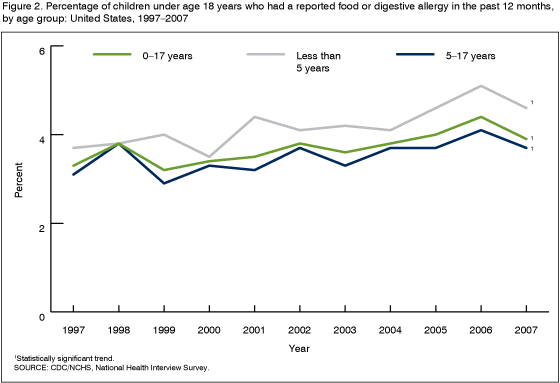
Allergy rates have been increasing since at least 1997 but have increased about 1.5 fold – from about 3% to a little over 4%. http://www.cdc.gov/nchs/data/databriefs/db10_fig2.gif
Obesity rates in the US have also increased at a linear rate by a total of about 1.5 fold since 1980 (i.e. 15 years before GMOs)- 44% to 65%. http://i1.wp.com/www.healthhabits.ca/wp-content/uploads/2013/03/overweight-rates.jpg Also England where GMOs are less prevalent (https://www.gov.uk/government/policies/making-the-food-and-farming-industry-more-competitive-while-protecting-the-environment/supporting-pages/genetic-modification)saw a parallel trend in obesity rates.
Correlation does not equal causation, but in this case there is no correlation. When looking at the graphs make sure you pay attention to the Y (vertical) axis.
October 24, 2013 at 12:44 am #789048
JanSParticipantVBD…it’s a start..it’s not perfect, I’ll agree….do you have a better solution? And, if that solution is to just not tell us what’s in our food,or might affect us if we eat it, why do you feel that way?
October 24, 2013 at 12:57 am #789049
VBDParticipantAgain, I don’t believe this is a start at all. I believe it’s a step in the wrong direction.
There are several good templates for how to do this labeling thing in an effective way. The European Union has a very good program. It mandates that food producers list the ingredients such that anything GE is indicated as such on the ingredient label. Simple, effective, cheap.
Making retailers police labels will not work. It will create burden and cost for grocers, and will reduce the availability of some food. And not just GE food, but a lot of non-GE food as well.
The logic of I-522 is like having a state speed limit, and expecting car companies to make cars that won’t exceed our limit. It simply does not follow.
Out of state food producers would not be obligated to label food under I-522. That’s the fact. The issue as to how the retailers convince food producers, or wholesalers, or distributors or whomever to actually add the labels is completely undefined.
It’s a bad law. We should instead do it like the Europeans.
October 24, 2013 at 1:15 am #789050
WorldCitizenParticipantI gotta tell you, VBD has very much swayed my opinion of the quality of this proposed law. Well argued, reasoned and clear, his (her?) points can not be denied. Poorly written laws have no place in society. We have too many already to add another to the books.
I would advise anyone I meet to vote against I-522 and encourage them to petition out lawmakers instead for a more appropriately written law to maintain a well informed public.
October 24, 2013 at 3:16 pm #789051
JoBParticipantI love what TanDL said..
” I for one want to make a loud statement that says I’m concerned about the safety of our food supply and I don’t want large agri-business telling us everything is perfectly OK without some serious long-term testing of their products.”
beyond that.. i really do want as much information as i can get about where my food comes from and how it is produced… even if the information is limited to whether GMO ingredients might have been used to produce that food.
What you don’t know can hurt you…
it is certainly hurting our pets..
thousands are dead and hundreds of thousands ill due to the consumption of jerky treats.
The labeling deniers would tell me that reading the labels to see if the treats i purchase for my pets are made in China is a useless endeavor that hurts american businesses who import their dog treats from China…
because we don’t know what is killing those dogs.
Still… i think a sensible person looks at the possible risk
and based on that possibility makes choices.
In my case i don’t purchase pet treats made in China.. period… which by the way eliminates most of the pet treats sold in our local groceries.
I can make that choice because of a law that requires manufacturers to label country of origin on their treats.
it’s that simple.
without the labeling law, you don’t have the option of making your own risk assessment of the foods you purchase.
without this law, there will be no GMO labeling at all… and very little chance for the future (better) labeling.
Accountability starts somewhere..
it might as well start here.
October 24, 2013 at 3:31 pm #789052
VBDParticipantJoB, what if the label on the jerky treats said “may be produced in a non-US country”, but didn’t tell you which country? Or even if it truly was produced outside the US?
Would you think that is enough information to do your own risk assessment?
October 24, 2013 at 3:47 pm #789053
JoBParticipantVBD..
Yes, i would.
call me old fashioned …
but if a manufacturer doesn’t want to tell me where and how the product i am buying from them is manufactured and doesn’t want me to know the source of it’s ingredients…
then I have to think that there is something about that process that they think i wouldn’t like if i knew about it.
This notion that consumers are so reactionary that they can’t make a good choice about what they purchase because they will react indiscriminately to buzzwords is insulting to the American consumer…
who btw.. just happens to be predominately female.
Every time someone tells me not to worry my pretty little head about something…
it’s a heads up that there is something there i should investigate further.
October 24, 2013 at 4:01 pm #789054
VBDParticipantIt’s not about what the manufacturer wants or doesn’t want to tell you. It’s about what the law compels them to tell you.
The reason why food will say “made in China” is because that is how it’s defined to be labeled by law.
If the law required that the product be labeled “may be imported”, then that’s what it would say. Food manufacturers will follow the laws that apply to them, so if we want good information, we need good laws.
There are thousands of facts about our food that we have no clue about. By your reasoning above, you wouldn’t buy anything at all.
Many people are very concerned about how and where their food is grown. But we usually don’t know what types of fertilizers, pesticides, soil, irrigation, harvesting, or which hybrid of seed was used in our food production.
If we want to know any of these things, we need to have a way to assure all food producers give the information in a clear and consistent way. The best way to achieve that is by passing a law.
If the law is any good, we would certainly get better information than something like “may be fertilized”.
October 24, 2013 at 4:25 pm #789055
JoBParticipantVBD..
Now tell me honestly..
do you really think that if I522 is defeated on the grounds that it only tells you that GMO products may be included
that another subsequent bill will pass if it drops “may” …
do you really think that the financial responsibility of informing consumers that GMO products may be included in their products
will lesson if producers have to investigate and certify each and every ingredient used in their products?
No, you are a reasonable and intelligent person. You don’t.
The truth is that the flaws in this legislation aren’t the real issue here..
GMO labelling of any kind backed by law is the real issue.
you state
“Many people are very concerned about how and where their food is grown. But we usually don’t know what types of fertilizers, pesticides, soil, irrigation, harvesting, or which hybrid of seed was used in our food production.
If we want to know any of these things, we need to have a way to assure all food producers give the information in a clear and consistent way.”
there is a group of food producers who do just that.. and as a result they are entitled to label their food organic.
Beyond that, there is a growing movement among specialty food producers to create websites and seek alternate certifications that give consumers that kind of information for food products that can’t be labeled organic.
there are grocers that stock only those food products that meet their own strict certification standards.. and they are strict. my favorite cleanser/moisturizer product was banned from the local PCC because of a single ingredient that failed their standards.
An alternate truth that is not being told is that resisting GMO labeling actually places an unfair disadvantage on retailers who would like to cater to the less price driven market of consumers who will pay more to know exactly what is and isn’t in their food products …
they miss a substantial amount of profitable business from consumers who don’t have the time to stand in the aisles reading the full ingredient list or research each and every item they purchase…
it’s simply a lot easier to shop where the work has already been done for you.
The market is changing … and food producers would be better served by adapting to the changing market than attempting to block all disclosure laws
October 24, 2013 at 4:54 pm #789056
VBDParticipantThere is too much listed above to go though it in detail but here’s a couple final points:
“Organic” implies that several criteria have to be demonstrated, and those criteria are clearly defined. I have no problem with that, nor do I have an issue with labeling foods as “GE-Free”. In fact, that is the best way to deal with the issue. I-522 does the opposite by declaring all food contains GE ingredients unless you prove it doesn’t, then it’s entitled to have no label to show it’s GE-free. That’s completely backwards
Next, I don’t know how you came to this conclusion:
“An alternate truth that is not being told is that resisting GMO labeling actually places an unfair disadvantage on retailers who would like to cater to the less price driven market of consumers who will pay more to know exactly what is and isn’t in their food products … “
How would that be true? Currently, any food producer can say their food is “GE-free” without any costly government intervention. Lack of regulation, in this case, would HELP those who want to define their own criteria, not restrict them.
October 24, 2013 at 10:57 pm #789057
JoBParticipantVBD..
have you ever taken your food cart around one of our local grocery stores and tried to find the section that had organic and GMO free foods?
For a while most major retailers had such a section.. i could go straight to it and make my purchases..
but some marketing all-star decided that if i did that i wasn’t looking at the rest of the store.. so they decided the stores should integrate all organic and GMO free products on their shelves…
as a result, i get to spend three or four times the amount of time in my local retailer to find what i used to come in to purchase… because i have to literally read the label on every product i purchase
and i still don’t buy anything more than i would have if they had made it easy for me to find…
in fact.. i purchase less because by the time i find what i want i am more than ready to get out of the store.
i would welcome a simple one step check for answers to my consumer questions..
i would reward those retailers who provide it with more of my business..
i suspect i am not alone.
The simple truth is that the customers who won’t buy foods labeled that they may contain GMO products are the customers those retailers are currently losing because they have made it too difficult for those customers to find the products they want to purchase..
ergo.. easily identifiable labeling would likely bring some of those customers back into the store
and since those customers are those who are willing to pay more for products that meet their standards.. they are likely to make more higher end purchases while they are there..
the logic of that really isn’t so hard to follow if you know anything about consumer shopping habits..
October 24, 2013 at 11:52 pm #789058
VBDParticipantOK, I’m confused with what you’ve said. Are you saying you would buy unlabeled food as long as it’s in the organic aisle? So is what you want a law mandating organic sections in stores?
I have seen lots of GE free and organic foods on shelves, and find them quite simple to identify. In fact, the green color and consistent graphics make it pretty darn easy.
I-522 will NOT designate isles or sections for food. They would have a simple, text-only message on some food, and no message at all on other food. Which has GE and which doesn’t would, at best, be a guess, since the label is indefinite.
Seems to me that if what you are looking for is an easy way to let you know something is GMO free is by selecting a package that says “GMO free”. If it doesn’t say “GMO free”, it might have genetically engineered ingredients.
October 25, 2013 at 12:55 am #789059
JanSParticipantwell, then, I suppose we’ll see come Nov. 05., won’t we? People feel strongly, either for or against. And people are voting now…
-
AuthorPosts


- You must be logged in to reply to this topic.