
- This topic is empty.
-
AuthorPosts
-
October 25, 2013 at 1:22 am #789060
JoBParticipantThe consumer’s union.. those folks who publish Consumer’s Report.. endorse I522
October 25, 2013 at 1:44 am #789061
JoBParticipantVBD..
“OK, I’m confused with what you’ve said. Are you saying you would buy unlabeled food as long as it’s in the organic aisle?”
Absolutely not!
“So is what you want a law mandating organic sections in stores?”
Nope.. i am happy to support this one.
“I have seen lots of GE free and organic foods on shelves, and find them quite simple to identify. In fact, the green color and consistent graphics make it pretty darn easy.”
I hope you don’t just pick up those products on the basis of what you think is an organic looking or green appearing label.
You might find a very nasty surprise if you read the actual ingredients and source the manufacturer and/or distributor.
sort of like the actual definition of free range on your egg carton… look that one up.. the way that one has been interpreted is amazing.
“I-522 will NOT designate isles or sections for food. They would have a simple, text-only message on some food, and no message at all on other food. Which has GE and which doesn’t would, at best, be a guess, since the label is indefinite.”
Who said it would?
what i said was that the simple text only message would be easy to locate,
making buying decisions for those who pay attention to labels much faster and easier.
“Seems to me that if what you are looking for is an easy way to let you know something is GMO free is by selecting a package that says “GMO free”. If it doesn’t say “GMO free”, it might have genetically engineered ingredients.”
So.. you are saying that i should assume that every product that doesn’t specifically state GMO free has GMO ingredients because it doesn’t have a GMO free label?
Isn’t that kind of prejudicial of you?
If such clear labeling already existed..
we wouldn’t be debating this initiative
the truth is that such clear and easy labeling does not already exist.
the fact that it does not exist
and the products I might buy from a regular grocery are not so simple to identify
means that I and other consumers like me
do more and more of our shopping either online or in specialty markets.
local grocers are losing business they would otherwise get from shoppers like me
because we are unlikely to make a special trip to the local grocer just to pick up selected items and non-grocery items.
Ergo.. they are losing business they might otherwise have because the food products they sell are not clearly labeled.
I am quite clear about the point i am making even if you seem unable to understand it..
or were you just trying to twist what i had to say because try as i might not to see it i detected the unwelcome stink of condescension in your post.
either way..
i broke my points down into tiny phrases to make it easier for you to understand…
or conversely…
much more difficult to misunderstand ;->
October 25, 2013 at 2:10 am #789062
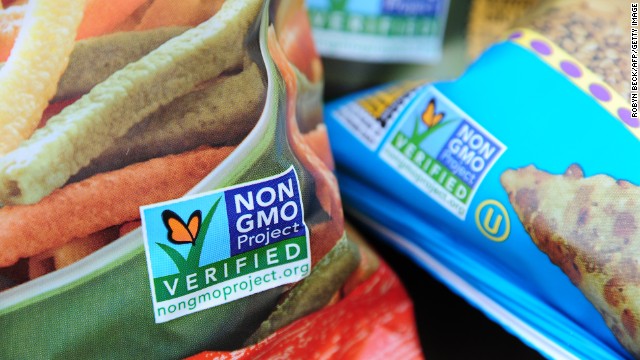
VBDParticipantJoB, you have not made your statement any clearer to me. Let me use some visual aids. From the Yes on 522 folks here’s an example of one possible label that 522 would mandate:
From what I understand you to say, is that finding packaged food without that label would be easier than finding food with this one:
http://i2.cdn.turner.com/cnn/dam/assets/130625084256-non-gmo-label-story-top.jpg
Or this one:
http://cfile4.uf.tistory.com/original/1404E74F4DBFEA48039F81
October 25, 2013 at 2:27 am #789063
JoBParticipantVBD..
No.. i didn’t say finding either of those labels would be easier… you did.
as you well know, those labels already exist..
they are the symbols of a pretty extensive and expensive certification process that is financially out of the reach of many small businesses…
not having a reading comprehension problem,
i don’t have any problem with that small notification right on the front of the package…
which does not carry with it an expensive certification process…
just a little due diligence on the part of the producer.
i would like to point out that It’s no wonder you have difficulty understanding my point when you attribute what you say to me.
And it’s likely why i found both this post and your prior one condescending in tone.
October 25, 2013 at 2:27 am #789064
VBDParticipantI can’t let these two statements go unanswered though:
“So.. you are saying that i should assume that every product that doesn’t specifically state GMO free has GMO ingredients because it doesn’t have a GMO free label?
Isn’t that kind of prejudicial of you?”
No it’s not prejudicial of me. It’s well publicized that as much of 70% of packaged foods have some sort of GE derived ingredients. So it is, in fact, a pretty sure bet that if it is not labeled as GE-free, it has GE ingredients.
And next:
“If such clear labeling already existed..
we wouldn’t be debating this initiative
the truth is that such clear and easy labeling does not already exist.”
I’ve just provided two examples of labels that are currently in use, quite clear, easy to understand, and generally recognizable. They are also specifically identified in I-522 as being exempt from the GE label, so they darn well better be accurate. Otherwise there will be NOTHING you can depend on.
The two statements above are your weakest arguments yet. I think you’re getting tired. As am I.
Let’s just vote already.
October 25, 2013 at 2:31 am #789065
JoBParticipantVBD..
I already voted.. as i suspect you did.
That’s not why either of us are still posting.
i addressed both of your “points” in the last post.
neither of those labels, organic or non-GMO are financially feasible for many small producers of food products.
due diligence is …
so this labeling could actually increase consumer choices…
October 25, 2013 at 2:36 am #789066
VBDParticipant“they are the symbols of a pretty extensive and expensive certification process that is financially out of the reach of many small businesses…”
Wrong!! The process to get the certifications is essentially the same process required to get out of having to label the food as being GE.
You clearly do not understand what I-522 says yet. It declares that ALL food contains GE ingredients unless it is proven to not have them. The act of proving GE ingredients are not in the food is one of the parts that costs money. The “proof” means that you have fulfilled the requirements of either the USDA organic certification or the non-gmo project certification. Alternately, you can claim you don’t know, and get a pass if you legally swear you really don’t.
Read the initiative already, it’s all there.
October 25, 2013 at 3:09 am #789067
JoBParticipantFound on I522 on page I-2570.1/12
“(3) Subsection (1) of this section does not apply to any of the
following:
(a) Food consisting entirely of, or derived entirely from, an
animal that has not itself been genetically engineered, regardless of
whether the animal has been fed or injected with any food produced Code Rev/AI:crs 7 I-2570.1/12
with genetic engineering or any drug that has been produced through
means of genetic engineering;
(b) A raw agricultural commodity or food that has been grown,
raised, produced, or derived without the knowing and intentional use
of genetically engineered seed or food. To be included within the
exclusion under this subsection, the person supplying a raw
agricultural commodity or food must provide a sworn statement that the
raw agricultural commodity or food: (i) Has not been knowingly or
intentionally produced through genetic engineering; and (ii) has been
segregated from, and has not been knowingly or intentionally
commingled with, foods that may have been genetically engineered at
any time. In providing such a sworn statement, a person may rely on a
sworn statement from his or her own supplier that contains such an
affirmation;”
The certification process for organic is pretty detailed.
To help you understand some of the differences..
livestock fed GMO feed does NOT meet the criteria for Organic…
nor do non-GMO crops unintentionally co-mingled with GMO crops…
such as a non-GMO crop grown in a field next to a the same crop grown with GMO seed without a barrier to contain cross-breeding.
nor would this label require outside certification or inspection..
All Organic and non-GMO certified food products are exempt because their certification far exceeds the standards required by I-522
October 28, 2013 at 2:28 pm #789068
JoBParticipantthis Mother Jones article fell into my inbox this morning…
It references the study i was too lazy to look up earlier that shows that GMO crops now require more chemical use.. not less..
“By 2011, farms using Roundup Ready seeds were using 24 percent more herbicide than non-GMO farms planting the same crops, Benbrook told me. What happened? By that time, “in all three crops [corn, soy, and cotton], resistant weeds had fully kicked in,” Benbrook said, and farmers were responding both by ramping up use of Roundup and resorting to older, more toxic herbicides like 2,4-D.”
http://www.motherjones.com/tom-philpott/2012/10/how-gmos-ramped-us-pesticide-use
October 28, 2013 at 6:40 pm #789069
wakefloodParticipantThat’s crazy! Who would’ve thunk?!? Besides everyone who knows how this stuff works, I mean. The law of unintended consequences rears its head yet again…
October 28, 2013 at 8:50 pm #789070
DESMemberOnce again. Yes, Roundup Ready results in more herbicide, specifically glyphosphate, being sprayed. But that is 1, ie ONE trait. It is the most widely planted trait, present in some corn, most soy, canola, cotton and sugar beets, but still just a single trait. Also to quote the article
“In light of its generally favorable environmental and toxicological properties, especially compared to some of the herbicides displaced by glyphosate, the dramatic increase in glyphosate use has likely not markedly increased human health risks.”
So to say all GMOs result in more herbicide being sprayed is disingenuous and highlights one of the failings of I-522 lumping all GMOs together. Without doubt increased glyphosphate use has increased resistant weeds, but that is not an unexpected consequence, it was totally predictable. The weeds did emerge faster than expected probably due to the quick adoption of the seed varieties.
No one here has ever said all GMO varieties are perfect, but wise choices require usable information which I-522 does not provide. Perhaps you would like to specifically avoid Roundup Ready ingredients- reasonable request. I-522 won’t really help you though.
October 28, 2013 at 8:54 pm #789071
JanSParticipantdoesn’t mean we should just ignore and give a pass. I still want to be informed, so I can make the choice for myself, not someone else being the decider.
October 28, 2013 at 9:22 pm #789072
VBDParticipantJanS, you say you want “information”, but you really won’t be getting any from I-522.
OK, here’s yet another analogy; what if the weather forecast today was:
“It might rain today.”
Now you might think that’s useful, right? I mean, it tells you at least it’s not certain, and that might be valuable, so perhaps you should bring your coat to work today.
Now what if that was the forecast EVERY DAY? Each day, all the weather report tells you is “It might rain today.” Or maybe somedays there is no forecast.
So those are your two choices; “it might rain” or no forecast at all.
Can you see how an ambiguous non-specific statement adds absolutely no value? That’s how many of us feel about I-522.
October 28, 2013 at 10:03 pm #789073
JanSParticipantand you have every right to feel that way…as I have a right to feel the way I do. I’ve voted…hope you have, too. Arguing here will not change whatever outcome there is after the election.
October 28, 2013 at 10:58 pm #789074
DESMemberhttp://www.realclearscience.com/blog/2013/10/massive-review-reveals-consensus-on-gmo-safety.html
the real article is here (but its behind a paywall):
http://informahealthcare.com/doi/abs/10.3109/07388551.2013.823595
October 29, 2013 at 3:13 am #789075
JoBParticipantVBD..
we will get more information from I522 than we have today ;)
DES..
from the Mother Jones article i sourced above..
” in a just-released paper published in the peer-reviewed Environmental Sciences Europe, Chuck Benbrook, research professor at Washington State University’s Center for Sustaining Agriculture and Natural Resources, shreds that claim. He found that Monsanto’s Roundup Ready technology, which dominates corn, soy, and cotton farming, has called forth a veritable monsoon of herbicides, both in terms of higher application rates for Roundup, and, in recent years, growing use of other, more-toxic herbicides.
Benbrook found that overall, GMO technology drove up herbicide use by 527 million pounds, or about 11 percent, between 1996 (when Roundup Ready crops first hit farm fields) and 2011. But it gets worse. For several years, the Roundup Ready trait actually did meet Monsanto’s promise of decreasing overall herbicide use—herbicide use dropped by about 2 percent between 1996 and 1999, Benbrook told me in an interview. But then weeds started to develop resistance to Roundup, pushing farmers to apply higher per-acre rates. In 2002, farmers using Roundup Ready soybeans jacked up their Roundup application rates by 21 percent, triggering a 19 million pound overall increase in Roundup use.
Since then, an herbicide gusher has been uncorked. By 2011, farms using Roundup Ready seeds were using 24 percent more herbicide than non-GMO farms planting the same crops,”
this is not a review of research published in Scientific literature for the last 10 years.. research that has been primarily funded by the industries that manufacture GMO products…
this is a local professor at one of our local schools, Chuck Benbrook, research professor at Washington State University’s Center for Sustaining Agriculture and Natural Resources, who looked specifically at pesticide use.. and he compared farmers using GMO crops with those who had planted non-GMO crops…
that’s about as gold standard as it gets…
October 29, 2013 at 3:57 am #789076
VBDParticipantJoB, I think you are on the winning side of this argument. I’ve had several other debates besides this blog, and I’ve gotten the impression that there are many more people in favor of I-522 than against it.
But any law as poorly conceived as this one will not survive. I’ve predicted earlier that this law would be declared invalid before it ever takes effect, and I’ll stand by that prediction.
If labeling, as defined in I-522 does make it into law, I’ll buy you a nice bottle of your favorite GE-free wine.
Oh wait, even with I-522, how would we know?? We won’t…
Let’s just make it some nice organic beer.
October 29, 2013 at 4:45 am #789077
JoBParticipantVBD..
thanks for the offer but i am alcohol free these days..
if i wasn’t.. “GE-free” wine is a whole lot easier to find than you seem to think..
in fact.. confine the search criteria to include grown and bottled here in Washington and wine that is not GMO free becomes very difficult to find.
October 29, 2013 at 8:13 am #789078
JanSParticipantOctober 29, 2013 at 3:53 pm #789079
JoBParticipantFrom Jan’s link
http://chefboyan.com/philosophy/
“Lie: GE foods pose no health safety risks.
Truth: GMOs have never been proven safe. The FDA requires no pre-market health safety studies, and the only long term peer-reviewed animal study conducted involving GMO corn sprayed with Monsanto’s Round Up herbicide, found massive tumors, organ failure and premature death in rats. In addition, a growing body of peer-reviewed animal studies have linked these foods to allergies, organ toxicity, diabetes, cancer, autoimmune disorders, birth defects, high infant mortality rates, fertility problems, and sterility. Clearly, more independent, long term studies are warranted. Until GMOs are proven unequivocally safe, they should be labeled so consumers can avoid them if they choose.”
November 1, 2013 at 10:02 pm #789080
VBDParticipantI read this post linked below, and of course, thought of our discussions here. I won’t attempt to summarize, but just let the article stand on its own.
Enjoy!
November 1, 2013 at 10:50 pm #789081
JanSParticipantI think there’s a misunderstanding among lots of people. I am not “anti-GMO”. If someone wants to “GMO” their food product, good for them…have at it. Just TELL ME. I think we are being labelled unfairly on both sides. I am “PRO-LABELLING”, you are “ANTI-LABELLING”. It’s that simple.
We’re louder? Really? In my book, money talks the loudest, and which side is taking in the most money. And, frankly, if this is not an issue, according to the “anti-labelling” side, why are those big conglomerates putting so much money into it – what are they so afraid of?
In 1996 I was taking HRT. One of the known side-effects was that HRT’s could raise triglycerides. It was not labelled on the packages then. I have battled high triglycerides since my mid-twenties. I ended up in the hospital for 4 months, because I didn’t know that side effect, with severe acute pancreatitis. I almost died twice, spent one week in a coma on a ventilator. If I had known (read:if it had been labelled as such), I would never had taken them. I didn’t have a “choice”. It is now on the labels of HRTs. I want the same choice for GE’d foods. If you don’t care that your food is GE’d, fine..the label wouldn’t mean anything for you. You are the decider, not some company. Give me the same choice.
November 1, 2013 at 11:59 pm #789082
VBDParticipantNot sure if by “you” you meant me but I am not anti-label either. The article was not about labeling. In fact, the word “label” never appears in the article.
She said “the anti-gmo movement is louder”, which you claim not to be a member of.
Confusing post…
November 2, 2013 at 12:17 am #789083
TanDLParticipantSeems like the big agri-Corps could use some new marketing people. In a free marketplace, you create a product or service and sell it as the best thing since sliced bread. In some cases you can even create the demand and then sell your product to meet that created demand. But, the big agri-businesses don’t seem to be trying to sell us anything. It seems to me that they want to keep it all quiet and just slide the stuff onto our grocery shelves without anyone noticing, then spend billions to defeat any measure that comes along demanding to know what they are up to when people do start to notice and express concerns about their products. What a stupid way to do business and I would recommend they read a few business marketing books. Of course what they are doing creates skepticism and concern about their products. Why don’t they label with pride if these GE products are the best thing we could possibly eat?
November 2, 2013 at 12:34 am #789084
JoBParticipant -
AuthorPosts

- You must be logged in to reply to this topic.