Upzoning, round 2, about to go into review. Do you know what’s planned for your neighborhood?

By Tracy Record
West Seattle Blog editor

Whether you agree with their view of upcoming city upzoning or not, residents of one West Seattle neighborhood have advice for you: Find out what’s planned for where you live – don’t assume someone would have contacted you directly to let you know about changes.

The next round of upzoning involves what’s called the Centers and Corridors legislation, which the City Council will consider when it resumes meeting as the Select Committee on the Comprehensive Plan – next meeting 2 pm Thursday, March 19, with its first of two standalone public hearings set for 9:30 am April 6. The focuses include the areas that will become housing/business hubs known as Neighborhood Centers and areas that are considered “transit corridors”; the city says the legislation is meant to:

… implement the vision in the One Seattle Plan by increasing our capacity to build apartments and condos more widely in areas with access to transit, shops, and services. This legislation would rezone land in newly designated Neighborhood Centers, in new and expanded Urban Centers, and along frequent transit corridors.
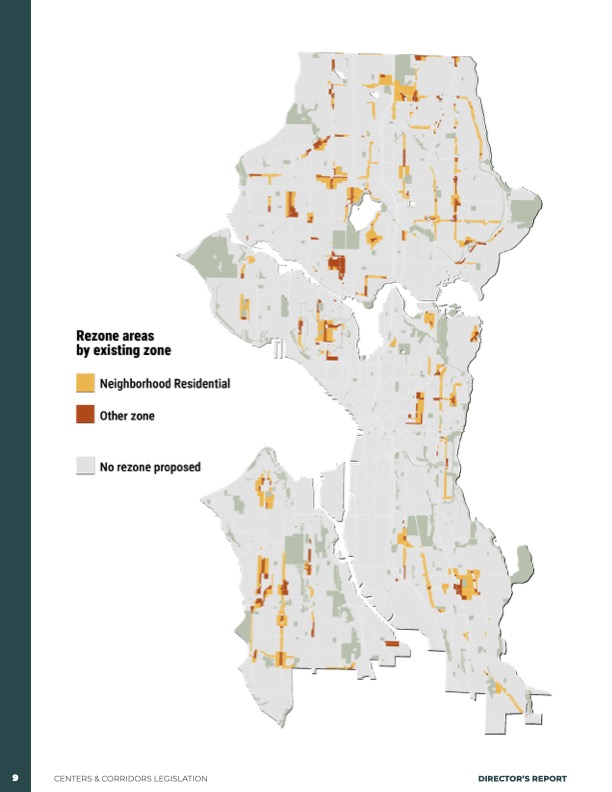
That’s the map included in a city report on the proposals, which we wrote about after the city released them in January. That story led residents of 39th SW north of Morgan in upper Morgan Junction [map] to look into what was planned for their street – using the city’s interactive map.

They discovered, Scott Roberts told us, a dramatic contrast between their side of 39th remaining Neighborhood Residential, and what the other side of their street would be zoned for, Lowrise 2. He provided these before and (potentially) after views to demonstrate what he called an “abrupt zoning edge”:
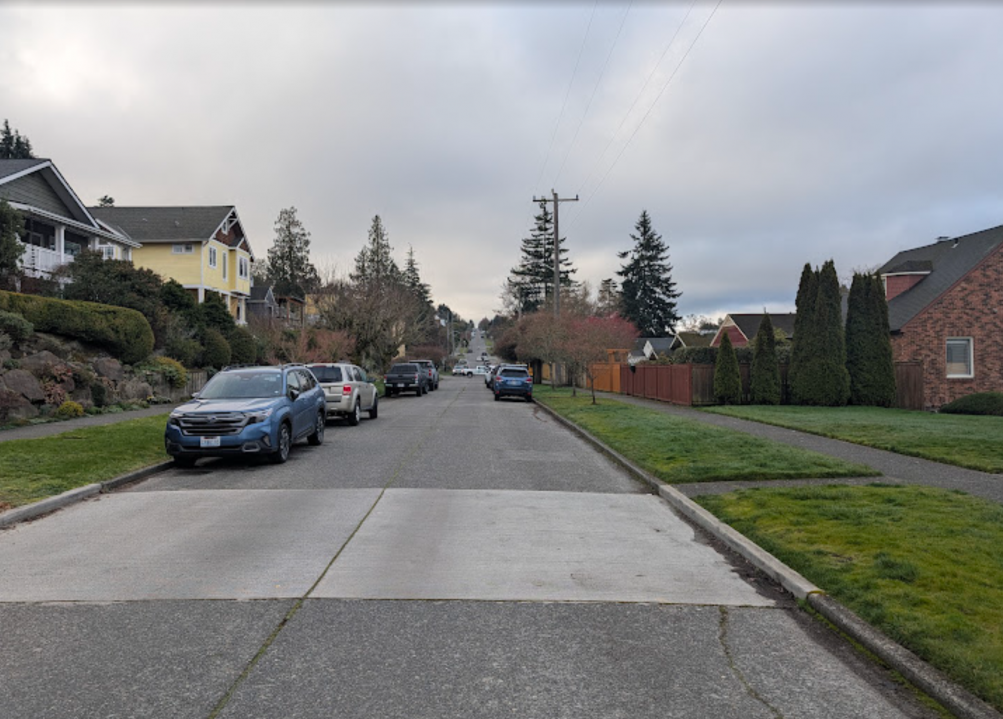
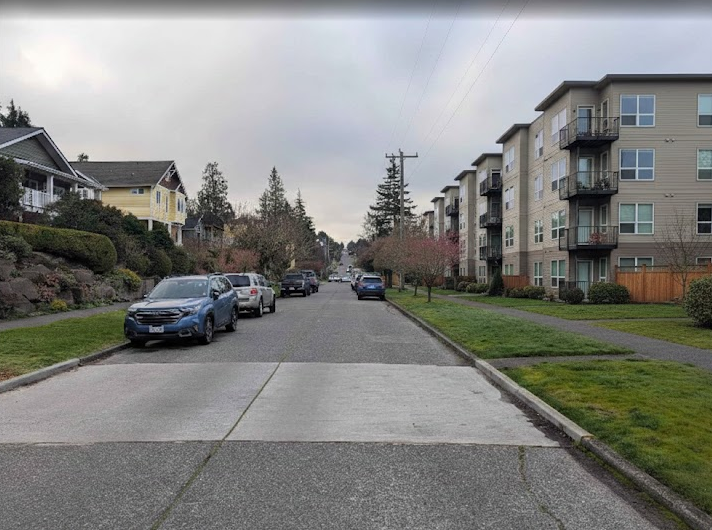
We talked with him and neighbors along their street recently, after one of those neighbors contacted WSB. Their blocks of 39th have many long-time residents; Roberts and his wife have been there 26 years; another neighbor who joined the conversation has been there 29 years; yet another has lived there more than 80 years. (Some newcomers too; yet another told us they’ve lived there three years.) The neighbors have dinners and take trips together and consider each other family. “We’ve put our hearts and souls into this neighborhood,” Roberts says, expecting to live in their 1912-built home for the rest of their lives.

They also expected it would remain a quiet, not-so-dense neighborhood. And they think the proposed zoning change on the west side of the street is based on a mistaken view of how the area fits into the future vision.

They say their street, a long stretch of 39th SW between Holly and Juneau, doesn’t qualify as a “corridor”; it’s just east of Fauntleroy, but buses don’t run there. The closest bus route is the 128 on the SW Morgan hill at the south end of their street. Roberts has done copious research; he and neighbors commented when the proposal was reviewed by the city Planning Commission last month. He’s contacted multiple city offices; so far, he’s heard back from Brennon Staley with the Office of Planning and Community Development, plus an offer to chat with District 1 City Councilmember Rob Saka during his in-district “office hours.”

In correspondence with Staley, Roberts noted it’s not just about height but also about other factors including a 50 percent reduction in required setback in Lowrise 2 – five feet, compared to ten feet for NR – compared to Neighborhood Residential, plus what he describes as “predatory developer pressure,” with property owners already being besieged by builders wanting to buy their homes, even before the rezoning is approved.

Staley’s replies included that the zoning difference was “fairly minor,” with four-story “stacked flats” actually allowable in both zones, plus the observation that the street is 60 feet wide, which he suggested provides “significant separation.”

If the zoning difference is “fairly minor,” Roberts countered to Staley via email, then why rezone at all?” What was “single-family” has already been upzoned, on this block and throughout the city, to at least four units on most if not all parcels, and some neighbors already have added “backyard cottages” (detached accessory dwelling units aka DADUs). Jeff, the 29-year resident, says he’s always been “excited about growth” and even recalled voting for the monorail expansion that once was planned to end at a station half a mile away.

Roberts and his neighbors also say they’re aghast that this change was proposed for their neighborhood – and other changes in other neighborhoods – without direct notification. They’ve been making flyers to circulate. And they’re hoping to convince city leaders to change the plan for their block, as they did with boundaries for some Neighborhood Centers, such as Endolyne before the proposed Centers and Corridors legislation came out.

The ultimate decision is up to the City Council, which starts the review next week and is expected to finalize the Centers and Corridors legislation in July. If you have anything to say about the plan, Roberts and his neighbors note, “Time is of the essence.”

HOW TO GET INVOLVED: Basic info on the Select Committee on the Comprehensive Plan, and its baseline meeting schedule, can be found here. When individual meeting agendas are set – usually a few days in advice – you’ll find them here. Don’t know how to contact councilmembers? Go here.

55 Replies to "Upzoning, round 2, about to go into review. Do you know what's planned for your neighborhood?"

  • Meeee March 10, 2026 (12:20 pm)

    I’m sure I’m well in the minority here, but I’m all for the upzoning.  We live in a city, and there is a desperate need for more housing.  For 30 years I’ve lived in a single family home I own, and i’m on a street that will be upzoned.  I’ve got no problem with it.  I’ve heard the complaints about loss of value in your home, lack of parking, losing the residential feel, etc.  I’m not bothered by the thought of a  3-5 story apartment or condo across the street from me.  When I bought my home in 1995 I was well aware the look of the neighborhood could evolve.  If I’d wanted a guarantee of the aesthetics of my neighborhood I’d have bought in the suburbs with an HOA.

    • k March 10, 2026 (2:11 pm)

      I’m all for it too.  The apartments near me house some of my best neighbors.  There are zero neighborhood events that aren’t made better by more attendance, and the additional neighbors also help keep our favorite local businesses open.  The “after” picture shown seems perfectly reasonable to me.  Perhaps some day there can be apartments on both sides of the street even.  

    • Lauren March 10, 2026 (2:33 pm)

      You’re not alone, I’m all for it! 

    • bolo March 10, 2026 (3:20 pm)

      “We live in a city, and there is a desperate need for more housing.”
      It was pointed out to me in a recent thread that contrary to a common opinion (that I had shared) there is not a desperate need for more housing, but yes there is a desperate need for more affordable housing.

      • Douglas Kilpatrick March 10, 2026 (6:12 pm)

        My reaction to looking at those maps is “wait, why so little?”Upzone me. Upzone my neighborhood. Upzone my street.We need more housing, period. Expensive/affordable/whatever.

        • Jake March 11, 2026 (8:28 am)

          Agree Douglas, we need MORE density than that. This picture should be standard and default. Need way more.

      • North Admiral Neighbor March 10, 2026 (7:53 pm)

        Yep, and with more supply of housing we can help drive down the price of existing and older housing which will make it more affordable for young families. It shouldn’t cost $1m to purchase a basic home in a decent neighborhood of West Seattle.

    • Seattlecris March 11, 2026 (4:37 pm)

      Ticks me off that only developers can build these. How come we can’t make a buck off our own land?

  • MacJ March 10, 2026 (12:26 pm)

    This post only quotes people who’ve owned houses in West Seattle for a long time and are basically unaffected by the rising costs of housing. The post also doesn’t mention that the stretch of 39th in question is one block off Fauntleroy, which seems like a perfectly suitable place to upzone to me.

    I grew up in West Seattle and know how difficult it is for new families to even afford what the older generations dismissively call “starter houses”. Try interviewing some new homeowners or second or third generation West Seattle families trying to keep up with the housing costs to stay in the neighborhoods we grew up in, rather than old homeowners with the time on their hands to fight for 1950s neighborhood design.

    Additionally, I really have no pity for people facing “predatory developer pressure”. When there are so many living on the streets the stress of being offered hundreds of thousands of dollars is hardly something we should be concerned about.

    • WSB March 10, 2026 (2:00 pm)

      Less than a block in some spots; what I wrote is in paragraph 7, “just east of Fauntleroy.”

      • Thomas March 10, 2026 (6:20 pm)

        The whole premise originally was that upzoning was going to bring affordable housing.That has never happened. Developers do not build units that are not profitable. .Developers are modern day carpet baggers!  The city really only cares about expanding the tax base. 

        • Frog March 11, 2026 (10:54 am)

          Exactly right.  There is a newish townhouse for sale in the Alki neighborhood for $720K (~1,100 sf, $640 per sf) that originally sold for $700K in 2023.  It’s a perfect example of the “infill” housing that upzoning advocates promise — part of a three-pack built on a formerly single family lot.  It’s also typical of how new construction is priced and always will be, based on the cost to construct.  It’s been on the market almost two months already.  It’s there for the taking; you can buy it today.  Nonsense to say there is a housing shortage in Seattle, or that this type of development makes anything affordable.  Demand exists for this type of housing when the big tech firms are expanding their high-wage workforce.  But not when they are not.

        • AnonymousToo March 11, 2026 (11:01 am)

          Ding Ding Ding.

    • Mark March 10, 2026 (5:57 pm)

      I would argue that the statement ” people who’ve owned houses in West Seattle for a long time and are basically unaffected by the rising costs of housing” seems disingenuous. I have lived in my Seattle house for “a long time”, and I am affected by the rising costs of housing in that those rising costs result in, directly or indirectly, rising real estate assessments for everyone which translate to higher property taxes. You might be astonished to learn that a fair number of people have been forced out of their homes by not being able to pay these higher property taxes. And, I imagine some of them are now among our homeless population.

      Also, the statement ” When there are so many living on the streets the stress of being offered hundreds of thousands of dollars is hardly something we should be concerned about” seems disingenuous as well. None of these proposed upzoned buildings will be affordable housing, and really have no connection to the homeless crisis other than making it worse, IMHO. You’re basically trying to lay a guilt trip on people who would love to stay in their homes which they love and have lived in for a long time, and are being offered a lot of money for something that they don’t want to sell.  So, they should feel bad about themselves because of the homeless situation, which they had no part in creating?

      • Anonymous March 11, 2026 (9:03 am)

        This is my situation exactly. Thank you for articulating.   I also appreciate acknowledgement of the constant predatory real estate calls.

    • WS98 March 10, 2026 (6:00 pm)

      I’m all for higher density and lower costs for housing that makes actual sense but this plan doesn’t. There is zero evidence to support that affordable housing will exist, quite the contrary for all properties that have already been upzoned. Builders are making a killing converting SF lots into multi ‘family’. A SF lot near our home that sold for around 800k was rebuilt into 4 small units that sold for 800k each. 

    • NR March 10, 2026 (7:54 pm)

      People in these neighborhoods don’t necessarily just have “time on their hands”. We are full time teachers, nurses, city employees etc. 

  • momof3boys March 10, 2026 (12:49 pm)

    Same for 41st, south of Holly. Progressive dinners, neighborhood happy hours. It’s the BEST neighborhood in W Seattle (or at least one of them!)Why right down the middle of the street? Makes more sense to me to divide in an alley, not from one side of the street to the other. We’re only the second owners of our home and have been here 40 years. Another reason we likely won’t stay post-retirement. Which is just sad.

    • CeeBee March 10, 2026 (2:23 pm)

      They generally don’t divide down an alley because then you have neighbors with a high elevation staring down into your back yard space / common living yard space. 

      • WS98 March 10, 2026 (6:02 pm)

        That’s not actually true, every apartment bld along California Ave has a view of yards behind them. 

  • Seattlite March 10, 2026 (12:53 pm)

    The bottom line is you get what you vote for whether or not there is sustainable infrastructure (aging sewer systems, aging electrical grid, etc.) or not.  Utility costs will increase as the city needs to do major infrastructure upgrades.

  • HS March 10, 2026 (12:54 pm)

    I know this is a lot of change. But our city does not have enough housing, especially what is called ‘middle housing’. An average price for a 2 bdrm in WS is $3,000/mo. and it’s almost impossible to find a 3 bdrm/2bath rental. Generally renters need to earn 3x the rent so to rent that unit someone needs to be earning at least a six figure income. As a result, new families, priced out of homeownership, are moving out of the city. That’s children and familiies who will no longer be part of our future community, schools, businesses and tax base. On the opposite end, older residents are struggling to find housing that is a single level or housing that is affordable for a medium income retired person. Those people are having to leave the city as well. And then there’s the rest of us – single people, couples, people who earn a median or lower income, etc. It’s incredibly expensive to develop here. Due to costs, it’s more likely that this street will be developed with two, 2 to 3 story duplexes on a single lot, and maybe one stacked flat (4 stories/40′ tall) and maybe one neighborhood commercial storefront with residential above on the corner. An example of that is the Volunteer Park Cafe & Pantry in Capitol Hill which is a neighborhood loved spot and primarily a walking and biking destination. To add, try looking at a denser neighborhood as a neighborhood with living options for people of all age ranges – someone with their first professional job, someone with roommates going to school, adult couples, families with children, and older adults. if your own a home in this area, with this zoning you have an opportunity.  If your plans were to age in place, consider additng a DADU to your property as space for your friends / family/workshop/crafts or for future rental income while living on a fixed income, or even a space to start new small craft business.

  • Nobody March 10, 2026 (1:08 pm)

    Why is Sodo and Georgetown largely overlooked in this plan? Why not start there? Easy in/out access, little to no housing, lots of open spaces, can build bigger. Spending 15 minutes looking for an open parking spot within walking distance of your 1912 home sounds like a good time. All because you went to the grocery store. Most streets around here aren’t even wide enough for two lanes of travel. And let’s not forget much of this new housing will be rentals/leases. Most of the money is going to some corporation who will have very little interest in the neighborhood once the money rolls in. For the homes that you can actually buy- you don’t own the land. The developer/investor who built all three homes on your lot owns it. Technically it’s two structures because the second and third are connected by a blocked off hallway between them. This is ridiculous.

    • gh March 10, 2026 (2:15 pm)

      Georgetown and SODO are probably amongst worst places in the city to build tall buildings. The ground in those areas is man-made fill and/or poorly consolidated river sediment, and are thus subject to significant site-amplification in the case of earthquakes. They are also likely to experience increasing issues with flooding as sea level continues to rise (such as South Park is currently experiencing). 

    • Doug March 10, 2026 (2:34 pm)

      This.

      Even though Sara Nelson was unpopular, I never understood why building housing in Sodo didn’t get more support, when it’s close to so much. (People not wanting to upset the Port?)

      Georgetown, too… You can put a Pickleball complex in, but no housing?

      • Ray March 10, 2026 (5:01 pm)

        Sodo doesn’t have housing because it is infill on top of mudflats. No city that experiences earthquakes should put dense housing in an area with high risk of liquefaction.Georgetown is height restricted due to the airport. Not to mention it is probably the least healthy neighborhood in the city, by air quality. Squeezed between two highways and under a flight path where the majority of aircraft still use leaded gas? The cancer cluster on the city map must be blinding for that neighborhood.

        • Doug March 11, 2026 (12:37 pm)

          It’s a big swing, but not out of the question if done intelligently and in the right areas.

          – Emissions are likely to be lower by the time any new housing would actually open, since diesel and port pollution should keep falling over the next 5–10 years (i.e., roughly the same timeline a major project would take to get built and occupied)

          – Not every parcel has the same pollution burden, so you can think in terms of edge areas and transition zones instead of treating the whole area the same

          – Liquefaction is a real issue, but can be engineered around

          – Airport height limits still leave room for midrise housing

          I visited Mission Bay in SF last year and loved what they’ve done with it. Seattle obviously can’t totally replicate that, but it’s hard to believe we can’t get part of the way there in the right subareas.

    • AT March 10, 2026 (6:10 pm)

      Georgetown only has a few pockets that are currently zoned residential, but Watershed is working on developing one of them along 4th Ave S.https://watershedcommunity.org/resources/

    • KM March 10, 2026 (6:11 pm)

      Yes, we should definitely put new housing in the most polluted areas of the city with dangerous streets and very limited nearby services nearby so it doesn’t hurt some people’s feelings in West Seattle. ❤️

  • gh March 10, 2026 (1:34 pm)

    39th is 4 blocks from the rapid ride C on California, and 4 blocks from the quasi-rapid 21 along 35th, it’s a highly transit connected area that’s a 5 minute walk to a dense commercial area and the 128 that’s so dismissed here goes directly to the main commercial area in West Seattle. Expecting a street that’s so well served by transit, and so close to commercial amenities to be completely unchanged over three decades in which the city’s population increased by 50% is a fanciful notion that should not be catered to by the city’s planners. 

    And the change they’re so aghast at?  Four story buildings across the street? The 2nd photo looks like many many streets in Seattle, and it is how highly connected areas should be allowed to look.

    • Lauren March 10, 2026 (2:34 pm)

      Agreed, that second photo looks great to me.

    • NR March 10, 2026 (4:15 pm)

      But why not just keep it NR zoning? It already allows for 42ft stacked flat multi unit housing. The extent of the zoning changes feels a bit extreme.

  • Aaron G March 10, 2026 (1:52 pm)

    Every lot in the city has been opened up to missing middle building. Just becuase that’s the case doesn’t mean that you will be forced to sell your home to a builder. Even if your neighbors are tempted to, they’d still need a home to move into. Isn’t it more likely that dilapidated homes that go up for sale are the most likely to be redeveloped first? Nicer homes are likely to break a builder’s budget, no?         

    • wetone March 10, 2026 (3:42 pm)

      The lot size (dirt) is where the value is today. Nicer home owners will in sense lose more value as nicer homes that had view in many cases will be blocked by the height restrictions being raised.  Nicer homes will in many cases have a driveway on property line with multiple cars using to access parking and much busier street traffic/parking on narrow single lane roadways, for most all WS neighborhoods. Nicer homes having nice yard for kids to play, relax, garden will now be shadowed in most all cases from new setbacks, raised height restrictions and less greenspace. Who is going to want to buy a nicer home impacted by these large build-outs ? most buyers will look elsewhere. Infrastructure in Seattle is very old and needs big money invested driving cost to live here even more expensive coming soon in higher taxes. New builds will also have an impact to higher taxes as smaller sqft new units with its postage stamp size lot sell for higher prices than neighborhoods surrounding properties. These builds are great for city as it brings in more tax money and great for builders/investors. In many ways just like a pyramid scheme…..great for the few at top, but rest will be stuck paying to clean up an irreversible mess.  

      • MacJ March 10, 2026 (4:52 pm)

        You’re just describing normal city growth like it’s a sinister conspiracy. Seattle isn’t the first city in the world to do this, it’s not some novel terror devised by the evil developers. The Denny Party called this place “New York Alki”, not “Pleasantville”.

    • NR March 10, 2026 (4:20 pm)

      Yes, that’s what NR zoning provides. L2 zoning is unnecessary in these communities.The L2 zoning just causes stress to long term residents. NR zoning flexibility provides plenty of density to support Seattle growth.

      • Jake March 11, 2026 (10:23 am)

        No housing and no cheaper housing is causing stress to everyone else. We need to upzone and do it NOW. We cannot keep waiting to do it. LR2 should be up and down main corridors like Admiral, Fauntleroy, and California and all the subsequent+ 3 blocks. 

  • pb March 10, 2026 (4:05 pm)

    I’m not a homeowner, but I just want to note that taxes often become a lot worse for single family homes in areas that have been upzoned. So it’s not just as simple as, “just don’t sell your house lol” as some of you might think (or pretend) when you’re getting hit with borderline punitive tax increases for something completely outside of your control. I’ve seen it happen to family and friends in Ballard and some are definitely bitter about feeling like they were forced out.

  • worried March 10, 2026 (7:11 pm)

    Curious. They show the apartments but no cars on the street. So they must be building parking in the apartments!Ha, what a joke.

  • A guy March 10, 2026 (7:34 pm)

    More density means more restaurants, shops, etc. People want to live near these things. Unless you own a condo unit in a 5 story building now, there will be more demand and it will increase your property value! Let’s up zone and make more walkable neighborhoods!

    • Exasperated March 11, 2026 (7:33 am)

      That’s not true for the people currently IN the areas being upzoned. We’re the ones getting screwed by all of you, since it’s our homes you want to bulldoze to make room for condos.

      • gh March 11, 2026 (11:31 am)

        I own a SFH  on a block that will be upzoned and I support upzoning.   Don’t claim to speak for me. 

    • natinstl March 11, 2026 (8:57 am)

      the city of Seattle and WA state at this point has made it clear they are anti-business, who can afford to open a restaurant or a shop anymore. When I moved here over 20 years ago, jobs that paid well were plentiful, employers were opening new offices here, now exact opposite. My husband owns a one-person small business and its ridiculous the taxes he’s paying. Talked to a restaurant owner in Roosevelt the other day, poor guy said even though people are coming in he doesn’t know that he can stay open. 

      • Jake March 11, 2026 (12:00 pm)

        Well many business owners are anti-worker or anti-union so that’s a big part of it, they don’t want to pay healthcare or minimum wage without a fuss or closing. 

  • TeacherMom March 11, 2026 (4:39 am)

    A few more things to consider about the reality of affordability and density in this neighborhood from a Morgan Junction resident:*The only grocery store within walking distance is the Thriftway… hardly affordable shopping… can’t afford to shop there*Morgan Street is STEEP… not an easy walk to reliable bus service or shopping…not helpful for disabled or elderly *Few residents have the privilege of working in West Seattle, most must commute to downtown or beyond, the 128 line does not serve this need; and this section of Fauntleroy Ave is not a transit corridor, no buses north of California * While some have spoken of planning to remain in their life long residences, rising property taxes make this a challenge when on a fixed income…and too expensive to try to relocate while remaining in a familiar community with existing support network (a real need for aging residents)*Loss of choice, variety of housing options 

  • Narinstl March 11, 2026 (8:07 am)

    My main issue is that so much of the new development is down right ugly. If the architecture was better perhaps people wouldn’t be so opposed to these new buildings. You just have to drive to Ballard to see what West Seattle will be like and it’s not good. That neighborhood is ruined. 

    • Foop March 11, 2026 (10:15 am)

      I judge my neighborhood by my neighbors and how much there is to do near me and how easy it is to get around. The tired trip of “ugly buildings ruin the neighborhood “ is tired and as old as time.id rather the buildings in Ballard that the unmaintained rotting vacant ramblers / fire hazards sprinkled throughout Seattle.

  • Jake March 11, 2026 (8:26 am)

    More density!!! I love seeing apartments on California and Oregon and all the close by roads to primary corridors. Line the Fauntleroy corridor with apartment density for lightrail.

  • Michael March 11, 2026 (8:50 am)

    Those images of the four-story block of apartments is not what a Floor-Area-Ratio of 1.4 looks like — that’s the limit for LR2. Which means you might see a four story building on a lot but it would be accompanied by about twice as much unbuilt area. More likely would be the three story townhouse packs or rowhouse packs with courtyards and driveways we’re also very familiar with. 

  • AnonymousToo March 11, 2026 (11:17 am)

    I haven’t seen one person discuss what this means to families, kids and quality of life. We are losing what makes this place special. The race to homogenize and pave over this place for profit is disguised as lower housing costs, which it won’t do. More density makes these small streets less safe for kids. WS has more community than pretty much anywhere, this blog is a testament to that. Renters for the most part do not invest socially in the same way owners do, that’s not an insult, that’s just logical. A lot of people talk about NIMBY like it’s just rich selfish people, when in my experience, it’s just normal hard working people trying to preserve and protect what they have built. Not everyone has to live in the same place, there’s plenty of undeveloped areas of king county. We don’t have to destroy existing homes and neighborhoods when we could be creating more of them. If you think this is to lower housing costs you have been sold a lie.

  • Jeff March 11, 2026 (12:16 pm)

    There is an interesting blurb in the proposal itself that seems a bit tone deaf to the real circumstances of our housing issues. 
    Here’s the clip:  These changes aim to increase capacity for apartments and condominiums throughout the city. Consequently, most proposedrezones would allow development of up to 5-6 stories, where construction of apartments and condominiums is considered more economically feasible. Building apartments and condominiums at a smaller scale is challenging given the higher requirements for energy efficiency, sprinklers, construction methods, elevators, accessibility, condo liability insurance, and solid waste. From 2020 to 2024, only two apartment buildings with 32 total units were built in residential zones with height limits of four stories or less
    What this misses  1)  That period covers COVID, hardly a standard period for point of comparisons.  2)  The answer to so f ew units being constructed may not be allowing higher buildings so much as re-considering some of the rules around apartment constructions.  Rules that are so onerous that they DEMAND 5+ story high-rises probably need review.

  • Jeff March 11, 2026 (12:23 pm)

    A caveat for anyone reading this article:  the map shared from the proposal is misleading, in that it only highlights some of the re-zoning.  Folks, make sure you access the interactive map linked in the article  if you want to see what will be happening to/near you; it is much more comprehensive in showing the re-zoned areas.

    • k March 11, 2026 (4:32 pm)

      Thank goodness, I was thinking this didn’t look like much.

  • Jeff March 11, 2026 (3:40 pm)

    Here is a blurb from the Seattle proposal:  These changes aim to increase capacity for
    apartments and condominiums throughout the
    city. Consequently, most proposed rezones would
    allow development of up to 5-6 stories, where
    construction of apartments and condominiums is
    considered more economically feasible. Building
    apartments and condominiums at a smaller scale
    is challenging given the higher requirements for
    energy efficiency, sprinklers, construction methods,
    elevators, accessibility, condo liability insurance, and
    solid waste. From 2020 to 2024, only two apartment
    buildings with 32 total units were built in residential
    zones with height limits of four stories or lessThis misses some key issues.  Maybe we shouldn’t be forcing developers into a situation where only LARGE developments work.  How about we review the regulations to help make 2, 3 and 4 story answers viable again?  I would add that the comparison period, 2020-2024, includes COVID and was NOT a high building phase, so isn’t necessarily representative of what was possible with current regulations.

  • Michael March 11, 2026 (6:15 pm)

    As someone who is looking at more permanent housing options right now, the constant NIMBYism in these threads has me exploring neighborhoods less hostile to light rail and up zoning after over a decade of living here. It kinda sucks but it is what it is at this point. Y’all who complain about these changes are a bit too much to weather. I’ve come close to giving up.

Leave a Reply to gh Cancel reply

Your email address will not be published.