
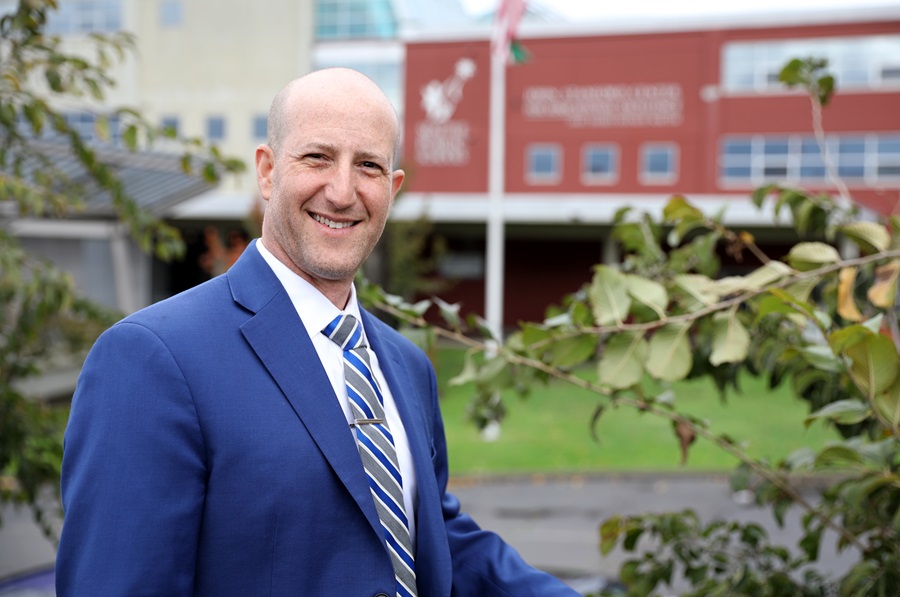
 (Seattle Public Schools photo)
By Tracy Record
West Seattle Blog editor
Seattle Public Schools‘ likely new superintendent is a fan of K-8 schools.
That’ll be welcome news for the West Seattleites involved with the two on the peninsula, Pathfinder K-8 on Pigeon Point and Louisa Boren STEM K-8 in Delridge, both of which have dealt with near-existential threats in recent years.
The district offered us a chance to talk with superintendent finalist Ben Shuldiner a few days after the board revealed that the current Lansing, MI, superintendent was their choice to lead SPS into the future. In our 25-minute online chat, we asked about a variety of issues with which SPS has grappled – some of which he faced in his current district, too.
INCREASING ENROLLMENT
He says public-school districts have to come to terms with the fact that while “30 or 40 years ago, they had a monopoly … now, there’s so much more choice.” But he says the ultimate way to solve the problem is “just do better at our jobs” – provide a better education. To increase enrollment in Lansing, Shuldiner says, “we made our schools better.”
And he says they noticed a trend – parents loved the elementary schools, but were “fearful about the junior highs.” So, he says, “we created a bunch of K-8s” – and that led to less loss between elementary and middle school, because the students would be staying on in schools with which they and their families were already familiar.
But overall, he repeats, “You increase enrollment because people want to come to our schools.”
SPS has been criticized for not marketing itself much if at all. What’s his view on that? He says promotion is important, from talking to the media to advertising such as billboards. “Everybody else is doing it, so you have to.” And that promotion should surface the “great stories” that he believes are already happening, waiting to be told. Then, he said, you tout the results – “in Lansing, we raised grades (and a board member told the community) ‘send your kids back’ (to the district).”
SCHOOL SIZES?
We brought up the shot-down-not-long-ago proposal to close schools so that the district would focus on larger, “well-resourced” schools. Shuldiner says he appreciates the concept of schools having full support staff, but “each community and neighborhood is different,” and that has to be considered when evaluating a school. The focus has to be on “let’s do right by the children,” he emphasized.
WHAT’S IN HIS FIRST-100-DAYS PLAN?
Shuldiner created one during the interview process, so we asked what it starts with. First, he said, “gotta be in the community.” Rebuilding trust between the district and community is paramount, he indicated. He hopes to “visit every single school in the first 100 days … walk the halls with the principals, with the kids.” (We were curious how many layers of bureaucracy his district had between the principals and superintendent; apparently as many as there are in Seattle.) Also, “make some decisions quickly,” with a deep dig into the budget. He also mentioned he might even move to “take down some walls (in the administration) building” (he meant that literally).
TOO MUCH BUREAUCRACY?
Knowing that principals report to a middle-management layer rather than directly to the superintendent, we wondered what the structure is in Lansing. Similar, he replied, but that doesn’t stop the superintendent from getting out and talking directly to school staff (as mentioned above). Shuldiner says he enjoys those visits since “I’m a teacher first and foremost,” and was a principal too, considering those roles and his current one all to fall under the umbrella label “educator.”
SCHOOL BOARD MEETINGS
The Seattle board halved its regular meeting schedule to monthly not long ago, so we asked him about the frequency of board meetings in Lansing: He said they met two or three times a month, and that the Lansing board had more members than the Seattle board. He said the board periodically has “informational study sessions,” something he’d like to bring to Seattle.
GIFTED PROGRAMS
SPS’s philosophy toward serving “highly capable” students hasn’t been consistent in recent years. So we asked Shuldiner about his views. He didn’t say much – voicing general support for “differentiating based on the needs of each child” – except to note that Lansing dramatically increased the rate of students passing AP exams. That, he said, was largely the result of “more AP classes, and we didn’t gatekeep who got into them.” That quickly segued into a topic we had planned to ask about anyway …
CAREER TECHNICAL EDUCATION
This is back in vogue, we noted, with “the trades” in some cases desperate for workers. Just outside Seattle, we noted, there are now public high schools dedicated to maritime and aviation. Shuldiner said his current district “created Lansing Technical High School,” and noted that Lansing had been “the home of trades” for so long. But counter to concerns that teaching the trades somehow diminished academics, he said he sees it as an “and” rather than an “or,” and also observed that basic subjects like math can be taught through hands-on learning as well as via abstract textbook problems. “Truth is, kids love learning hands-on.”
HOW TO EVALUATE HIM IN THE EARLY GOING?
Obviously, he said, results won’t be immediate – in terms of stats, at least – so what he hopes is that people will be able to evaluate him for transparency, for building trust, for listening, for staff feeling more supported, for “more vision and direction.”
That’s where we wrapped up. So what’s next? Assuming Shuldiner reaches a contract/salary agreement with the district, the board will vote on finalizing the hire. They said they’re hoping he’ll start “early next year.”
| 13 COMMENTS