
West Seattle, Washington
24 Saturday
As noted here two days ago, another stretch of low-low tides has begun. Misti was out during today’s low-low tide and shares the amazing video you can see above – describing it as “My mic drop achievement, catching a nudibranch fight on a video. Think mama was protecting her eggs, which are the cluster of white spots you see.” Misti saw these near the Fauntleroy ferry dock, and shared other low-tide wildlife images on Twitter, which has had some turmoil today, so apologies if you can’t see it – here’s another eye-catching image, identified by Misti as a sea pen:

Tomorrow’s low-low tide is -3.2 feet at 10:38 am; Seattle Aquarium beach naturalists will be out too (see when and where here).
 (Photos courtesy Puget Sound Bird Observatory)
Want to turn bird-watching into science? Here’s an opportunity we were asked to share with you:
The Puget Sound Seabird Survey is looking for birders in West Seattle and throughout Puget Sound to join this established Community Science program.
(Common Loon)
Volunteers are asked to conduct 7 surveys with a small team of fellow surveyors at specific locations. All surveys are synchronized to take place once per month on the first Saturday, October – April. You will be provided training in the survey technique, and ideally will have good seabird identification skills. However, there are roles on the survey teams for birders of all levels. Now in its 15th season, you’ll be contributing to valuable science that monitors
wintering seabirds across Puget Sound and informs important management decisions.Previously, the project was part of Birds Connect Seattle’s (formerly Seattle Audubon) science program but transitioned to its new home at Puget Sound Bird Observatory in 2022. More information can be found on our website and if interested in taking part, please reach out to Program Manager Toby Ross
t_ross@pugetsoundbirds.org
 (Monterey Dorid sea slug, photographed during recent low tide by Rosalie Miller)
If you’re staying home for the extended holiday weekend, you might factor beach walks into your staycation. The next round of low-low tides is almost here. Saturday through Thursday will be prime dates for beach exploration. On Saturday, the tide will be out to -2.4 feet at 9:54 am; on Sunday, -3.2 feet at 10:38 am; on Monday, -3.8 feet at 11:24 am; on Tuesday (the Fourth of July), -4.0 feet at 12:11 pm (this summer’s lowest low tide); on Wednesday, -3.8 feet at 12:59 pm; and next Thursday (July 6th), -3.0 feet at 1:48 pm. Here’s the full chart. If you want expert guidance, Seattle Aquarium volunteer beach naturalists will be at Constellation Park (63rd/Beach Drive) and Lincoln Park (8011 Fauntleroy Way SW) Sunday through Thursday – see the schedule here.

Thanks for the photos! For the first time in a long time, we’ve received reports of a West Seattle coyote sighting. Very early this morning, in Upper Fauntleroy, along 37th SW – the photo above is from William, and the one below is from Adam.

As we routinely reminded readers back when we received and published many such sightings (you can scroll through the archives here), this is not something to be alarmed about. Yes, coyotes eat smaller animals, sometimes even roaming cats, but more often, their diets have been found to include what you might consider nuisances/pests – like rodents. William, in fact, reported seeing the coyote after it “had just finished his unsuccessful pursuit of a squirrel.” Advice on how to coexist by keeping them at a distance is part of this state-produced Living With Wildlife guide.

Thanks to readers’ contributions, here’s another West Seattle bird gallery – starting with a mystery bird that several people have asked us about in recent weeks. The photo above is from Heather, who said, “This guy has been hanging around the Fauntleroy Park area (near Cambridge entrance) for the past month. Anyone know the story of this lone pheasant friend?” Please comment below if you do! Meantime, less mysterious sightings include fledglings – Ann Anderson photographed a House Sparrow:

And this Steller’s Jay is from Robin Sinner:

Two from James Tilley – first, a Bald Eagle:

And a Common Loon:

Jon Anderson says these Band-Tailed Pigeons are fans of his feeder;

Finally, a hummingbird photographed by Brian Michel:

You can find info about these and other bird species seen in our region – with photos and even audio of their calls – by going here. P.S. We also feature bird photos periodically in our daily event lists, published every morning – thanks again to everyone who contributes!

Thanks to Gary Jones for the photo! Three harbor porpoises surfaced while swimming off Alki Point. They’re not endangered, but they are protected. The most-recent federal estimate of their population: More than 11,000 in the inland waters of Washington and southern British Columbia, including Puget Sound.

7:13 PM: The remains of old pilings are part of what comes into view when low-low tides arrive on local shores. The photo above is from Theresa Arbow-O’Connor. Today’s low-low tide was out to 3.3 feet; Brandy DeWeese also sent photos, showing some of the sealife revealed by the receded tide under and near the Fauntleroy ferry dock:


The low-low tide will be out even further the next two days – -3.7 feet both days, at 12:26 pm Monday, and at 1:13 pm Tuesday. Seattle Aquarium volunteer beach naturalists will be out both days too – 10:30 am-2:30 pm Monday, 11 am-3 pm Tuesday, at Constellation Park (63rd/Beach Drive) and Lincoln Park (8011 Fauntleroy Way SW) both days.
ADDED 9:22 PM: Curry Gibson sent this pic of kelp crabs:

ADDED 11:45 PM: Thanks to SF for this montage:

 (WSB photo by Patrick Sand)
By Judy Pickens
Special to West Seattle Blog
Students from the Fauntleroy Children’s Center capped one of the biggest salmon-release seasons on Fauntleroy Creek since the first, in 1991.
Between April 27 and May 31, volunteers with the Fauntleroy Watershed Council hosted 730 students and some 235 adults for 17 releases in Fauntleroy Park. They brought 1,850 coho fry reared from eyed eggs through Salmon in the Schools-Seattle.
The total included 500 fry raised by volunteer Jack Lawless to ensure that, in the event of a school die-off, every student would have a fish to put in the water. His fish also enabled children from four additional preschools to have a release experience.
 k(WSB photo – volunteer Dennis Hinton at left)
Elementary field trips to Fauntleroy Park included exploring nearby habitat and seeing some of the aquatic insects that comprise a large portion of a fry’s diet. Those that find enough food and protection in the creek will head to saltwater next spring as smolts.
 (Photo by Tom Trulin)
From mid-March to late May, volunteers checked net traps in the upper and lower creek twice daily to document 41 smolts that had survived to leave for nearshore habitat in Fauntleroy Cove. Eleven of them came from the pond that formed during April’s partial blockage of the creek culvert under 45th Avenue SW.
“Finding so many downstream of the park confirmed that juveniles are making use of the entire system,” said veteran volunteer Dennis Hinton. “Those released at the big bridge in the park will linger there for a few weeks, so come have a look – but be sure to keep your dog out of the water.”

Thanks to James Tilley for the photo! He reports, “Infrequent visitor to our area – I saw a brown pelican flying along Alki on my morning walk.” They’re only brown when immature, so this is a younger pelican. In our region they’re more commonly seen along the open-ocean coast, but we do get visits here inland. They’re no longer listed as endangered by the state or federal governments, according to this state Department of Fish and Wildlife status report from last year, which also notes: “Brown Pelicans are protected from ‘take’ by federal law under the Migratory Bird Treaty Act, and are a ‘protected wildlife’ species by state law.” They’re big birds – wingspan up to 6 1/2 feet.
The report and photo are from Jonathan:
I was just walking to my car at 1:30 pm today, parked on the 3400 41st Ave SW block, and almost stepped on this snake. Google says it’s a gopher snake. I was wondering if it could be a pet. I gave my neighbors a head’s up, but thought I might broaden the work in case someone lost their pet. Or, you know, beware of the snake, even though it shouldn’t be venomous.
One of our favorite sources for “co-existing with wildlife” info, the state Department of Fish and Wildlife, says that is indeed one of the common snakes in our state, with habitat generally “deserts, grasslands, and open woodlands.” It is indeed NOT venomous – it kills prey by squeezing, and it’s good to have around because rodents are among favorite prey.
 (WDFW photo)
Before we get to today’s list of events, an FYI for tomorrow – it’s likely to be one of the busiest days of the year at Don Armeni Boat Ramp, because it’s the one-day “season” for spot-shrimp fishing in nearby waters, 9 am-1 pm Thursday, May 25th. Usually the turnout fills the Don Armeni parking lot. Spot shrimp are the largest shrimp in Puget Sound, per WDFW. The state says Elliott Bay will be open this year as well as the central Sound.

Story by Judy Pickens
Photos by Tom Trulin
Special to West Seattle Blog
Installation of a new rabbi usually doesn’t include a salmon release – but it just made sense for Kol HaNeshamah, West Seattle’s progressive synagogue.
On Sunday morning (5/21), an estimated 35 people, from infants to elders, rendezvoused with Fauntleroy Watershed Council volunteers and a bucket of coho fry to release in upper Fauntleroy Creek.
“As a sacred community, we’re called to affirm life – and salmon have been central to Pacific Northwest communal life since time immemorial,” said Shannon Ninburg, KHN board of trustees member, seasonal naturalist, and creek volunteer. “We were thrilled to be able to include it as we welcomed Rabbi Sabine Meyer into our communal life.”
 (Volunteer Dennis Hinton hands a cup of fish to Rabbi Sabine Meyer to start the release
She is the fifth rabbi to serve Kol HaNeshamah since its founding in 2003. After more than a decade as an educator for congregations in the Southwest, she was most recently rabbi for Tree of Life Congregation in Columbia, South Carolina.
By the last Fauntleroy Creek salmon release of the season on May 31, more than 900 students and adults will have stocked the upper creek with nearly 2,000 fry reared through the Salmon in the Schools program.

It’s been a while since our last gallery of reader-contributed West Seattle bird photos, but the contributions have continued coming in (thank you!), and we finally have an opportunity to show them to you. Above, Trileigh Tucker‘s cooling view of an Anna’s Hummingbird; Trileigh reminds us, be sure to keep water out for birds in this hot weather! Below, a California Scrub-Jay photographed by Susan Whiting Kemp in the Morgan area:

Cindy Roberts photographed two Common Loons “in a mating display”:

Jay Speidell found a Northern Flicker woodpecker making a new nest on Puget Ridge:

James Tilley caught an immature Bald Eagle landing in an Alki-area snag:

Two from Jerry Simmons: An American Goldfinch:

And a Finch:

From Arlene Rubin, a Hawk:

IDs are from the photographers; links are from BirdWeb, where you can see and hear other bird species that spend time in our region. Photos to share, from wildlife to breaking news (and beyond)? westseattleblog@gmail.com – thank you!
If you’re going to the beach this weekend – watch out for tiny, spiny larval crabs. We’ve heard from two readers today reporting they’re back on Alki, and one reported a painful encounter. The other, Kaitlin, emailed to say:
As people hit the beach this weekend, just wanted to let neighbors know that there are large bands of crab larvae washed up on the beach. These spiny little friends are uncomfortable to walk on, so make sure to bring water shoes.
They’re called zoae and we published this reader report about them last year. That report noted, “It feels like glass or an itchy pinch” if you encounter them with bare hands/feet (etc.). This state Ecology Department page has more about them. Kaitlin reports seeing them just east of Alki Bathhouse.
 (Photo sent by Chemine)
11:59 AM: Thanks for the photos and tips. A sixgill shark washed up on Alki this morning. Wildlife experts tried to save it – Kersti Muul was there, as was SR3, but Kersti tells us they couldn’t.
 em>(Photos sent by Kersti Muul)
Kersti says it was a juvenile male, seven and a half feet long. (According to this species-info page on the Seattle Aquarium website, that’s about half as long as they grow to be.) Here’s a look at its namesake gills:

And its teeth:

The state Fish and Wildlife Department was going to come get it.

ADDED 4 PM: If you didn’t already see the link in a comment below, wildlife photographer Jamie Kinney has a gallery here.

46 students from Roxhill Elementary were the first to visit Fauntleroy Creek as this year’s Salmon In The Schools releases begin.

Volunteer creek stewards help school students and staff release the fry they’ve been raising at school, a process that starts with volunteers delivering eggs from hatcheries. Over the next five weeks, 17 releases are planned at Fauntleroy Creek, one of Seattle’s few remaining salmon-bearing creeks.

The annual salmon life cycle continues in the creek with coho spawners’ return in fall – last year volunteers counted 254, one of the highest totals since creek restoration a quarter-century ago.
Even if you don’t fish, the scenery might be reason enough to catch the Fly Fishing Film Tour‘s 2023 West Seattle stop. It’s this Thursday (April 13th), 7 pm at the Admiral Theater (2343 California SW), hosted by West Seattle’s own fly-fishing specialists at Emerald Water Anglers (WSB sponsor). We’re told EWA proprietor Dave McCoy is featured in one of this year’s films! You’re invited to stop by EWA’s gear/apparel shop in The Junction (4502 42nd SW) before Thursday’s screening, “as we will be having some activities to celebrate all things fly fishing.” And you can get your ticket(s) in advance via The Admiral’s website.

Thanks to Brandy DeWeese for sharing photos of wildlife seen during low tide this afternoon at Lincoln Park. We’re not in a super-low-tide phase, but low enough to make shore exploration worthwhile.

The tide was out to -1.2 feet this afternoon and will be lower, -1.4 feet, at 2:39 pm tomorrow.

Brandy noted that the beach was relatively deserted on this drippy afternoon.

If you’re interested in guided exploration, Seattle Parks has a guided beach exploration for the April 22 low tide (register here), and Seattle Aquarium volunteer beach naturalists start their season in early June.
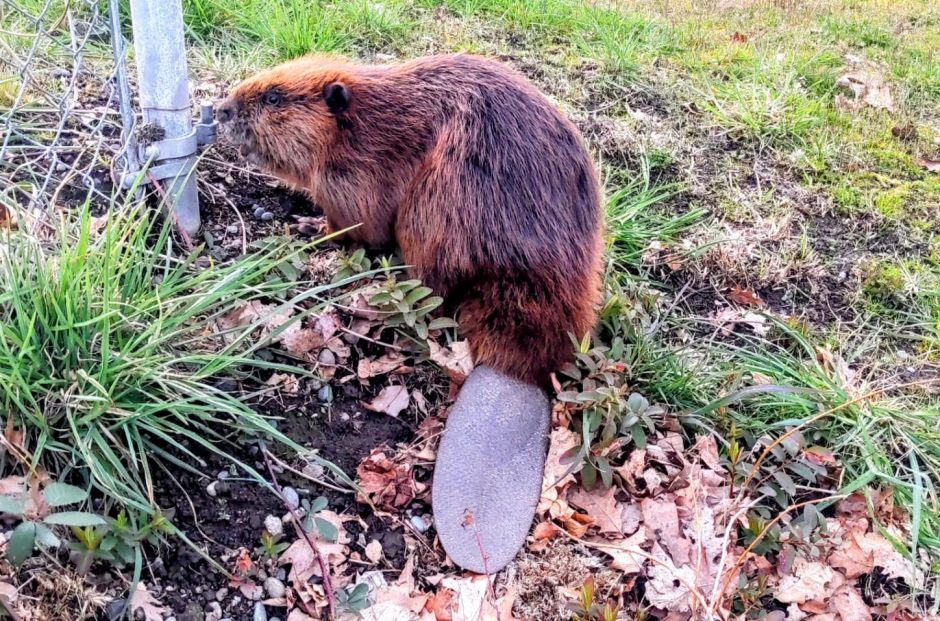
The photo is from Kersti Muul, who explains she got a report of a beaver along SW Thistle, and indeed, that’s what it was. So what happened next? “He’s fine. I scooted him into that yard and he ate and then bedded down in the blackberries. Most concerned for it being on such a busy road. I imagine it’s a path it takes all the time back and forth to the creek. [Longfellow] I told everyone to leave it alone and give it space.” Here’s the state Living With Wildlife infopage about beavers.

Thanks to the readers who’ve sent bird photos in recent weeks – enough for the first gallery of spring! First, two views of Steller’s Jays, above from an unidentified texter, below from Danelle Jay:

Next, a Sharp-shinned Hawk from Mark Dale:

From David Butler, a Raven:

Marc photographed this Barred Owl:

James Hiersche sent this photo of a Bald Eagle over Lincoln Park:

From Ann Anderson, a Ruby-crowned Kinglet:

Two from Mark MacDonald – a Spotted Towhee:

And a Goldeneye:

Finally, from Stringtie – a Herring Gull with a snack:

Thanks as always for sending bird photos so we can share with your West Seattle neighbors! westseattleblog@gmail.com is the best way to send non-breaking-news photos like these, but if you decide to text instead, please include your name so we can credit you – thank you!

(File photo)
With longer days, more sunshine, and rising temperatures, you’ll likely spend more time outside. So Nancy is sharing an alert, intended for her neighborhood but a cautionary tale for others too:
I live at 48th Ave SW between Hinds & Spokane. Behind Madison Middle School. I wanted to warn neighbors … For the past week, a large raccoon has been showing up in my yard in afternoons, 1:30 pm (not usual nocturnal time).
He snarls & bares his teeth. He does not back down when I throw a handy object at him.
I’m a gardener & almost always outside these days. He then climbs trees to get on my roof. Two years ago,, raccoons killed all my 3 chickens in early 5 am time.
Nancy was planning to consult experts. We also suggested one of our favorite resources for urban-wildlife info, the state Department of Fish and Wildlife’s “Living With Wildlife” series. Check out this page and scroll all the way down to find the “preventing conflicts” advice.

(2017 photo by “Diver Laura” James)
Six years ago, we told you about herring spawning off West Seattle – which led to pearly eggs, like those in the photo above, on the beach, after sea birds and sea lions were seen in a feeding frenzy offshore, near “milky swaths” that are telltale signs of what’s happening. “Diver Laura” James says it’s time to watch for that again – and to report it if you see it. She tells WSB, “Our West Seattle herring spawn should be starting any day now and and it would be amazing if local readers could keep an eye out for spawning activity so we can capture the action with drone and 360 underwater cameras.” The Coastal Watershed Institute has been watching – saying it’s “been extremely predictable the last five years. You could literally set your watch to the shoals of fish, brilliant white water, layer upon layer of herring eggs, and caterwauling sea lions and birds. This year? Nothing.” But spawning has begun in an area of British Columbia, so there’s hope they’re just running late this year. If you think you’re seeing signs of spawning, you can email Laura – ljjames (at) mac (dot) com.

Tom Trulin sent that photo of a nesting hummingbird, a perfect illustration for this reminder we received from Suzanne Krom: When you’re out doing yard work (or if you don’t have a yard, if you’re out helping or volunteering in greenspaces), watch carefully to be sure you don’t unintentionally disturb one of these nests:
Hummingbirds nesting now … be super aware if you’re pruning
These tiny nests are so easy to miss! They are only 1.5 inches in diameter.
Before pruning and without touching the branches of a tree or shrub (or minimally touching, at most), carefully look for nests. They’re usually somewhat obscured by leaves. Their placement will probably be at the intersection of a stem and an anchoring branch.
allaboutbirds.org/guide/Annas_Hummingbird/lifehistoryIf you see a nest, leave the birds alone to let them raise their young in peace. Disturbing an active nest often results in the adults abandoning the eggs/young. Let them be. A bird’s greatest secret is the location of their nest.
It’s up to each of us to respect that secret. Life is hard enough for them without us interfering in their lives.
The perfect nest in the photo was in our Tall Oregon Grape last year, located about 4 feet off the ground. The pair of Anna’s hummingbirds that frequent our yard used it twice to successfully raise their young. I moved it into our home at the end of October, when I knew their nesting season was complete.


| 7 COMMENTS