
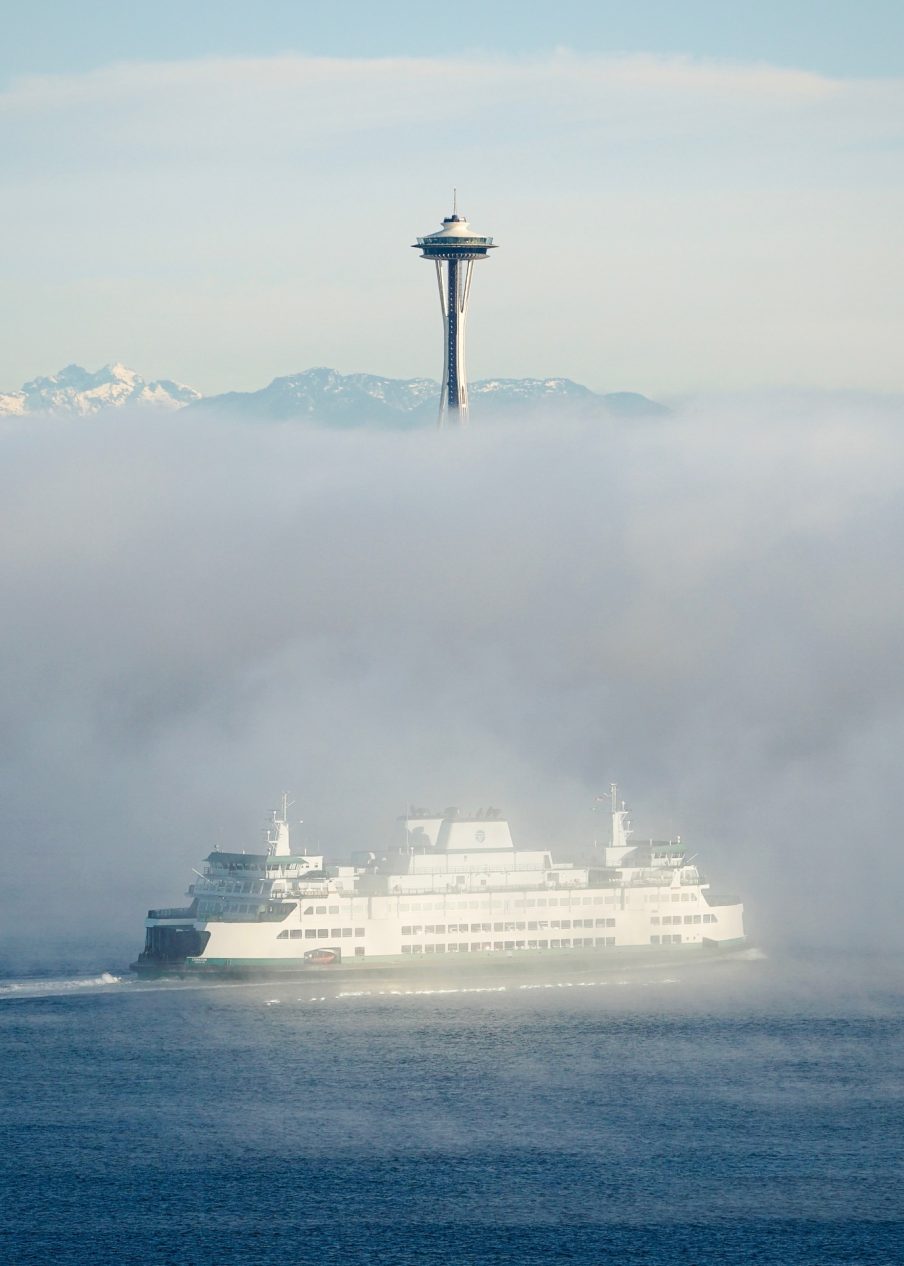
 (Ferry in this morning’s fog – photo by Steven Rice)
By Tracy Record
West Seattle Blog editor
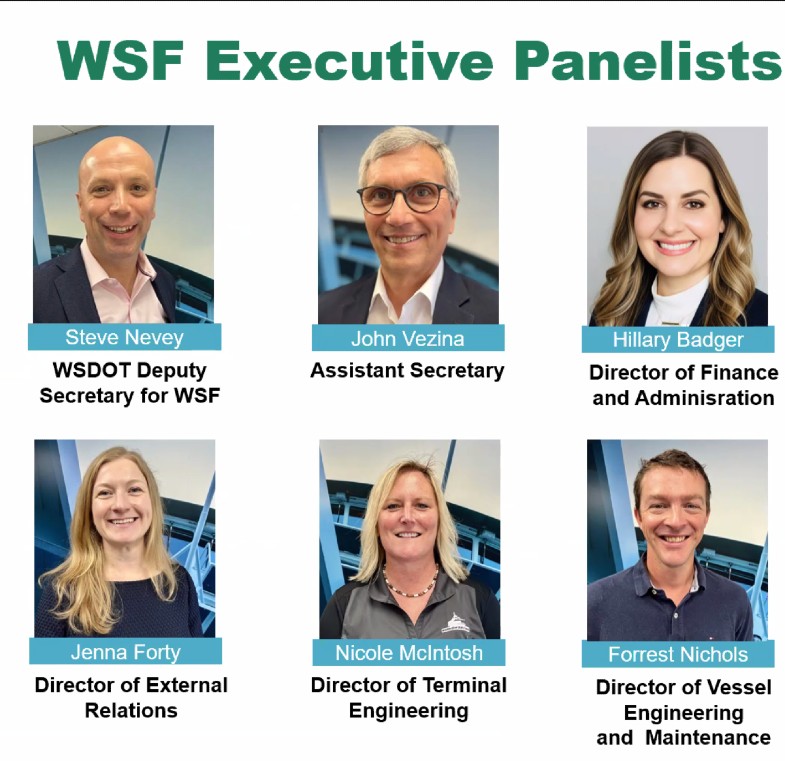
The Fauntleroy ferry-terminal project got a semi-quick mention during Washington State Ferries‘ first of today’s two online systemwide community meetings at noon today. So did a wide range of topics, including ICE-related policy and the ongoing pet pilot. We monitored the meeting and are presenting this report in time for you to tune in to the second one at 6 pm if interested. Here are the WSF executives who participated:
It was noted toward the start that about 80 people had signed in to watch. As has become customary for these online meetings, they began with quick polling about what route they used the most (only about 9 percent said “the Triangle Route”) and how often they ride (“a few times a month” was the top response).
Ferries boss Steve Nevey spoke first, with a recap of 2025 (here’s the official report). “We added thousands of sailings in 2025, and the number of cancellations went down.” Here’s the year “by the numbers”:
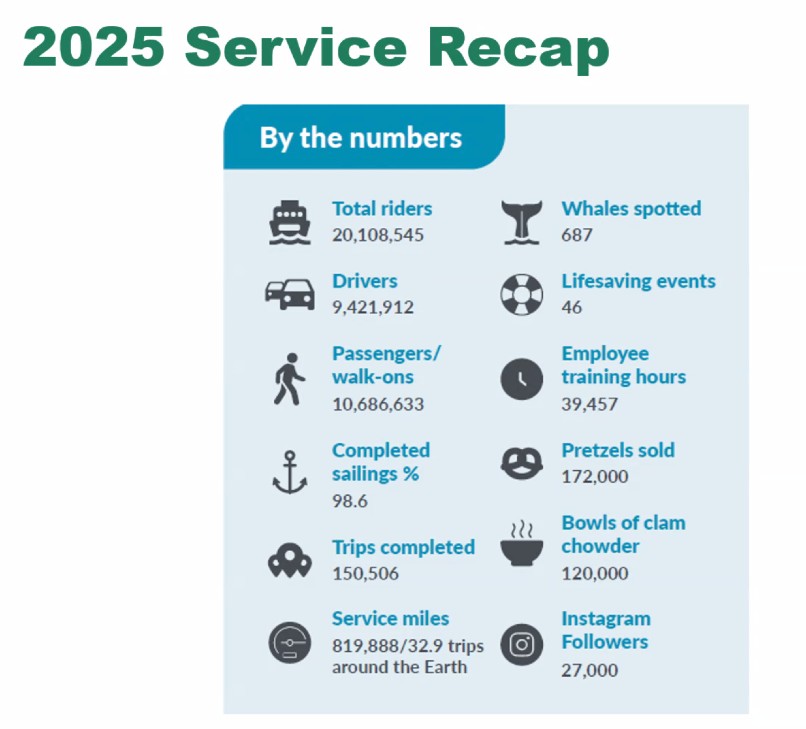
The ridership number, he said, was a million more than the year before. Now, the challenges and opportunities:
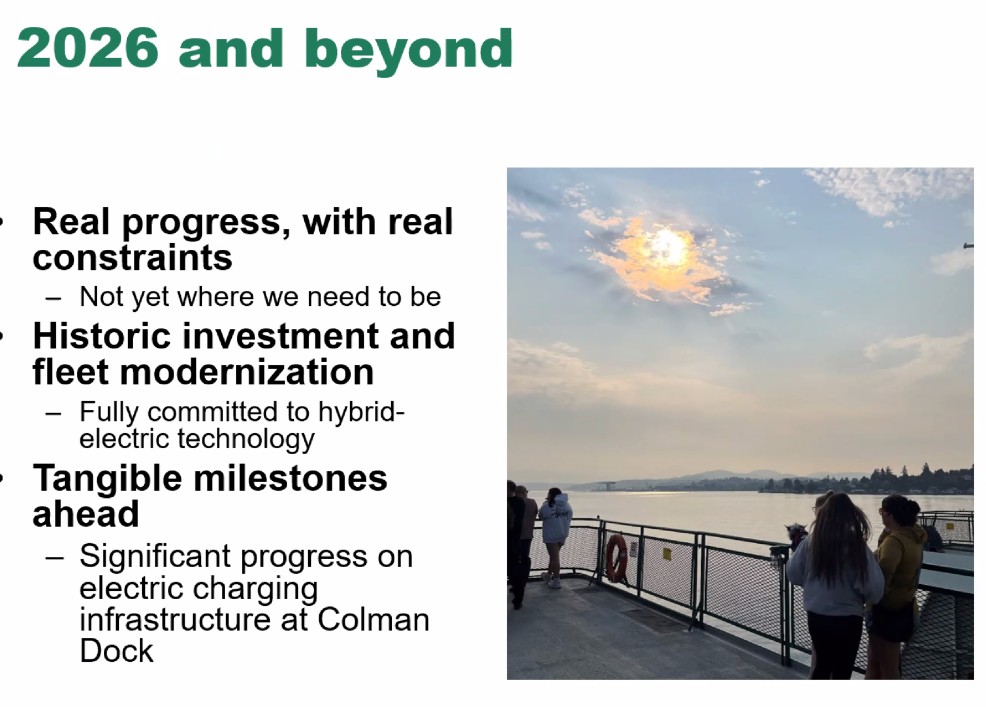
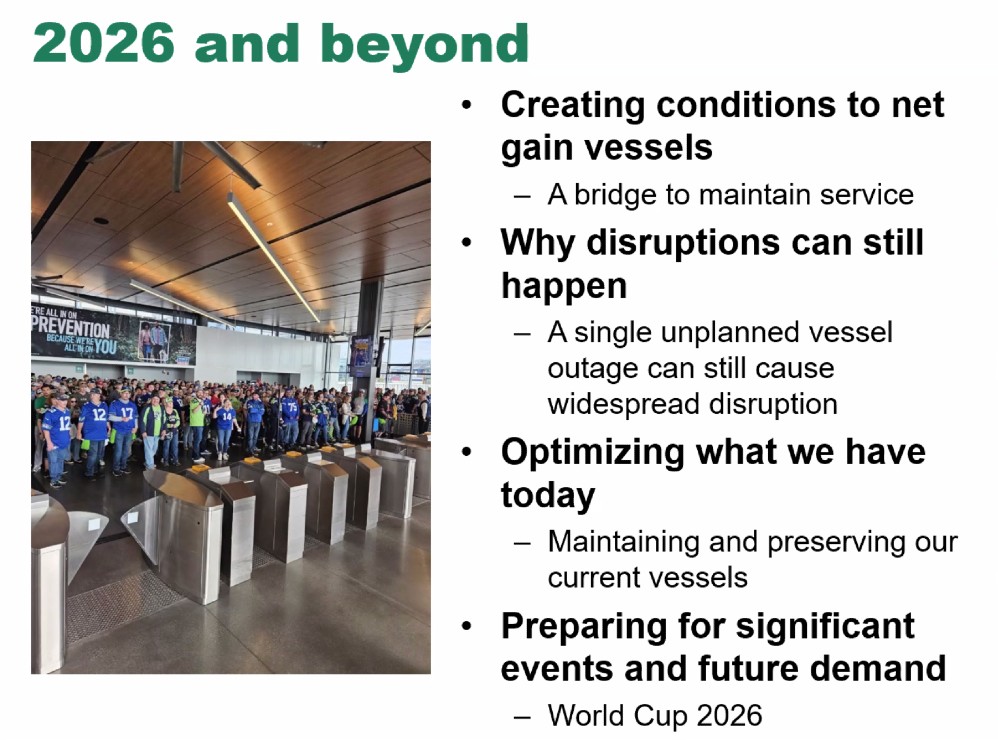
They’re short on vessels, and that isn’t going to change until the next new ones start coming online in 2030. The average age of the fleet is 35 – that’s 10 years past, for example, when a cruise ship might be looked at for retirement from a fleet. Nevey said the Legislative session is “going to be big for Washington State Ferries” because the governor is requesting $1 billion for three more new vessels (beyond the three now funded) and $150 million to keep the three oldest ones in service in the meantime. “That proposed investment from the governor is a huge deal.” They have 21 vessels now, 18 in service at any given time, and just one breakdown can wreak havoc on the whole system. (During the meeting, in fact, it was noted a vessel on the Bainbridge run has broken down, but should be fixed within hours.) He also said that rather than a “system electrification plan” the road they need to be on is a “fleet modernization plan.” For now, though, they are “laser-focused” on making the most of what they currently have. He also mentioned the terminal upgrades – without specifically naming Fauntleroy (which came up briefly later, in the Q&A) – saying they remain a vital part of the future plan.
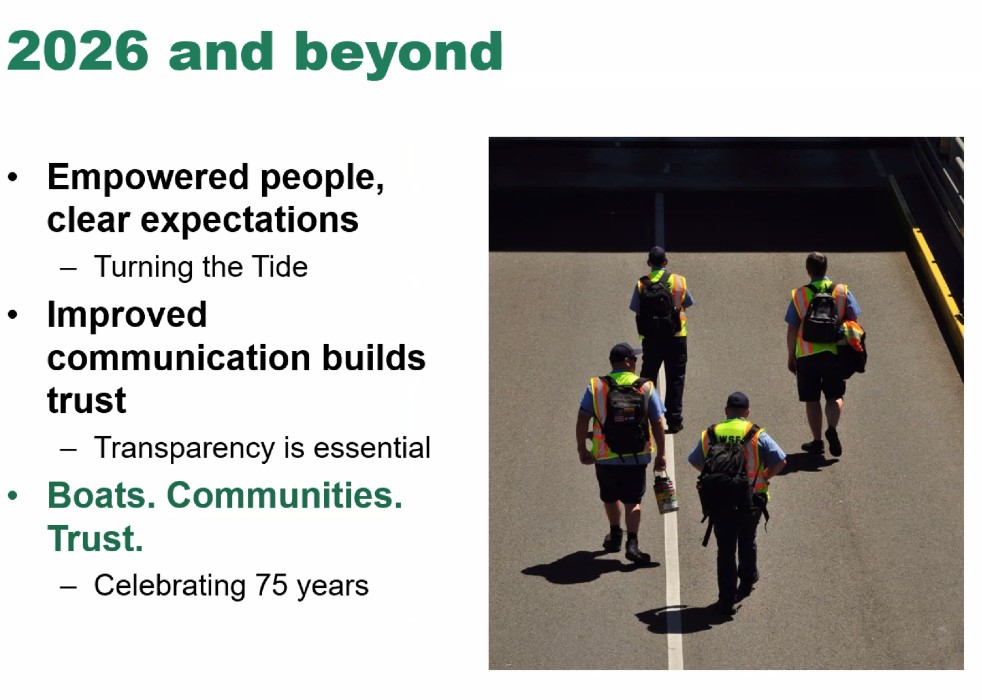
Regarding planning for the FIFA World Cup games in the region, “it’s going to be a pretty big deal” for WSF too, and they plan to have “all but one vessel” ready to be in service during that time this summer. He said culture change and communication improvement have been emphasized as well – for the latter, being clearer, and more timely, when decisions are made about changes such as “moving boats around.” Their focuses can be summarized as “boats, communities, trust.” And – this year marks WSF’s 75th anniversary.
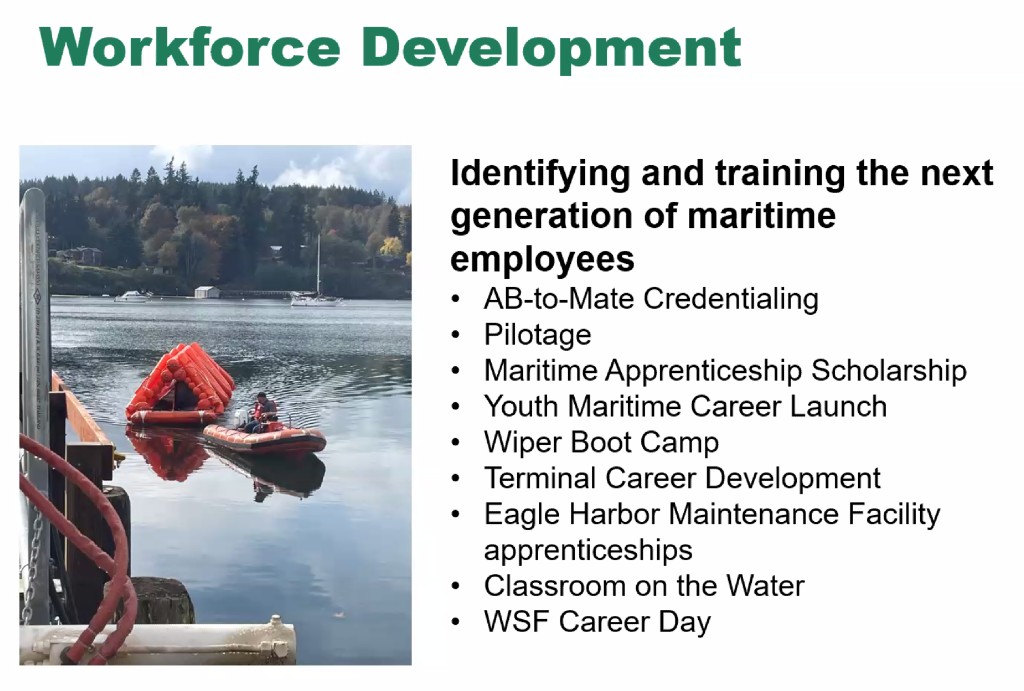
Next, the system’s second-in-command, John Vezina, took the mic. He opened with a recap of what WSF is doing for workforce development, getting new crew members in the pipeline, which is “getting better,” Vezina said.
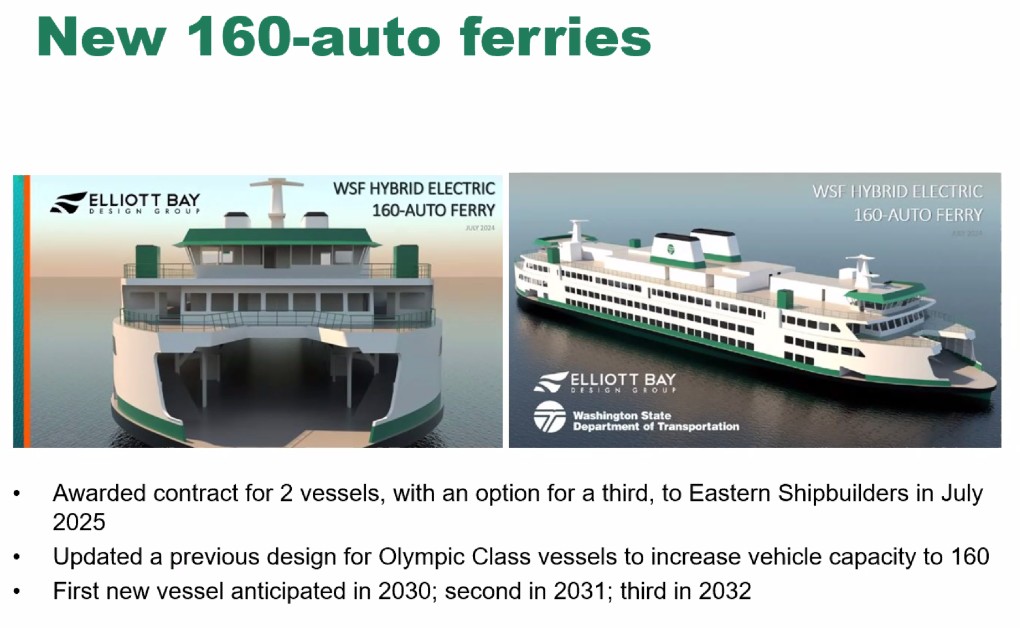
He also updated system electrification, recapping the choice of a Florida builder for two new hybrid-electric vessels and an option for a third, converting three vessels to hybrid (the Wenatchee is complete and timeline is TBA for two more), and setting up four terminals for charging capabilities, for starters. They expect to “cut steel and lay keel” for the first new vessel this summer; it’ll be a lot like the Olympic Class, but longer, and a higher vehicle capacity (16 more, total 160).
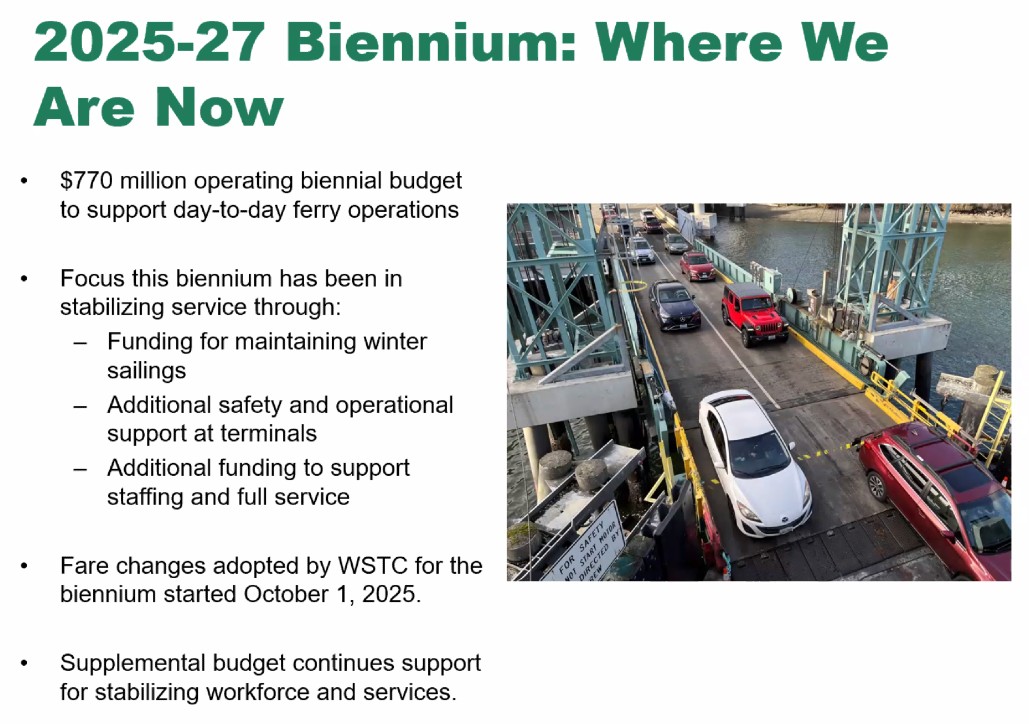
Next, finance leader Hillary Badger provided an update on WSF funding and what it’s being used for:
She was followed by Jenna Forty with legislative updates – mostly that they’ll find out in late February how the two chambers in Olympia will deal with the governor’s proposals for WSF funding. She noted that those proposals would be supported by bonds.
Forty also said WSF is overhauling its System Contingency Plan, taking “a holistic look at how we deploy our assets,” this spring – before the World Cup (she and others mentioned getting people to and from Fan Zones around the region as well as the Seattle matches).
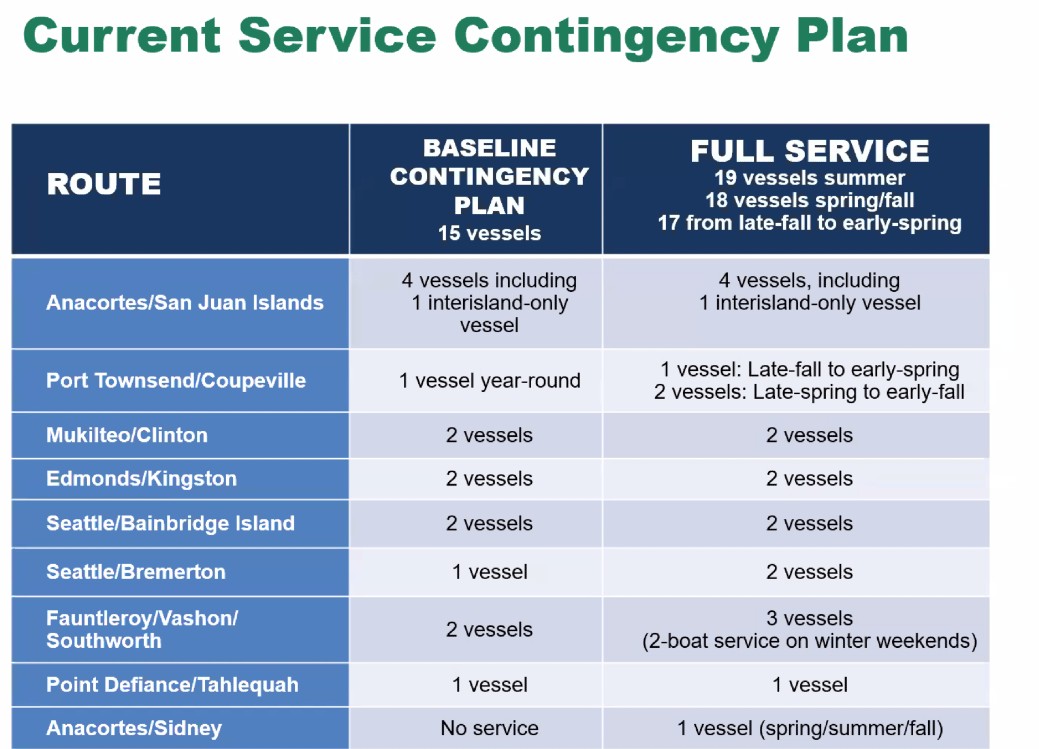
Then, half an hour into the meeting, it was Q&A time – they took questions in writing, and moderator Tally Teal read them aloud. First one was a request for a recap of vessel numbers mentioned above. Next, if Legislature does approve funding for three more new vessels, what would the timeline be? Vezina said they’ll focus on that if they get the money – seeking to build them “as quickly as possible.” Forty said that would also be contingent on any policy direction from legislators and/or the governor.
Other questions of interest: Could/should the ferry system be privatized? Vezina noted the 75th anniversary and the decision made at the start for it to be a public service. “The governor and legislature certainly COULD decide to get out of the ferry business,” he said, but keep in mind that privatizing might lead to de-emphasizing service available even in the less-busy times. Forty also noted that a private company would look for profitability and fares would invariably be raised. Nevey talked about BC Ferries, which was privatized, and how they face that kind of expectation.
The next question was addressed to vessel-engineering director Forrest Nichols – how much will the double stack in the new ferries’ design affect their performance? The double stack’s sail area doesn’t result in much drag, he said, also considering that the added length of the new ferries will improve their performance. Nichols was also asked to explain crew quarters on the ferries; he said it’s necessary because crew members have to be available or early-morning sailings, among other things; Nevey added that snowstorms, for example, are a time when they want to keep crew aboard and not have them trying to commute.
Which terminals are first for charging capability? The new boats in 2030-2031 will be assigned to Mukilteo-Clinton, so that terminal is up for electrification; Seattle needs to be electrified to handle the Wenatchee; Bainbridge and Bremerton. Forty added that there’s no funding so far for electrification capability on the Triangle Route or the San Juans. Followup: When will Seattle be electrified? 2028 or 2029, was the reply.
Why has the Wenatchee had so many problems – today included – since returning to service following its hybrid conversion? “We’re marrying 30-year-old control systems with brand-new technology,” for one, he said, although today’s problem is with a “shaft seal,” which happens to all the vessels, he noted. “I would anticipate going forward that the Wenatchee will continue to improve on its reliability. (But) I would expect to see intermittent issues related to its being a boat.”
Then the Fauntleroy terminal project came up, briefly. Terminal-engineering director Nicole McIntosh talked about the reason Fauntleroy is getting replaced – it’s low, it’s small, it has creosote, it’s seismically vulnerable … She said they’re at 5% design now, going into the next environmental-review phase “shortly”; current estimate is for construction to be complete in 2031. Will it be electrified when upgraded? another attendee asked. Short answer: No.
As for other terminal projects, McIntosh said, Anacortes is not going to get a building replacement but they’re studying some upgrades/renovations.
Forty fielded a question that often arises at these meetings – when will WSF return to serving Sidney, B.C.? “We’re still aiming for 2030 when (the first new boat) comes online” but that’s not for certain. M/V Chelan used to be certified for Safety of Life at Sea, which is required for an international run, and Nichols said they’re working on restoring that, though it’s complicated – maybe other vessels in the fleet too.
Where’s the biggest need for new staff? Vezina said licensed deck and engine-room employees, though some changes – like the “AB to Mate” on-the-job training program and a scholarship program have helped alleviate that – but, he added, as they move employees through the system, that creates more entry-level jobs. He said this part of the workforce is diversifying, too.
One question was whether, after “modernization,” ticketing will still be available “on the computer,” not just via mobile phones. Vezina said yes.
He also was asked to field a question that’s been asked and answered at previous meetings – wouldn’t it just be faster to build new diesel boats? Vezina said no – they’re not faster to build, and they’d have to start design from scratch, as the previous round of new boats – the Olympic Class – was build on propulsion equipment that’s not available any more. Focusing on hybrid-electric vessels is actually the fastest path forward, “not the result of some ‘woke’ environmental agenda,” Vezina insisted.
Could the third boat on the Triangle Route be put into service for more hours? Vezina said they’re running it at the level they’re funded for.
Does WSF have a plan for dealing with ICE raids on vessels? That agency hasn’t asked for any “preferential loading,” said Vezina, and there’s no agreement for anything like that, but if it does, “we are prepared to contact the people we need to.”
With the Bainbridge and Bremerton schedules to be revised, has WSF considered hourly sailing times, for some consistency? Forty said, that’s one option they’re looking at, and also noted they’re recruiting for an advisory committee to be involved in this process.
Other questions included how – whether – they coordinate with Kitsap Transit passenger-ferry service, in times when they’re down boats on corresponding ferry routes, etc. Vezina says they see KT and King County Metro (Water Taxi) as “partners,” since WSF is prohibited from operating passenger-ferry service (which they used to do). Forty said they let KT and KCM know when they’re having unexpected service reductions, but those services can’t just change schedules at the drop of a hat.
Any plan to update the schedule for Tahlequah-Point Defiance (South Vashon to Tacoma)? Short answer – not any time soon.
How’s the pet-policy trial going? Vezina said they’ve had pro- and con- feedback and will decide “in the next couple weeks” what to do permanently. The policy might be, keep allowing them, but restrict them to a certain area of the passenger deck, so people who don’t want to be near them can keep their distance.
Time limits for multi-ride passes are likely to be extended to 90 days starting in May, Forty said.
In summary, Nevey said, this year will be about mazimizing and being realistic with the resources they have – “we’re doing all we can to make sure boats are available” though they don’t have enough of them. And, “I hope everybody understand we are on the fastest path to building new vessels. … If there were a faster path, we’d be pushing hard” to move to it. And WSF is working hard to keep its current fleet in service; he gave props to the engineering staff for “keeping these 50-to-60-year-old vessels going.”
WHAT’S NEXT: The 6 pm session of this meeting is expected to feature the same presentations and Q&A from whomever’s in attendance; register here to get the link. If you can’t watch that one live either, note that a recording of the meeting will eventually be posted here.
| 5 COMMENTS