
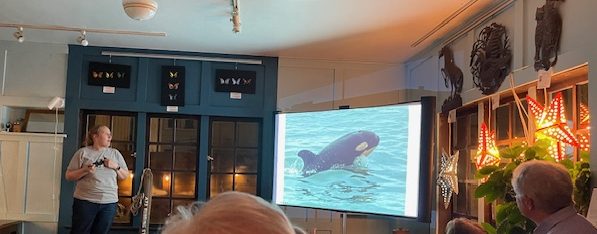
 (Maya Sears showing a photo of the new Southern Resident Killer Whale calf)
By Tracy Record
West Seattle Blog editor
The newest Southern Resident Killer Whale – the K-Pod baby born just days ago – is looking good.
That was the word last night from two of the researchers who have seen the calf up close, Mark Sears and Maya Sears, the West Seattle-based father-and-daughter team who were guest speakers at The Whale Trail‘s Winter Gathering.
The heart of the event hosted by Whale Trail founder/executive director Donna Sandstrom at C & P Coffee Company (WSB sponsor) was a celebration of Mark’s half-century of work with the orcas; the Sears family has had a front-row seat for Puget Sound, whales and more, as multigenerational resident caretakers for Colman Pool on the shore at Lincoln Park. When the Southern Residents are in central Puget Sound, they head out too, partnering with other organizations to gauge the health of the endangered 74-orca population.
How the Southern Resident population dwindled so low was part of the discussion, revisiting the painful years in the 1960s and 1970s when Puget Sound’s orcas were allowed to be rounded up and captured to be put into captivity at commercial aquariums and amusement parks. Mark explained that knowledge and understanding of the giant marine mammals was woefully lacking – there was a prevailing misconception that the population numbered in the thousands, when in reality it was only hundreds. At least four times the current number, he said, but that was decimated soon enough – and the indignity and injustice was compounded by the deaths of many during, or shortly after, capture operations … and the anguish of the family members left behind, some of whom followed boats transporting orcas out of the area. Some of the whales fell prey to the capturers because they didn’t want to leave their families, he added. The captures “completely short-circuited the entire Southern Resident community” for a generation.
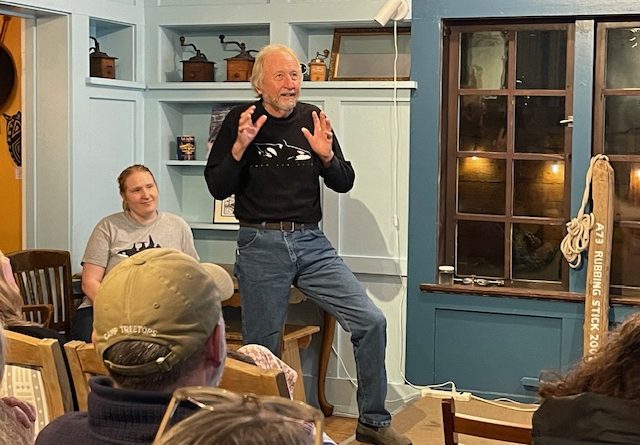
Speaking of generations – Mark’s been involved with the orcas since 1976; Maya became a NOAA-certified researcher in 2018. She was described as “known far and wide as the best identifier of the whales” – she can see a patch, a dorsal fin, and know which whale it is.
Mark explained that he got involved by being “a reliable reporter of whales” when the movement to protect them grew to include the need for information on when they were present in Puget Sound. He laughed at the memory of a hotline that people often called “collect” (back when it cost extra for phone calls depending on how far away the caller was from the person or place they were calling; if you didn’t want to pay the extra charge, you could make a “collect” call asking the recipient to be charged instead).
His many memories over the years included the honor of naming a whale – J35, Tahlequah, who has gained sad fame in recent years as the mom orca who swam for days while carrying her dead calves. She was born in 1998 and named after the South Vashon community that held a lot of importance for the orcas.
Also on the subject of Vashon, he told his side of the story of rescued Northern Resident orca Springer, the historic rescue that brought Sandstrom even more deeply into the world she had shared with whales for 20 years by then, and that she had recapped at the start of last night’s event (she’s published an award-winning book about it too, Orca Rescue). Mark said a friend of his who worked for Washington State Ferries would call him when WSF became aware of orcas in the area. His friend told him about this lone young whale; Mark verified its presence and “then started making calls … this animal just glued itself off North Vashon for weeks.”
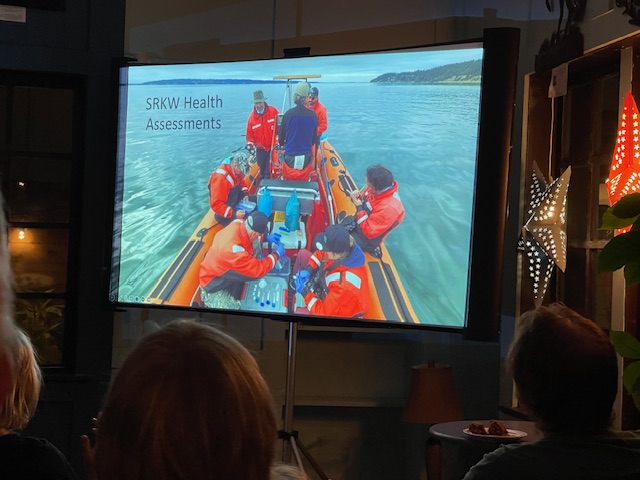
When he yielded the stage to Maya, she shared some of her secrets about identifying which whale is which – with patches and fin shapes. And she talked about the work they do gathering mucus and fecal samples – not glamorous, but vitally important: “We’re really trying to understand what is going on inside a killer whale,” such as whether they’re absorbing nutrients. They partner with researchers/veterinarians from the San Diego Zoo and Sea Doc Society in this work, as well as with NOAA, and what they learn about what the whales are eating helps advocates push for protection of species on which the whales rely to stay alive. Largely, Maya said, they’re eating chinook salmon, chum salmon when they come down here in the fall (because they’re “big and numerous,” she explained). She also had a whimsical aside explaining how the orcas like to play with their food and might toss a big salmon around for a bit before dining on it.
Maya and Mark said the new baby orca in K-Pod, which visited the area this week, looks “promising” – so many calves don’t survive, and some look borderline from the beginning, but this one seems healthy so far. They showed a photo of the baby, whose sex is not known yet, with other older females from the pod. Its mom is K36, Yoda, 22 years old.
Sandstrom had pointed out earlier that this birth brings the Southern Resident orca population to 74, and that’s important in a glass-half-full way – rather than dwelling on “only 74,” she contends, it should be noted that the population includes 11 calves under six years old, seven of the female: “The future is here now.”
But keeping it a hopeful future, she said in her opening remarks, will require ongoing advocacy. Growing the Southern Resident population has been by no means just a matter of not capturing any more; the population built back to almost 100 when the captures stopped, but then other trouble intensified – noise, lack of fish, pollution, and more. She ticked off a list of action that’s helping, much of it springing from the Southern Resident Killer Whale Recovery Task Force formed by former Gov. Jay Inslee (Sandstrom was part of that group). Action you take to lessen thse pressures doesn’t have to be herculean, Sandstrom noted – help the salmon by watching what you put down drains, for example. And whale-watching from shore instead of from sea. And then, as the actions of so many compound and the Southern Residents pull back from the brink, Sandstrom told attendees, “You can say ‘we did that’.”
After some Q&A for Mark and Maya, they were honored with a toast – to the years they’ve worked with and for the whales, and to hopefully “many more to come.
LAST CALL FOR ‘WELCOME THE ORCAS’: The Whale Trail’s “Welcome the Orcas” activities – including a Pod Passport and a special menu item at Arthur’s in Admiral – run through Monday; read about them here.
| 1 COMMENT