VIDEO: Highland Park Way lane-conversion critics get their face-to-face with SDOT

By Tracy Record
West Seattle Blog editor

SDOT‘s contention is that converting a downhill lane on the Highland Park Way hill will make the road safer.

“For bikes or cars?” asked an attendee at last night’s HPAC meeting, loudly.

“For people!” retorted another attendee.

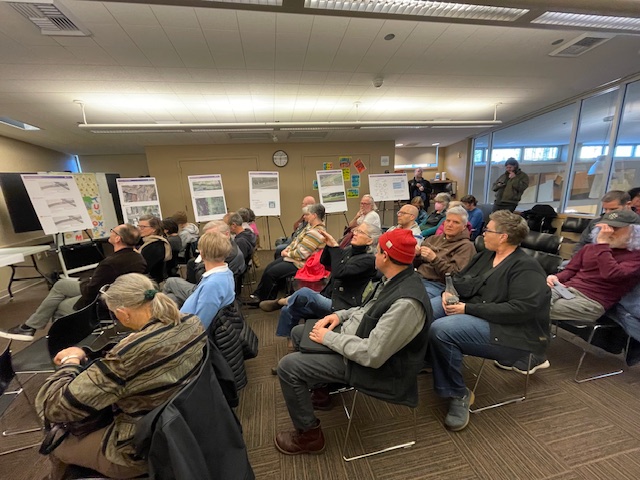
HPAC – the community coalition for Highland Park, Riverview, and South Delridge – has long been asking SDOT for an in-person meeting to answer questions about the lane-conversion project, which is fiercely opposed by drivers who say removing a driving lane will lead to traffic jams on one of the few ways out of West Seattle. Last night, they got that meeting. Judging by various bursts of applause and jeering – which HPAC co-chairs Kay Kirkpatrick and Barb Biondo tried to discourage – that viewpoint dominated among the 50+ people who filled the Southwest Library meeting room, but at least a few supporters were present too.

SDOT has remained resolute that driving-lane removal is not up for debate, but other aspects of the project are. Earlier this week, they unveiled another option for configuring the bottom of the hill, where Highland Park Way meets West Marginal Way. Before that, they announced they would separate the converted lane from the vehicle lane via jersey barriers that could be removed in case of catastrophe like another West Seattle Bridge long-term closure requiring restoration of the second downhill lane. But that didn’t seem to placate those whose memories of the 2020-2022 bridge closure remain fresh. Two people even brought signs, one reading “Fix Existing Problems Before Creating New Ones.”

Last night’s meeting was held in three parts – first, SDOT reps recapped where things stood, then everyone was invited to engage them in conversation around the room, and finally a reconvening of the full room for questions/comments. We recorded the first and third parts on video. Here’s part one:

SDOT reps who spoke were project manager Tony Roberts, project engineer Luke Larson, and project communicator Dan Anderson. They opened by trying to clarify a statement made at the online meeting earlier this month, in which this was described as a “safety project” rather than a “bicycle project.” Yes, but, they said, the money – $4 million – comes from Bicycle Master Plan funding and Vision Zero. In addition, the bicycle lane is intended to address a gap in how riders can get from West Seattle to the Duwamish River Trail. Regarding the newly unveiled Option 2B for handling traffic at the bottom of the hill, SDOT feels that its configuration means two lanes aren’t needed to feed into it any more. Larson said they’d done “modeling” to verify this. They also intend to use plastic center-line posts (like Sylvan Way and Alki/Harbor Avenues) and a high-friction surface treatment – all that will be part of a separate project but concurrent with construction on the lane-conversion. They reiterated that putting jersey barriers on the center line is not an option because they need two feet of width.

When the time came to circulate, about half the attendees did, while the other half stayed in their seats until the full-group session – here’s our video of that:

One of the first to comment declared, “You need to give precedence to the cars over the bikes, I’m sorry.” Anderson acknowledged “this is where we get into disagreement … there’s a lot of expertise … we feel with this it will still work OK.”

In the face of repeated contentions that “this will make it worse,” he insisted, “We don’t believe it will.”

The “what if the West Seattle Bridge goes out?” question also repeatedly arose. Larson said the jersey barriers could be removed to reopen a car lane “within a couple of days.” Anderson also tried to use this to reinforce that SDOT had listened to feedback on some points, saying that SDOT did not expect feedback to include “what if the West Seattle Bridge goes out?”

Another attendee declared, “You’re not solving the crashes – you need to separate the downhill and uphill. Put in some trees like you did on Delridge.”

Then, the question, why not improve the existing sidewalk on the downhill side?

“There’s not room,” said Larson, saying it’s six to eight feet now but they need 10 to 12 feet, adding that the steep dropoff from the existing sidewalk would require “tens of millions of dollars (to be spent) on retention walls.”

A man who spoke in favor of the lane conversion said he’s biked up Highland Park Way “100 times, and downhill maybe once” because of the bumpy path. When this is built, he said, he can put his kids on a bike and ride to South Park. “I will not be driving that street in the future if I can ride the street safely” – one less car, he noted.

A number of concerns were raised by people who live on Othello, a southward turn off the hill. Anderson said SDOT would come out to talk with those residents before long. He also acknowledged that the concept of adding a traffic signal there was mentioned at the meeting, though it hadn’t come up previously.

The SDOT replies to concerns didn’t win over the doubters. One concern about “so much road rage” on the hill was met with a reply that it would be less prevalent with one lane of traffic, if you’re only looking at a car directly in front of yours. That drew derisive hoots.

If the goal is to slow drivers down, why not speed bumps? someone asked. Larson said they’re generally not installed on slopes steeper than eight percent – HP Way is 11 percent.

What about a speed camera? someone else asked. Short answer: That would have to be enabled by state law (which currently limits speed cameras to school zones; the HP Way hill is not part of one).

What about widening the path on the uphill side? Kirkpatrick reminded everyone that the uphill side has had slides, and trees fall fairly frequently.

The SDOT team kept trying to reassure the room that they had “looked at a lot of concept.” Larson mentioned Alki and Green Lake. Those are flat, someone countered. Yet another attendee who described himself as “the most seasoned cyclist in Highland Park”

“By reducing the number of lanes, you’re reducing our quality of lives!” someone said. Another: “This plan is pitting drivers against bikes, but we should be working together.” Another: “This is planning for the future.”

Meantime, alternatives were suggested. Rumble strips? Turtles?

One person also noted that Highland Park has been saddled with a lot over the years, dating back to the municipal-jail proposal that HPAC fought tooth and nail more than a decade and a half ago, and multiple encampments, both RVs and tents, not to ention the future Glassyard Commons tiny-homes-and-RV-lot site close a short distance east of the Highland Park Way hill.

Another tried a final line of questioning: “Is there a date by which you have to spend the funding for this?”

SDOT didn’t really answer that, but Roberts noted that construction is currently set for next year.

79 Replies to "VIDEO: Highland Park Way lane-conversion critics get their face-to-face with SDOT"

  • K March 26, 2026 (1:02 pm)

    It is so disappointing to see so many people unwilling to accept the tiniest inconvenience for the sake of making someone else safer.

    • Arush March 26, 2026 (2:55 pm)

      I don’t think eliminating one of five lanes out of West Seattle could possibly be construed as “the tiniest inconvenience.” If you drive the route, the inconvenience will be anything but tiny.

      • K March 26, 2026 (4:56 pm)

        It’s so disappointing to see people prioritizing convenience over the safety of their neighbors, period.

      • DC March 26, 2026 (6:02 pm)

        This is exactly what everyone claimed about the Marginal Way bike lane. Haven’t heard a single person complain about it since. I’m curious, would you be willing to admit you were wrong if there aren’t major backups causing anything more than the tiniest inconvenience?

        • Erik March 26, 2026 (7:24 pm)

          It’s a regular pain in the ass and I regularly use the turn lane to pass slow drivers. 

          • Flip March 26, 2026 (8:03 pm)

            And that’s why this is needed. Because as someone who regularly drives this hill, I absolutely guarantee those “slow drivers” are going at least the speed limit and likely faster.

    • Erik March 26, 2026 (2:57 pm)

      This is not a small inconvenience. People who drive the stretch every day will be impacted every single day by backups.

    • Concerned HP Resident March 26, 2026 (7:03 pm)

      Problem is it’s not making anyone safer. what would make everyone safer would be if they kept the two lanes and put a divider in between oncoming traffic going up and down the hill. If you look at people that have been killed on the hill or cars flipped over it’s at night time speeding down the hill from the cops or just speeding and then going in to head on traffic or flipping over in the woods. So the work that’s going to be done is not making anyone safer. Not to mention it is not safe to ride a bike down that hill on a bike path or any or in the street given the 11% grade.

    • Mark H March 27, 2026 (11:34 am)

      Agree. This is wild to me and makes it feel like I’m back in the 1970s. 

  • WS Guy March 26, 2026 (1:20 pm)

    I love the sarcasm in “fix existing problems before creating new ones.”  Implying that SDOTs goal is to create problems.  Which, it is. 

  • BDR March 26, 2026 (1:55 pm)

    Don’t think SDOT has any intention to be open to comments about what the local residents think about this project. They seem to think letting people vent would reduce the anger and frustrations. 

  • Actually Mike March 26, 2026 (2:12 pm)

    Thanks for covering this. SDOT seems to have their fingers in their ears while saying, “Nyah, nyah, nyah–we don’t hear a word you’re saying.” Nothing new there, I guess, but it still stinks.

    • Foop March 26, 2026 (3:03 pm)

      Wild to me that people here want to complain about SDOT not listening. These two people are experts in this domain, they presented data and evidence of their findings, or at least tried to, just to be met with aggression and jeering from our neighbors. The folks there had no interest in listening to SDOT and the facts, they have an emotional connection to a lane on a road and will dismiss facts presented by people who went to school for and trained for this stuff as their living. This would be like a carpenter going to a farm and yelling at a farmer about how they are milking their cows wrong.Kudos to these SDOT employees for enduring these disrespectful people pointing fingers in their face, jeering at them, interrupting them and crying fowl. Absolutely shameful showing from many of my neighbors.

      • Kyle March 26, 2026 (5:58 pm)

        What facts? 

    • SDOT: Go home March 26, 2026 (4:10 pm)

      Agree.  But all of the city departments are the same.  SDOT, SPR, you name it, it’s the same condescension from people who think that we work for them instead of the other way around.  If they like this trash so much they should do it on their streets.

  • Scarlett March 26, 2026 (2:20 pm)

    It’s clear that this entire project is ideologically driven and SDOT is not going to seriously consider any objections, or options which lead to a substantive compromise.  There is no way to remotely rationalize or justify reducing a lane for motorists, commercial vehicles, emergency vehicles and bus transit when there are other options.  This isn’t enlightened thinking, this is plain old rigid ideology, old wine in new bottles.    

    • WS Guy March 26, 2026 (6:56 pm)

      Considering the opposition by the locals, the ideology must be “Mommy government knows what’s best for you.”

    • B March 27, 2026 (7:58 am)

      Oh no! Ideological thinking that safety is more important than your ability to drive 15mph over the speed limit! What will they think of next, filtering our water so we don’t drink industrial runoff? The horror!

      • Kyle March 27, 2026 (8:25 pm)

        Actually B the correct analogy here would be changing to ultra filtering water for 75 people who have special straws while changing the drinking water for 20,000 other people to the duwamish directly.

  • Arush March 26, 2026 (2:57 pm)

    This truly seems like a solution in search of a problem.  Do the feasibility studies show projected numbers of bike riders who would use this lane? Versus the expected increase in traffic for drivers? How does this project possibly pass any kind of cost benefit analysis?  

  • Erik March 26, 2026 (2:59 pm)

    Thank you to everyone who showed up in opposition of this ridiculous project. If anything, it shows that SDOT is absolutely not listening to the 95 percent of residents who do not want this project. 

  • AT March 26, 2026 (3:45 pm)

    Do the incidents they are trying to prevent only occur during weekday rush hour?  Because honestly I don’t see this controlling speeds outside of peak hours.  On a Sunday morning or Tuesday at noon when traffic is not backed up, you’ll still only be limited by the speed of the person in front of you.  Rush hour will be a clusterf*** and their grand $4 million plan will be ineffective the rest of the time.  If they want everyone to slow down going downhill, they could  put one single stop sign at Othello, but that doesn’t funnel cash to their contractors.  Follow the money and audit SDOT.

    • Kyle March 26, 2026 (7:59 pm)

      The incidents or accidents are fairly low, SDOT has included all accidents including the intersections and it’s still ~10/yr. Assuming a generous 40% decrease, that would bring it to ~6. This is also just assumptions from national studies. A real analysis of the road would look to reduce the risk of head on collisions, not fender benders.

  • Dunno March 26, 2026 (3:47 pm)

    Wow!  Just wait for another closure of the WS Bridge!   It will happen.  As for bikes or people on this steep hill,  it’s almost as rare a sighting as Sasquatch!   People will pass and make this an extremely dangerous roadway.

    • foop March 26, 2026 (5:16 pm)

      It’s a rare sight because of how dangerous this road is for people not in a car. Please consider that. Would you ride your bike down this road? 

      • Look Both Ways March 26, 2026 (7:47 pm)

        Every cyclist has the option to walk / ease their bike down the existing hill path; then continue riding without disrupting disrupt existing conditions. Please consider that.

        • Foop March 26, 2026 (8:49 pm)

          Every driver has the option to walk their car down the hill if they can’t handle the speed limit. Consider that.

          • WS Person March 27, 2026 (8:59 pm)

            When they put the concrete barriers up admiral a couple months ago, so many folks said “I would ride up but I don’t feel safe”. Since then there are no more cyclist’s there.  A block of barriers a block without, and then another less then a block until your riding in traffic. People love to say that with xyz changes they would ride there but they won’t. This is a huge hill. It’s wet and dark half the year and only a nominal amount of people will ever ride it. 

        • Par March 26, 2026 (9:03 pm)

          Look both ways soon you will have the pleasure of easing down the hill in your car!

      • Kyle March 26, 2026 (8:00 pm)

        All in favor of repaving the path. A 6 foot wide multi use path could be repaved in the median.

  • DJsackman March 26, 2026 (4:59 pm)

    biggest waste of money I ever heard of for roadway construction.  this area does NOT need improvement for bicycle or pedestrian, at all.  When was the last time you saw a bicycle or pedestrian using this area?  This is ludicrous 

    • k March 26, 2026 (7:34 pm)

      No, biggest waste of money for road construction definitely goes to Saka’s Triangle at Delridge and 22nd.  A monument to his inability to admit he was wrong, or back down on a wildly unpopular stance, we removed parking and made the area less safe for bicyclists and pedestrians so that a few people whose kids are enrolled at a single private business nearby can turn around dangerously across a multimodal corridor.

      • WSB March 26, 2026 (7:47 pm)

        For accuracy’s sake, the Refugee & Immigrant Family Center preschool is not a “private business.” It’s part of Sound Child Care Solutions, which is a 501(c)3 (you can find the financial forms on their site).

  • pophouse March 26, 2026 (5:14 pm)

    Wild how many people think this steep stretch of road, with people flying 20 -30 mph over the speed limit whipping around other cars, is working just great. No wonder people think project zero is just a pipe dream that can only be accomplished in every other developed country. 

  • Mark B March 26, 2026 (5:37 pm)

    “SDOT did not expect feedback to include ‘what if the West Seattle Bridge goes out?’”…really tells me all I need to know about how much SDOT thought went into this.

    • k March 26, 2026 (7:37 pm)

      Probably because when the WSB was out, the backups they heard about constantly were the ones at the top of the hill, particularly Holden.  It’s weird to complain about the road downstream of the actual choke points, but they underestimated how people lose their minds over any perceived reduction in space cars are allowed to use in this city.

      • Jarring84 March 26, 2026 (8:01 pm)

        Who are the “car people” you are referring to? I hear this sort of framing a lot. Who are you specifically referring to? Because it seems like a convenient way to write off a majority of residents as irrational instead of engaging with their reality.

        • k March 27, 2026 (8:11 am)

          I looked back at the other comments, and the only person who has used the phrase “car people” is you, so do feel free to tell us who you are referring to.

      • Kyle March 26, 2026 (8:03 pm)

        This is not true. Lived through it and some days took 25 minutes just to get through the light at the bottom of the hill. People would pull an illegal u-turn to then try Olson.

      • Foop March 26, 2026 (8:14 pm)

        This! Holden backs up often, and it was particularly bad during the closure. Once you were on the hill you were home free. The folks complaining about the hill are exhibiting classic knee jerk reactions. I do feel for the othello folks but having a lane split to allow cars to aggressively pass you is probably more dangerous than them having to slow while you maneuver a turn.

        • Nrrd March 27, 2026 (11:15 am)

          Not true. I live off of Othello, so was starting down the hill below the light at Holden during the WSBridge closure. I timed waits as long as 45 min to get from Othello to the entry ramp to the First Ave s bridge. Also remember that we were extremely “lucky” that most of the WS bridge closure happened during lockdown so traffic was already reduced. Any similar closure now would have a larger impact.Furthermore, traffic on the hill is affected by closure of the 1st ave s bridge as well. The recent bridge closure had traffic backed up past Othello for extended periods. 

  • Admiral2009 March 26, 2026 (5:41 pm)

    Scarlett – agreed 

  • Ts March 26, 2026 (6:32 pm)

    Why do we keep reducing lanes on one of the few north-south roads to get out of west Seattle and now this hill? While also allowing multi-unit buildings on residential streets and moving island ferry traffic through west Seattle instead of going directly to downtown? More people, more cars and less road? How about More walk on ferries if you want cars off of the roads. It worked once before it can work again. And no we cannot all ride bikes everywhere. 

  • Jarring84 March 26, 2026 (7:24 pm)

    We’re taking away road capacity from the majority of people who rely on it every day and spending public money to support bike infrastructure that, at least right now, serves a relatively small but influential group. That’s a real trade-off, and speaks volumes about the priorities we set and how easily we can explain away issues that impact the majority of people.Meanwhile, a lot of working people don’t have the option to bike. They can’t show up sweaty, hair disheveled, and still be taken seriously at work. They have long commutes, on-site jobs, kids to manage—this just isn’t realistic for them. And they’re also the least likely to have time to show up to meetings where these decisions get made.Maybe traffic won’t be as bad as some think. But it’s not hard to imagine the outcome: people sitting in traffic on their way to work, staring at an empty bike lane most days, and then once in a while watching someone ride past on a bike that costs more than their car.

    • Foop March 26, 2026 (8:18 pm)

      Imagine a world where you can take a quick shower at work, or you have an ebike so you don’t sweat more than a nice walk. Imagine a world where you aren’t stuck in traffic because we have safe road ways for bikes that free up some of the congestion for cars. We must invest in other modes of transit! The folks at the meeting said it, we’re growing, more people are moving in. You want to complain about more cars? Why then are we constantly diminishing bikes? Let’s enable more people to live without a car so that those who must still have space to rely on it.gridlock is the on discernible future if we can’t move away from car dependency. I still need mine for many of my trips but I’ve been able to replace almost all of my needs on peninsula with an ebike and it’s been amazing for my health and fitness.

      • Jarring84 March 26, 2026 (8:42 pm)

        That kind of comment feels disconnected from reality. Safer bike routes are critical and need to be constructed but bikes vs cars isn’t helpful. Plenty of people are coordinating kids, carrying equipment, or working jobs that require a vehicle. Suggesting biking is the obvious answer comes off as dismissing anyone whose life doesn’t fit that model.

        • Foop March 26, 2026 (10:18 pm)

          Did you misunderstand “let’s enable more people to live without a car so those who must have more space to do so?”kids are not really a good blanket excuse , I saw a woman just the other day riding with her child in a covered seat on the rear of her bike on Delridge just this week.granted she looked tense riding on Delridge and not relaxed like the folks I saw hauling their kids in Utrecht.

          • Scarlett March 27, 2026 (10:00 am)

            Utrecht is not West Seattle.  Tokyo is not West Seattle. I’m all for reducing speed limits and taking  measures to increase safety, but parents who drag their kids around in a bike carriage on busy arterials, only a piece of flimsy fabric between them and a several ton car, are guilty of child endangerment – as well as being quite insane.    

          • Canton March 27, 2026 (10:52 am)

            Your comments are completely self centered, and dismissive of actual working people.

      • WS Person March 27, 2026 (9:04 pm)

        Imagine a world where it’s not dark and wet half the year and half the city isn’t hills.  And people work farther away then a 20 minute bike ride. Glad you can imagine it, cos that’s NOT Seattle. 

        • Foop March 28, 2026 (12:50 pm)

          I got news for you, it’s hilly and rainy in other parts of the work that prioritize far more multimodality than here. Cyclists in Seattle all over bike year round. Just because you’re afraid to doesn’t change reality. Also many many people work downtown, which is pretty much a 20 minute ride from anywhere in Seattle, often quicker than driving in rush hour.

    • dc March 27, 2026 (7:36 am)

      One bike lane will neither exacerbate nor solve world hunger. Bike lanes are a policy preference, an implementation of a set of political and moral values. If this is your preferred policy, you cheer and support when your representative wins an election and delivers projects. If this is not your preferred policy, you lament that your opinion is not being represented when the opposition representative wins an election and delivers projects. That’s simply how our single-winner political system works: those who hold political preferences that lose at the ballot box are, at a basic level, unrepresented and owed no mind.

      Please remember to vote in a timely and regular fashion whenever a ballot shows up in your mailbox. Register with King County Elections if you are not.

  • redfolder March 26, 2026 (7:37 pm)

    I wish some people would observe the speed limits (car drivers and bike riders).

  • Look Both Ways March 26, 2026 (7:57 pm)

    Watch the “part 2” video starting at 46:30. A self-proclaimed “most seasoned cyclist in all of Highland Park”, who has bike-commuted downtown for 12 years, articulates how he uses the hill. He artfully concludes why this project is a waste of funds and where SDOT should instead prioritize to the real problem zones (he cites Michigan Ave). SDOT would do well to listen to him and truly consider his input.

    • pophouse March 27, 2026 (12:23 pm)

      the guy who says people should bike 45 mph around corners in moving faster and weaving lanes. yeah real genius that one. 

  • Km March 26, 2026 (9:25 pm)

    I have a lot of respect for SDOT employees who have to put in these types of outreach sessions. Constant complaining from people with a lot of free time and little to no knowledge or expertise, who wouldn’t come close to being hired for the jobs they do. I went to a couple meetings in the past decade on SDOT projects and it was so frustrating. I would be happy to see a lot of listening sessions/talking sessions/open houses/community discussions/in person outreach/vision quests go away, and keep the process moving forward with those who have the skills to get it done. There are plenty more efficient venues to get in comments!

    • Craig March 27, 2026 (6:55 am)

      While you would rather disregard with public engagement,  you might scale back your criticism of the meeting attendees as the Highland Park resident’s, many in the room, have been ahead of city planners, requesting improvement for all modalities including cycling for decades- finding funding to plan for the Highland Holden intersection, working to mitigate pedestrian issues during the bridge closure, and funding their own neighborhood community center in HPIC all due to the historic lack of city investment in the area.  I too appreciate the SDOT reps who presented; however, the absolutely maddening aspect of  engagement relating to this project is that SDOT  heard virtually all of the same feedback in 2024 via their own survey, lots of anecdotal contributions, and a letter from several local neighborhood groups/stake holders , and had at the time, responded with alternate designs that retained all of the lanes at the base of the hill  but then came to the March 4th 2026 meeting having essentially returned to their initial design (and another  design that would certainly lead to collisions between cars and cyclists).  Sdot then, after a week or so, shares the more reasonable option 2B just before last night’s meeting. Sdot’s choice to proceed presently as if there has been no prior engagement and to hold off sharing 2B  until after we, West Seattle residents, are in a divided frenzy is largely why this meeting was so hostile.  There were several in the meeting, myself included, that would rather see the existing off street path widened  but are open to talking about design options.  But is Option 2B an option or just another rendering of what we’d like but that SDOT has no intent on building?  Highland Park is a wonderful community because we have people that care in our midst.  Thanks to all that attended.  

  • BL March 27, 2026 (12:43 am)

    7th Ave SW resident here.  What is the deterrence in any of the current plans to reduce speeding?  IMO, reducing one downhill lane removes an escape path for avoiding a head on from someone coming up hill that crosses the median.  It also removes any safety valve for issues with the West Seattle high bridge.  People will always speed unless there are deterrents or consequences.  Just look at marginal Way industrial area between Highland Park Way intersection north to the Intersection near the Chelan Cafe.  30mph and traffic consistently travels 45-50.   I have often wondered why there aren’t speed cameras on both Marginal Way and Highland Park Way.   Given the speed limit is 25 on HPW, why aren’t there speed bumps?  SDOT seems to be sprinkling them all over west Seattle streets in almost every direction.  Consider the following:  Widen the curbside uphill lane by about two feet into the area that currently has no sidewalk (may need to move a few power poles).  Shift the uphill lanes to allow for a center jersey barrier with a break for Othello egress/ingress, Put a jersey barrier up on the down hill curbside area (or replace the curb with a jersey barrier) to protect a widened existing path, that includes a bike lane and walking path.  A break in the jersey barrier would provide for the bus stop just downhill of Othello as well as a break for Othello egress/ingress.  Add speed bumps, all 4 lanes, that require 20mph speed and install speed cameras.  3-4 speed bumps would not be an inconvenience, would not slow traffic significantly below 25mph and the cameras would be a deterrent that has some teeth in it ensure a reduce speed and protect everyone using that roadway.   I am not a traffic engineer but someone should be able to show why this isn’t workable or modified to be workable and compromise to give everyone most of what they want.   Perhaps, just the speed bumps and no center jersey barrier or uphill road widening?

    • Foop March 27, 2026 (7:10 am)

      All of your points are addressed directly in the second video by the actual traffic engineers.

  • Doug Holland March 27, 2026 (4:43 am)

    From any, every connecting street, there’s never more than one lane of access to go downhill on Highland Parkway. There’s thus no logical reason it needs to become two lanes before the bottom of the hill. Get over your panicked reactions.

  • Natta Chance March 27, 2026 (7:29 am)

    The 15 mph school zone speed bumps that have a hole down the center line just big enough for super compact cars like the Fit to zoom through down the center line are great! I’ve never seen some idiot nearly head on a bus doing that. Reducing available parking downtown without having built truly meaningful additional commuter capacity was also brilliant. I love people throwing on their flashers and parking in the street. It’s so much safer! But hey, there was just a report out that over 30% of commercial real estate in the downtown core is vacant. Maybe SDOT is committed to bringing that same sort of success to residential real estate in West Seattle. When you add this lane removal to the admission that the light rail may never make it to the Junction, it certainly starts to look that way. 

  • CL March 27, 2026 (8:16 am)

    Imagine driving down an 11% grade hill with a 3 foot divider on one side and 2 or 3 foot delineators in the middle going into a corner.. I doubt very much the new lighting will be bright enough to light the center lane. This will be like driving into a tunnel at 11% grade, add rain, the dark and the new bright uphill headlights and this road will now be very dangerous. Any of SDOT’s configurations are going to cause more accidents then there are now.

    • Natta Chance March 27, 2026 (1:56 pm)

      Exactly! And it’s extra frustrating because the majority of drivers are talking about safety concerns for cyclists and pedestrians as well. A huge amount of what I’m seeing from the bike lane crowd is “Sucks to be you, get used to it. That may be a fine attitude to have with me personally, but it’s not going to keep a garbage truck from going right through the jersey curb if the only other option is two lanes of opposing traffic and their brakes fail. Are we also going to ban vehicles over 10,000lbs?There’s no option to build a pedestrian path _at a lesser grade, diagonal through the green belt? Maybe repurpose the money that isn’t going to expanded surveillance cameras to put in that that supposedly $4M fence against the drop off on the path that’s already there? Put the money into getting the bus to actual run on time so folks can get down the hill encased in tons of steel? Tell Amazon, Microsoft, etc that their 100% RTO (even for folks that were remote before COVID) has added 20% to commuter traffic and they need to pony up?I’m not saying I have the ultimate solution, but your description is an accurate picture of the hell they will create if they continue to pave the roads with good intentions and refuse to examine the real world consequences.

  • Rob March 27, 2026 (8:55 am)

    It would be interesting to know how many SDOT employees use this arterial on a regular/daily basis.

    • JUSTJOSH March 27, 2026 (1:12 pm)

      Do you really think it’s reasonable that SDOT traffic engineers drive on all 4000 miles of roadway in the Seattle city limits in order to make decisions about safety and traffic flow?

  • Shawn March 27, 2026 (10:51 am)

    People don’t ride bikes there much because there’s no protected lanes, so we should not build protected lanes because nobody rides bikes there much? Do yall even hear yourselves? If we listened to these people they’d never build any real bike lanes at all.  Think of it this way, every protected bike lane represents less bikes driving 10 mph in the middle of the road you have to dodge. Less sharrows nonsense. Less injury and death. I like cars just fine, but you can’t expect everyone to drive in the middle of a dense urban environment like Seattle.  Walking and biking infrastructure is a basic requirement for any city, not an inconvenience to drivers.  Drivers should want more bike lanes, not less, and if it costs a lane that’s still worth it.

    • Scarlett March 27, 2026 (12:50 pm)

      You’re advocating reducing capacity on a critical East-West corridor that serves not only motorists, and every other type of transport, including metro buses.  We want to keep this 4 lane corridor as it is and spend what it takes to implement a separated multi-modal bike/ped lane.  We’re spending billions on redundant light rail the usefulness of which will come primarily during rush hour, surely we can drop a few bucks on a bike path.  

    • Kyle March 27, 2026 (2:02 pm)

      Highland Park way hill is not a dense urban environment. It’s one of a few egress routes off the peninsula and leads to an industrial area on a steep hill. Repave the path in the median to increase bike usage and be done.

      • k March 27, 2026 (3:43 pm)

        Wait, make up your mind.  It’s either a main thoroughfare handling all the cars from a densely populated neighborhood or it’s a backwater to an industrial area.  You can’t have it both ways.

        • Kyle March 28, 2026 (12:48 pm)

          The hill is a major arterial, it’s also not dense with housing or any buildings. Original commenter was trying to blanket statement that everywhere in Seattle is a dense urban environment, instead of looking at this specific project and location.

  • DemandCurve March 27, 2026 (10:57 am)

    How many of the Luddites here have ever actually rode a bike to work?  I spent 10 years in Seattle commuting via bike (up and down 23rd from the CD to UW) and the number one thing in my route planning was “how much effort – where are the fewest hills?”. That uphill is a major grind that will turn most cyclists off unless their work destination happens to be at the bottom of that hill orthey are carless or they are working on their fitness.  This whole thing is silly.  SDOT thinks if there’s a path from A to B cyclists will use it.  They are not cyclists and the cyclists they have on staff hate cars with a fervor and think everyone can’t wait to climb 400 feet elevation after a day’s hard work.  Less than 25 people a day are going to grind out that uphill (and hats off to you few. I’ve done it too)

    • pophouse March 27, 2026 (12:32 pm)

      When I was younger and in great shape I would never have attempted a hill like that. But now that I am older, and ebikes exist, I bike up stuff like that all the time. 

    • Scarlett March 27, 2026 (1:00 pm)

      A voice of sanity in the Wilderness.  Sometimes it takes someone with “street cred” as a bicyclist to articulate what we’re all screaming in our heads.  For many of this, our objection has zero to do with being anti-bicyclist or anti-pedestrian, sometimes a silly idea is just a silly idea. 

    • Platypus March 27, 2026 (1:14 pm)

      Ebikes have really changed everything, are are very accessible for any income and fitness level.

      • Scarlett March 27, 2026 (2:34 pm)

        Ebikes don’t change the weather, they don’t change the inherent danger of riding down a steep incline, they don’t change the inconvience of packing everything you’ll need for a day on a bike.  They’re a nice upgrade for many but are not going to replace cars in massive numbers.       

    • Foop March 27, 2026 (3:46 pm)

      Living in Seattle, specifically west Seattle has taught me that hills are inevitable. Many days I pick and choose between short and steep or long a shallow; as resident of highland park, this hill is short, brutal but when it’s done, I’m home. Some days I’d rather save 35 minutes and take this hill than ride 6 miles out of my way north and back south. With my ebike I can easily get up this hill going 10mph.

  • Lahaina, anyone? March 27, 2026 (2:14 pm)

    No one is talking about the obvious: the reduced carrying capacity in the event of a catastrophic event. The 2023 Lahaina wildfire should serve as a stark reminder that blocked exits (whether by police or permanent barrier) can be deadly, and exacerbate an already horrific scenario. To think that WSea cannot have a similar fire event is foolish, or the more likely earthquake where people wisely wish to leave the waterfront. The SDOT is being reckless here (do they not participate in disaster planning?–honest question…), all for the benefit of a VERY small percentage of population who wishes to recreate or otherwise travel by bike. As Lahaina illustrated, there would be zero time in which to move the jersey barriers during an emergency, so let’s end that silly argument. I am totally against this plan which effectively reduces our escape routes by 20% even during normal operation. That 20% could mean life or death during an emergency. Someone with deeper pockets than mine needs to take this to court. 

    • k March 27, 2026 (3:48 pm)

      If there were actually a disaster like that, everyone would be travelling the same direction so swapping a lane to handle traffic the other direction (like all of us have seen done literally every day in construction areas) would not be an issue.  Same with emergency vehicles.  They know how to cross paint on the road; they do it all the time.  There are one-lane roads all throughout Pierce county and you know what?  In the event of a lahar, they’re going to be able to leave.  Roads are designed with every day use in mind.  Contingencies are possible, but everyday design should allow those contingencies, not be centered around them.

  • DRW March 27, 2026 (4:54 pm)

    For the love of Kathy Lee Gifford! Please just widen the existing sidewalk!

Leave a reply

Your email address will not be published.