VIDEO: ‘Shared streets’ and what else is on the road ahead for SDOT’s safety aspirations, as told to City Council committee

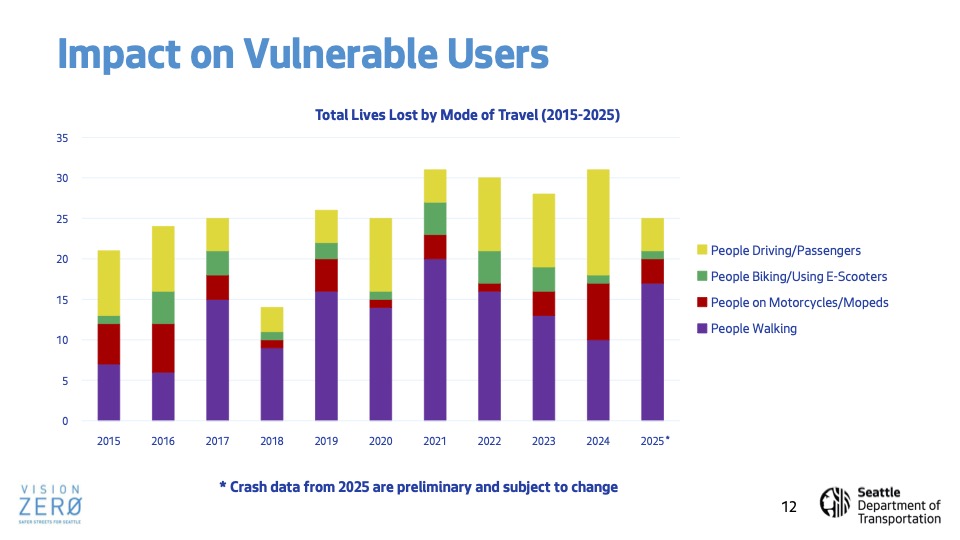
As previewed here, the newly expanded-in-scope committee chaired by District 1 City Councilmember Rob Saka got a general SDOT update during its first meeting of the year. The department’s new director Angela Brady was there for the meeeting of the Transportation, Waterfront, and Seattle Center Committee, but mostly to introduce chief transportation-safety officer Venu Nemani, who led most of the briefing. As shown in the slide deck presented during the meeting, 25 people were killed on Seattle streets last year, mostly people on foot:
In an attempt to reduce that, SDOT has continued expanding a variety of tactics:
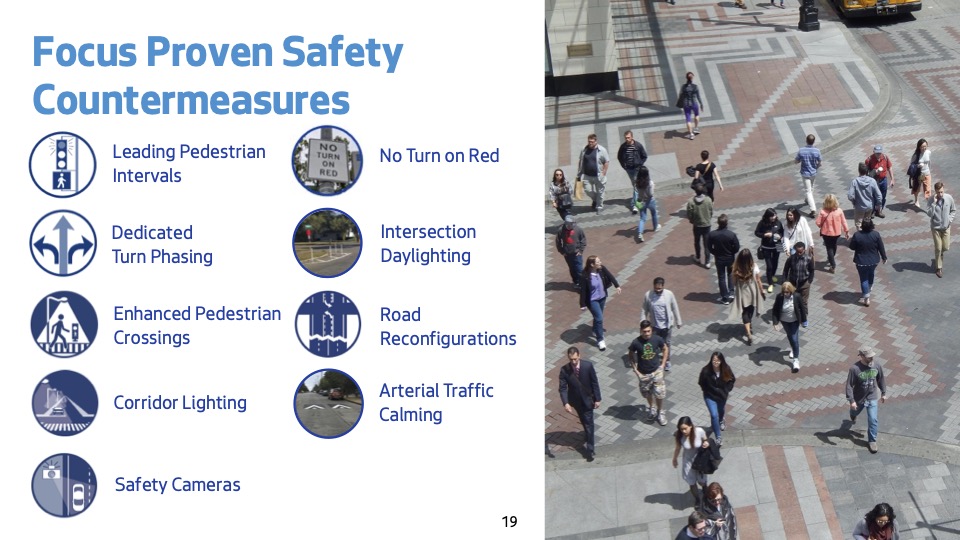
It’s added “no right turn on red” signage in more than 800 places, with fewer than 200 left to add, and is planning more “enhanced crossings” with marked crosswalks:
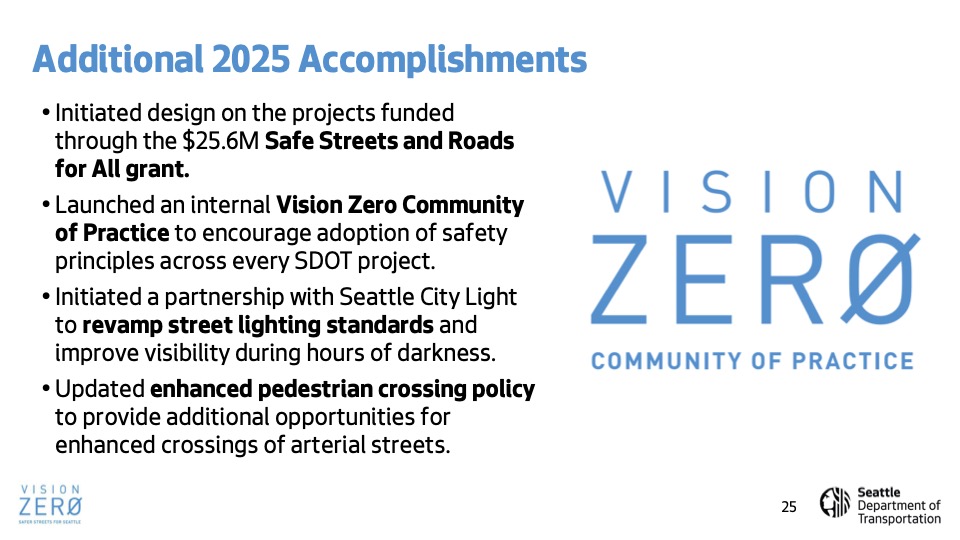
Speed cameras are still in the study mode, so don’t expect to see those soon.
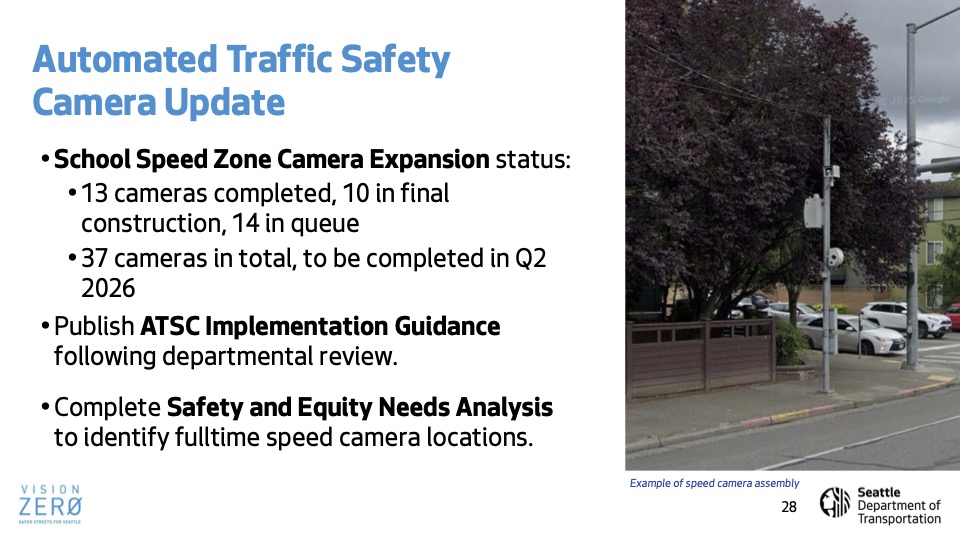
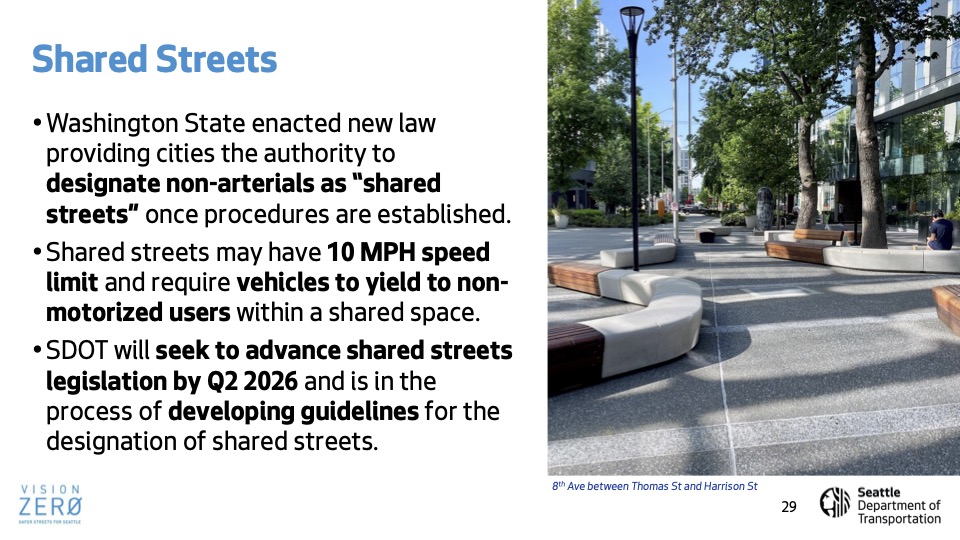
Also of note, the potential implementation of “shared streets,” which sound somewhat like Healthy Streets:
The presentation mentioned only one West Seattle-specific project, the plan to convert the outside downhill lane on Highland Park Way to a bike/foot path, described as in design this year:
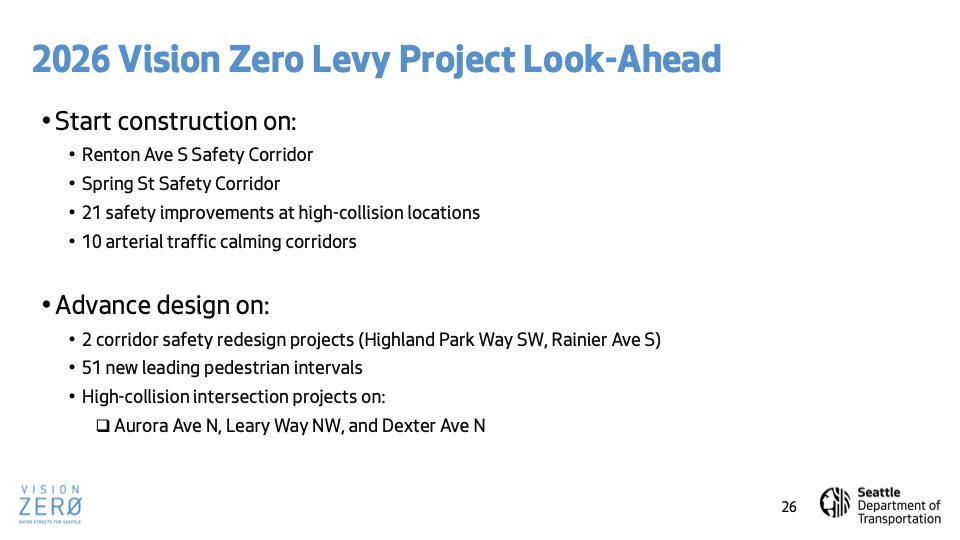
(The project website hasn’t been updated since spring.) No votes at this meeting; it was just a briefing, but a window into where SDOT is focused right now.

6 Replies to "VIDEO: 'Shared streets' and what else is on the road ahead for SDOT's safety aspirations, as told to City Council committee"

  • Vizio. January 20, 2026 (12:23 am)

    How do we get SDOT to drop this insane, ideological program?  “Vision zero” is a nationwide scam wasting money on diminishing returns instead of providing and maintaining safe functional roads and sidewalks.

  • North Admiral Cyclist January 20, 2026 (5:52 am)

    Glad to see this post with this information. I notice West Seattle has a higher rate of serious and fatal crashes (Slide 14) compared to the rest of the city.  As someone on the road almost every day, that looks to me as a result of 1) lack of up-to-date ped/bike infrastructure compared to other neighborhoods; 2) higher percentage of car-brains on West Seattle’s roads (that are still railing against bike/peds and safe streets).  Of course it does not help when Rob Saka uses his sway in an attempt to remove street safety infrastructure (“Curby”) on Delridge so he can make it easier to pick up and drop off kids at his daycare.  

  • M January 20, 2026 (6:40 am)

    So glad SDOT is pushing forward with safer streets. When I see crime or safety mentioned in our community, most of the time threats and outcomes from aggressive drivers are not mentioned (SPD, crime and safety surveys, local TV media, etc.) and we have some local cases of vehicular violence that have never been prosecuted. It’s one of the issues that makes me feel most threatened in our current society. I would argue SDOT it not going far enough, but it’s hard to push back against default car supremacy in the US. 

  • Alki resident January 20, 2026 (7:07 am)

    The “No turn on red” policy is a disaster for anyone in a vehicle. This includes buses. It’s causing gridlock all over the city during busy times. And when it isn’t busy, cars are just sitting idling for no reason. It took two hours to get home from Queen Anne the other day. And that was just a regular day, no accidents.  What a mess! Another failed progressive policy. It needs to be repealed!

    • Platypus January 20, 2026 (8:53 am)

      “no turn on red” should be implemented state wide at every intersection. It is the single most impactful safety measure and would save many lives. I agree that traffic  is slow, but turning on red is a bad and ineffective way to solve that. The only solution to better flowing transportation are better choices than driving. Major and  constant investment in bus only lanes, more trains, better bikes routes, better sidewalks, help everyone and speed up car traffic too.

    • Mickymse January 20, 2026 (8:55 am)

      I’m older than laws in most places in the U.S. allowing right runs on red—which happened in the late 1970’s. And, while it wasn’t particularly liberal at the time compared to now, it might surprise you to know that California was the early adopter in the U.S. a couple of decades before. Many historians attribute the change to a misguided belief during the oil crisis that we need to prevent idling cars as much as possible. Of course, back then, most people drove slower than they do today and the cars they drove were much less dangerous to pedestrians. Like everything else, policies are changing because a few people can’t manage to follow the laws, so the rest of us have to suffer the consequences. I can’t tell you how many people I (anecdotally, of course) see in this city who can’t even bother to stop before turning on the red or who blow right through stop signs at intersections. So, yeah, we could stand to stop this at many corners around here.

Leave a Reply to Vizio. Cancel reply

Your email address will not be published.