
 (WSB photos)
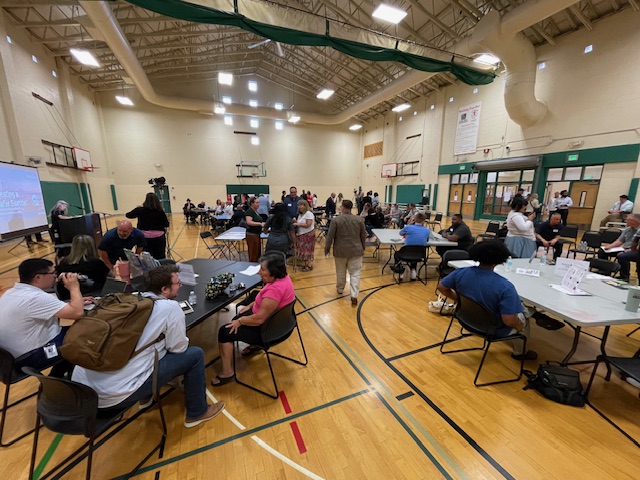
6:02 PM: Just hours after one of the highest-profile crimes in West Seattle this year, the noontime smash-and-grab robbery at Menashe and Sons Jewelers in The Junction, the city’s bringing its community-safety forum to West Seattle tonight. We’re here at Delridge Community Center for the forum, which is scheduled to be about half speeches – primarily from the city’s three public-safety chiefs (police, fire, CARE) – and half table discussions – the tables are labeled with these planned topics:
-Crime prevention and small business activations
-Youth and community investments
-Neighborhood beautification
-Neighborhood traffic safety
-Neighborhood park safety
-High-impact crime reduction
-Substance use disorder response
-Effective emergency response
-Gun violence reduction and prevention
-High-impact crime reduction
We’ll be updating live during the forum, at least every 10 minutes. Organizers were worried about capacity but there’s still plenty of room in the DCC gym as this gets started, so there’s time to get here if you’re interested.
(Added 11:30 pm: Video of forum’s first hour, before table discussions)
6:12 PM: The emcee stressed that collaboration would be key. Continuing introductory explanations, she walked through what the mayor’s office calls the “One Seattle Restoration Framework.” (Added: The emcee is Leandra Craft, Seattle Restoration Team director for the mayor’s office.) She introduced District 1 City Councilmember Rob Saka:
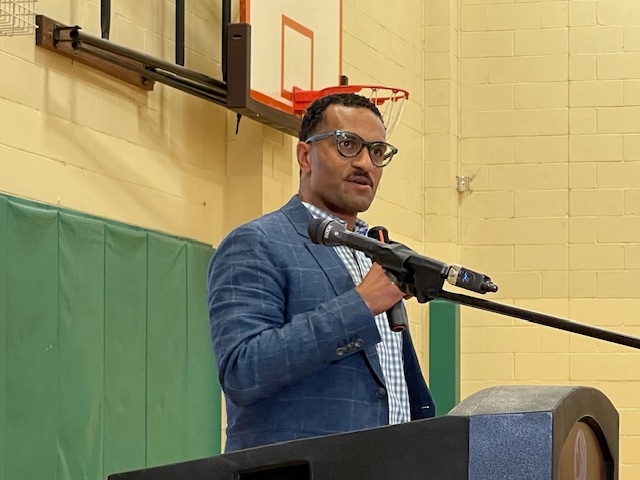
“We’re all here because we care about public safety in District 1.” He said it’s the top issue his office hears about. He said he takes the job “very seriously” regarding working on this issue (he is vice chair of the council’s Public Safety Committee). He promised to “listen, learn, and act” as a result of the forum.
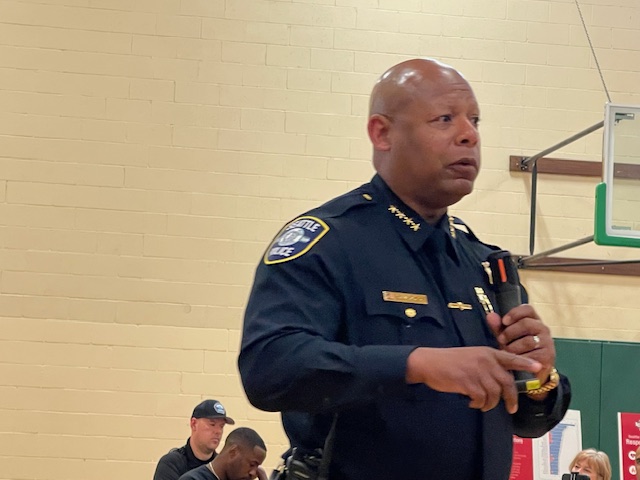
SPD Chief Shon Barnes spoke first, saying his presentation at these forums has been “getting shorter and shorter … How do we return Seattle to the Seattle we all know and love?”
He said he’d spent his first six months on the job putting together “not just a plan but a commitment to public safety,” which he calls “Seattle-Centric Policing.” It’s “about partnership,” not always police-led, he said, so they have broken it down into priority issues, priority areas, “priority offenders …we have to set them on the right path if we can and if not we have to hold them accountable for their actions.” He said the plan is “crime- and harm-focused” so they can “find the right partner” to address an issue. “It’s city-supported and service-oriented.” He said that in other cities he’s had trouble ‘bringing people together” but not here. He says the work is harder to collaborate with “service providers.” That might include nonprofits, the faith community, people who want to help, people who are already helping.
Communication is key, and he said SPD is changing some of that. They’re working on a “community concern portal .. I know that your concerns are valid, we’re not just going to listen, we’re going to be ‘boots on the ground’.” They’re also piloting “neighborhood-oriented policing” with an unnamed neighborhood where two officers are spending their entire shift in the entire neighborhood, and they’re going to measure whether that reduces crime, adds to neighborhood and officer satisfaction, etc., before potentially expanding.
He said they’re reorganizing the department, with bullet points including combining and centralizing “units that support cre and harm reduction planning and analysis.” That involves developing a lot of strategy for how to address different problems. They now have a new manager dedicated to this area. “We’re working on a more science-based approach,” Barnes said. He spoke about focusing on “an area where people like to go to test fire weapons” in “this precinct” and addressing that. (He didn’t say where; we’ll follow up.) He also mentioned the Real-Time Crime Center.
Moving on to “recruitment and retention,” he said this is on track to be the year with higher hiring than any preceding year, He said that preceded him because the community wanted to “restore the police department” He put up a slide showing that crime is going down in some categories, “but there’s still a long way to go” and he wanted to make it clear he’s not taking a victory lap. “This is good, but we can do better.”
6:22 PM: Chief Barnes said that when things are going better, it’s the time to work together to try to improve. He gave a shoutout to community members including members of the business community – he mentioned going to the scene of the Menashe and Sons robbery to say he was glad to be able to offer a little reassurance to them – “I have a big heart for the business community” because his dad ran a small business.
He promised “you’ll hear from me when things are going well, when things are going not so well … Everything we do to keep you safe, you should see (us) working to solve the problem.” With that, he took a few questions that had be written. The first one was about parking enforcement. Precinct commanders can deploy those officers “as they see fit,” he said. He said that will be part of the Community Concern Portal and that they hope to integrate more concerns into Find It Fix It. “We need quicker response, a more coordinated response ., and we want to be able to report back to you when we found out about the problem, what we did about the problem.” Second question was about ensuring that police investigate crimes reporting online. “We direct people (there) when you don’t have leads” or anything else to follow up on. He said they’d like to “make some tweaks .. improving the customer-service experience” and that his new managerial hire is interested in that.
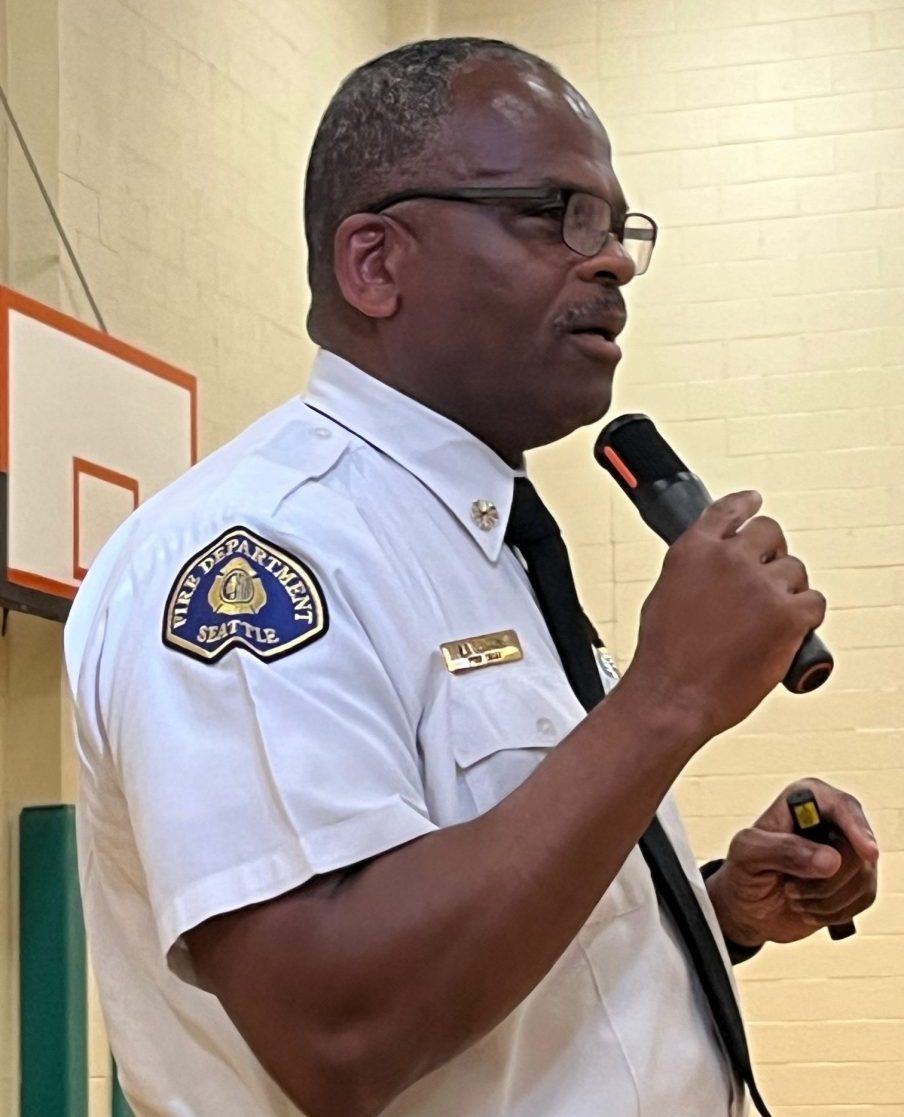
6:32 PM: Fire Chief Harold Scoggins took the mic. He started by introducing some of his staff. “Saving lives and prtecting property and the environment is what we’re anchored in,” he said, adding that “trust” is paramount, as people trust his crews to come into their home to handle whatever the crisis is. Their job also is “to be a national leader” such as with the Medic One program. He showed and briefly explained his department’s org chart, as well as its non-emergency roles such as building inspections. “Prevention, education, and mitigation: are their focuses. Last year, the department responded to 112,320 calls. more than half of them were “basic life support” (lower-level medical), and more than 10 percent were “advanced life supprt,” with less than a fourth of them “fire-type response(s).” He ended with a plug for the department’s monthly newsletter, promising it will leave you “dialed in”; he pitched the SFD’s blog-format Fire Line website too.
6:42 PM: Scoggins also got to answer questions, revealing they were provided in advance; the first one asked about ways in which the department provides information and education. He mentioned Firefighter Story Times, Fire Safety Fairs, educational events at Housing Authority buildings. Second question: What steps are being taken to ensure enough staff to respond to emergencies? He mentioned the extra ladder truck added to West Seattle back before the bridge closure and the added Medic unit at the same time in South Park. He also mentioned the nurse line through which some 911 calls might be referred if it seems more appropriate than a “lights and sirens response.” He talked about 4,000 calls “pulled out of the 911 system” last year alone to connect people with resources.
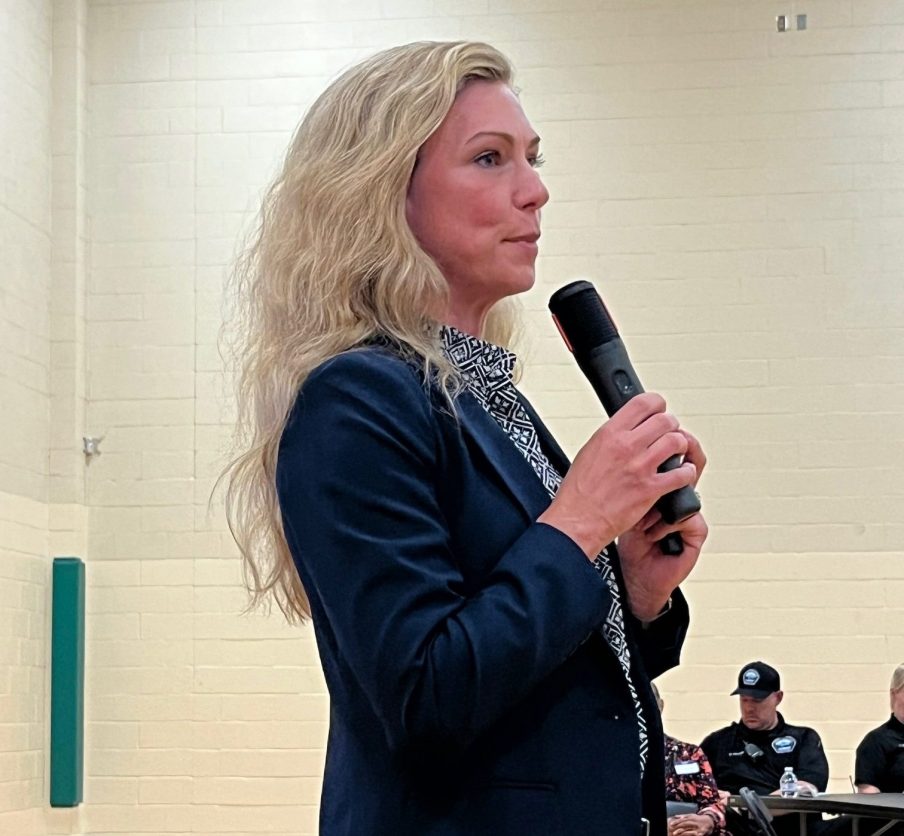
CARE Chief Amy Barden was next up. She declared that she’s accessible and ready to answer questions about anything. Her department, with 911 and crisis responders, will mark its second anniversary in October. They have about 30 on the response side. Then comes the dispatch side – the 911 Center has to decide which of the three departments a call should be addressed to. Chief Barden said it’s imperative that the departments be equal – hers, SFD, SPD.
In the first half of this year alone, 911 dealt with 416,615 calls. She said right now they only have three vacancies in the center. She talked about response time, but police are still averaging 11 minutes she said.
6:52 PM: She said that moving 911 into an independent department meant they could participate in the “911 community” nationwide. She offered a little coaching on calling 911 about someone you’re worried about – maybe, they need “a welfare check,” to see if they’re OK. What’s next? CARE “assuming diversion and outreach contract oversight,” for one, and more proactive intervention.
Q&A: First, “how is CARE engaging with West Seattle residents to understand how they access social services?” They’re studying the hot spots, for one, she said, and understanding what services are available and where. She declared that if anybody would like her to show up at their group or event, “I will show up.” Second question, what’s being done to help drug users beyond just saving them when they overdose? She said intervention should be followed by diversion – CARE is essentially a diversion unit – but sometimes, she said, people have to be arrested, “the behavior has to stop,” to break the cycle. “It’s so predictable how we end up where we end up sometimes,” she said. “We all need accountability … but that’s NOT the same as punishing someone,” she said.
After Chief Barden, 34th District State House Rep. Brianna Thomas took the mic. She said she’s working with Chief Barden on HB 1816 “to make the CARE Department permanent in the eyes of the state,” which it currently is not.
7:02 PM: Now it’s time for table talk; the chiefs will rotate between tables, and Department of Neighborhoods liaisons. We’re going to sit in on the business table – considering some of what we’ve been covering lately – and we also have an associate sitting in on the park-safety table.
At the business table, entrepreneurs whose business has been hit twice recently asked what more can be done – cameras alone don’t seem to help. Southwest Precinct crime prevention coordinator Jennifer Satterwhite said she can do assessments to make recommendations. A city program for funding to help with prevention costs, “Back to Business,” was mentioned, by Phillip Sit of the Office of Economic Development. (It couldn’t be spent for cameras, but, for example, security gates, or CPTED – Crime Prevention Through Environmental Design.) So was another area of the city that had “ambassadors” because of their Business Improvement Areas (the only BIA in West Seattle is in The Junction), How could that be replicated elsewhere? Satterwhite said that short of forming a BIA, they do have a Business Block Watch program that might help businesses improve communication amongst themselves – SPD might be able to help organize a meeting about that possibility.
7:16 PM: Satterwhite talked about other ideas such as security film, which can be applied to windows to avoid shattering. Bollards to avoid crash-and-grabs could be another possibility for funding. They can be decorative even, she said. Lighting is another deterrent, she added. She was asked if cleanliness help deter crime? Yes, Satterwhite replied, a la the “broken-window theory.” Graffiti vandalism is something to be addressed immediately, she agreed when that came up too. That’ll discourage the painters from returning to that area. She talked about an anti-graffiti coating that can be applied too, a sort of “clear paint.” Another table participant mentioned that often, if you add a mural to a wall, it won’t be damaged by others, so that’s often a recommendation. The participant mentioned how that’s ended a vandalism program on a wall in his neighborhood, and all neighbors have had to do is touch it up as it fades over time.
A participant with a child-care center voiced concerns that businesses involving vulnerable people like children aren’t being appropriately prioritized, citing a recent incident in which the response time for a possibly dangerous situation was frighteningly low. Satterwhite said that while she can’t comment too specifically without having been there, the 911 operators do have priority levels and it might be helpful to have a conversation about the issue. She also stressed that if you’re not getting the response you feel is warranted, call back and explain that you need the response ratcheted up. Afterward, you can also provide feedback to the 911 center about how a call was or wasn’t handled.
How to get that kind of information to businesses? Perhaps a meeting, like a Chamber of Commerce luncheon, could bring businesspeople together to learn and share. She can coach about the kind of language to use, things to point out, that will help calltakers understand what’s going on. Satterwhite also said notes can be added into the CARE system that provide more context about certain addresses/callers. She also spoke about the realities of times when there are just not enough officers to respond to lower-level calls, and the decisions that calltakers/dispatchers have to make about who to send where.
7:35 PM: They’ve declared this to be wrapping up. We’ll add notes from our other monitored breakout topic later; we also recorded the opening presentations on video and will add that when it’s uploaded. We’ll be requesting the slide deck that had supplementary information for the chiefs’ presentations and will add that when it’s available.
11:30 PM: Added our video of the first hour, before the table talks. Also, here are our team’s notes from the table discussion on park safety:
At the table focused on park safety, Parks & Recreation’s Community Services Branch Manager Jon Jainga was there to host the discussion along with a city park ranger. A Puget Ridge resident expressed concerns about drug activity along the stairs that lead into the greenbelt at 18th & Graham in her neighborhood. Two people talked about their frustration over camping, camp fires and drug use (needles left in the area) in Fauntleroy Park. One pointed to neighborhood, community, and city efforts to make the creek salmon-friendly (including an upcoming project for culvert improvements) as being at cross-purposes if the city allows people to camp there and pollute the waterway. A woman who regularly walks in Fauntleroy Park said she didn’t feel comfortable walking there with campers, and so she went to Schmitz Preserve Park instead to walk, but then found campers there as well. Rob Saka’s chief of staff Elaine Ikoma Ko said she has been working to escalate this issue, and there may be some resolution as early as next week.
The topic of park rangers came up with questions about Pioneer Square, where a nearby resident told about a big uptick in drug use and camping as soon as rangers go home from patrolling the parks, including playgrounds and playfields. Jainga said the department has 5 open ranger positions that they are trying to fill, and would ideally like to expand the program, having more rangers at more parks around the city. There was also discussion about the limited authority rangers have. They wear uniforms and body armor, but don’t have the authority to cite people. They also are limited to enforcing rules within the parks, and not on the sidewalks or in the right of way.
Permitting was the focus of one of the last questions from someone at the table, around an August 30th event planned at Cal Anderson Park that they said was granted to anti-LGBTQ fundamentalists who held a similar event last spring, drawing a protest and leading to arrests.l that ended in almost 2 dozen arrests. They asked the rationale behind granting this new permit for the group to return to the heart of the LGBTQ+ community, which Jainga could not answer. He suggested bringing it up at the next Park Commision meeting during the public comment period. (In looking at the board’s website tonight, we notice the next meeting that would have been before the planned protest has been canceled.)
ADDED FRIDAY: Here’s the slide deck from the meeting.
| 9 COMMENTS