
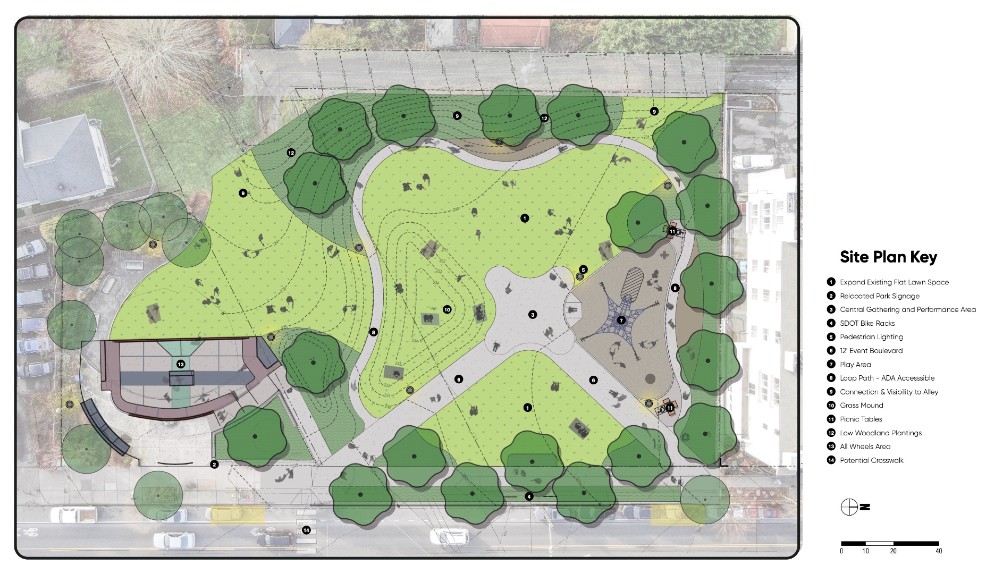
 (Current design for expanded Morgan Junction Park, ‘skate dot’ in lower left)
By Tracy Record
West Seattle Blog editor
The latest meeting about the “skate dot”/all-wheels area in the Morgan Junction Park expansion plan served largely as a reminder of how much bureaucracy has bogged it down.
Project manager Trae Yang from Seattle Parks noted toward the end that she’s in negotiations involving a multitude of other city departments, including Public Utilities, City Light, and Construction and Inspections; some of that was explained in a meeting at the site last September, particularly the complication caused by stormwater-drainage requirements.
Development of the site – which held a mini-mart and dry cleaner when the city bought it more than a decade ago – has proceeded at the proverbial glacial pace. If not for advocacy by community members who at one point turned it into an unsanctioned skatepark and formed the Morgan Junction All-Wheels Association, it’s hard to say it would even reached the current point, where it’s just opened as a field of grass.
“It’s been a journey,” design consultant Zack Thomas of Board & Vellum sighed toward the meeting’s start, regarding the eight-year history of the Morgan Junction Park expansion project.
He joined Yang and planner Olivia Reed from Seattle Parks at the meeting in the basement community room at The Kenney. Though the project has drawn extensive interest, and skating-community involvement, over the past few years, attendance was relatively low.
Reed opened with history of the site purchase (closed for $1.9 million in 2014), the start of early design in 2018, the pandemic putting the project on hold (2020), and what’s happened since then:’
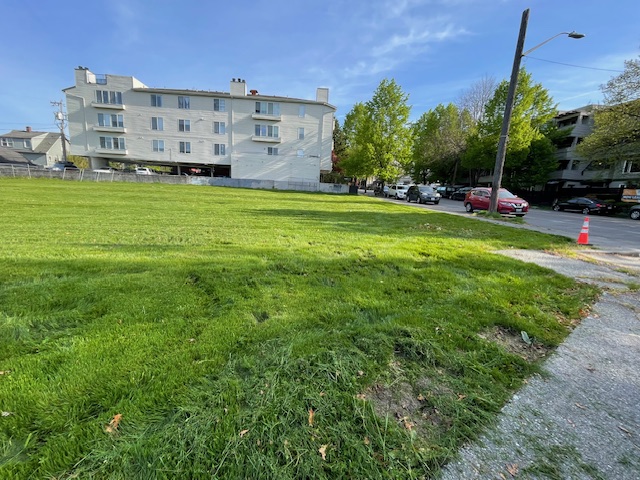 (WSB photo, April 30)
Current status: Fencing came down two weeks ago and grass covers the area. (Several attendees mentioned seeing it used for family play and dog-walking.)
Updated design context: Most original design concepts and park features stayed but a few were removed until they see, with the help of “professional cost estimates,” if some can be restored.
“This project is small but” has “unique” challenges, as the project team described it The site is still classified by the state as “contaminated” so that is affecting what can and must be done with the site. “We have to be careful when we think about how ww’re going to program this site.”
The stormwater matter was explained again. Then the project team answered questions. Could the expansion site be “activated” beyond lawn status before the project is built? Yang said the current plan is just to maintain the grass but “we’re open to collaboration.”
The relative lack of seating in the revised plan drew some attention. What about donated memorial-type benches? Reed said the program for those is just now relaunching, to be managed by the Seattle Parks Foundation, but it would require $10,000 to cover the cost of one. Why so much? “That includes 10 years of maintenance,” she replied.
Some attendees also voiced hope that the potential “sentinel tree” could be restored to the plan – a tree maybe 12 to 14 feet high, possibly atop a mound. And since the “skate dot” is currently planned for part of the original Morgan Junction Park site, advocates wanted assurance that cracked/upthrust concrete would be addressed.
 (Grindline’s schematic for proposed ‘skate dot’ at Morgan Junction Park site)
One person voiced a concern about a particular part of the existing infrastructure being potentially conducive to skater spills that could send skateboards flying into nearby California SW traffic.
One huge question, especially given Yang’s mention of “negotiations”: What can community members do to ensure this really does get built? Yang promised to reach out if she needs “extra lift”; otherwise, she said, “I feel I have momentum.”
MJAWA’s Zac Corum thanked the team for “keeping this project alive – it means a lot to us as community members. It has been a ride to get here; it’s time to get this project across the finish line – this will be a much-better place for families, kids, pets … MJAWA is ready to step up as we have been from the beginning.”
Next steps include the Parks team reviewing th latest cost estimates, which Yang said she received just before the meeting and didn’t want to disclose except to say she saw some “room for refinement” on initial review. Current total budget, from the money already spent on design and contaminated-soil removal plus additional Parks funding and the $700,000 that City Councilmember Rob Saka got into the budget to cover the skate dot, is ~$8 million. Construction is currently projected to start in the second half of next year.
| 12 COMMENTS