
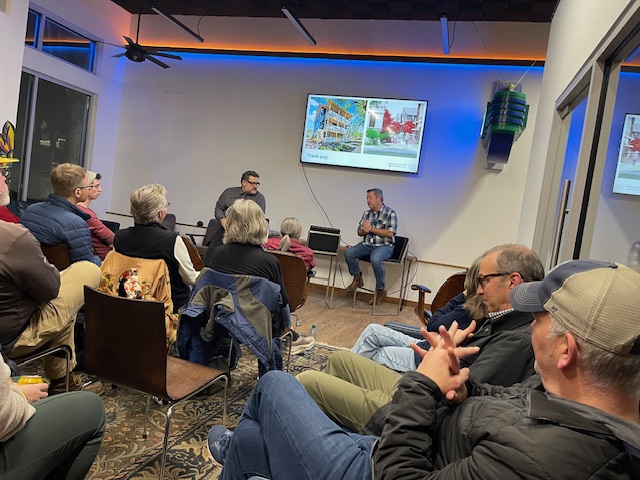
 (WSB photo: Matt Hutchins and Kevin Broveleit at West Seattle Realty event)
By Tracy Record
West Seattle Blog editor
One of the most pointed audience questions during last night’s discussion of “Zoning Changes in Seattle” was whether everyone whose property has been, or will be, upzoned by those changes is aware of it.
All the discussion leader, local architect Matt Hutchins, could say was, in essence, if not, they should – this all has been years in the making, and it’s not over yet.”You can not like the outcome, but you can’t say this was done hastily,” he contended. (He’s had something of an inside view, as co-chair of the city-convened Planning Commission.)
More than two dozen people filled the seats at West Seattle Realty (WSB sponsor), whose proprietor Kevin Broveleit both hosted and participated. Here’s our full video of the event:
Though it was a full house at WSR, those were just two dozen out of hundreds of thousands – Hutchins’ slide deck included the projection that by mid-century, the city of Seattle’s population could hit 1 million. That’s why city, county, and state leaders have been changing zoning to accommodate more housing. And the city has just launched its next round.
Hutchins touched on many points in his presentation – including how replacement of older residential units with newer, denser buildings increases housing affordability, even if it’s the classic case of one older $750,000 house getting replaced with three smaller new homes selling for that or more. (His term for what happens: “Vacancy chains.”) He showed a multitude of examples of types of housing now allowed on some if not all single-family sites, including a phrase you might have heard, “stacked flats.” (Those buildings could hold up to 11 units and four stories, in certain cases, Hutchins said, or even 16 one-bedroom “deed-restricted, for-sale” units.)
He also explained why rezoning only means what can be done on a site, not what will, and discussed reasons why redevelopment hasn’t happened as quickly as it could have. According to Hutchins, one factor in Seattle is the Mandatory Housing Affordability component, requiring a builder either to include “affordable” housing in their project, or pay a fee that the city would apply toward funding it somewhere else. That fee currently must be paid before construction, Hutchins says, and that’s a dealbreaker for some builders who would be better able to afford the fee if it was collected afterward, when the units are sold.
In the meantime, a lot of building is being done with homeowners in the role of “developer” – Hutchins and Broveleit said “backyard cottages” are a surprisingly sizable percentage of home sales right now. With most lots now able to be developed into at least four units, Hutchins said this will “open the door to a new kind of competition among architects – who’s going to design the best backyard duplex.” He showed an example of a duplex that could be home to multiple generations of the same family.
And it’s not only about housing; he noted that corner stores and child-care businesses. Overall, “you’re going to see all kinds of variants” of projects because of the way the code (zoning) was written.
Bottom line, toward the end of the hour-and-a-half event, was a declaration that “density and affordability doesn’t have to be scary – (you have to) get people talking to each other.”
WHAT’S NEXT: This was a community-led event, not official, but plenty of official proceedings are coming up. Most importantly: The dates are set for consideration of the next phase of city rezoning, the Centers and Corridors proposals, as the council meets as the Select Committee on the Comprehensive Plan:
March 19 – 2:00 PM meeting
April 6 – Public Hearing 9:30 AM
May 29 – Public Hearing 9:30 AM
June 4 – 1:00 PM
June 18 – 1:00 PM
The Centers and Corridors proposal was unveiled a month ago.
| 39 COMMENTS