
By Tracy Record
West Seattle Blog editor
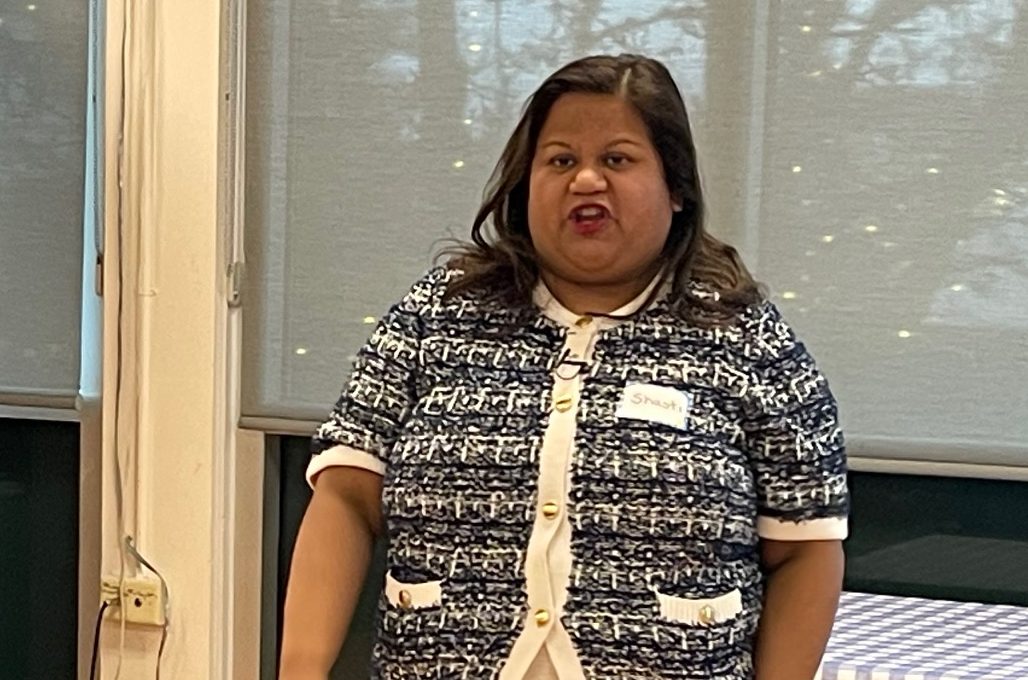
Shasti Conrad not only leads the Democratic Party in our state, she’s a national leader too – a vice chair of the Democratic National Committee.
But when Conrad spoke to Sunday’s monthly meeting of West Seattle Indivisible, she made it clear she wasn’t there as a cheerleader for the Democratic Party’s status quo. Conrad said she’s hoping to be a changemaker from within, believing the party is “in a revolutionary moment.”
She’s already done some changemaking via history-making in a variety of ways, including by being the first South Asian woman to lead a state party in the U.S. But her attributes go beyond her identity, said Jordan Crawley, chair of the 34th District Democrats, who introduced her, saying they’d met during her days as chair of the King County Democrats. Crawley declared, “After seven years, I can confidently say she is what leadership looks like.”
Conrad, saying she was just back from the DNC winter membership meeting in Los Angeles, said her upbringing led her down this path. She was born in India, adopted by an American, raised on a farm in rural Oregon, and was influenced by her grandmother, a community organizer who considered her own advocacy as being “just a neighbor.”
She came to Western Washington to attend college. She spoke of working on the 2004 election and learning from others that regardless of whether you win or lose, you “show up to work the next day.” She also spoke of having hope to “make the impossible possible” – like electing America’s first Black president in 2008. She referred to the current president as a “horrible, horrible man,” but warned that it’s not just about him – he is “emblematic” of a “disease in this country” – racism, sexism, homophobia, more – but “it (won’t) just go away” when he leaves office, “we have to root it out from the ground … we are in a moment of true revolution, deciding what … the next phase of the world is going to be and what we are going to do to bring it into fruition.”
Continuing her story, Conrad said she took time away from politics, working for Nobel Peace Prize winners including Malala Yousafzai – and then in 2016 “got pulled back in.” What’s happened then “has been a wild ride.” And it’s not just about elections, she said – “elections can feel transactional sometimes.” Though sometimes it feels like elections don’t matter, this current moment shows that’s absolutely wrong, she noted.
She also talked about Washington getting incrementally bluer, and being asked why. Her theory is that “we run pragmatic progressives.” Gov. Bob Ferguson, for example, she said, “ran on public safety, and on making the ferries work … I also think public trust is important … for the large part, Washingtonians believe Democratic leadership has been good for the state. … People trust us to solve problems … If we don’t solve problems, we’ll see the door.”
She also noted that she’s one of the few fulltime paid state party chairs – single digits, out of 57 states and territories. She believes “the results show.” She has 10 fulltime staffers “who are doing the organizing work day in and day out … and that’s made a huge difference. … that basic infrastructure matters.” Overall, in her view, “we are the road that candidates drive on … to get them closer to their destinations.” The state party does not make endorsements, “no thumbs on scales,” so whoever the candidate is, the party ensures “they have the resources to be successful.”
She ran for the national committee and was elected “after a little bit of controversy” (here’s the backstory on her election) “so that Washington’s story gets told”,” observing that “often times people forget … that we’re out here. Conrad said she’s the only committee officer who lives on the West Coast. The DNC also is there to ‘set the strategy,” she said, suggesting some might be surprised to hear that the fact the current chair “comes from state parties” is “radical.” One difference from prior leadership, she said, is the decision to invest in more than “just battleground states,” with recent results showing “we’re winning all over this country.”
After thanking West Seattle Indivisible for its work, Conrad answered open-mic questions.
The first question was about health-care costs and “solving the problem for Washingtonians.” Conrad said “we are in a moment where electeds are realizing they have to deliver … and be bold” but the “tough budget cycle” is going to pose a challenge.
Second question was about voter registration and what demographics, if any, should be targeted. Conrad noted that since our state doesn’t register by party, campus registration is potentially fruitful ground. But geography matters too, Conrad declared, saying that southwest Washington’s Congressional District 3 “is our #1 priority for 2026,” she said, “that’s where we need more people to turn out.” Rather than focusing on flipping Republican voters, she said, motivating the Democratic base to turn out is more important. “If we turn out, we will win.” She also suggested that recent gains by progressives were largely the result of bigger-than-ever turnout by voters under 29.
Next question/comment was from someone bluntly pointing out that despite recent gains, “The Democratic brand is in the toilet,” and she feels national leaders aren’t allowing local decisionmaking: “The national party sees us as November doorknockers and ATMs.” She took issue with the party’s “corporate identity” and said “it’s going to need to be a lot better.” She implored Conrad to let her compatriots know that.
That’s where Conrad talked about making change from the inside, saying she’s doing what she’s doing “because it’s broken and I want to fix it.” She said that “we’re showing (party leaders) that we have to do it differently” because of what’s happened despite party leadership, not because of it (such as Zohran Mamdani‘s NY mayoral victory). She said she’s traveling the country listening to people say “we’re mad at the Democrats” and responding, “I am the party … this party is in a revolutionary moment …. when Katie Wilson and Mamdani win, that shakes the party.” And Democratic leaders need to recognize that “we’ve let Republicans define us for too long … we repeat the same talking points that they do.”
One problem, she said, is that election committees tend to be “funded by the incumbents” … so she and others are working to break that. “I’m OK with us building a bigger coalition ….” She offered the example that candidates saying they were “standing with the working people” was a surefire death knell, but now it’s not: “We have to push and build this party,” she repeated. Some of the old guard is problematic in a big way, she continued, such as the Democrats who voted to end the shutdown – without knowledge, Conrad said, of party leadership. Most of them “are retiring,” she added.
She also said local knowledge is important, that the party must recognize who can win in which districts, and what their issues are. That led Conrad to again mentioned Congressional District 3 and said that has to be won or else they’re not getting the House majority back.
Other questions included a request for advice on what’s helpful for activists to do and what’s not. Conrad said she was excited to see the rally turnouts for events such as “No Kings Day” but was also concerned: “Does it translate into votes?” She said she’s heard that people who showed up for the protests didn’t all know who their representatives were, when the next election was, weren’t necessarily registered – so, in her view, the most constructive work is to ensure that people are ready to vote.
She also had some comments on the recent Seattle mayoral vote, suggesting that it’s important to remind people that Katie Wilson is “going to do something that you don’t like” as mayor but she needs to be supported “because she didn’t win at Mamdani levels of support.” She said she’s seen too often that people will throw politicians away the first thing they do that people aren’t happy with but in cases like this, “We’ve gotta have her back.” Some already have knives out, she continued because the mayor-elect is a woman, she’s been open about child-care issues, “there are people waiting to rip her apart.” That’s not to say she’ll be above criticism: “If things don’t get better over time, you can get louder,” but not right off the start.
Another person said she’s very interested in the push for young voters; Conrad replied that the key isn’t necessarily young candidates or party officials, but rather, what really matters is focusing on an agenda that resonates with younger people. That said, responding to another question, Conrad says they do have candidate incubators, including a toolbox for candidates calling “Candidate in a Box” for entry-level local candidates like conservation districts, fire commissions, etc., and starter roles like Precinct Committee Officer.) Meantime, Conrad told yet another attendee, there’s a group in the party looking at everything that will have to be repaired when power swings back their way.
WHAT’S NEXT: West Seattle Indivisible’s upcoming events include a march and rally titled “We’re Still Standing,” 12:30 pm at Hiawatha, marching south to The Junction, described as an event to “acknowledge that it’s been one very difficult year under the Trump Administration” and to celebrate the group’s “continuing fight against fascism” and resolve “to protect our communities, our democracy, and our Constitution.” Other events are listed on their website.
| 8 COMMENTS