
 (Photo by Kay Kirkpatrick, May 2025 ‘First Friday’)
By Tracy Record
West Seattle Blog editor
“This past summer, a thousand people came to an empty lot.”
Amy Durgin, president of the Highland Park Improvement Club board, still marvels at that – the number of people who showed up for First Fridays at the once-and-future HPIC building site on the northeast corner of 12th SW and SW Holden.
It’s an “empty lot” because of the fire that gutted the century-old HPIC building four and a half years ago.
 (Photo by Dina Johnson, June 2021)
Less than a year after the fire, HPIC was hoping to rebuild quickly and reopen in 2023. Now we’re on the doorstep of 2026, and reopening is still in the distance. But next year’s city budget includes a much-needed boost for the project, so we asked for a little of Amy’s time to get an explanation of where exactly things stand, at what she declares is “a really exciting time for HPIC.”
First, a quick recap of what HPIC is and isn’t. It’s a nonprofit community organization that happens to own its own site for community-centered activities and events, It’s not government-owned, operated, or funded – except for occasional grants, most notably the $500,000 that District 1 City Councilmember Rob Saka managed to get added to next year’s city budget, which has been signed into law by outgoing Mayor Bruce Harrell.
What the HPIC building lost to fire – its remains subsequently demolished – was: An old building originally meant as a social hall. What it’s become over the years, and is intended to support with the rebuild: The community’s beating heart.
 (Rendering of future HPIC HQ, by Wittman Estes)
What’s gotten in the way along these many months is the need for money. And it’s not just because the new building can’t be as bare-bones as the old one; it’s everything that’s happened along the way, even in the early stage, Amy explains: “We’ve found little anomalies as we dug into the ground .. we’re going to need a little more concrete .. the cost continues to grow.” But “we’re trying to be as thoughtful and strategic as possible.”
Not only does what they find at the scene continue to change, so does the landscape of the grant world. Right now, that’s what they’re focused on, large grants to cobble together the cost, rather than hoping thousands of small contributions will somehow get them over the finish line. Yes, grant-seeking is harder now because of all the federal changes; at all levels, Durgin says, “There’s much more competition for funding, especially for arts and culture groups”- even a fight to keep money, not just to get new funding. “We’ve never had to fight for funds like this before.” And that fight has ups and downs – recently, while the half-million-dollar city contribution was finalized (the largest they’ve ever got for the rebuilding project), they also got word they were turned down for another source of city funding, an Equitable Development Initiative grant.
All the while, the HPIC board is also working on programming for both before and after the new building’s opening, “anything that brings the community together.” Demonstrating how HPIC has done, can do, and will do that is a vital way to show potential funders why they’re worth investing in: “The board is thinking about what’s happening after the build, how are we going to be sustainable?”
On one hand, that’s not difficult – “people are thirsty for HPIC,” Durgin says, as evidenced not only in what they’ve done (the aforementioned First Friday events, most recently) but also in how they’re forging new relationships, with organizations such as African Community Housing and Development, which also got a slide of budgeted city funding for its planned International Public Market at the other end of Highland Park (8850 9th SW).
On the other hand, they need more people power. Volunteers, for example; they can strategize and make plans all they want, but the board can’t also take all the action to turn strategy and plans into reality. “We need more volunteers to do the work,” Amy stresses. They are hopeful that partnerships and affiliations will help with that too, helping HPIC “reach different segment of our community … there’s a big community out there.”
And there’s one simple action people can take: Become a member. Membership has grown exponentially but there’s infinite room (and you don’t even have to live and/or work in Highland Park). The more members HPIC has, for one, the more they’ll be taken seriously by potential funders. Members “are saying this is important to me – that shows grant funders how important this asset is to the community.” So important that HPIC exists even without its building; while First Fridays happened on the site, HPIC also gathers with the community at other spots – this year’s Not-So-Silent Night Parade on New Year’s Eve, for example, will again start at Highland Park Corner Store.
 (WSB photo)
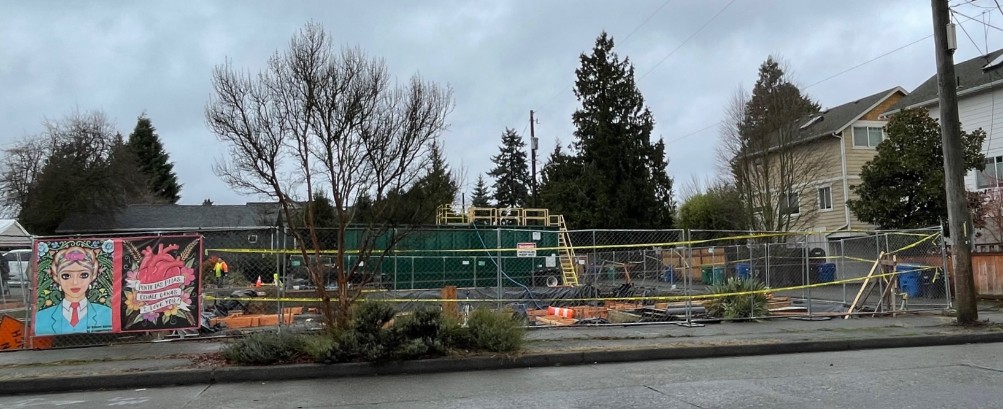
Back to the rebuilding project: They’ve completed four of its seven phases, including utilities and other ground work. Phase 5 includes framing the building and weatherizing it. Fundraising is about halfway to this phase’s $1;7 million cost. And optimism is running high: “We can do this. It’s very possible.”
| Comments Off on 4+ years post-fire, it’s 4 phases down, 3 to go for Highland Park Improvement Club rebuild