
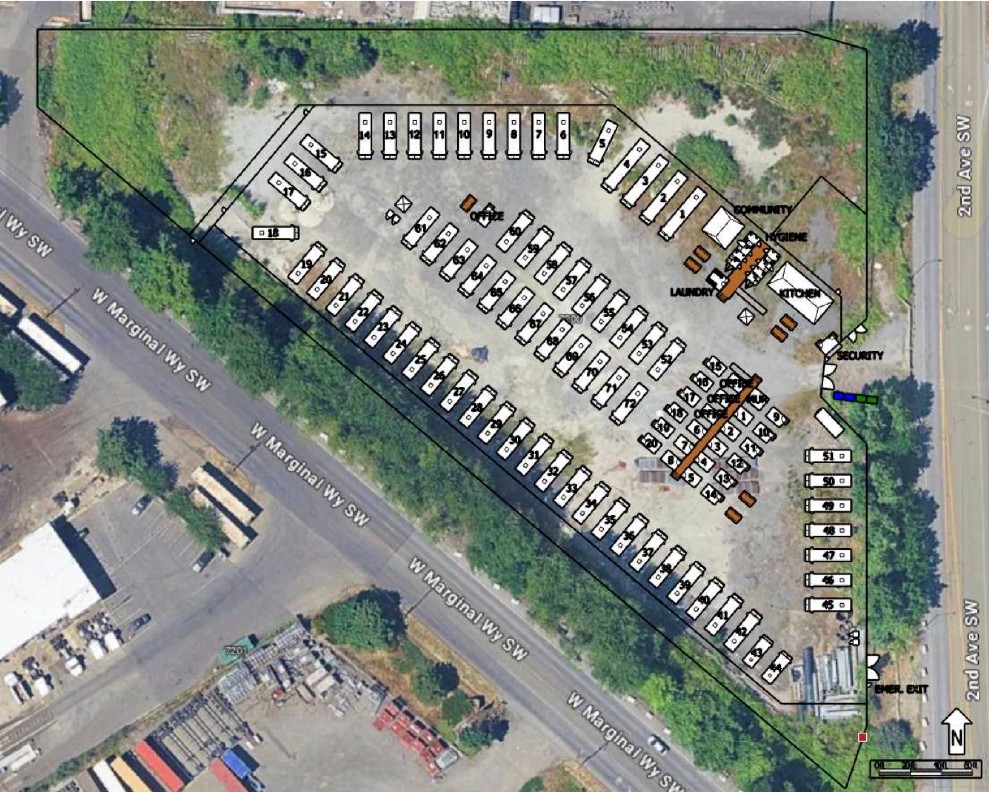
 (‘Site plan’ from city permit filings for Glassyard Commons, with 72 RV spaces and 20 tiny houses)
By Macey Wurm
Reporting for West Seattle Blog
Three and a half weeks have passed since we covered a community meeting about the plan for a new RV lot and tiny-house site called Glassyard Commons on state-owned land at 7201 2nd Ave SW [map] in southeast West Seattle. To find out where things stand now – as the city continues to say it plans to add hundreds of shelter spaces soon but has yet to announce other new sites – we followed up with the site’s planned operator, the Low-Income Housing Institute (LIHI). We inquired for not also updates, but also for answers to questions raised by community members during the meeting.
Glassyard Commons is still projected to be up and running by early June. LIHI also has reiterated plans to open up the site for tours by local business owners and community members upon construction completion.
The site’s religious sponsor is New Hope Missionary Baptist Church, and as noted at the community meeting, having a religious sponsor means “special consideration” to accelerate permitting. This is not the first LIHI project to be religiously sponsored, with others including Olympic Hills Tiny House Village and Miracle Temple Village. The construction-permit application for Glassyard Commons remains under review.
LIHI also provided us with a more in-depth outline of the process that potential residents would go through living at Glassyard Commons. Prospective occupant outreach is already being conducted by UHeights Vehicle Resident Outreach team (VRO), who plan to keep City Council District 1 as the priority focus for referrals to the facility. District 1 includes West Seattle, South Park, SODO, Georgetown, and Pioneer Square.
Each occupant will participate in an individual client service plan, which includes initial intake with a case manager where the occupant will learn about the code of conduct and potential safety measures. After this initial integration, clients will remain with their case managers who will aim to “support clients on the pathway to housing, including and not limited to assistance in securing identification, income support, SNAP benefits, employment resources, health care and behavioral health services, and housing options,” according to Marta Kidane, LIHI’s community engagement manager.. “Our program, in partnership with the UHeights VRO, will serve as a first step for clients to move into permanent housing.”
At the March 5 meeting, one community member raised a question about using Crime Prevention Through Environmental Design at the Glassyard Commons site – about which LIHI did not have a concrete answer at the time. Since then, they have been coordinating with the Seattle Fire Department and the Seattle Police Department, regarding fire safety and crime prevention throughout the facility’s layout. LIHI now says safety features will include “24/7 staffing, a secured front entrance, site lighting, a security camera system” as a part of the safety plan. The organization plans to develop a physical layout that will enable staff to maintain a view of what’s happening.
Aside from the ongoing volunteer opportunities listed on LIHI’s website, if you want to get involved, an online form is now open to join the Glassyard Commons Community Advisory Committee, which will meet monthly once the village begins its operations. Meetings would include a report on the site’s status as well as an opportunity to surface questions and concerns from the community outside the site.
| 10 COMMENTS