Combined RV ‘safe lot,’ tiny-house village proposed for southeast West Seattle site that’s seen encampments before

By Tracy Record
West Seattle Blog editor

Mayor Katie Wilson vowed less than two weeks ago to “accelerate the expansion” of shelter capacity to get homeless people off the streets.

We just found a permit filing for a West Seattle site that might contribute space for almost 100 – a site identified more than a decade ago as a potential “transitional encampment” site.

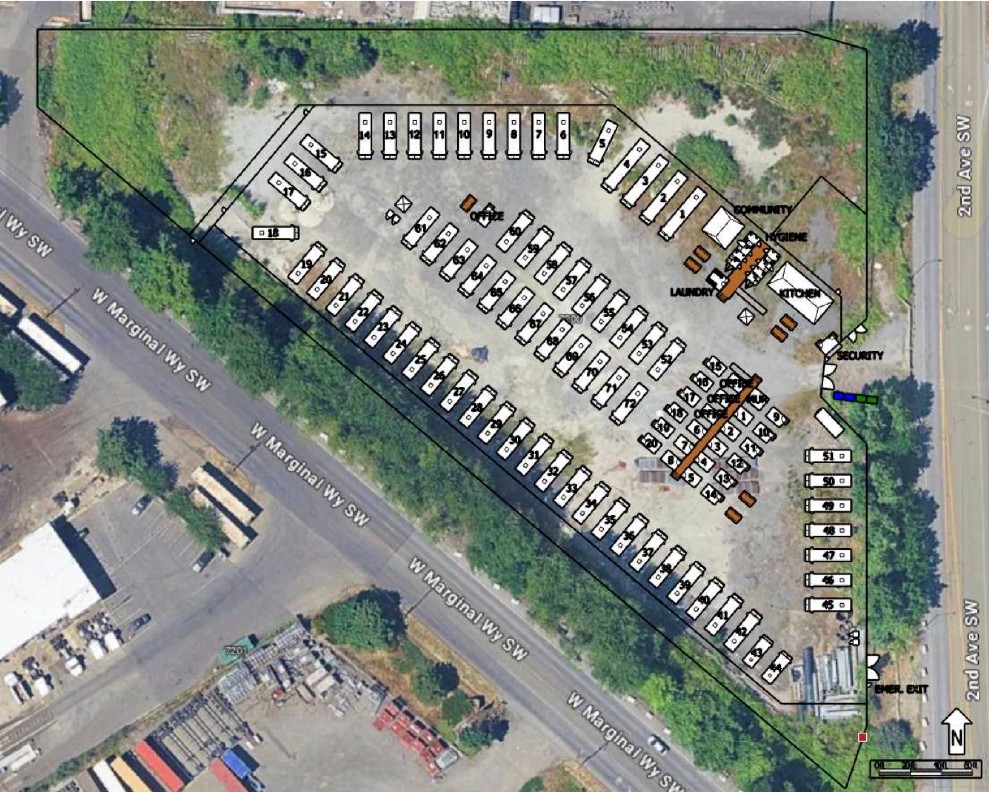
This is state-owned property known as the “WSDOT Glassyard” site in southeast West Seattle, officially 7201 2nd SW [map], and it has a “site plan” on the drawing board for a combination RV safe lot and tiny-house village – up to 72 RVs and. 20 tiny houses. This area has been the site of unsanctioned encampments before, and is adjacent to the original location of the first encampment to draw widespread attention 18 years ago, the original “Nickelsville.”

The filing is very preliminary; it summarizes the proposal as:

WSDOT Glassyard RV Safe Lot

Establish a religious controlled emergency transitional encampment, per the land use code. Site will consist of (20) tiny homes and parking spaces for up to (72) RV’s on existing impervious surface. Construct decks and install buildings accessory to emergency transitional encampment, per plan.

What “religious controlled” means is not explained on the site plan, which bears the name of the secular Low Income Housing Institute, the nonprofit that operates other tiny-house villages, including the first and only one in West Seattle, Camp Second Chance on Myers Way. The site plan also has these notes:

1. All Offices, tiny houses, laundry buildings, check in offices, and family rooms are under 120 square feet in size and are considered wooden tents.
2. Site will be for resident and staff use only. No part of the site will be open to the public at any point during operation.
3. Finish height of the deck will not exceed 18″ at any point.
4. Storage will consist of an 8′ x 20′ metal storage container. Structure will be anchored to the ground.
5. The existing site surface is compact gravel. Land disturbance activities will be under 5000 SF. There will be no added impervious surfaces. There will be no clearing or grading activities.
6. The hygiene trailer, laundry room, and kitchen tent will be connected directly to new water and sewer
branch lines from 2nd Ave SW.

The site plan also carries fire-safety notes including the stipulation that RVs will be “drained of gas and oil before connecting.”

Checking WSB archives, we’re reminded that one of Mayor Wilson’s predecessors, Ed Murray, identified this site in 2015 as a potential “transitional encampment” site. In 2016, a proposal to put a small RV safe lot on a nearby parcel was shelved. Unsanctioned RV camping in the area was the subject of multiple sweeps just a few years ago. Also in the site’s history: City consideration for a new misdemeanor jail, a plan also shelved, after intense community pushback in the late ’00s.

We’ll follow up on this tomorrow with the city, state, and LIHI, to find out more, including a timeline, approvals needed, and whether any community briefings are planned. The site’s status as state-owned property would fit with the focus on public lands mentioned in the mayor’s executive order issued earlier this month.

76 Replies to "Combined RV 'safe lot,' tiny-house village proposed for southeast West Seattle site that's seen encampments before"

  • Derek January 27, 2026 (10:44 pm)

    Love it. How could anyone be upset about this? Sanctioned shelter areas is a win-win so RVs have a place to park.

    • Ashley January 28, 2026 (8:26 am)

      agreed!

    • Aaron January 28, 2026 (10:32 pm)

      💯 

    • Resident February 1, 2026 (11:29 am)

      I can tell you how people can be against this. When you live fairly close by and the people that live in these places typically don’t have jobs. They need money. I know people don’t want to believe it, but crime is higher near encampments. That’s because people steal. So increased crime rates don’t make me really excited.

    • AISI4130 February 3, 2026 (8:45 am)

      My company rents space in the building across the street along with many other companies.  I can tell you that as someone who works in SoDo, RV’s bring crime – the street lights where my office is located have been non-functional for years due to copper theft.  Once they put bike lanes on 6th Avenue, thereby making RV parking impossible, such thefts and vandalism have significantly dropped and businesses no longer have graffiti painted on their buildings.   Residents, building owners, and workers of West Seattle should demand these parking lots get assigned to places such as the Talarus property in Laurelhurst; why should industrial areas that form the base of Seattle’s economy bear this weight while others get off with no burden?

  • 1994 January 27, 2026 (10:56 pm)

    Always sounds good on paper but when the wheels hit the road that is another story. Sounds like it will cost a bundle. If this gets up and running no more tents in parks or green spaces. No more RVs parked on streets. 

    • ColumbiaChris January 28, 2026 (10:13 am)

      It will cost less than the knock-on effects of unmanaged homelessness.

    • West Seattle resident January 31, 2026 (9:33 am)

      Personally, I don’t care what it will cost. Stuff like this is exactly what taxes should be for. If our money can go towards helping people then I think it’s great. Any new change should bring about conversation about where we are already spending our money and where we can make changes. But even if we have to spend a little more, I think it’s money well spent.

  • C January 27, 2026 (10:58 pm)

    I really hope it makes it to the final stage. Transitional housing and a safe place to have an RV is absolutely the future we need. How wonderful it will be for people to have access to basic things like water, a laundry room, and garbage removal, etc. I hope people give it a chance before lambasting the idea. Nothing ventured nothing gained. It is far more expensive to do nothing. 

  • West Seattle Mad Sci Guy January 27, 2026 (11:16 pm)

    Neat. Curious how much it costs to maintain a site like this once it is up and running.

    • Clinker January 28, 2026 (7:08 am)

      The cost to taxpayers will be directly proportional to the amount of money made by drug dealers at the site. Here’s hoping that spd takes the opportunity that they’ll be centralized to do some detective work.

      • Jake January 28, 2026 (8:59 am)

        Ah yes, let’s go ahead and assign pre-guilt to the poor people living in these places. Not every homeless person is a drug addict. Stop with this nonsense. 

        • Pete Marovich January 28, 2026 (6:23 pm)

          Sure Jake, but the vast majority are. If we are to realistically deal with the situation we must accept that basic truth

      • Deeebeee January 28, 2026 (9:18 am)

        Just a reality based thought here…. IF THE PLACE IS NOT OPEN TO THE PUBLIC IT WILL BE A BIT TOUGH, NOT TO MENTION UNHOUSED PEOPLE ARE RESPONSIBLE FOR THE SMALLEST OF DRUG TRANSACTIONS…. FOR OBVIOUS REASONS. Nobody is making a killing off selling dime bags to someone in an RV. If ‘detectives’ want to knab the Big fish… they won’t be doing there. Ijs 🤦‍♀️

        • LauraJ February 2, 2026 (8:23 pm)

          Very good point. 

  • Rats January 28, 2026 (2:06 am)

    I hope it becomes a reality. As WSB points out, RV safe lots have been proposed a couple of times before and never got off the ground.

    • 1994 January 28, 2026 (10:28 pm)

      RV lots have got off the ground several times but ultimately closed.  The King County Regional Homelessness Authority awarded $1.9 million to LIHI to set up and operate an RV safe lot, which is expected to serve about 35 vehicles or about 50 people. That was Salmon Bay Village, provides a combination of tiny houses and safe parking for those living in RVs that opened in 2024. This was closed as the property owner had other plans.Seattle had publicly sponsored lots open in 2016 and 2018 that hosted vehicles in Ballard and SODO, but issues with the property in Ballard and safety concerns in SODO ultimately closed those down. A handful of smaller sites, like one at the University Heights Center, currently offer overnight spots for cars (and not RVs).

  • K January 28, 2026 (5:30 am)

    92 transitional shelter spaces is a good start.  Were there other similar lots identified elsewhere around the city?  What is nearby transit like?  Glad to see a mayor looking at more humane (and more affordable) alternatives to sweeps.

    • DC January 28, 2026 (8:34 am)

      The 131 is a short walk from the site. 30 minute frequency to Downtown Seattle through SODO and Burien through White Center. Not exactly the best frequency or connectivity, but seems workable.

      • Looking for hope January 28, 2026 (10:52 am)

        If I read the maps correctly (no guarantees), this location should be in the area served by Metro Flex, which is the same cost as the bus. If staff could help residents obtain Orca Lift cards (discount fares) and schedule rides for those without phones, they could get to local stores. With the card, riders can even transfer to other buses. https://kingcounty.gov/en/dept/metro/travel-options/metro-flex

  • Eric1 January 28, 2026 (6:51 am)

    Drain an RV of gas and oil?  Not a problem for trailers but that sort of defeats the purpose of a motorized RV. Is the city basically asking for RVs to park there and be eventually abandoned for the city to dispose of?  I don’t think many RV fires a caused by the gas and oil in them (DOT regulations have safety measures). Most fires in RVs are caused by the same things as regular home fires: cooking (food or meth), heating systems, and faulty electrical systems.  If you want a “transitional” campsite, maybe keep it so residents can move along and not be permanently stuck.  

    • Daniel January 28, 2026 (8:18 pm)

      You can put gas and oil back in the RV before moving it.  I think the intention isn’t to stop fires from occurring due to spontaneous combustion of the RV’s gas or oil, but rather to limit the spread from not exploding agas tank after one starts 

  • Kyle January 28, 2026 (7:35 am)

    This is great, can’t wait.

  • bill January 28, 2026 (7:39 am)

    Needs coordination with Metro for good bus service, perhaps including a free shuttle to a major grocery store like the Roxbury Safeway. Needs parking for those fortunate enough to have a car. If we want these people to get out of the hole they are in they need to be able to get to jobs.

  • L January 28, 2026 (7:53 am)

    Please ask the question: Will drug use be permitted in this encampment?

    • ColumbiaChris January 28, 2026 (10:18 am)

      Drug users are permitted in private residences, so why should this place be any different?

      • waikikigirl January 28, 2026 (10:55 am)

        Yes you are correct that private residences are permitted to use drugs in “THEIR” home, thats the magic word it is their home to destroy if it so happens, not the City’s, not the taxpayers.

      • wscommuter January 28, 2026 (11:47 am)

        Because private residences are not funded by the government.  That’s one difference.  More to the point, however, because so many homeless are suffering from addiction, we ought not provide enablement for their drug use – we should be providing treatment and support to break the cycle of addiction.  If we’re funding transitional housing, we should require no drugs.  

  • Nicklesville2 January 28, 2026 (7:58 am)

    This was done many years ago. Crime in the Southeast corner of West Seattle increased. Did anyone ask the Highland Park neighborhood?

  • CaptAdmiral January 28, 2026 (8:20 am)

    I’m afraid it will make little difference if RV’s are not mandated to move to the lot away from their various street locations. As seen with tent encampments, reach out only accomplishes so much when folks can easily decline services.

  • DBurns January 28, 2026 (8:22 am)

    It always amazes me how some people have to publicly assume that unsheltered people are drug dealers or “cooking meth”. Have you ever been to Camp Second Chance or any other Tiny Home Village? These are real people living lives. In my experience they are functioning like many other neighborhood communities which may or may not include some discreet drug and alcohol use but no more than other apartment buildings or multi living communities. The number of people forced out of homes because of our chaotic economy is growing & why not assume this could be a good solution for our city instead of making immediate negative assumptions? Just try and be kind or keep it to yourself. 

    • Seattlite January 28, 2026 (10:52 am)

      DBurns:  The  most current research on Seattle’s homeless population shows that approximately “44% of respondents reported having substance abuse problems.”  In 2020, approximately 54% of Seattle’s homeless population reported mental illness problems.  Approximately 47% of Seattle’s homeless population reported PTSD sufferers.  The two adults in my family who live on and off the streets…both have severe drug problems, mental illness problems.  One is in Seattle.  The other is in Portland.  Drugs have destroyed their lives and their brains.

    • k January 28, 2026 (11:05 am)

      What DBurns said.  Do you know what drug dealers and meth cooks make?  They can definitely afford rent.  It’s the people working minimum wage, or who can’t work at all who get left out.

  • WSGreenSpirit January 28, 2026 (8:45 am)

    Folks who question who could be upset about this proposed site, probably do not frequently hike or play (Riverview Playfields, etc.) in Seattle’s largest contiguous forest (West Duwamish Greenbelt), which is roughly a block away. There are even preschool classes that hike in it. The greenbelt has miles of trails, deep into the woods. It’s wonderful. And many of us in the neighborhoods nearby amble through parts of it every day. There are some campers and garbage dump spots, spread through out the forest, but this new site will make that much worse, and the trails less safe. The Nickelsville site that used to be there (by the newly proposed spot) was 2 years of constant drama, crime, and disorder that rippled far beyond the camp site, into the surrounding neighborhoods. Despite promises, they couldn’t keep the meth dealers and former evicted residents out. For those interested in a history lesson, you can find plenty of detailed coverage on the WSB about the adjacent Nickelsville site from~12 – 13 years ago. Moreover, the eastern edge of West Seattle already has Camp Second Chance, just south of this new proposed spot.

    • Nearly bionic January 28, 2026 (11:49 am)

      I came here to say this. The issues with Nickelsville were not the encampment itself, which was fine. It was the increase in crime and unsanctioned, unsanitary, and unsafe camping in the green belt. There needs to be a part of the plan that addresses this for nearby neighborhoods. I also question why West Seattle is being targeted for this again? Are there many sites being considered? The Meyers Way site is already very close. It’s time to spread the solution around the city a bit as we already have one of these sites in our “back yard”. Of course we will take our “turn” but other parts of the city need to contribute as well. 

      • WSB January 28, 2026 (12:14 pm)

        100 people comprise just a fraction of the 4,000 that the mayor has said she hopes to add shelter for, so there must be other sites, and that’s another of the questions I’ve asked. I only scan the building permit files for WS projects so there may be others out there already. – TR

    • Matter January 28, 2026 (12:36 pm)

      And all you have to do is drive by Camp Second Chance to see what this is going to look like. These areas are placed outside of the mainstream where the city is going to shove people into. I believe the city needs to codify what its part is going to be in keeping the place clean and protect the surrounding businesses.Why don’t they turn the Jackson Park Golf Course into a large RV and Small Home Community? It certainly is large enough to house all of the unhoused in the city along with the RV’s. Its close to a train station and facilities. This proposed site has no grocery stores within miles. Its poorly served by transit. Only the 131 goes past it on its way to Burien from Downtown and West Marginal Way has no bus service at all. 

    • westseattlebob February 2, 2026 (12:51 pm)

      This 100 percent!!! Well stated and thank you. As a local who uses the trails on a heavy basis this is accurate in every way. It was unbearable seeing every example of humanities digressions occurring in the greenbelt every time i went there. 

  • Melany H January 28, 2026 (9:08 am)

    Good news, but I wonder about the site being adjacent to the original Nickelsville which featured flooding in heavy rain events and contaminated soils.

  • WS Parent January 28, 2026 (9:17 am)

    The “tiny house” model is showing solid evidence of transitioning people to long-term housing. Homelessness is less a failure of housing than it is a failure of community. Combining the privacy and safety of separate units with the care, structure, and resources of community appears to be the magic formula. I am excited to see this here! 

  • Scarlett January 28, 2026 (10:26 am)

    A couple of thoughts.  First, a few serious financial setbacks can put anyone in this position of needing this kind of emergency housing.  Secondly, I hope that legal citizens have priority.  Thirdly, this seems to be the path we heading down as the feudalistic wealth gap widens between the landed and the unlanded.  If this continues we are going to again need massive federal action akin to the programs of the early 20th century. 

    • Jake January 28, 2026 (10:51 am)

      “Legal citizens?” What? So human rights out the window for you?

      • Scarlett January 28, 2026 (9:19 pm)

        Yes,  housing spots will be scarce and citizens should be prioritized, if it comes down to that.      

    • K. Davis January 28, 2026 (1:36 pm)

      Pretty much, when you’re talking in terms of “feudalistic wealth gap … between landed and unlanded”, you become unserious.  Perhaps go read a bit of history about feudalism and what that word actually means.  I get it – you pine for a socialistic utopia  – but it would aid the conversation if you knew what you were talking about. 

      • Scarlett January 28, 2026 (8:35 pm)

        Are you deliberately trying to be obtuse, cute or what, K. Davis ?  You know exactly what I mean when I use the word “serf” to mean those who do not own property, as in the renter class.    Socialist utopia?  Would that be, for example, the Yesler Terrace a New Deal project that housed many workers coming to Seattle to work for a little company called “Boeing?”I’d try cracking a book sometime, I might take you are little more seriously.    

    • Beni January 28, 2026 (4:02 pm)

      I hope that legal citizens have priority” is a weird thing to point out. When did you go pro-state? You’d like to screen those suffering for their documents first?

      • Scarlett January 28, 2026 (8:29 pm)

        You want the short answer without the lecture? Yes.  

  • lucy January 28, 2026 (10:46 am)

    I hope there is also healthcare, drug counseling, job counseling  and mental health care available a few days a week.  And I hope there is some security so the residents feel protected.  Hot showers, laundry facilities and garbage pickup would help too.  I suspect the initial expenditures would be large, but the savings would come in hopefully fewer ER visits, and crime reduction in neighborhoods because people have somewhere to go.

    • WSB January 28, 2026 (12:17 pm)

      LIHI also runs Camp Second Chance and staff there has included a case manager, plus from past advisory group meetings I’ve covered, I know they’ve also worked to bring in mental-health counseling and health-care providers too. Not daily but regularly. The advisory-group meeting has moved around so I don’t have up-to-the-minute info, though – TR

  • JP January 28, 2026 (10:47 am)

    This is excellent news and as a West Seattle resident I wholeheartedly support it. 

  • Erik January 28, 2026 (11:15 am)

    Honestly, whatever gets the RVs off of residential streets and out of our hair. Surely we have spent more money playing whack-a-mole clearing out encampments than it would cost to just run a sanctioned area for them. All for this plan. 

  • Homeless and Tired January 28, 2026 (11:31 am)

    I love tiny house villages and everything about them but they seem so darn hard to get into. I’ve been trying for months and I’m either calling every few days to check for vacancies or waiting on my caseworker to refer me and wait for that to get accepted or denied. Most of them you can’t just call or walk in and be like “hey, I’m homeless how can I join?” You gotta go through a bunch of hoops.I keep being told that supposedly the fast track in is to get caught up in a sweep but I don’t live in an encampment nor do I plan to anytime soon plus getting caught in a sweep sounds like not the greatest plan for anyone. I’m part of the hidden homeless you never notice and I’m getting exhausted of hiding. I work, I go to community events, I’m around but no one but my friends know I’m homeless. It’s so much effort. I don’t wanna go to the shelter every single night, when it’s this cold it’s not even guaranteed. Sorry that sort of turned into a vent

    • Scarlett January 28, 2026 (1:50 pm)

      You’re right, the bureaucratic hurdles are outrageous and often involving going to a labyrinthine website rather than being able to pick up the phone and talk to a person, or simply walk in.   I know an older gentleman who’s  desperately trying to get into low income housing downtown (Pike Pl Market) and he couldn’t even send a  message to the manager for more info because he didn’t have Outlook installed.     It’s as if they are deliberately discouraging people. 

      • Homeless and Tired January 28, 2026 (4:43 pm)

        I’m pretty sure they are. I’m somewhat lucky, I’ll get a job and hold a place down for a year but then it all somehow falls apart through either me or something else. I won’t say I’m perfect and nothing’s my fault. I am definitely someone who needs to be in one of these villages. I can admit admit how much I need help yet I don’t seem to get much cuz I’m able bodied and working most of the time. I’ve been homeless off and on since 2018, for only like 3 or 4 of those years I’ve actually been housed. I’m only 25 ffs

  • Matter January 28, 2026 (12:07 pm)

    The businesses along West Marginal Way SW have suffered for more than a decade.  While the original Nickelsville seemed to run reasonable well it was what was taking place outside of it. An encampment was developed on the hillside above Detroit Ave SW which a was a lair for drug dealers and users. The businesses along Detroit Ave SW have tried to get the city to remove and discourage inhabitants from returning and the city has done nothing and the problem persists today. Just go and drive down Detroit Ave SW and see for yourself. All the businesses from Highland Park to Kenyon have all suffered significant monetary damages from theft, having to hire security and night and weekends,  property damage and in our case flagship tenants departing who have cited the homeless problem and the associated crime. Our cyclone fences been made into Swiss Cheese. I want to know what the city is going to do for us, the businesses along West marginal Way SW and 2nd Ave SW. Are they going to get rid of the encampment on Detroit Ave SW? Are they going to prohibit RV’s from parking in the area outside of this? I fear it will turn into what’s happening on Meyers on Meyers Way.  I fear this will just encourage more RV and homeless to show up on our streets and the already unbearable theft and property damage will increase. Is there no public comment period or permits or needed?

    • WSB January 28, 2026 (12:12 pm)

      Among the questions I have out are, what kind of “community engagement” – if any – is planned.

    • T Rex January 28, 2026 (3:33 pm)

      All true, worked on Detroit for years, it was horrible at the end when my company moved. a few years ago. Building break ins, fences cut, etc. Very scary folks, doing things in the daylight hours that are not shown on TV, no police ever there. Many of us stopped getting gas there and stopped using the store.  It is a very isolated area.  

  • Cole January 28, 2026 (12:37 pm)

    Sorry, but…”religious-controlled”? Somebody explain that. Great plan. I love it. I wanna help. I also wanna know what “religious-controlled” means. I’m a Veteran. I’ve seen what “religious-controlled” CAN mean… We don’t need that shit here. 

    • WSB January 28, 2026 (3:44 pm)

      That’s yet another question I have out. LIHI, which is on the site plan as prospective operator of this (and which already operates numerous tiny-home villages including Camp Second Chance), is not a religious organization, so either that’s an erroneously included word or there’s another partner in this somewhere. As of right now, still no replies from any of the potentially involved parties, not even the mayor’s spokesperson, who has previously been fairly (and quickly) responsive – TR

  • LR January 28, 2026 (12:37 pm)

    Is that the site that was flooded out several years ago?

  • flimflam January 28, 2026 (2:20 pm)

    So this means if there is space at this location people wont be permitted to camp in parks it have their RVs lined up on city streets?

  • Monica C January 28, 2026 (6:03 pm)

    This sounds like movement but:Years ago we fought the jail building there.What about the overflow? I see it’s fenced but there is a bunch of space including a wetland that is now being trashed with garbage & smashed fences. This area needs protecting as the West Seattle Greenbelt trails, where 2 vehicles were recently dumped, one being burned. I don’t want to see the area trashed with more encampments. How about a lot South of the stadiums? Closer to DT and transit? 

    • Logic January 28, 2026 (9:42 pm)

      I wholeheartedly agree with every word you wrote. This puts at risk a fragile ecosystem in that area.

  • Ken January 28, 2026 (7:19 pm)

    Personally I’m for it.  Worst case it will be way better than an unsanctioned encampment and best case it’ll be way better.The real solution is that we actually pay living wages and make life worth living so people aren’t in such a bad spot, but capitalism really doesn’t like that so here we are.  Reminder, there are several times more empty houses owned by speculators than there are homeless people in this country, and since 1971 the richest Americans have hoarded the vast riches that the rest of us have created through the massive increase in productivity since then.  That is the cause of this problem.

    • Scarlett January 29, 2026 (8:36 am)

      Agreed.  And thanks for using the word “speculator” instead of disguising sheer greed with the term “investor.”   Bernie Sanders was laughed at when he used the word “speculator” years ago as an old-fashioned relic of Lenin or Marx,  but that’s exactly the term to describe what is driving markets today.     

  • John January 28, 2026 (8:50 pm)

    If every church in the country housed two un-housed persons, there would be not homelessness, just saying…

  • Daniel Naranjo January 29, 2026 (12:07 am)

    LIHI may run CAMP SECOND CHANCE,  but they are not who started CAMP SECOND CHANCE!  from what I hear,  from both people who live inside the camp and people who have worked at the location(managers and non managers) is this location is unsafe and should be closed.   LIHI is at fault and it will be a complete waste of money to have another site under there control!!  All their So called”CODE OF CONDUCT” they say they enforce and it’s followed is and has been a lie the whole time! SOUNDS GOOD BUT THEY DO NOT ACTUALLY ENFORCE AND FOLLOW WHAT THEY CALL”CODE OF CONDUCT”!  why would they,   following, correction,  enforcing such rules would be more work and might actually help people get off the street which would in the end stop the money coming to LIHI!   SOUNDS good but has LIHI made a difference? Or have they just seemed to make it sound like they have? Mark my words,  we are better off letting the homeless run and make their OWN safe parking and tiny house village!! 

  • Chuck Jacobs January 29, 2026 (5:29 am)

    If the city sold the land to a KOA franchise for $1, waived all fees and taxes, and covered the rent of everyone who stayed there, it would still cost 1/10 of what they’ll spend under they’re current “plan”.

    • k January 29, 2026 (6:54 am)

      You definitely didn’t look up KOA rates and do the math before making this declaration, lol.  

    • Jim January 29, 2026 (11:19 am)

      You’re absolutely right!

    • 1994 January 29, 2026 (9:57 pm)

      I agree with you! The people staying at this city provided outdoor homeless shelter should contribute to their stay and the upkeep expenses for water, electricity, garbage service. laundry and shower facilities…..these things are not free and the people accessing these services should contribute to using them. 

  • Keenan January 29, 2026 (7:23 am)

    Good.  Get the RVs and encampments out of our residential neighborhoods.  We have all this industrial land by the bridge that can be used for stuff like this.  Then make sure everyone registers and we have adequate policing to make sure this doesn’t turn into a garbage infested slum.

  • Admiral2009 January 29, 2026 (4:59 pm)

    Ken – agreed

    Hopefully the RV will at a minimum be operating and functional.  I think more tiny homes and fewer RV’s would be better.  And I hope the residents are not allowed to use illegal drugs and will be shown the exit if they break the law (theft, vandelism, illegal drugs).  

  • carolei January 31, 2026 (10:36 am)

    I’m very happy to see this plan! Our new mayor is following through with her campaign promises.

  • Andrew B. February 2, 2026 (7:33 am)

    Hi all, I work for Sound Foundations NW (https://soundfoundationsnw.org/), the local nonprofit builder of the large majority of the tiny homes
    you see in Seattle and King Co. We’ve built more than 700 of them since
    we began in 2018, using all-volunteer labor. While we do not install
    or operate the tiny home villages, we work closely with the Low Income
    Housing Institute (LIHI) who operates most of the villages in Seattle.
    Chief Seattle Club also operates a couple, as does Nickelsville but with
    a slightly different model.

    Many of these issues and questions surrounding tiny homes and villages have answers on the FAQ page of our website (https://soundfoundationsnw.org/faqs-2/), or elsewhere on our site. But I’m happy to answer anything I can here, too.

    Very quickly, a couple of facts:

      • –  Our homes are 8′ x 12′, about the size of a typical bedroom, and are built with all-volunteer labor on an assembly-line
        style system in a warehouse in SODO, and for just the cost of materials which is about $4500
        ea. Our homes are fully insulated, shingle-roofed, and floored with
        Pergo flooring, and have two operable windows and a locking front door
        for privacy and security.  Once installed in a village, they’re wired
        for electricity and have overhead light, power outlets, heat, and a/c.
        Each home is designed for one occupant but can accommodate a couple, or a
        parent and child.
      • –  A typical village is 40-45 homes although some are smaller/
        larger. The cost of the infrastructure for a village is approx. $800k,
        plus the cost of 45 homes, means a village can be installed for about
        $1M total, and operated going forward for +/- $1M/yr. Villages are
        installed on a mix of private land that is donated or leased, surplus
        city or Sound Transit land, or land that’s slated for development but
        that in the meantime can host a village for a few years. It’s not
        uncommon for a village to move after 3-5 years.

      • –  The historic median stay in a LIHI-operated tiny home village is
        114 days, or about four months. That means that up to three people per
        year can transition off the streets and into each tiny home. Our homes
        are built to last 20 years which means every home we build and deploy
        will shelter up to sixty otherwise homeless folks over its designed
        20-year lifetime.

      • –  In 2023 (most recent data available), tiny home villages had an
        87% occupancy rate. In late 2023, one of the top reasons that homeless folks
        who were asked said that they refused shelter even when it was offered,
        was that it wasn’t a tiny home. Tiny homes are the most requested
        shelter type by the folks who need it, according to city and nonprofit
        outreach workers. Read more about that on our Stories page (https://soundfoundationsnw.org/stories/).

      • –  Over 50% of LIHI tiny home village residents who leave, move into
        permanent housing and 95% were still housed 12 months later. Those
        rates far exceed that of other types of shelter.

      • Lastly, these tiny homes are NOT intended to be permanent housing.
        Tiny homes are a warm, safe, dry, dignified, and TEMPORARY alternative
        to tents, encampments, and RV’s while residents await permanent
        housing. Tiny home villages are fenced, secure, and staffed 24/7. They
        offer privacy and security, food and kitchens, community laundry,
        restrooms, and showers, and counseling and case management services to
        help residents recover and develop/ act on a plan for permanently ending
        their homelessness.

      I’m happy to answer questions here as I can. Anyone wishing to
      stay up to date or volunteer their time, no building experience
      required, can sign up for our newsletter here (https://soundfoundationsnw.org/how-can-i-help/giving-of-time-and-talents/).

      Thanks for reading this far!

    1. Amy Thomson February 2, 2026 (11:51 am)

      While I’m pleased that the city is stepping up to address homelessness by providing this site, the city ALSO needs to step up and control the halo of illegal encampments that will spring up in the nearby  greenbelt.  Often the people in these illegal encampments are unable or unwilling to follow the rules of the legal encampment nearby.  The city also needs to find compassionate solutions for the residents of these illegal encampments.  It’ll be hard, and in some cases impossible, but without social services and police support this site will be another Nicklesville rodeo, with serious impacts on neighboring businesses and residents (and yes, there ARE residents who will be impacted).I also hope that there will be lots of other sites in different parts of the city, spreading out the impact to other neighborhoods.

    Sorry, comment time is over.