
FOLLOWUP: Longfellow Creek still lethal to more than half its returning salmon, says the latest survey – but ‘solutions exist’
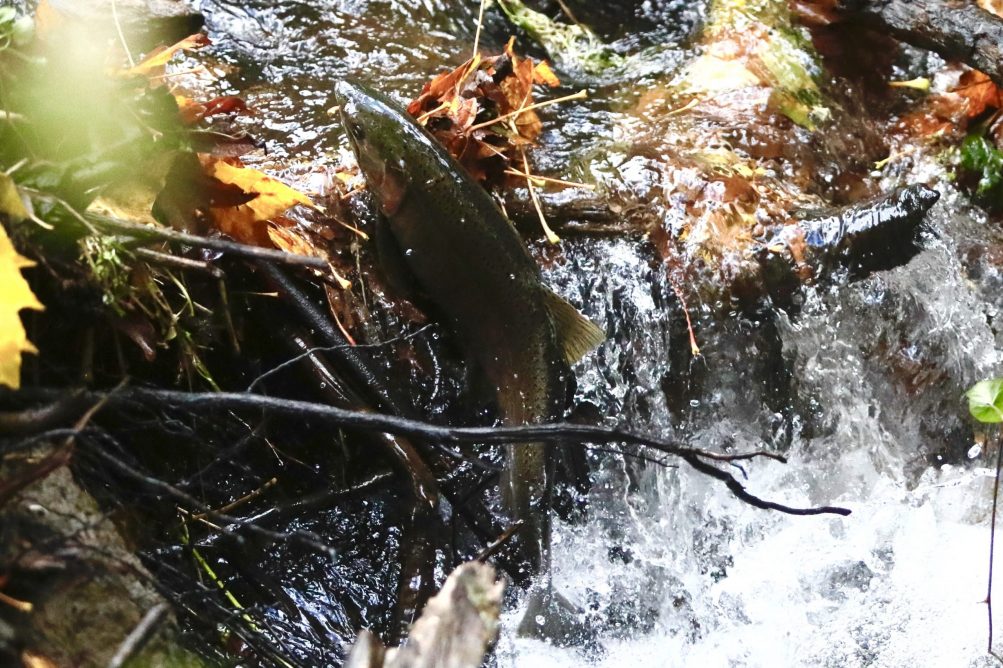 (October photo of salmon in Longfellow Creek by Manuel Valdes)
Puget Soundkeeper has released its full report on the fall salmon season in Longfellow Creek. It’s been monitoring coho salmon in the eastern West Seattle creek for a decade now, with a focus on gathering data about how urban pollution affects salmon survival. As its announcement explains:
For years, Longfellow Creek has been the epicenter of research studying the effects of 6PPD-quinone – a toxic tire chemical lethal to Coho salmon. Exposure to 6PPD-quinone causes a condition called Urban Runoff Mortality Syndrome (URMS), a disease characterized by symptoms such as disorientation and gasping for air, often killing Coho
within 24 hours. Furthermore, this chemical has been strongly linked to Pre-Spawn Mortality (PSM), where adult salmon die before successfully reproducing. Puget Soundkeeper’s annual Pre-Spawn Mortality Survey analyzes the spawning success of Coho salmon in Longfellow Creek to better understand the impacts of 6PPD-quinone.
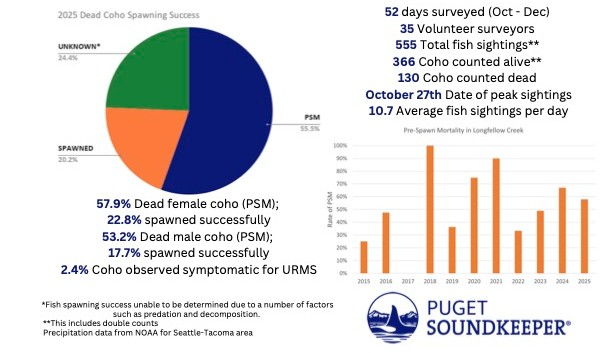
Here’s a one-sheet with results of this year’s survey, conducted from October through December. 55.5% of coho in Longfellow Creek died before spawning, and Puget Soundkeeper says that’s consistent with the data it’s been collecting since 2015 – some years up to 90 percent of the fish died before spawning.
So what can be done? Puget Soundkeeper says:
Fortunately, solutions exist. Green Stormwater Infrastructure (GSI) projects, such as raingardens or bioswales, can effectively remove toxins from runoff and prevent harmful chemicals from entering our waters. In addition to GSI projects, policy action is critical. A bill (HB 2421) aimed at removing 6PPD from tires was introduced to the Washington State House and Senate Environment Committees last week. Community members can help move this legislation forward by calling their representatives and voicing their support. [Here’s how]
Puget Soundkeeper will be recruiting the next cohort of salmon surveyors in August; stay tuned to our website for more information. Puget Soundkeeper thanks all volunteers, partners, and donors who make this project possible.
There are also volunteer cleanups during the season; we reported on one back in November.
Thank you for your good and important work, Puget SoundKeepers. 💕Neighbors, consider donating to this worthy nonprofit. As a top-rated 501(c)(3) nonprofit, Puget Soundkeeper Alliance relies on our support. They are the only watchdog group that provides the legal and scientific work needed to hold industrial polluters accountable and keep our 2,500 miles of shoreline swimmable and fishable.
Puget Soundkeeper Alliance are top notch!! I also highly recommend DNDA (Delridge neighborhood development association) for their work restoring forests along Longfellow Creek! You can volunteer with them most weekends. They remove blackberry and plant native species and also perform water quality testing in the creek.
I’d love to join in on any riparian restoration if schedule allows. Is it similar to the KCDistrict work being done along the green river?
Here’s a solution for my West Seattle neighbors: reduce scofflaw driving habits. Speeding and aggressive driving wears out your tires faster leading to more tire dust in the environment. Driving the speed limit on the West Seattle Bridge is scary due to the number of drivers speeding past you on both sides. Biking under the bridge you can see all the rainwater carrying the tire dust from the WS Bridge down onto the surface below. Please examine your conscience when you drive over the speed limit. You may think you are still safe for yourself inside your vehicle, but your speeding has a very negative impact on the people and creatures around you.
Also I might add trade your car for a more environmentally friendly transportation like a bicycle or walking quit being the problem towards the environment trade your buying habits to more non toxic products and forget about heavy pollution industries the standards need be higher for saving the earth… environmentalism is that old notion that humans should pick up after themselves…
Could this be related to the kilm burning tires in sodo or a giant metal recycler closeby. Its not suprising this creek toxic AF.
6ppdq can be found in air emissions, but a lost of this comes from the tiny tire particles that gather on roads as normal vehicles drive around each day. It only takes a miniscule amount to kill Coho, so urban streams with lots of poorly controlled/filtered stormwater runoff are a really tough place for those fish specifically to spawn and rear successfully, if they can even get there in the first place.Somebody else posted that video from King County that talks about this problem at Longfellow Creek specifically. It’s very informative.
EVs need tire replacing much more often than regular cars due to their weight.
My Model Y weighs about the same as a Toyota Highlander and my Nissan leaf weighs as much as a Honda CRV. But I have zero tailpipe emissions and I get my electrons from the solar panels on my roof. You can’t convince me that I’m doing more damage to the Salmon than you are.
Apparently the salmon-harming chemical is released to a higher extent when the rubber turns into particles from tire wear, (or the rubber is ground up for recycling). The internet says they put the “6PPD-quinone” chemical in the tire rubber to make the tires last longer. Otherwise, (to protect salmon) people would have to pay more for maintaining their cars when they have to replace their tires more often. Hmm, maybe that would be OK . . .
The creek is channelized or put in a pipe for multiple sections; only conventional wisdom and lack of funds is keeping us from both daylighting and eliminating surface drainage into the salmon habitat. Where do we think the Westwood Village and Home Depot parking lot grime ends up, if we’re being honest?
While diverting road runoff from the stream may seem like a good idea, doing so would greatly reduce in-stream flow and undoubtedly be far worse for salmon (and birds, beavers, etc.). That’s why this is so challenging. You need the water but that water is not clean. My hope is, now that we know the source, regulation can move to have 6PPD eliminated from tires. But that will require rebuilding the EPA, which won’t happen until at least 2029 (electorate willing). Of course, there are all sorts of other nasty chemicals coming off roads that need to be addressed as well. Restoration of wetlands and hyporheic zones will help a lot. This was done in Thronton Creek near Northgate with a lot of measurable success.
Removing car tire toxins from storm water runoff is the most expensive possible way to solve the problem. It’s better to prevent the toxins from reaching the roadway in the first place. The least expensive solution is to reduce the number of miles people drive cars. Walking, biking, and taking transit help salmon, humans, orcas, and all other creatures survive and thrive.
@donbrubeck . Really? The “most” expensive? Even if that were true, that also doesn’t mean we should dismiss a reasonable, accessible solution that is proven to work. Relying on human beings to be even slightly inconvenienced (or adding regulations to remove toxins from car tires, which takes political time and will, and for corporations to be potentially less profitable which they seem great at working against) seems like the bigger boulder to dislodge. It has taken 50+ million years of evolution for us to have salmon. In a couple of centuries mankind has almost completely wiped them out. I’d say their permanent loss (and the chain reaction loss of other species in the food chain) would truly be significantly more expensive.
This 8 minute video is worth a watch for more on Urban Stream syndrome and some of the soil mixes King County and partners are developing to mitigate the impacts of road run off: https://kingcounty.gov/en/dept/dnrp/about-king-county/about-dnrp/newsroom/2025-news-releases/03-27-treating-tire-chemicals
Can tires be made without the offending chemical?
Industry will never change until it becomes financially advantageous. My solution…a little push we can all make individually…and one try regularly…is to pull into Les Schwab (or your favorite tire store) and ask for a set of 4 of the new ‘fish-friendly’ tires. When they say they don’t have any, I say ,”hmm”. And drive away
Some simple things that folks can do to help the salmon, without drastic lifestyle changes:
-Wash your car at a car wash place that recycles the water, where it doesn’t go down the storm drains.
-Maintain your vehicle, check for leaks like motor oil.
-Take old unused prescriptions in to a pharmacy. Don’t flush them down the drain where the chemicals get into the sound.
-Clean up after your animals and don’t take dogs to places they shouldn’t go (pet waste is a toxin).
-Limit using pesticides, weed killers, and other toxins in your garden. use gentle cleaning products.
-Pick up your trash and litter in your community.
-Adopt a drain and keep your storm drains clean.
Stay safe and protect your local wildlife!
Banning the chemical is a nice gesture, but there need to be requirements to test any replacement chemicals to see their effects on salmon and other organismal mortality too. If a simple ban is passed and nothing else, manufacturers will just slightly modify the chemical, and we’ll end up with either no improvement or very possibly something even more toxic. We’ve seen this over and over and over again: phthalates, PTFE/polyfluorinated hydrocarbons aka “forever chemicals”, etc.
This is exactly why I filed the Orcaappeal.org and exactly why total deregulation of building is not the answer. The intersection of environmental Protection and affordability is carefully planned Affordable housing and middle housing, not unregulated luxury home building. green space filters, cools, and reduces polluted runoff from washing into our waterways. Seattle did not do an adequate assessment of stormwater impacts and tree removals on fish and endangered species like killer whales. Special interests have lobbied hard to remove all environmental protections so that builders can create the most expensive luxury homes that pay them the most per square foot that are the least eco-friendly because they create the most impervious surfaces which fast track pollutants into waterways. At every turn, the city has tried to cheat the process and throw out our case. We are currently in the Washington State Court of Appeals division I with an oral argument date on March 4thVisit orcaappeal.org for more information or @orcanexus